
LES-215 · Lesson 6 of 12 · 20 min
Physical testing: the PREP, the RCMP fitness assessment and the standards debate
▶ Video coming soon A video version of this lesson is on the way.
Marco DiSanto runs the Physical Readiness Evaluation for Police for the first time on a practice night at the Port Ardent training centre in October. He has kept fit since leaving the army reserve, and he expects it to be easy. The aerobic shuttle run goes well; he reaches stage 8. The pursuit and restraint circuit does not. By the third lap the weighted vest and belt feel heavier than they look, the body control simulator takes longer than he planned, and the mannequin drag at the end leaves him bent over. His time is 2 minutes 49 seconds. The standard is 2 minutes 37. 'I was fit,' he says afterward. 'I was not fit for that.'
Boyce has seen this many times. 'Almost everyone who fails our physical test is reasonably fit,' she says. 'They trained for fitness in general. They did not train for the test, or for what the test is built to represent.' This lesson looks at the physical tests used in police hiring and training, why they are designed as they are, and the long debate about what the standards should be.
Why physical tests exist
Police work is mostly sedentary: driving, talking and writing. But it includes short bursts of intense physical demand that officers cannot predict or postpone: running after someone, climbing a fence, pulling a person from a vehicle, controlling a person who is resisting, carrying an injured person, or performing CPR for many minutes. An officer who cannot do these things safely puts themselves, colleagues and the public at risk. Physical tests in hiring are meant to show that an applicant can meet those demands at the start of a career, and fitness standards in training are meant to build the capacity further.
There are two broad approaches. Job-task simulation tests recreate the physical demands of the job directly, often as a timed circuit with obstacles, a resistance simulator and a drag. Fitness tests measure general components of fitness, such as aerobic capacity, muscular endurance and strength, with standard exercises like a timed run, push-ups and sit-ups, and compare the results with norms. Many services use one or the other; some use both.
The PREP and other Canadian tests
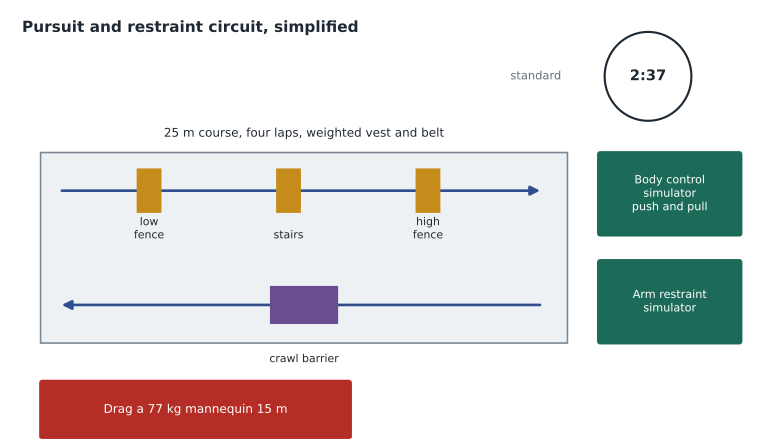
The PREP, the Physical Readiness Evaluation for Police, is used by most Ontario services. It has two parts. The pursuit and restraint circuit simulates a foot chase and a struggle: candidates wear a weighted vest and a weighted belt of about four kilograms each, run four laps of a twenty-five-metre course with fences, stairs and a crawl under a barrier, work a body control simulator by pushing and pulling handles to lift a weight of about thirty-five kilograms, work an arm restraint simulator, and finish by dragging a seventy-seven-kilogram mannequin fifteen metres. The standard, as published by Ontario services such as London's, is to complete the circuit in two minutes thirty-seven seconds or less. The aerobic shuttle run is a twenty-metre run between two lines in time with recorded beeps that get faster each stage; the standard is to reach at least stage seven. The OACP no longer requires the PREP at the pre-screening stage, but services use it later in hiring. The RCMP uses its own Police Fitness Assessment; applicants who apply on or after September 15, 2026, must pass the field version of that assessment to continue in the process, and the RCMP offers preparation workshops. Other provinces use other tests, such as the POPAT in British Columbia and the A-PREP in Alberta, and conservation officer applicants in Ontario may submit a passed PREP, RCMP test or Quebec police test from the previous nine months.
| Stage | Speed | Time per 20-metre length |
|---|---|---|
| 1 | 8.5 km/h | about 8.5 s |
| 2 | 9.0 km/h | about 8.0 s |
| 3 | 9.5 km/h | about 7.6 s |
| 4 | 10.0 km/h | about 7.2 s |
| 5 | 10.5 km/h | about 6.9 s |
| 6 | 11.0 km/h | about 6.5 s |
| 7 | 11.5 km/h | about 6.3 s |
| 8 | 12.0 km/h | about 6.0 s |
| 9 | 12.5 km/h | about 5.8 s |
| 10 | 13.0 km/h | about 5.5 s |
Grant's advice for the shuttle run is to train for the turns as well as the running. Each length ends with a stop and a change of direction, and at the higher stages applicants who turn wide or late lose a fraction of a second on every length until the recording leaves them behind. Practising with short shuttle intervals once a week, alongside steady runs that build aerobic fitness, prepares both the legs and the timing.
To get the time per length, convert the speed to metres per second and divide 20 metres by it. At stage 8, 12 km/h is 12,000 ÷ 3,600 ≈ 3.33 metres per second, so a length takes 20 ÷ 3.33 = 6.0 seconds.
The protocol in the table is a common version of the twenty-metre shuttle run; the recording used for the PREP sets the actual pace, and applicants should practise with the official recording if the service provides it. The point of the example is that each stage asks for a little more speed, so the last stages feel very different from the first. Marco, who reached stage 8, is running about twelve kilometres an hour by the end.
The standards debate
Physical standards in police hiring have been argued over for decades, in courts and in services. The core questions are whether a test measures what the job actually requires, whether its cutoff score is set at the right level, and whether it is fair to groups that score differently on average, especially women and older applicants.
In Canada, the leading case is British Columbia (Public Service Employee Relations Commission) v. BCGSEU, known as Meiorin, decided by the Supreme Court in 1999. A female forest firefighter who had done the job well for three years was dismissed after failing a new aerobic standard that most women could not meet. The court held that a standard that discriminates must be a bona fide occupational requirement: rationally connected to the job, adopted in good faith, and reasonably necessary to accomplish its purpose, which includes showing that the employer cannot accommodate individuals without undue hardship. The decision shaped how Canadian police tests were designed afterward. Job-task tests such as the PREP were built around research on what officers actually do, and they use a single standard for everyone because the job's demands do not change with the officer's sex or age.
Desjardins asks the class which approach is fairer. Priya argues for job-task tests with one standard: 'The person you are dragging out of a car does not weigh less because I am a woman.' Amara argues that the norms make sense for entry tests if training then builds everyone to the job's demands. Jesse points out that most officers' fitness declines over a career and asks why only applicants are tested. Boyce says that all three points are made inside police services, and that several have introduced voluntary or required fitness testing for serving officers. 'What nobody disputes,' she says, 'is that the job has physical moments, and that officers who are fit are injured less and recover faster.'
| Approach | Strength | Criticism |
|---|---|---|
| Job-task circuit with one standard | Directly reflects job demands; same for everyone | May screen out more women and smaller applicants at hiring; cost of equipment |
| Normed fitness tests | Simple, cheap, measures underlying fitness | Critics say the job does not change with age or sex |
| Entry standard plus training to a graduation standard | Builds capacity in training | Recruits who fail late have invested months |
| Ongoing testing of serving officers | Addresses fitness across the career | Contentious in collective bargaining; accommodations needed |
What the test day looks like
Boyce describes a typical test session. Candidates arrive early, sign in, show identification, and often sign a waiver and a statement that they are fit to take the test. Some services require a medical clearance form from a doctor. Staff explain the test and usually demonstrate it. There is a warm-up period. The test is run under supervision, and the timing is strict. Results are usually given on the spot. Candidates who fail can usually retest after a waiting period set by the service or the testing body, and some services allow one retest on the same day for certain components but not others. 'Read the rules before you go,' she says. 'People lose a test because they did not know they had to bring a signed form.'
She also explains why the tests are supervised so carefully. Injuries happen on test days, especially among candidates who are untrained, who have trained too hard in the days before, or who push through pain. Staff will stop a candidate who appears to be in distress. Candidates should report any illness or injury beforehand and reschedule rather than test while hurt. 'A failed test can be retaken,' she says. 'A torn hamstring takes months.'
Fitness and the people who are tested
Desjardins raises one more point. Physical tests can discourage good applicants who assume they cannot pass. Many Ontario services run free PREP practice sessions, and the RCMP runs preparation workshops for its fitness assessment. These sessions let applicants try the real equipment or format, get coaching and see that the standard is achievable with preparation. Boyce says that the applicants who attend practice sessions pass at much higher rates than those who show up cold. Women, older applicants and people from communities with less exposure to policing are especially encouraged to attend, because they are the groups most often put off by unfamiliar tests.
Jesse asks what happens to officers who are injured later in their careers and can no longer meet the hiring standard. Boyce explains that serving officers are not usually retested against the hiring standard, but that their duties must be safe for them and the public, and services must accommodate disabilities under human rights law, often through modified duties or reassignment. Several services, including Port Ardent, have introduced voluntary fitness programs for serving officers with incentives, such as time off, for meeting benchmarks.
Grant, who attends this class as a guest before his own lesson, adds a few words about the mental side of physical testing. Many candidates who fail are capable of passing but panic at the start, go out too fast and fade, or freeze when something unexpected happens, such as slipping on a barrier. He tells the students to practise the test until it feels routine, to plan the pace of every part, and to have a simple cue for staying calm if something goes wrong, such as a slow breath and a word to themselves. 'The test is short,' he says. 'You only have to stay organized for a few minutes. Practise being organized while tired.'
Boyce also reminds the students that passing the hiring test is the minimum, not the goal. Recruits who arrive at training just above the standard find the physical side of training much harder than those who arrive well above it, and they are more likely to be injured. 'Aim to pass the hiring test comfortably,' she says, 'and then keep going. You are training for a career, not a single morning.'
Marco's retest plan includes something Grant insists on for everyone: a practice test at least three weeks before the real one, under conditions as close to the real test as possible, followed by an honest review. If the practice result is well within the standard, the remaining weeks are for consolidation. If it is close, the plan changes. If it is well short, it may be wiser to postpone the test than to fail it. 'Most services will let you reschedule,' Grant says. 'Fewer will let you retest soon after a failure. Know the rules and use them.'
Worked problem
Finding where the time goes
Marco's PREP circuit took 2 minutes 49 seconds, twelve seconds over the standard. A recruiter timed his segments: laps 1 and 2 took 38 seconds together, laps 3 and 4 took 47 seconds, the body control and arm restraint simulators took 52 seconds, and the mannequin drag took 32 seconds. Where should he focus his training?
Show solution
- Add the segments to check them: 38 + 47 + 52 + 32 = 169 seconds, which is 2 minutes 49 seconds.
- Compare the two halves of the running: the second pair of laps was nine seconds slower than the first, which suggests he is fading, a sign of limited anaerobic endurance.
- The simulators and the drag took 84 seconds, half the total; strength-endurance work for pushing, pulling and dragging will pay off most.
- Practise the actual test, or a close copy, every two to three weeks to measure progress.
- Increase training load gradually to avoid the injuries that end many applicants' attempts.
Answer: Marco plans twelve weeks of circuit-style training, with intervals for the fade and loaded pushing, pulling and sled drags, and books a retest for January.
Common mistakes
MistakeIf I am generally fit, I will pass the physical test.
InsteadTests reward specific preparation for their tasks and format.
MistakePhysical standards are arbitrary.
InsteadStandards must be job-related; courts have required employers to justify them.
MistakeFitness only matters for getting hired.
InsteadFitness affects injury, recovery and performance throughout a career.
MistakeThe debate about standards is settled.
InsteadServices and courts continue to weigh job-task standards against normed fitness standards.
Summary and key terms
- Police physical tests reflect short, unpredictable but intense physical demands of the job.
- Job-task tests simulate the work; fitness tests measure general fitness against norms.
- The PREP has a pursuit and restraint circuit with a published standard of 2:37 and a shuttle run to stage 7; the RCMP uses its own fitness assessment.
- Courts require physical standards that screen out protected groups to be justified as job-related.
- Specific, gradual training aimed at the test is the most reliable way to pass.
- PREP
- Physical Readiness Evaluation for Police, used by most Ontario services.
- Meiorin
- The 1999 Supreme Court of Canada case on bona fide occupational requirements.
- Job-task simulation
- A test that recreates the physical tasks of the job, usually as a timed circuit.
- Normed standard
- A fitness standard set relative to people of the same age group or sex.
- Shuttle run
- A test of aerobic fitness in which runners go back and forth between lines at rising speeds.
Practice problems
Work each problem on paper first, then reveal the answer to check.
What were the two broad approaches to physical testing in the lesson?
Show answer
Job-task simulation and normed fitness tests.
What did Jesse point out about physical testing?
Show answer
Most officers' fitness declines over a career, yet only applicants are tested.
Why did Marco struggle on his first attempt?
Show answer
He was generally fit but not trained for the circuit's specific demands.
What do supporters of normed standards argue?
Show answer
That norms measure the same underlying fitness fairly across groups.
Lesson quiz · 5 questions
Score 60% or more to complete this lesson.
Create a free account to save your progress, take quizzes and earn a certificate.