
LES-112 · Lesson 9 of 12 · 19 min
Searching vehicles, phones and digital devices
▶ Video coming soon A video version of this lesson is on the way.
Desjardins holds up two objects: a set of car keys and a phone. 'Twenty years ago,' he says, 'most of the evidence I seized in a year came out of cars and houses. Today, most of it comes out of one of these,' and he holds up the phone. 'And the car keys now unlock a computer on wheels that records where it has been, how fast it went and who it was connected to.' Vehicles and digital devices are where search law has changed fastest, and where officers most need to know the current rules. This lesson brings together what the class has already learned about warrants, search incident to arrest and the exceptions, and applies it to the two places officers search most often.
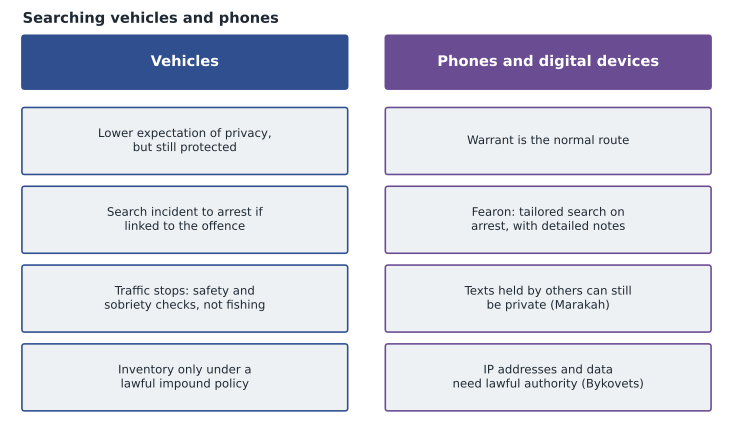
Vehicles: a lower but real expectation of privacy
Canadian courts recognize a reduced expectation of privacy in vehicles, because they are heavily regulated, travel on public roads and are often in public view, but the expectation is still real, and a search of a car without a warrant or a recognized exception is presumptively unreasonable. There is no general automobile exception in Canada. Police may search a vehicle incident to a lawful arrest when the search relates to the arrest, as Caslake held; with valid consent; in exigent circumstances under section 487.11 or a similar statutory power; where a statute authorizes it, such as section 11(7) of the Controlled Drugs and Substances Act or provincial liquor and cannabis laws that allow searches of vehicles where an officer has reasonable grounds to believe cannabis or liquor is being transported unlawfully; and under a warrant. In R. v. Mellenthin (1992), the Supreme Court held that an officer at a sobriety checkpoint could not use the stop to search a gym bag in the car without grounds; the checkpoint justified only questions about sobriety and documents.
In practice, this means a Canadian officer at a vehicle stop must ask a specific question before looking inside: under which power am I searching? If the answer is a search incident to arrest, the arrest must be lawful and the search connected to it. If the answer is a statute, the officer must have the grounds that statute requires. If the answer is consent, the Wills conditions must be met. And if the answer is 'I just wanted to see,' there is no power, and anything found is likely to be excluded.
Inventory searches and impounds
When police lawfully take custody of a vehicle, for instance after an arrest or when it is towed from a dangerous position, they may list its contents to protect the owner's property, protect police from false claims, and protect officers from hazards. Canadian courts accept inventory searches where there is lawful authority to impound the vehicle and the inventory is done under a policy for those purposes, but Caslake shows that an inventory cannot be a cover for an evidence search: the officer's real purpose matters. The key is that the impound must be lawful and the inventory must follow a written policy, applied the same way every time.
Phones: the normal route is a warrant
Phones are the most important source of evidence in modern investigations and the most sensitive. LES-111 covered the constitutional principles and Lesson 7 covered search incident to arrest. Here Desjardins focuses on the practical workflow that keeps a phone's evidence admissible. In Canada, Fearon allows a narrow search of a phone incident to arrest, but the conditions are demanding and the recommended practice in almost every service is to seize, secure and apply for a warrant, often a general warrant or a section 487 warrant specifying the types of data, date ranges and methods of examination. In R. v. Marakah (2017), the Supreme Court held that the sender of text messages can retain a reasonable expectation of privacy in them even after they are received on another person's phone, so obtaining the messages from the recipient's device may still need a warrant if the sender is the target. In R. v. Bykovets (2024), the Court held that an IP address attracts a reasonable expectation of privacy, so police need a production order or warrant to obtain it from a third party.
The workflow Desjardins teaches has five steps. First, seize the phone lawfully, under search incident to arrest, a warrant, plain view or consent. Second, secure it: photograph it, note whether it is on or off and locked or unlocked, and place it in a signal-blocking bag or airplane mode only if trained to do so, because some actions can change data. Third, document the chain of custody from the moment of seizure. Fourth, apply for a warrant that describes the device, the data types and the time period sought, and explains why those data are likely to hold evidence. Fifth, have a trained examiner extract and analyse the data within the warrant's terms, keeping a record of what was examined. A warrant that asks for everything on the phone for all time is likely to be found overbroad; one that asks for messages, photos and location data between two dates connected to the offence is much stronger.
# Is a phone warrant request focused? Compare the requested window to the crime timeline.
from datetime import date
crime_start = date(2026, 3, 1)     # earliest planning evidence
crime_end = date(2026, 3, 20)      # date of the garage search
requested = {"messages": (date(2026, 3, 1), date(2026, 3, 20)),
             "photos": (date(2026, 3, 1), date(2026, 3, 20)),
             "location": (date(2026, 3, 13), date(2026, 3, 15)),
             "browser history": (date(2020, 1, 1), date(2026, 3, 20))}
for kind, (a, b) in requested.items():
    days = (b - a).days + 1
    outside = max(0, (crime_start - a).days) + max(0, (b - crime_end).days)
    flag = "focused" if outside == 0 else f"{outside} days outside the crime period"
print(f"{kind:16} {days:5} days {flag}")messages 20 days focused photos 20 days focused location 3 days focused browser history 2271 days 2251 days outside the crime period
Three of the four requests are tied closely to the offence period. The browser history request covers more than six years, almost all of it before any evidence of planning. Detective Sergeant Ali's supervisor sent that part back and asked him to justify a longer window or narrow it. He narrowed it to the same period as the messages. A reviewing judge, Desjardins says, would almost certainly have asked the same question, and a warrant that is overbroad in part can lead a court to question the whole thing.
Unlocking devices and passwords
Locked phones raise their own questions. Canadian courts have not settled whether compelling a person to unlock a phone with a password or biometric would violate the right against self-incrimination, and officers should not try to compel a password; a warrant can authorize examination of the device using forensic tools, and officers can ask, while respecting the person's right to silence and right to counsel. Desjardins tells the class that forensic tools can open many devices, but not all, and that a voluntary unlock, properly recorded, is still valuable.
Other devices: computers, vehicles and cloud data
The same principles apply to laptops, tablets, game consoles and smart watches. Modern vehicles carry infotainment systems that record paired phones, call logs, locations and even text messages, and event data recorders that store speed and braking information before a crash. Data stored in the cloud may be held by a company in another country. Each of these needs lawful authority, and in most cases that means a warrant or production order. Desjardins describes a Port Ardent collision investigation where the event data recorder showed a driver at 112 km/h in a 50 zone two seconds before impact, evidence obtained under a warrant that specified exactly which modules would be downloaded.
Vehicle searches at the roadside: a practical checklist
Desjardins finishes the vehicle section with a checklist for officers at the roadside. Know why you stopped the vehicle, and stay within that purpose unless new grounds arise. Identify the power before searching: arrest, statute, consent or warrant. Search only where the item could be. Record what you searched and why, what you found and where. If the car is impounded, follow the inventory policy exactly. And if the phone in the cupholder might hold evidence, seize and secure it, and leave the screen alone until a warrant says otherwise.
Border and regulatory searches
Some searches of vehicles and devices happen under powers that have little to do with criminal investigation. At the border, officers of the Canada Border Services Agency have broad powers under the Customs Act to examine goods, including vehicles and, in some circumstances, devices, without the grounds required for a criminal search, because people crossing a border have a lower expectation of privacy. Courts have been examining how far those powers extend to the contents of phones and laptops, and Parliament and the courts have moved toward requiring some level of suspicion for device searches. Municipal police rarely use these powers, but officers working on joint task forces or near a border crossing should know they exist and that they belong to other agencies.
Regulatory searches are another category. Commercial vehicle inspections, liquor licence inspections of bars, and inspections of scrap metal dealers and pawnshops are authorized by statutes that set their own conditions, often allowing inspection without a warrant during business hours for regulatory purposes. Police may sometimes accompany inspectors, but they cannot use a regulatory inspection as a way around the warrant requirement for a criminal investigation. Once the purpose shifts from checking compliance to gathering evidence of a crime, the criminal rules apply.
Desjardins gives an example from Port Ardent. Officers checking a pawnshop's register under the municipal licensing bylaw found a listing for a cordless drill whose serial number matched one of the items stolen from Lakeshore Hardware. They could note the entry under the bylaw, but to seize the drill as evidence and examine the shop's records for other stolen goods, they obtained a warrant. The drill turned out to have been pawned by a man who had bought it from Brandt, which added a charge of trafficking in stolen property to the file.
Priya Sandhu, who spent five years investigating fraud at a bank, adds a point from her own experience: much of the most useful evidence about a person's movements and money is held by companies, not on the person's own devices. Bank records, ride-share trips, toll records and app data can all be obtained with the right court order, and they are often more complete and more reliable than what is on a phone. Desjardins agrees and tells the class that a good investigator thinks about where evidence is held before deciding which power to use, and that the order to a company is often both more effective and less intrusive than a search of the person's device.
Worked problem
Searching Brandt's car
Two days after the break-in, an officer stops a car Brandt is driving for a burned-out headlight. Brandt is no longer under arrest. The officer remembers the break-in and sees a cordless drill box on the back seat. He would like to search the car. What can he do?
Show solution
- Recognize the limits of the stop: a headlight violation justifies checking licence, ownership, insurance and the defect, not a search for evidence (Mellenthin).
- Plain view: the drill box is visible from outside. A drill box alone is not obviously stolen; the officer needs more before seizing it.
- Look for grounds: check whether the box's serial number or model matches the missing items, by looking through the window without opening the car; if it matches, there may be reasonable grounds to believe it is stolen property.
- Then choose the power: arrest for possession of stolen property and search incident to that arrest, or ask for informed consent, or seek a warrant while the car is held.
- Record every step, especially what was visible from outside and when it was matched.
Answer: The officer cannot search on a hunch; he needs grounds connecting the box to stolen property, and then a recognized power such as arrest, consent or a warrant.
Common mistakes
MistakeCars can be searched whenever an officer stops them.
InsteadThere is no general automobile exception in Canada; every search needs a power and grounds.
MistakeAn inventory search can be used to look for evidence.
InsteadInventories must follow a standard policy for protective purposes; a pretextual inventory is an unlawful search.
MistakeA warrant for a phone can ask for everything.
InsteadWarrants should specify data types and time periods tied to the offence; overbroad requests risk the whole warrant.
MistakeOfficers can make a suspect unlock a phone.
InsteadCompelled unlocking raises self-incrimination issues; use forensic tools under a warrant or voluntary cooperation.
Summary and key terms
- Vehicles carry a reduced but real expectation of privacy; searches need arrest, statute, consent, exigency or a warrant (Mellenthin, Caslake).
- Inventory searches need a lawful impound and a standard policy.
- Phones: seize, secure and get a warrant; Marakah and Bykovets extend privacy to texts held by others and IP addresses.
- Phone warrants should specify devices, data types and time periods tied to the offence.
- Compelled unlocking is legally uncertain; rely on forensic tools and voluntary cooperation.
- Vehicle computers and cloud data need lawful authority too.
- Inventory search
- A listing of an impounded vehicle's contents under a standard policy for protective purposes.
- General warrant
- A warrant under section 487.01 authorizing techniques not covered by other warrants.
- Production order
- A court order requiring a third party to produce records or data.
- Overbroad warrant
- A warrant authorizing more than the grounds justify.
- Chain of custody
- The record of who held an exhibit and when, from seizure to court.
- Event data recorder
- A vehicle module that records speed and braking data before a crash.
Practice problems
Work each problem on paper first, then reveal the answer to check.
What did R. v. Mellenthin decide?
Show answer
A sobriety checkpoint stop does not allow a search of a bag in the car without grounds.
In the code example, which request was not focused, and by how much?
Show answer
Browser history, which began 2,251 days before the offence period started.
Name the five steps of the phone workflow.
Show answer
Seize lawfully, secure, document custody, apply for a focused warrant, and have a trained examiner extract within its terms.
What makes an inventory search lawful?
Show answer
A lawful impound and a standard policy applied consistently for protective purposes.
Lesson quiz · 5 questions
Score 60% or more to complete this lesson.
Create a free account to save your progress, take quizzes and earn a certificate.