
ITIL-120 · Lesson 9 of 12 · 31 min
Applying the principles together
The previous seven lessons examined each guiding principle on its own. In practice, nobody applies a single principle in isolation. A real decision, such as how to improve a slow onboarding process or whether to replace a monitoring tool, draws on several principles at once, and sometimes they seem to point in different directions. This lesson looks at how the principles interact, how to resolve apparent tensions between them, how to adapt them to an organization's values and context, and how to use them as a practical decision aid. It also explains how ITIL (Version 5) extends the guidance on applying the principles, while keeping the principles themselves unchanged.
The principles interact
ITIL states that the guiding principles should not be used in isolation. Each principle supports and depends on the others. Some of the strongest connections are:
- Focus on value guides all the others: it decides what is worth simplifying, optimizing or automating.
- Start where you are and progress iteratively with feedback form a natural pair: understand the current state, then improve it step by step.
- Collaborate and promote visibility supports think and work holistically, because seeing the whole system depends on information flowing between its parts.
- Keep it simple and practical comes before optimize and automate: simplify first, then automate what remains.
- Progress iteratively with feedback supports focus on value, because feedback reveals whether value is being delivered.
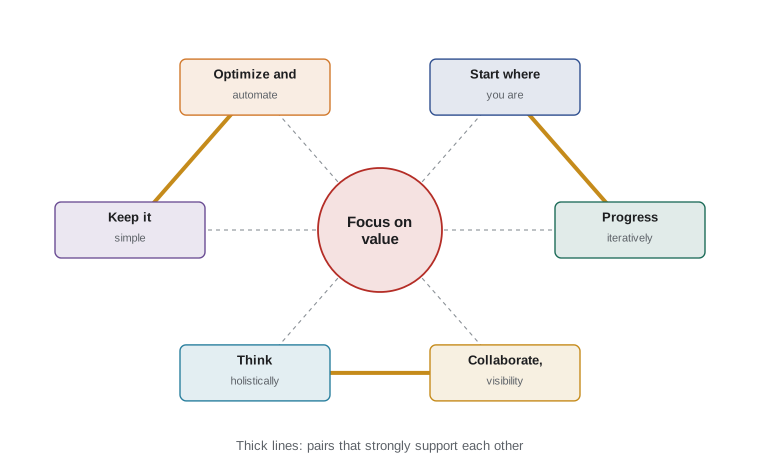
The figure is a simplification: every principle connects to every other in some way. But the three pairs shown are useful to remember, both for practical work and for exam questions that ask which principles naturally go together.
Which principles apply to a decision?
Not every principle is equally relevant to every decision. ITIL advises that organizations should consider which principles are relevant and how they apply, rather than mechanically applying all seven. A useful habit is to review each principle briefly against the decision at hand and note which raise important questions.
| Principle | Question it raises for a decision |
|---|---|
| Focus on value | Who gets value from this, and how will we know? |
| Start where you are | What already exists that we can use or learn from? |
| Progress iteratively with feedback | What is the smallest useful first step, and how will we get feedback? |
| Collaborate and promote visibility | Who needs to be involved, and what should be visible to whom? |
| Think and work holistically | What else does this affect, across all four dimensions? |
| Keep it simple and practical | What is the simplest design that achieves the outcome? |
| Optimize and automate | Where can resources be used better, and what is worth automating? |
Worked problem
Applying the checklist to a decision
A university IT department wants to introduce a chatbot to answer common student questions. Use the checklist to identify the key questions.
Show solution
- Focus on value: which student questions are most common and costly, and what would students value from a chatbot?
- Start where you are: do existing knowledge articles and FAQs already answer these questions? Can the chatbot reuse them?
- Progress iteratively: start with a small set of the most common questions, measure success and expand.
- Collaborate: involve students, service desk agents and faculty in designing and testing the chatbot.
- Think holistically: how will the chatbot hand off to human agents? What data privacy issues arise?
- Keep it simple: begin with clear, limited scope rather than trying to answer everything.
- Optimize and automate: automate only once the knowledge content is accurate and well organized.
Answer: The checklist turns a vague idea into a focused plan: start with the most common questions, reuse existing knowledge, pilot with students and agents, design clear handoffs, and expand based on feedback.
Resolving tensions between principles
Sometimes principles appear to conflict. ITIL acknowledges this and asks practitioners to use judgment, guided above all by value. Common tensions include:
- Start where you are versus optimize and automate: reusing an old tool may be cheaper now, but a new tool may allow automation that saves more later.
- Progress iteratively versus think holistically: small iterations may seem to ignore the bigger picture, while holistic planning may seem to delay action.
- Collaborate versus keep it simple: involving many stakeholders can make decisions slower and more complex.
- Keep it simple versus think holistically: considering every dependency can make solutions more complicated.
In each case, the tension is resolved by applying the principles together rather than choosing one. For iterative versus holistic, ITIL's own wording helps: "comprehend the whole, but do something". Understand the whole system, then take a small step within it. For collaborate versus simple, involve the right people in the right way, which is not the same as involving everyone in everything.
Worked problem
Resolving a tension with value
A team must choose between (A) keeping an existing ticketing tool with minor adjustments, at $10,000, ready in one month, and (B) moving to a new platform that enables automation, at $80,000, ready in six months. The new platform is expected to save $4,000 a month from month 7. The old tool saves nothing extra. Over a three-year horizon, which option delivers more net value, and which principles support each?
Show solution
- Option A: cost $10,000; extra savings $0; net value −$10,000.
- Option B: savings from month 7 to month 36 = 30 months × $4,000 = $120,000; net value $120,000 − $80,000 = $40,000.
- Start where you are and keep it simple favour option A; optimize and automate and focus on value favour option B.
- Progress iteratively suggests a middle path: adjust the old tool now (option A) to fix urgent problems, while planning the move to the new platform in stages.
Answer: Option B delivers about $50,000 more net value over three years. Focus on value tips the balance, but iterative delivery can capture quick fixes first.
Adapting the principles to the organization
The principles are universal, but how they are applied depends on context. A small start-up, a large bank and a government department will apply them differently. ITIL (Version 5) places more emphasis on this, encouraging organizations to adapt the principles to their own values, culture and circumstances rather than treat them as a fixed checklist.
Factors that influence how the principles are applied include:
- Regulatory environment: a heavily regulated organization may need more formal controls, which affects how far it can simplify.
- Risk appetite: an organization tolerant of risk may iterate faster and automate more boldly.
- Size and structure: collaboration in a ten-person team looks very different from collaboration across a multinational.
- Culture: an organization with a blame culture must work on trust before visibility will work (lesson 12).
- Maturity: an organization just starting service management may focus on start where you are and keep it simple before tackling advanced automation.
Worked problem
Same principle, different contexts
Compare how progress iteratively with feedback might be applied when deploying a change to (1) a social media app with millions of users and (2) a hospital's patient record system.
Show solution
- Social media app: iterations can be very small and frequent, with features released to a small percentage of users first and feedback gathered from usage data within hours.
- Hospital system: iterations are still useful but must be larger and more carefully tested, because errors could harm patients; feedback comes from clinical staff in controlled pilots.
- Both apply the same principle, but risk and regulation change the size and pace of iterations.
Answer: The principle applies in both settings, but the hospital uses larger, more controlled iterations with structured clinical feedback, reflecting higher risk.
The principles as a decision aid
The principles are most useful when they become a shared language for decisions. When a team proposes a change, reviewers can ask which principles it applies and which it neglects. When a project stalls, the principles help diagnose why: perhaps the team did not start where it was, or feedback was missing. When two people disagree, the principles provide neutral ground for discussing the trade-offs.
Worked problem
Scoring a proposal against the principles
A review panel scores a proposed process change from 1 (poor) to 5 (strong) against each principle: focus on value 4, start where you are 2, progress iteratively 5, collaborate 3, holistic 2, simple 4, optimize and automate 3. What is the average score, and where should the proposal be strengthened?
Show solution
- Total: 4 + 2 + 5 + 3 + 2 + 4 + 3 = 23.
- Average: 23 ÷ 7 ≈ 3.3.
- Weakest areas: start where you are (2) and think holistically (2).
- The proposal should assess the current state more fully and check effects across the four dimensions before approval.
Answer: The average is about 3.3. The panel should ask for a current-state assessment and a four-dimension impact review.
Scores like these are judgments, not precise measurements. Their value lies in prompting discussion about where a proposal is weak, not in the number itself.
Principles in exam scenarios
Foundation exam questions often describe a situation and ask which principle is being applied or ignored. A reliable approach is to look for key words. References to existing tools, data or observation point to start where you are. Small steps and reviews point to progress iteratively. Removing steps points to keep it simple. Involving stakeholders or sharing information points to collaborate and promote visibility. Effects across teams or dimensions point to think and work holistically. Consumers and outcomes point to focus on value. Technology replacing manual work, after improvement, points to optimize and automate. Questions may also ask which principles work well together; the pairs in the figure above are the most common answers.
Diagnosing a stalled initiative with the principles
The principles are also useful after the fact, to understand why an initiative struggled. Imagine a two-year program to introduce a new service management platform that ended late, over budget and with low adoption. A review using the principles might find that the team did not start where it was, because it rebuilt workflows from scratch and discarded knowledge articles that worked; that it did not progress iteratively, because everything went live on one weekend; that collaboration was weak, because agents saw the new tool for the first time in training; and that focus on value was lost, because success was measured by go-live date rather than by user outcomes.
Each finding suggests a lesson for the next initiative. The review also shows that weaknesses in one principle often cause weaknesses in others: without collaboration, the team could not understand the current state, and without iteration, it had no feedback to reveal the problem early. This is the practical meaning of the statement that the principles interact.
Key point to remember
Use the principles as a set of questions, not a set of rules. For any decision, ask which principles are relevant, look for tensions between them, resolve those tensions by returning to value, and adapt the answers to your organization's context. The principles stay the same; the way they are applied changes from one situation to the next.
Common mistakes
MistakeApplying one principle at a time in isolation.
InsteadConsider the principles together, since each supports the others.
MistakeMechanically applying all seven to every decision with equal weight.
InsteadConsider which principles are relevant and how they apply.
MistakeChoosing one principle when two seem to conflict.
InsteadResolve tensions by applying them together, guided by value.
MistakeApplying the principles identically in every organization.
InsteadAdapt how they are applied to context, risk, regulation and culture.
MistakeTreating principle scores as precise measurements.
InsteadUse scores to prompt discussion about weaknesses, not as exact values.
Summary and key terms
- The guiding principles should not be used in isolation; each supports the others.
- Focus on value guides the other principles.
- Useful pairs: start where you are with progress iteratively; collaborate with think holistically; keep it simple with optimize and automate.
- Consider which principles are relevant to each decision rather than applying all mechanically.
- Resolve apparent tensions by applying principles together, guided by value.
- Adapt how the principles are applied to the organization's values, risk and context, as Version 5 emphasizes.
- The principles provide a shared language for proposing, reviewing and diagnosing decisions.
- Principle interaction
- The way guiding principles support and depend on each other.
- Tension
- A situation where two principles appear to point in different directions.
- Risk appetite
- The amount and type of risk an organization is willing to accept.
- Context
- The circumstances, such as regulation, size and culture, in which principles are applied.
- Decision aid
- A tool or checklist that structures thinking about a decision.
- Maturity
- How well developed an organization's capabilities are.
- Pilot
- A limited trial of a change before wider rollout.
- Shared language
- Common terms that allow people to discuss decisions consistently.
- Horizon
- The period over which costs and benefits are compared.
- Judgment
- Weighing evidence and principles to reach a decision where no rule decides it.
Practice problems
Work each problem on paper first, then reveal the answer to check.
Should guiding principles be applied in isolation?
Show answer
No; they should be considered together.
Which principle guides all the others?
Show answer
Focus on value.
Name the three principle pairs highlighted in this lesson.
Show answer
Start where you are with progress iteratively; collaborate with think holistically; keep it simple with optimize and automate.
How is the tension between iterative and holistic resolved?
Show answer
Comprehend the whole, but do something: understand the system and take a small step.
What does Version 5 emphasize about applying the principles?
Show answer
How they interact and adapting them to the organization's values and context.
A proposal scores 3, 4, 2, 5, 3, 4, 4. What is the average?
Show answer
25 ÷ 7 ≈ 3.6.
Give two factors that affect how the principles are applied.
Show answer
Regulatory environment and risk appetite.
A scenario mentions observing existing processes. Which principle?
Show answer
Start where you are.
Why might a hospital use larger iterations than a social media app?
Show answer
Higher risk and regulation require more testing and control.
What is the main value of scoring proposals against principles?
Show answer
Prompting discussion about weaknesses.
Lesson quiz · 5 questions
Score 60% or more to complete this lesson.
Create a free account to save your progress, take quizzes and earn a certificate.