
ITIL-120 · Lesson 3 of 12 · 30 min
Start where you are
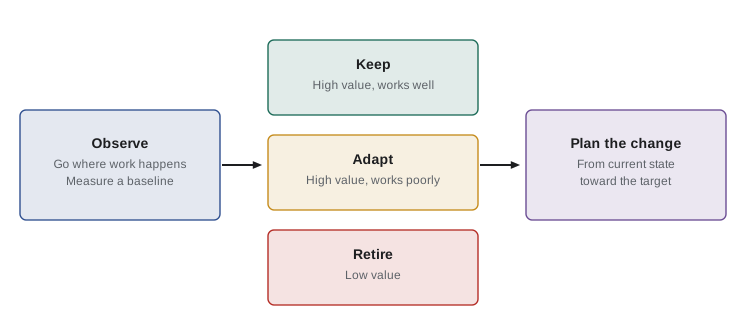
When an organization decides to improve, the temptation is to sweep away what exists and build something new. New tools, new processes and new teams feel like progress. Yet the current state almost always contains services, people, knowledge and tools that already work, and discarding them wastes money and destroys value. The second guiding principle asks organizations to look carefully at what they already have, decide what can be reused, and build from there. This lesson explains how to assess the current state objectively, why direct observation beats reports, and how to decide what to keep, adapt or replace.
What the principle asks
Start where you are means: do not start from scratch without first considering what is already available to be leveraged. Services, practices, projects, people and tools in use today will usually have something to offer. The principle does not say "never replace anything". It says the decision to replace should be made after an honest look at the current state, not before.
Applying the principle involves:
- Looking at what exists as objectively as possible, using the customer or desired outcome as the starting point.
- Getting data from the source, through direct observation, rather than relying only on reports and opinions.
- Deciding what to reuse, what to adapt and what to retire, based on that evidence.
- Using risk management skills: reuse can carry risks, such as copying a flawed process, just as replacement can.
Why organizations skip the current state
There are understandable reasons why organizations jump straight to a new solution. A new leader wants to make a mark. A vendor promises that its product solves everything. A failed initiative leaves people believing that everything in the old way was bad. Sometimes the current state is simply poorly understood, so it feels easier to design something new than to find out what exists.
Each of these reasons leads to the same costs. Investment is spent recreating things that already worked. Valuable knowledge held by experienced staff is lost. People who built the current state feel their work has been dismissed, which damages engagement. And the new solution often repeats old mistakes because nobody studied why the old one struggled.
Measurement and observation
The principle has a strong link to measurement. To know where you are, you need data. Yet measurement has a trap: the act of measuring can change behaviour, and reported data can differ from reality. A team asked to report on process compliance may report what they believe management wants to hear. A dashboard may show averages that hide serious problems for some users.
For this reason, ITIL encourages going to where the work happens, an idea borrowed from Lean, where it is known as "going to the gemba" (the real place). Watching a service desk agent handle calls, sitting with a user as they try to request access, or tracing a change from request to deployment reveals things no report shows: workarounds, duplicated effort, unclear handoffs and tools used in ways their designers never intended.
| Source of evidence | Strength | Weakness |
|---|---|---|
| Reports and dashboards | Cover large volumes quickly | May hide variation; can be gamed |
| Interviews and surveys | Capture opinions and experience | Influenced by memory and politics |
| Direct observation | Shows what really happens | Takes time; small samples |
| System data (logs, tickets) | Objective record of events | Records what systems capture, not why |
| Customer feedback | Shows the outside-in view | Often from unhappy customers only |
Assessing what to keep, adapt or retire
Once the current state is understood, each element can be sorted. A simple approach scores each element on two questions: how much value does it contribute, and how well does it work? Elements that contribute value and work well are kept. Elements that contribute value but work poorly are adapted. Elements that contribute little value are candidates to retire, whether or not they work well.
Worked problem
Sorting current practices
A service desk is reviewing five elements of its current state, each scored 1 to 5 for value contribution (V) and performance (P): the knowledge base (V4, P2), the ticketing tool (V5, P4), a weekly paper report (V1, P5), the escalation matrix (V4, P4), and a manual password reset process (V3, P1). Using a threshold of 3, sort them.
Show solution
- Keep (V ≥ 3 and P ≥ 3): ticketing tool (V5, P4) and escalation matrix (V4, P4).
- Adapt (V ≥ 3 and P < 3): knowledge base (V4, P2) and manual password reset (V3, P1). The password process could be automated, linking to lesson 8.
- Retire (V < 3): weekly paper report (V1, P5). It works perfectly but delivers little value.
- The well-performing paper report shows why value comes first: doing something efficiently is no reason to keep doing it.
Answer: Keep the ticketing tool and escalation matrix; adapt the knowledge base and password reset; retire the paper report.
Baselines
Starting where you are also means recording a baseline: a measured description of the current state that later improvements can be compared against. Without a baseline, an organization cannot tell whether a change made things better. Lesson 11 shows how baselines feed the continual improvement model. For now, the key point is that a baseline must be measured from real data, not estimated from memory, and should include enough context (time period, volumes, conditions) to be meaningful.
Worked problem
Building a simple baseline
Over four weeks, a team records the time to fulfil laptop requests. Weekly averages are 6.2, 5.8, 7.1 and 6.5 working days, with 40, 35, 52 and 45 requests respectively. What is the weighted average baseline?
Show solution
- Multiply each average by its volume: 6.2 × 40 = 248; 5.8 × 35 = 203; 7.1 × 52 = 369.2; 6.5 × 45 = 292.5.
- Total request-days: 248 + 203 + 369.2 + 292.5 = 1,112.7.
- Total requests: 40 + 35 + 52 + 45 = 172.
- Weighted average: 1,112.7 ÷ 172 ≈ 6.47 working days.
Answer: The baseline is about 6.5 working days per laptop request over 172 requests in four weeks. A simple average of the four weekly figures (6.4) would understate it slightly.
Reuse carries risks too
The principle is not an argument for keeping everything. Reusing a flawed process can lock in its flaws. Reusing an old tool can mean inheriting security weaknesses, unsupported software or poor usability. The principle asks for judgment: understand the current state well enough to make an informed decision. Sometimes the right decision, after an honest look, really is to replace something entirely.
Worked problem
Reuse or replace a tool
A team must choose between upgrading an existing monitoring tool (cost $40,000, 2 months, staff already trained) and replacing it with a new product (cost $70,000, 5 months, plus $15,000 of training). The new product offers features that would avoid about $20,000 a year of manual effort that the upgraded tool still needs. Compare the three-year cost difference.
Show solution
- Upgrade: $40,000 upfront plus $20,000 × 3 years of manual effort = $100,000.
- Replace: $70,000 + $15,000 training = $85,000, with no extra manual effort.
- Three-year difference: replacing is about $15,000 cheaper, but takes three months longer.
- Risks also matter: the replacement carries adoption risk, while the upgrade keeps familiar ways of working.
Answer: Replacement saves about $15,000 over three years but adds delay and adoption risk. Start where you are does not decide the answer; it ensures the comparison is made honestly.
Applying the principle in different settings
The principle applies whenever change is planned. Before introducing a new incident management approach, study how incidents are handled today. Before moving services to a cloud provider, inventory what exists and what depends on what. Before reorganizing teams, understand the informal networks that make work happen. In mergers, where two organizations each have their own ways of working, the principle helps avoid the assumption that the larger organization's way is automatically better.
Canadian public-sector organizations are expected by the Treasury Board Policy on Service and Digital to reuse common solutions, such as shared platforms, before building their own. That expectation is a form of starting where you are applied across a whole government.
Links to other principles
Start where you are works closely with progress iteratively with feedback (lesson 4): once the current state is understood, improvements can be made in small steps from it. It also supports focus on value (lesson 2), since the assessment of what to keep should be guided by value. And it relies on collaborate and promote visibility (lesson 5), because the people doing the work today are the best source of information about the current state.
A short assessment checklist
Teams applying this principle for the first time often find a simple checklist helpful. Before proposing any significant change, they answer the following questions in writing and share the answers with the people affected:
- What exists today that touches this outcome: services, tools, processes, documents, skills and relationships?
- Which of these did we observe directly, and which do we know only from reports or opinions?
- What does each element contribute to value, and how well does it perform?
- What have previous attempts to improve this area taught us, and why did they succeed or struggle?
- What is the measured baseline we will compare future results against?
- What would we lose, in knowledge, money or goodwill, if we replaced each element?
The checklist takes hours, not weeks, for most changes. Its purpose is not to delay improvement but to make sure the first step builds on solid ground. Where the answers reveal that little is known about the current state, the right first iteration is often simply to find out.
Worked problem
Valuing knowledge that would be lost
A team plans to replace a long-standing support process. Three senior agents hold undocumented knowledge that resolves about 150 complex incidents a month on first contact. If that knowledge is lost, each of those incidents would need an escalation adding about 2 hours of technical team time at $70 per hour. What is the annual cost of losing the knowledge?
Show solution
- Extra hours a month: 150 × 2 = 300 hours.
- Monthly cost: 300 × $70 = $21,000.
- Annual cost: $21,000 × 12 = $252,000.
- Documenting the knowledge before changing the process protects that value, whatever the final decision about the process itself.
Answer: Losing the knowledge would cost about $252,000 a year in extra escalation effort, before counting slower service for users.
Key point to remember
The current state is rarely as bad, or as good, as people believe. Only careful, direct assessment reveals which parts deserve to be kept, and the baseline recorded at this stage is what later proves whether improvement actually happened.
Common mistakes
MistakeReplacing everything with a new solution without looking at what exists.
InsteadAssess the current state first and reuse what delivers value.
MistakeRelying only on reports to understand the current state.
InsteadObserve the work directly and compare it with reported data.
MistakeKeeping something just because it works efficiently.
InsteadKeep elements because they contribute value, not merely because they run smoothly.
MistakeEstimating the baseline from memory.
InsteadMeasure the baseline from real data with context such as period and volume.
MistakeTreating the principle as a ban on replacement.
InsteadUse the principle to make an informed decision, which may still be to replace.
Summary and key terms
- Do not start from scratch without considering what already exists and can be leveraged.
- Assess the current state as objectively as possible, using desired outcomes as the reference.
- Direct observation reveals workarounds and problems that reports hide.
- Sort current elements into keep, adapt and retire, guided by value first.
- Record a measured baseline so improvements can be demonstrated.
- Reuse carries risks, so the principle calls for judgment, not automatic retention.
- The principle links closely to progressing iteratively and collaborating with the people who do the work.
- Current state
- A description of how services, practices and resources work today.
- Baseline
- A measured description of the current state used as a reference point for later comparison.
- Gemba
- A Lean term for the real place where work happens.
- Direct observation
- Watching work as it is done rather than relying on reports.
- Workaround
- An informal way of getting work done around a problem or gap.
- Weighted average
- An average where each value counts in proportion to its volume.
- Reuse
- Using an existing service, practice, tool or asset rather than building a new one.
- Retire
- To stop using a service, practice or tool deliberately.
- Observer effect
- The tendency of measurement or observation to change the behaviour being measured.
- Shared service
- A service provided once and used by several organizations or units.
Practice problems
Work each problem on paper first, then reveal the answer to check.
State the principle start where you are in one sentence.
Show answer
Do not start from scratch without first considering what is already available to be leveraged.
Why is direct observation valuable?
Show answer
It reveals what actually happens, including workarounds that reports and opinions hide.
What is a baseline and why is it needed?
Show answer
A measured description of the current state; it lets improvements be compared and demonstrated.
An element scores value 2 and performance 5. Keep, adapt or retire?
Show answer
Retire candidate; it works well but contributes little value.
Give two costs of starting from scratch unnecessarily.
Show answer
Wasted investment recreating working elements; loss of staff knowledge and engagement.
Weekly averages are 4 days (10 requests) and 6 days (30 requests). What is the weighted average?
Show answer
(40 + 180) ÷ 40 = 5.5 days.
Does start where you are forbid replacing tools?
Show answer
No. It requires an informed decision, which may be to replace.
Name one risk of reuse.
Show answer
Locking in a flawed process or inheriting security weaknesses.
Which Lean idea encourages going to where work happens?
Show answer
Going to the gemba.
Which principle naturally follows once the current state is understood?
Show answer
Progress iteratively with feedback.
Lesson quiz · 5 questions
Score 60% or more to complete this lesson.
Create a free account to save your progress, take quizzes and earn a certificate.