
ITIL-120 · Lesson 6 of 12 · 30 min
Think and work holistically
No service, practice or team works in isolation. A change to one part of an organization ripples through others: a new security control slows a development pipeline, a supplier price rise forces cuts elsewhere, a reorganization breaks informal knowledge networks. Organizations that improve parts without considering the whole often make the whole worse. The fifth guiding principle asks people to see the bigger picture and to manage the connections between parts as carefully as the parts themselves. This lesson explains systems thinking in plain terms, how local optimization can harm overall performance, how to map dependencies and how the four dimensions provide a practical check for holistic thinking.
What the principle asks
Think and work holistically means: no service, or element used to provide a service, stands alone. The outcomes achieved by the organization will suffer unless it works on the service as a whole, not just on its parts. Results are delivered to internal and external customers through the effective and efficient management and dynamic integration of information, technology, organization, people, practices, partners and agreements, all coordinated to provide a defined value.
Applying the principle involves:
- Recognizing the complexity of systems: different levels of complexity need different approaches to decision-making.
- Collaborating as key to thinking and working holistically, since no one group sees the whole.
- Looking for patterns in the needs of and interactions between system elements.
- Using automation to support holistic working, for example by connecting data across tools.
Systems thinking
A system is a set of interacting parts that together produce results none could produce alone. Systems thinking looks at how parts relate, rather than at each part on its own. Three ideas from systems thinking are especially useful in service management:
- Interdependence: parts depend on each other, so changing one affects others.
- Feedback: outputs of the system loop back to influence its inputs, sometimes reinforcing problems and sometimes damping them.
- Emergence: the system has properties, such as the overall customer experience, that belong to the whole and cannot be found in any single part.
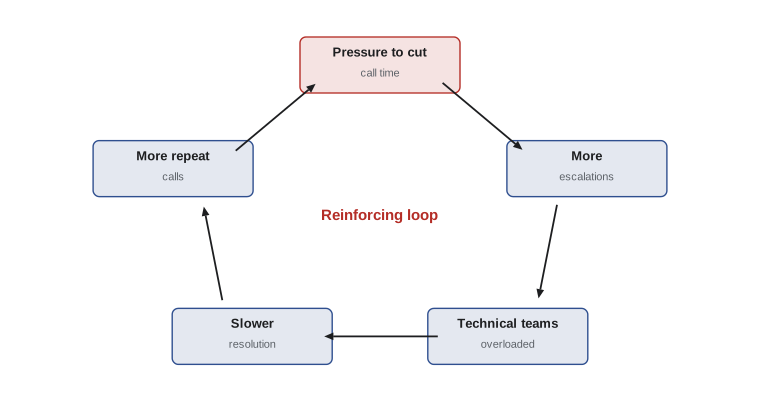
A service desk, for example, is part of a system that includes users, technical teams, knowledge, tools and suppliers. If the desk is told to cut call times, agents may pass more tickets to technical teams. Those teams become overloaded, resolution slows and users call back, raising call volumes at the desk. A local improvement has created a reinforcing loop that makes the whole system worse.
Local optimization
Local optimization means improving one part in a way that harms overall performance. It is common because teams are usually measured on their own results. Examples include:
- A procurement team that cuts costs by choosing the cheapest supplier, raising support costs elsewhere.
- A development team that releases features faster than operations can support them.
- A security team that adds controls without considering their effect on users, who then find workarounds that are less secure.
Worked problem
Local saving, global cost
A procurement team switches to a cheaper laptop model, saving $150 on each of 800 laptops bought a year. The cheaper model has a higher failure rate: 12 % fail in the first year compared with 4 %. Each failure costs $300 in support time and $250 in lost user productivity. Does the switch save money overall?
Show solution
- Purchase saving: 800 × $150 = $120,000.
- Extra failures: (12 % − 4 %) × 800 = 64 failures.
- Cost of extra failures: 64 × ($300 + $250) = 64 × $550 = $35,200.
- Net saving: $120,000 − $35,200 = $84,800.
Answer: The switch still saves about $84,800 a year overall, but the true saving is 29 % smaller than procurement's figure suggests. Holistic thinking reveals the hidden cost, even when the decision stands.
The example shows that holistic thinking does not always reverse a decision. It ensures the decision is made with the full picture, including costs and risks that fall outside the deciding team.
The four dimensions as a holistic check
ITIL-110 introduced the four dimensions of service management: organizations and people; information and technology; partners and suppliers; and value streams and processes. They provide a practical checklist for holistic thinking. Before making a change, ask how it affects each dimension, and how external factors (political, economic, social, technological, legal and environmental) might affect it.
| Dimension | Questions to ask about a change |
|---|---|
| Organizations and people | Who is affected? What skills, roles or culture changes are needed? Who might resist? |
| Information and technology | What data and tools are involved? What integrations or security concerns arise? |
| Partners and suppliers | Which suppliers are affected? Do contracts need to change? |
| Value streams and processes | Which value streams are affected? Do handoffs or workflows change? |
| External factors (PESTLE) | Do regulations, market conditions or environmental concerns affect the change? |
Worked problem
Spotting a missed dimension
A team plans to move a booking service to a new cloud platform. The plan covers technical migration, data transfer and testing in detail. Using the four dimensions, what gaps should be checked?
Show solution
- Information and technology: well covered by the plan.
- Organizations and people: are support staff trained on the new platform? Do roles change?
- Partners and suppliers: does the cloud contract cover data residency, support levels and exit terms?
- Value streams and processes: do incident, change and monitoring workflows need updating for the new platform?
Answer: The plan is strong on technology but should add training, contract review and process updates. External factors such as data residency rules should also be checked.
Mapping dependencies
Working holistically requires knowing what depends on what. Service maps, configuration management data and value stream maps all help. A simple dependency map lists each service, the components it relies on and the services that rely on it. When a component changes or fails, the map shows the impact.
Worked problem
Counting affected services
A dependency map shows a shared authentication service used directly by 6 services. Three of those are themselves used by 2 further services each, with no overlap. If authentication fails, how many services are affected?
Show solution
- Directly dependent services: 6.
- Indirectly dependent services: 3 × 2 = 6.
- Total affected: 6 + 6 = 12, plus the authentication service itself.
- This shows why a change to authentication needs careful assessment and coordination with all 12 service owners.
Answer: Twelve services depend on authentication, directly or indirectly. Without the map, the change team might consult only the six direct owners.
Complexity and decision-making
Different situations need different approaches. A useful model, the Cynefin framework, distinguishes clear situations (cause and effect obvious; apply best practice), complicated situations (cause and effect discoverable by analysis; apply expert judgment), complex situations (cause and effect only clear in hindsight; experiment and learn) and chaotic situations (act first to stabilize). Holistic thinking includes recognizing which kind of situation you face. Treating a complex problem, such as improving organizational culture, as if it were merely complicated leads to detailed plans that fail; treating a clear problem, such as a routine password reset, as complex wastes effort.
Holistic thinking in practice
Several practical habits support this principle:
- Involve representatives from affected areas when planning changes (lesson 5).
- Measure end-to-end outcomes, such as total time to restore service for the user, not just each team's portion.
- Review incidents and problems across team boundaries rather than within one team.
- Use value stream maps to see the whole flow of work from demand to value.
- Ask "what else does this affect?" as a routine question in planning and change assessment.
Links to other principles and frameworks
This principle is closely tied to the service value system covered in ITIL-130, which describes how all components and activities of an organization work together to create value. It also connects with Lean's focus on the whole value stream and with DevOps, which treats development, operations and security as one system. In governance (lesson 10), holistic thinking means considering the whole organization's objectives and risks, not only those of IT.
Value stream mapping as a holistic tool
A value stream map is one of the most practical tools for thinking holistically. It follows a single type of demand, such as a request for a new employee's equipment, through every team and system involved until value is delivered. For each step it records the work time, the waiting time and the people involved. The finished map usually surprises everyone: each team knows its own part well, but nobody has seen the whole flow before.
Building the map is itself an act of collaboration. Representatives of every team involved walk through the flow together, often using sticky notes on a wall or a shared online board. Disagreements about how the work really happens are common and useful, because they reveal handoffs that nobody owns.
Worked problem
Estimating waste in a value stream
A value stream map for onboarding a new employee shows six steps: request submitted (work 0.25 h, wait 8 h), manager approval (work 0.25 h, wait 24 h), account creation (work 1 h, wait 16 h), equipment ordering (work 0.5 h, wait 40 h), equipment set-up (work 2 h, wait 8 h) and handover (work 0.5 h, wait 0 h). What is the total lead time, how much is waiting, and which wait is the biggest target?
Show solution
- Total work time: 0.25 + 0.25 + 1 + 0.5 + 2 + 0.5 = 4.5 hours.
- Total waiting time: 8 + 24 + 16 + 40 + 8 + 0 = 96 hours.
- Lead time: 4.5 + 96 = 100.5 hours; waiting is 96 ÷ 100.5 ≈ 95.5 % of it.
- The largest wait is equipment ordering (40 hours). Keeping a small stock of standard laptops could remove most of it.
Answer: Lead time is about 100.5 hours, of which about 95.5 % is waiting. Equipment ordering is the biggest single target, followed by manager approval.
The example shows how holistic analysis changes where improvement effort goes. Each team in the flow might have tried to speed up its own work, but the work time totals only 4.5 hours. The real gains lie in the gaps between teams, which no single team owns.
Key point to remember
Before any significant decision, ask "what else does this affect?" and check each of the four dimensions. Most failures of holistic thinking are not failures of intelligence but of attention: the effects were knowable, but nobody looked beyond their own part of the system. Measuring end-to-end outcomes, mapping dependencies and involving people from across the flow are the habits that keep the whole system in view.
A final caution: holistic thinking can be taken too far. Trying to analyze every possible effect before acting leads to paralysis, which is why this principle works best alongside progress iteratively with feedback. Map the main dependencies, consult the people most affected, take a small step and watch what happens across the system.
Common mistakes
MistakeOptimizing a team's own measure regardless of its effect elsewhere.
InsteadMeasure and improve end-to-end outcomes that reflect the whole system.
MistakePlanning changes using only the technology dimension.
InsteadCheck all four dimensions and external factors.
MistakeConsulting only directly dependent service owners.
InsteadUse a dependency map to find indirect impacts too.
MistakeTreating every problem with the same planning approach.
InsteadMatch the approach to whether the situation is clear, complicated, complex or chaotic.
MistakeAssuming holistic thinking always changes the decision.
InsteadUse it to ensure decisions reflect full costs and risks, whatever the outcome.
Summary and key terms
- No service or element stands alone; outcomes suffer unless the whole is managed.
- Systems thinking looks at interdependence, feedback and emergent properties.
- Local optimization improves one part while harming overall performance.
- The four dimensions and external factors form a practical checklist for holistic thinking.
- Dependency maps reveal indirect impacts of changes and failures.
- Different levels of complexity need different decision-making approaches.
- End-to-end measures and cross-team reviews support holistic working.
- System
- A set of interacting parts that together produce results none could produce alone.
- Systems thinking
- Analyzing how parts of a system relate and influence each other.
- Local optimization
- Improving one part in a way that harms overall performance.
- Reinforcing loop
- A feedback loop in which a change amplifies itself.
- Emergence
- Properties of a system that belong to the whole rather than any part.
- Dependency map
- A diagram or list showing which services and components rely on which.
- End-to-end measure
- A measure covering the whole flow of work from the consumer's point of view.
- PESTLE
- Political, economic, social, technological, legal and environmental factors.
- Cynefin framework
- A model distinguishing clear, complicated, complex and chaotic situations.
- Four dimensions
- Organizations and people; information and technology; partners and suppliers; value streams and processes.
Practice problems
Work each problem on paper first, then reveal the answer to check.
State the principle think and work holistically in one sentence.
Show answer
No service or element stands alone; work on the service as a whole, not just its parts.
What is local optimization?
Show answer
Improving one part in a way that harms overall performance.
Give an example of a reinforcing loop in service management.
Show answer
Cutting call times increases escalations, slowing resolution and raising repeat calls.
List the four dimensions.
Show answer
Organizations and people; information and technology; partners and suppliers; value streams and processes.
A saving of $50,000 creates $20,000 of costs elsewhere. What is the net saving?
Show answer
$30,000.
A component serves 4 services; 2 of them serve 3 more each. How many services are affected?
Show answer
4 + 6 = 10.
Which situation in Cynefin calls for experimenting and learning?
Show answer
Complex.
Why measure end-to-end outcomes?
Show answer
They reflect the consumer's experience and discourage local optimization.
Does holistic thinking always reverse a decision?
Show answer
No; it ensures decisions are made with full costs and risks in view.
Which ITIL course covers the service value system in depth?
Show answer
ITIL-130.
Lesson quiz · 5 questions
Score 60% or more to complete this lesson.
Create a free account to save your progress, take quizzes and earn a certificate.