
ITIL-120 · Lesson 1 of 12 · 29 min
What guiding principles are and why ITIL has them
This course is the second step in the HSM University ITIL preparation program. ITIL-110 introduced the vocabulary of service management: value, outcomes, costs, risks, utility, warranty and the roles of providers and consumers. This course turns to the ideas that guide decisions when no procedure tells you exactly what to do: the seven guiding principles, the governance that directs and oversees service management, and the continual improvement model that keeps services getting better. Together they answer a practical question every service team faces many times a day: given everything we know, what is the sensible next step?
A note on independence before we begin. ITIL® is a registered trade mark of the PeopleCert group. This course is an independent study guide written in our own words. It does not reproduce official publications and contains no real exam questions. The quiz and exam questions are original practice items designed to build understanding.
Why a framework needs principles
Frameworks such as ITIL describe practices: incident management, change enablement, service level management and dozens more. Practices are useful, but no set of practices can anticipate every situation. A service desk manager deciding whether to add a new approval step, a product owner choosing between two features, and an executive deciding whether to outsource a data centre all face choices the practice guides do not settle. Principles fill that gap. They are short statements of good judgment that apply in any situation, at any level and in any organization.
ITIL describes a guiding principle as a recommendation that guides an organization in all circumstances, regardless of changes in its goals, strategies, type of work or management structure. Three properties make a statement a principle rather than a rule:
- It is universal. It applies to a ten-person start-up and to a federal department, to software development and to facilities management.
- It is self-validating. Its usefulness has been shown repeatedly in practice; you do not need to accept it on faith.
- It empowers people. It helps people make good decisions without waiting for someone to write a procedure.
The contrast with rules is important. A rule says "every change must be approved by the change advisory board". A principle says "keep it simple and practical". The rule may be right for high-risk changes and wasteful for low-risk ones. The principle helps people decide which situations need the heavy process and which do not.
The seven guiding principles
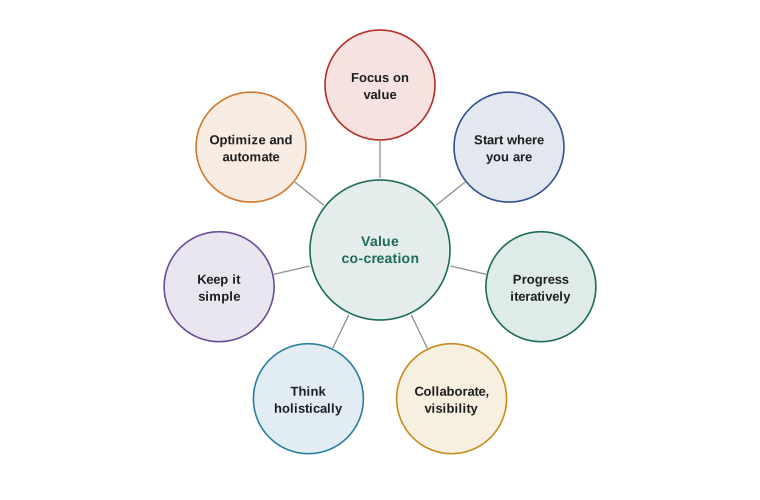
ITIL 4 introduced seven guiding principles in 2019, refining earlier versions that appeared in ITIL Practitioner guidance. ITIL (Version 5), released by PeopleCert in February 2026, keeps all seven names unchanged and adds more guidance on how they interact and how organizations can adapt them to their own values. At the time of writing (October 2026), both editions are in use for training and examinations, so always confirm which edition your exam is based on. The principles are:
| Principle | Core idea | Typical question it raises |
|---|---|---|
| Focus on value | Everything should link back to value for stakeholders | Who benefits from this, and how? |
| Start where you are | Build on what already works instead of starting over | What do we already have that we can use? |
| Progress iteratively with feedback | Work in small steps and learn from each one | What is the smallest useful step, and how will we know it worked? |
| Collaborate and promote visibility | Work together and make work and decisions visible | Who needs to be involved, and what do they need to see? |
| Think and work holistically | No part of a service works in isolation | What else does this affect? |
| Keep it simple and practical | Use the minimum number of steps needed to deliver value | Does this step add value? Can we remove it? |
| Optimize and automate | Improve work first, then automate where it helps | Should we improve this before we automate it? |
Where the principles sit in ITIL
In ITIL 4, the guiding principles are one of the five components of the service value system, alongside governance, the service value chain, practices and continual improvement. The service value system as a whole is covered in ITIL-130; for this course it is enough to know that the principles shape how every other component is used. Governance uses the principles when setting direction. Teams apply them when they design a value stream or run a practice. Continual improvement relies on them at every step.
ITIL (Version 5) organizes its guidance around digital products and services and their life cycle, and it gives more attention to experience, sustainability and the responsible use of artificial intelligence. The guiding principles remain at the centre of that guidance. If anything, they become more important when technology changes quickly, because detailed procedures date faster than principles do.
Principles from other bodies of knowledge
ITIL is not the only framework built on principles. Agile software development rests on the values and principles of the Agile Manifesto (2001). Lean thinking grew from the Toyota Production System and emphasizes value, flow and the removal of waste. DevOps emphasizes flow, feedback and continuous learning. The PRINCE2 project management method has seven principles of its own, and the PMBOK Guide (eighth edition, 2025) is organized around principles of project management. The ITIL principles share much with these. That is deliberate: ITIL was written to work alongside other approaches, not to replace them.
| ITIL principle | Close relatives in other approaches |
|---|---|
| Focus on value | Lean: specify value from the customer's point of view; Agile: customer collaboration |
| Start where you are | Lean: go and see (gemba); Kaizen: improve from the current state |
| Progress iteratively with feedback | Agile: deliver working software frequently; Scrum sprints; plan-do-check-act |
| Collaborate and promote visibility | DevOps: shared ownership; Kanban: make work visible |
| Think and work holistically | Systems thinking; DevOps: optimize the whole value stream |
| Keep it simple and practical | Agile: simplicity, the art of maximizing work not done |
| Optimize and automate | Lean: remove waste before automating; DevOps: automate the delivery pipeline |
For an exam, learn the ITIL wording. For practice, recognize that a team already working in an Agile or Lean way will find the ITIL principles familiar and can connect them to habits it already has.
How to use the principles
The principles are not a checklist to recite. They are lenses for looking at a decision. A useful habit is to take a proposal and ask the question each principle raises. Consider a team proposing to replace its ticketing tool. Focus on value asks who benefits. Start where you are asks what the current tool does well. Progress iteratively asks whether the switch can happen in stages. Collaborate asks who should help choose. Think holistically asks what reports, integrations and training will change. Keep it simple asks whether all the requested features are needed. Optimize and automate asks whether the current workflow should be improved before it is copied into a new tool.
Not every principle will matter equally for every decision, and sometimes they pull in different directions. Keeping things simple may argue against an integration that holistic thinking says is needed. Lesson 9 looks at how to handle those tensions. For now, the key point is that the principles are meant to be considered together.
Worked problem
Testing a proposal against the principles
A manager proposes that every service request, including password resets, must be approved by the requester's manager before work starts. Use three principles to evaluate the proposal.
Show solution
- Focus on value: a password reset restores access quickly; manager approval adds delay without adding value for anyone.
- Keep it simple and practical: an extra approval step for a routine, low-risk request is unnecessary complexity.
- Think and work holistically: approvals slow the service desk, frustrate users and consume managers' time across the whole organization.
- A better proposal: require approval only for requests with real risk or cost, such as access to sensitive systems, and let routine requests flow straight through.
Answer: The proposal fails at least three principles. Targeting approvals at risky or costly requests keeps control where it matters.
Worked problem
Estimating the cost of an unnecessary step
The approval step in the previous example would affect about 18,000 password resets a year. Each approval takes a manager about 2 minutes and delays the requester by an average of 45 minutes of lost work. Manager time costs $70 per hour and employee time $45 per hour. Estimate the annual cost.
Show solution
- Manager time: 18,000 × 2 minutes = 36,000 minutes = 600 hours. 600 × $70 = $42,000.
- Requester time lost: 18,000 × 45 minutes = 810,000 minutes = 13,500 hours. 13,500 × $45 = $607,500.
- Total: $42,000 + $607,500 = $649,500 a year.
Answer: About $650,000 a year, almost all of it in lost requester time. Putting a number on waste is a powerful way to apply the principles.
Worked problem
Spotting principles in a story
A service desk lead notices that many tickets are reopened. Instead of buying a new tool, she studies the last 200 reopened tickets, finds that most lacked a confirmation step with the user, adds a one-line closure check, tries it for two weeks with one team and shares the results with the whole department. Which principles did she apply?
Show solution
- Start where you are: she studied existing tickets rather than replacing the tool.
- Keep it simple and practical: the fix was a one-line check.
- Progress iteratively with feedback: she tried the change with one team for two weeks before expanding it.
- Collaborate and promote visibility: she shared the results with the department.
- Focus on value: fewer reopened tickets means users get working solutions the first time.
Answer: At least five of the seven principles are visible in one small improvement.
What this course covers
Lessons 2 to 8 take the principles one at a time, with scenarios, failure modes and worked examples. Lesson 9 shows how they work together and how to resolve conflicts between them. Lesson 10 covers governance: how a governing body evaluates, directs and monitors service management, with Canadian and US examples. Lesson 11 covers the continual improvement model, the continual improvement register and measurement. Lesson 12 covers reporting and culture and finishes with a capstone that applies everything to a struggling service desk.
Common mistakes
MistakeTreating the principles as a checklist to recite in meetings.
InsteadUse them as lenses that each raise a question about a real decision.
MistakeApplying one principle alone, such as automating everything.
InsteadConsider the principles together and look for tensions between them.
MistakeThinking the principles are only for IT teams.
InsteadApply them to any service work, from facilities to finance.
MistakeAssuming ITIL (Version 5) replaced the principles.
InsteadKnow that Version 5 kept all seven names and added guidance on applying them.
MistakeConfusing principles with rules or policies.
InsteadRemember principles guide judgment; rules prescribe specific actions.
Summary and key terms
- A guiding principle is a recommendation that guides an organization in all circumstances.
- Principles are universal, self-validating and empowering.
- ITIL has seven guiding principles, unchanged in name between ITIL 4 and ITIL (Version 5).
- In ITIL 4 the principles are a component of the service value system.
- The principles overlap with Lean, Agile, DevOps and project management principles.
- Use the principles as questions to test proposals and decisions.
- The principles work as a set and sometimes pull in different directions.
- Guiding principle
- A recommendation that guides an organization in all circumstances, regardless of changes in its goals, strategies, type of work or management structure.
- Universal
- Applicable to any organization, service or situation.
- Self-validating
- Proven useful through repeated practice rather than accepted on authority.
- Rule
- A prescribed action that applies in defined situations, unlike a principle that guides judgment.
- Service value system
- In ITIL 4, the model showing how components and activities work together to enable value co-creation.
- Lean
- An approach focused on customer value, flow and the removal of waste.
- Agile
- An approach to work based on short iterations, collaboration and responding to change.
- DevOps
- A culture and set of practices that bring development and operations together to deliver value quickly and reliably.
- ITIL (Version 5)
- The edition of ITIL released by PeopleCert in February 2026, focused on digital products and services.
- Waste
- Any activity that consumes resources without adding value for stakeholders.
Practice problems
Work each problem on paper first, then reveal the answer to check.
Name the seven ITIL guiding principles.
Show answer
Focus on value; start where you are; progress iteratively with feedback; collaborate and promote visibility; think and work holistically; keep it simple and practical; optimize and automate.
What three properties make a statement a guiding principle?
Show answer
It is universal, self-validating and empowering.
Did ITIL (Version 5) change the names of the principles?
Show answer
No. All seven names are unchanged; Version 5 adds guidance on how they interact.
How does a principle differ from a rule?
Show answer
A principle guides judgment in any situation; a rule prescribes a specific action in defined situations.
Which Lean idea is closest to "start where you are"?
Show answer
Go and see the current state of the work (gemba) and improve from there.
An approval step affects 10,000 requests and takes 3 minutes each at $60 per hour. What is the cost?
Show answer
30,000 minutes = 500 hours × $60 = $30,000 a year.
In ITIL 4, where do the guiding principles sit?
Show answer
They are a component of the service value system.
Why are principles especially useful when technology changes quickly?
Show answer
Detailed procedures date quickly; principles still guide decisions in new situations.
Which principle asks "what else does this affect?"
Show answer
Think and work holistically.
Why should the principles be considered together?
Show answer
Each covers a different aspect of good decisions, and they sometimes pull in different directions.
Lesson quiz · 5 questions
Score 60% or more to complete this lesson.
Create a free account to save your progress, take quizzes and earn a certificate.