
IRW-320 · Lesson 1 of 12 · 21 min
Ornamental and miscellaneous metals
▶ Video coming soon A video version of this lesson is on the way.
On Monday, November 9, 2026, Shay Donnelly reported to the Ashcroft Medical Building at 7:00 a.m. with his tool bag and a lunch, but not to Carla Duquette's raising gang. The frame had topped out on October 23 and the deck crew had finished the last details that week, so Hal Prentiss had lent him for five days to Lionel Hartigan, Crossbeam's foreperson for miscellaneous and ornamental metals. Lionel had been an ironworker for thirty-four years, the last twenty of them on stairs, railings, canopies, embeds and the hundred small pieces of steel that turn a frame into a building people can use.
"The raising gang builds the skeleton," Lionel said, handing Shay a clipboard. "We do everything people touch. A beam can be off by a few millimetres and nobody ever knows. A handrail that's off by that much, somebody's hand finds it every day for fifty years." His crew that week was Rhea Mallory, a journeyperson who had come into the trade through ornamental work and ran most of the railing and glass-related installations, and Benno Torvik, a third-year apprentice. The clipboard held the misc metals list for Ashcroft, a sheet the crew called the scope sheet.
This course follows that week at Ashcroft, from Monday, November 9 to Friday, November 13, and the jobs Lionel and Rhea drew on while they worked. This first lesson explains what ornamental and miscellaneous metals are, how the work is divided among trades, how it is specified and scheduled, what makes it different from structural erection, and how a misc crew plans its work.
Two names for the finishing metalwork
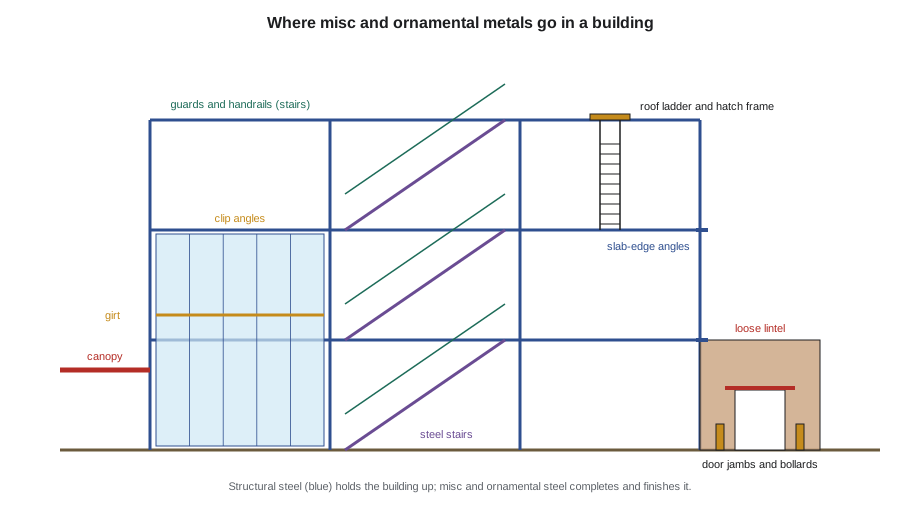
Miscellaneous metals, usually shortened to misc metals or misc steel, are the steel items that are not part of the main structural frame but are needed to complete the building. They are mostly functional: loose lintels over masonry openings, embedded plates and angles cast into concrete, steel stairs and ladders, pipe guards and bollards, door frames and jamb angles for overhead doors, support steel for equipment, curtain wall and window wall, elevator pit ladders and sill angles, trench covers and frames, and roof hatch framing.
Ornamental metals are the pieces people see and touch, where appearance matters as much as strength: decorative railings and guards, glass railings, feature stairs, canopies and entrance steel, metal screens, gates and grilles, and architectural metalwork in stainless steel, bronze or aluminum. The line between the two is blurry. A steel egress stair is misc metals; the same stair with a glass guard, stainless handrail and exposed welds ground smooth is ornamental. Many contractors and many collective agreements simply say ornamental and miscellaneous metals.
The ironworker trade has long included this work. In Ontario, the apprenticeship Shay is registered in is called Ironworker (Structural and Ornamental), and the ornamental half of the name refers to exactly this scope.
- Structural steel holds the building up: columns, beams, braces, joists and deck.
- Miscellaneous metals complete it: lintels, embeds, stairs, ladders, guards, bollards, frames and supports.
- Ornamental metals finish it where people see and touch it: railings, canopies, entrances, screens and architectural metalwork.
- Curtain wall, window wall and storefront are glazing systems that ironworkers install in some regions and glaziers in others; lesson 5 covers both.
How the work is specified
On most projects, the specification is organized by MasterFormat, the numbering system used in both Canada and the US. Canadian federal and many provincial projects use the National Master Specification, which follows the same numbers. Division 05 covers metals. The sections a misc crew reads most are these.
| Section | Title | What it usually covers |
|---|---|---|
| 05 12 00 | Structural steel framing | The main frame (for reference: the raising gang's scope) |
| 05 31 00 | Steel decking | Floor and roof deck (the deck crew's scope) |
| 05 50 00 | Metal fabrications | Lintels, embeds, ladders, bollards, frames, supports and other misc steel |
| 05 51 00 | Metal stairs | Steel pan stairs, stringers, landings and stair framing |
| 05 52 00 | Metal railings | Guards, handrails and their anchorage |
| 05 70 00 | Decorative metal | Ornamental items, feature railings, screens and architectural metal |
| 08 41 00 | Entrances and storefronts | Storefront framing and entrance doors (often a glazing contractor) |
| 08 44 00 | Curtain wall and glazed assemblies | Curtain wall and window wall (glazing or ironworker scope by region) |
| 08 33 00 | Coiling doors and grilles | Rolling steel doors (usually a door contractor) |
Each section has three parts: general requirements (submittals, quality, delivery), products (materials, finishes, design loads) and execution (installation, tolerances, protection, cleaning). The execution part is where an installer's obligations are written, and Lionel reads it before the first piece arrives. At Ashcroft, section 05 52 00 required railings to be designed by the fabricator's engineer for the code loads, installed plumb within 3 mm in 3 m (1/8 in in 10 ft) and protected until the building was turned over. Section 05 50 00 required galvanized lintels at exterior walls and shop-primed steel inside.
Who does what
Misc and ornamental work involves more trades than structural erection, and every project draws the lines a little differently. The specification, the contracts and the collective agreements in the area decide who installs what. On a typical job the pattern is like this.
- The misc metals fabricator designs the connections where the contract asks for it, prepares shop drawings, fabricates, finishes and delivers. On Ashcroft that was Stonegate Metalworks, whose detailer, Paulette Vashti, drew the stairs, railings and canopy.
- The erector, here Crossbeam, installs the fabricator's pieces: setting stairs, bolting and welding railings, setting embeds and lintels, and installing support steel.
- The concrete contractor places the concrete around embeds, but the misc crew usually sets the embeds or checks them before the pour.
- The mason builds loose lintels into the wall; the misc crew or the mason sets them, depending on the contract.
- A glazing contractor installs storefront and often curtain wall; at Ashcroft that was Sunbridge Glass and Curtain Wall, whose project manager was Mina Daoud. Crossbeam's scope was the steel that supports the curtain wall.
- A door contractor installs overhead and rolling doors; Crossbeam installs the steel jambs and headers they mount to. At Ashcroft that was Penhale Door Systems.
"Half of misc is knowing whose job something is," Lionel said. "The other half is doing your part so the next trade's part fits."
The Ashcroft scope sheet
Lionel's scope sheet listed every misc and ornamental item at Ashcroft, its section number, its status and who was next. Shay copied it into his apprentice log that morning.
| Item | Quantity | Status on November 9 |
|---|---|---|
| Steel pan stairs, Stair 1 and Stair 2 | 2 stairs, 3 levels each | Set October 19 to 22; pans not yet filled |
| Stair guards and handrails | 210 m (690 ft) of rail | Temporary rails in place; permanent rails this week |
| Roof access ladder and hatch framing | 1 ladder, 1 frame | Frame set by the raising gang; ladder this week |
| Curtain wall support steel at the entrance lobby | 1 girt line, 13 clip angles | Girt and clips this week |
| Entrance canopy | 1 canopy, 4 outriggers | Outriggers this week; soffit and roofing by others |
| Slab-edge angles and embeds for window wall | Levels 2, 3 and roof | Check this week, before the slab pours |
| Loose lintels at the service wall | 14 lintels | Delivered; set with the masonry in December (plan) |
| Loading bay door jambs and bollards | 2 door openings, 6 bollards | Jambs this week; bollards after paving (plan) |
| Wall girts for metal panels | East and north walls | Shop drawings approved November 6; installation in December (plan) |
How misc work differs from erection
Shay had spent eight weeks connecting beams and bolting braces. Misc work used many of the same skills, but the rhythm was different, and Lionel listed the differences before the crew started.
- Pieces are small and many. A raising gang may set fifty pieces a day; a misc crew may handle three hundred, from a 6 m (20 ft) stringer to a 50 mm (2 in) clip angle.
- Tolerances are tighter where people touch the work. A handrail must be at a code height along its whole length, and a guard opening must not let a sphere of a given size pass anywhere.
- The work fits to other trades' work. An embed must land where the concrete forms are, a lintel where the mason's opening is, a curtain wall clip where the glazier's anchor will be. Field measuring is a daily task.
- Finishes matter. Galvanizing, paint, stainless steel and powder coat must not be scratched, burned or contaminated, and repairs follow a written method.
- Much of it is done in a building that is being finished around you, with other trades, finished surfaces and, near the end, people.
- Most pieces go in by hand, by hoist or by a small machine such as a telehandler or a scissor lift, rather than by a large crane.
At Ashcroft, the heavy pieces of the week, the canopy outriggers and the curtain wall girt, would be set with Crossbeam's telehandler, and almost everything else by hand.
Sequencing and scheduling
Misc metals are scheduled around the other trades, which makes the work look scattered across the life of a job. Some items come early, before the concrete. Others wait for the walls, the glazing or the paving. Lionel's rule was that every misc item has a moment before which it cannot go in and after which it is too late, and the schedule is a list of those windows.
- Before the concrete: embeds, anchor plates, slab-edge angles and pit ladders that are cast in.
- With the frame: stair stringers, roof hatch framing, elevator support steel and other pieces that are bolted to the steel.
- Before the envelope: curtain wall support steel, girts for panels, door jambs and lintels.
- After the floors: permanent guards and handrails, once the stair pans are filled and the floors finished.
- At the end: bollards after paving, ornamental railings after finishes, touch-up and protection removal.
At Ashcroft, the slab-edge angles had to be checked before the late-November slab pours, the curtain wall steel had to be in before Sunbridge started the lobby curtain wall in December, and the door jambs before Penhale's door crew. That is why the week of November 9 was busy.
Worked problem
Estimating the railing work
Ashcroft has 210 m (690 ft) of permanent guard and handrail at its two stairs. Crossbeam's company figure for steel rail on pan stairs, including posts, welding and touch-up, is 1.75 m per crew-hour for a two-person crew. How many crew-hours does the railing take, and how many working days for a two-person crew working 8-hour days?
Show solution
- Crew-hours = 210 m ÷ 1.75 m per crew-hour = 120 crew-hours.
- Days = 120 ÷ 8 = 15 days for one two-person crew.
Answer: About 120 crew-hours, or 15 working days for one two-person crew. The production figure is Crossbeam's own, not a standard; it changes with the rail design, the access and the finish. Lionel planned to start the rails that week and finish them in December, after the stair pans were filled.
Planning a misc crew's day
A misc crew's day starts with a walk. Lionel's crew walked every area they would work in that day, checking that the other trades' work they depended on was ready, that the pieces were on site, and that access was safe. On the Monday walk, Shay noticed that the scissor lift they needed for the curtain wall clips was parked on the second floor with a flat battery. Lionel phoned the rental yard before 7:30. "If you find it at seven, it's a phone call," he said. "If you find it at ten, it's a lost morning."
The rest of the plan was a short list on the clipboard: the pieces for each area, the tools and consumables, the drawings, the hot-work permits, the lift and access equipment, and the other trades to coordinate with. Misc crews carry more consumables than raising gangs: anchors and adhesive, welding rod, grinding discs, zinc-rich paint for touch-up, shims, bolts in four or five sizes, and protection film and corner guards.
Hot work is a daily issue on misc jobs, because much of the work is welding and grinding inside a building where other trades have stored combustible materials. Every hot-work location has a permit, a fire extinguisher, a fire watch during and after the work and a check for anything below or behind the work that could catch a spark. Lesson 4 returns to this, because welding railings inside a finished stair is a classic setting for a fire.
Common mistakes
MistakeTreating misc work as small structural work.
InsteadExpect more pieces, tighter tolerances where people touch the work, more coordination and more care with finishes.
MistakeAssuming the misc crew installs everything in Division 05 and 08.
InsteadCheck the contract and the local agreements: glazing, doors and masonry often belong to other trades.
MistakeMissing the window for an item.
InsteadList the moment before which each item cannot go in and after which it is too late.
MistakeArriving to find the lift or the material not ready.
InsteadWalk the areas first thing and fix problems before the work starts.
MistakeWelding in a finished stair without a permit and fire watch.
InsteadTreat every hot-work location as a fire risk and follow the permit.
Summary and key terms
- Miscellaneous metals complete the building: lintels, embeds, stairs, ladders, guards, bollards, frames and supports.
- Ornamental metals finish it where people see and touch it, and the line between the two is blurry.
- Division 05 sections 05 50 00, 05 51 00, 05 52 00 and 05 70 00 are the misc crew's main specifications, with Division 08 for glazing and doors.
- Fabricators, erectors, concrete, masonry, glazing and door contractors share the work, and the contracts decide who does what.
- Misc work has many small pieces, tight tolerances where people touch it, constant field measuring and finishes to protect.
- Each item has a window in the schedule, from embeds before the concrete to bollards after paving.
- Miscellaneous metals
- Non-structural steel items needed to complete a building, such as lintels, embeds, stairs, ladders and guards.
- Ornamental metals
- Metalwork chosen partly for its appearance, such as decorative railings, canopies and architectural metal.
- MasterFormat
- The numbering system that organizes specifications by division and section, used in Canada and the US.
- Scope sheet
- A foreperson's list of every item in the crew's scope, with its status and the next trade involved.
- Hot-work permit
- A written permit for welding, cutting or grinding, with fire precautions and a fire watch.
Practice problems
Work each problem on paper first, then reveal the answer to check.
Name three items that are miscellaneous metals.
Show answer
Any three of: lintels, embeds, steel stairs, ladders, bollards, door jambs, support steel.
What section number usually covers metal railings?
Show answer
05 52 00.
A crew installs rail at 1.75 m per crew-hour. How long does 84 m take?
Show answer
84 ÷ 1.75 = 48 crew-hours.
Why are embeds scheduled before the concrete?
Show answer
They are cast in, so they must be set and checked before the pour.
Who usually installs storefront at an entrance?
Show answer
A glazing contractor, though it varies by region and contract.
Lesson quiz · 5 questions
Score 60% or more to complete this lesson.
Create a free account to save your progress, take quizzes and earn a certificate.