
IRW-310 · Lesson 5 of 12 · 25 min
Erecting long-span roofs and trusses
▶ Video coming soon A video version of this lesson is on the way.
Before Larkmont, Shay's only long-span pick had been truss T-1 over Ashcroft's entrance lobby on October 7, a single 18.3 m (60 ft) truss that the whole gang talked about for a week. On November 6, Carla showed the group the job Crossbeam had done the November before: six 36 m (120 ft) trusses over the gymnasium of the Ravensworth Community Centre. "A truss is a beautiful thing when it's finished," she said, "and the most dangerous piece of steel on the job when it's hanging from a crane or standing on its own. It's tall and thin. It wants to roll over."
This lesson covers long-span roofs: trusses, girders and joist girders over large spaces, why long members are unstable during erection, how they are rigged and lifted, how the first members are braced, how the rest are tied in, and the role of camber, bearing and expansion at the supports.
Long spans
Gymnasiums, arenas, auditoriums, hangars, warehouses and the lobbies of some towers need roofs or floors that span far without columns. For spans beyond what a rolled beam can do economically, designers use trusses, deep plate girders, joist girders, arches or space frames. Trusses are the most common for spans of about 25 to 60 m (80 to 200 ft), because they carry large loads with little steel. They are made of top and bottom chords joined by web members, often wide-flange or tee chords with angle or tube webs, and are usually shipped in pieces and spliced on the ground before the lift.
Why long members are unstable
A long truss or girder is strong in the direction it was designed for, vertical loads, and weak sideways. In the finished roof, its top chord is held every few metres by purlins, joists or deck and by the roof bracing, and its bottom chord by bottom-chord bracing. During erection, none of that is there. A truss standing on its bearings with nothing holding it is like a long, thin board on its edge: a small push, a gust, or its own slight lean can make it buckle sideways or roll over. A truss hanging from a crane can also buckle if it is picked at the wrong points, because the lifting puts its chords into forces they were not designed for.
For this reason long-span members are critical lifts under Crossbeam's rules, which treat any truss or piece over 15 m (50 ft) long, or any piece with engineered pick points, as a critical lift with a written plan.
Rigging long trusses
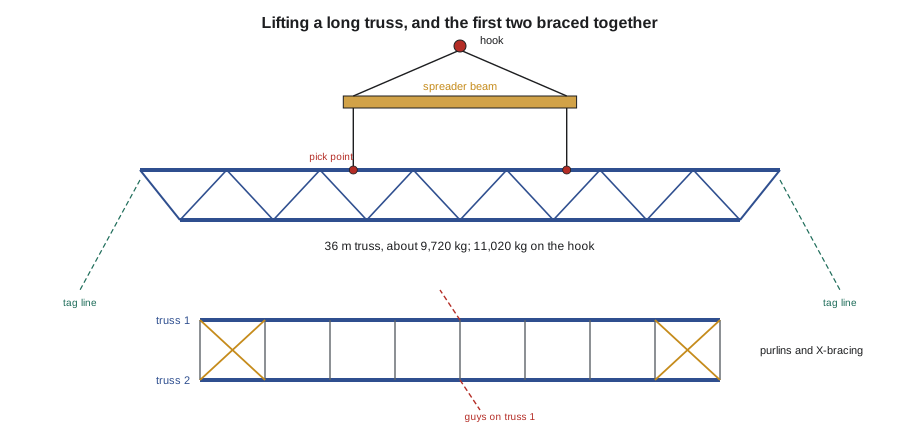
The erection engineer or the fabricator's engineer designs the rigging for a long truss: the pick points, the spreader or lifting beam, the slings and the hardware. Pick points are usually at panel points on the top chord, where web members meet, so that the lifting forces go into the truss the way loads do in service. A spreader beam lets the slings hang vertically, so they do not squeeze the truss with horizontal forces, and it keeps the truss from buckling between the pick points.
- Pick points are marked on the truss by the fabricator and on the lift plan.
- The spreader and its rigging are part of the load on the hook.
- Tag lines at each end control rotation; the tag line crew never wraps a line around a hand or stands under the truss.
- A truss may need temporary stiffening, such as a strongback or a timber lashed to the top chord, for the lift; the engineer specifies it.
Worked problem
Weighing a gym truss pick
Each Ravensworth truss was 36 m long and weighed about 270 kg/m. The spreader beam weighed 1,100 kg and the slings and shackles about 200 kg. The crane chart gave 14,500 kg at the radius needed. What was the load on the hook and what share of the chart did it use?
Show solution
- Truss = 36 × 270 = 9,720 kg.
- Load on hook = 9,720 + 1,100 + 200 = 11,020 kg.
- Share = 11,020 ÷ 14,500 = 0.76, or 76 in 100.
Answer: About 76 in 100 of the chart, over Crossbeam's 75 in 100 line, so each truss pick was a critical lift twice over: by its length and by its share of the chart. The spreader and rigging added about 1.3 t (2,850 lb), which is why they are never left out of the weight.
Worked problem
The slings above the spreader
The spreader hung from the hook on two slings, each at 60° to the horizontal. If the 11,020 kg load is shared equally, what is the tension in each upper sling?
Show solution
- \[T = \frac{W/2}{\sin 60^\circ}\]
- T = 5,510 ÷ 0.866 ≈ 6,362 kg.
Answer: About 6,360 kg (14,120 lb) in each upper sling, more than half the load because of the angle. The slings below the spreader hang vertically and each carries half the truss and its share of the lower rigging, about 4,960 kg (11,000 lb).
Bracing the first truss
The first truss is the hardest, because there is nothing to tie it to. It is set on its bearings and held by the crane while the crew does what the erection procedure calls for: usually guy cables from the top chord to anchors on both sides, or a connection to a braced bay or wall at the end of the building, or temporary struts to a stable structure. Only when the first truss is held that way may the crane release it.
The second truss is set and immediately tied to the first with the roof purlins or joists and the roof bracing between them, so that the two together form a stable box. Each truss after that is tied to the box before the crane lets go. The rule that comes from this is simple: a truss is never released from the crane until it is braced as the procedure says, and the bracing between the first trusses is complete before any load is put on them.
At Ravensworth, the first truss was set on the morning of November 10, 2025, guyed to concrete blocks on both sides and released after 40 minutes. The second truss was set, and four purlins and the two X-braces in the first bay were bolted before the crane released it. The remaining four trusses took a day and a half. The guys came off the first truss only after the roof bracing in the first and last bays was complete, and only on Odette's written release.
Gymnasium trusses span over a floor where nobody may stand during the picks. The trusses were spliced on the gym floor itself, protected by plywood, then flown out through the open end of the building, because the roof steel at the other end was not yet up. The site was a school-board property next to an occupied school, so the exclusion zone and the timing of the picks were set with the school's principal: no picks during recess or dismissal.
Bearings, camber and expansion
Long-span members change length with temperature and deflect under load, so their supports are designed for it. One end may be fixed and the other free to slide on a slotted connection or a bearing plate. The erection drawings show which end is which, and the bolts in slotted holes are often installed snug and positioned in the slot as the drawings show, for example centred, or at one end depending on the temperature at erection. A crew that pretensions bolts at a sliding bearing, or welds it, can lock a joint that was meant to move and crack something later.
Trusses and girders are often cambered, fabricated with an upward curve so that they come level when loaded. The camber is shown on the drawings and checked on delivery. A truss is set with its camber up; setting one upside down is a mistake that happens more than people admit, because a long truss can look symmetrical. Fabricators mark the top chord and the direction of camber, and the crew checks the marks before the pick.
Worked problem
Expansion at a sliding bearing
A 36 m truss is erected when the steel is at 5 °C. Steel expands about 0.000012 per °C. How much longer will it be in summer when the steel reaches 35 °C?
Show solution
- Change in temperature = 35 − 5 = 30 °C.
- Change in length = 36,000 mm × 0.000012 × 30 ≈ 13 mm.
Answer: About 13 mm (1/2 in). That is why the sliding end's bolts were positioned in their slots as the drawings showed for the erection temperature, leaving room for the truss to grow.
Long-span girders and joist girders
The same rules apply to long plate girders, deep wide-flange girders and joist girders. A long girder is picked at points that keep it from twisting, often with a spreader, set on its bearings and connected at once to braced steel or held by guys or the crane until the beams or joists that brace it are connected. Long joist girders, lesson 1 of IRW-230, need their bottom chords held and their bridging or joists attached before they are released. Over a lobby or atrium in a tower, a long transfer girder may also carry columns from the floors above, as Larkmont's did, and it must be connected and its welds or bolts complete before the columns above it are loaded.
Roof bracing and the finished roof
Once the trusses or girders are up and tied together, the roof is completed with purlins or joists, the roof bracing between trusses, bottom-chord bracing and the deck. The roof bracing in particular must be installed early and fully bolted, because it is what keeps the trusses from leaning as the roof is loaded with deck bundles. Deck bundles are landed only where the erection plan allows, usually over the truss panel points, and never on a truss that is not yet braced.
Splicing trusses on the ground
Long trusses are usually shipped in two or three pieces and spliced on the ground before the lift. The pieces are set on blocking at the right camber and alignment, the splice plates are bolted or the joints welded as the drawings show, and the assembled truss is checked for length, camber and straightness before it is rigged. Blocking must be level and solid, because a truss assembled on uneven blocking can be locked into a twist that will not come out when it is lifted. At Ravensworth, each truss was assembled on six timber cribs on the gym floor, checked with a string line and a level, and bolted the day before its lift, so that every lift day started with a finished truss ready to rig.
Truss splices are as much part of the structure as any other connection. Their bolts are installed, tightened and inspected to the same standard as connections in the air, and the inspector usually checks them on the ground, where it is easiest. A splice that is not complete when the truss is lifted is a weak point at the worst possible moment.
Landing and connecting at the bearings
As the truss comes down onto its bearings, the connectors guide each end onto its seat, often from aerial lifts at the tops of the columns, while the tag line crew controls rotation from the ground. The fixed end is bolted first, then the sliding end is positioned in its slots as the drawings show. The connectors check that each end bears fully on its seat, with no gap, before the guys or bracing go on and before the crane slacks off. If an end does not seat, the crane holds the truss while the problem is found; a truss is never left to settle onto its bearings by itself.
Bundles and loads on a new roof
Once the trusses are braced and the purlins or joists are in, the roof starts to fill with material: deck bundles, insulation, roofing, mechanical units and their curbs. Each is a load on trusses that were designed for the finished roof, not for a concentrated stack in the middle of a span. The landing plan shows where bundles may go, usually close to a truss panel point near the supports, and how much may be stacked. At Ravensworth, deck bundles were limited to one per bay, landed over the second panel point from the bearing, and the roofing contractor's material was not allowed on the roof until the deck was fastened.
Common mistakes
MistakeReleasing a truss from the crane before it is braced.
InsteadBrace each truss as the procedure says before the crane lets go.
MistakePicking a truss at any convenient point.
InsteadUse the engineer's pick points, usually panel points, with the designed spreader.
MistakeLeaving the spreader out of the weight.
InsteadCount the spreader, slings and hardware in the load on the hook.
MistakeSetting a cambered truss upside down.
InsteadCheck the camber and top-chord marks before the pick.
MistakeTightening or welding a sliding bearing.
InsteadInstall bolts in slotted holes as the drawings show and leave the joint free to move.
Summary and key terms
- Long-span roofs use trusses, girders and joist girders that are strong vertically and weak sideways until braced.
- Long members are critical lifts with engineered pick points, spreaders and tag lines.
- The first truss is guyed or tied to stable structure before release; the second is tied to it to form a stable box; each later truss is tied in before release.
- Bearings may be fixed or sliding; slotted connections are installed as shown so the member can move with temperature.
- Camber is checked and set upward; roof bracing is installed early and fully bolted.
- Deck bundles and other loads go only on braced trusses, over panel points.
- Truss
- A frame of top and bottom chords joined by web members, used for long spans.
- Panel point
- A point on a truss where web members meet a chord.
- Spreader beam
- A beam that holds slings apart so they hang vertically over a long load.
- Camber
- An upward curve fabricated into a member so it comes level under load.
- Sliding bearing
- A support that lets one end of a member move as it expands and contracts.
- Roof bracing
- Diagonal members in the roof plane that keep trusses or girders from leaning.
Practice problems
Work each problem on paper first, then reveal the answer to check.
A 30 m truss weighs 240 kg/m. What does it weigh?
Show answer
30 × 240 = 7,200 kg.
Add 900 kg of spreader and 150 kg of slings. What is on the hook?
Show answer
7,200 + 900 + 150 = 8,250 kg.
Two upper slings at 60° carry 8,250 kg equally. What is each tension?
Show answer
4,125 ÷ 0.866 ≈ 4,763 kg.
A 30 m truss warms by 25 °C. How much longer is it?
Show answer
30,000 × 0.000012 × 25 = 9 mm.
When may the guys come off the first truss?
Show answer
When the engineer's conditions are met, typically roof bracing complete, and only on written release.
Lesson quiz · 5 questions
Score 60% or more to complete this lesson.
Create a free account to save your progress, take quizzes and earn a certificate.