
IRW-310 · Lesson 2 of 12 · 22 min
Tower cranes and climbing cranes
▶ Video coming soon A video version of this lesson is on the way.
Ewan Kilbarry ran Larkmont's tower crane from a cab about 60 m (200 ft) above the street, and in six months on the job Carla's gang heard his voice more often than they saw his face. On the October 16 session Carla read the group a line from her 2025 diary: "Ewan stopped the transfer girder pick at 3 m (10 ft) off the ground because the load moment alarm went amber. Weight on the shipping ticket was wrong. Good call." The ironworkers on a tower live by the crane, and an ironworker who understands it signals better, rigs better and knows when to stop.
This lesson covers the types of tower crane, how they are erected, tied to the building and climbed, how their load charts and limiting devices work, who may operate and signal them, and how the erector works with a crane it does not own.
Why a tower crane
A mobile crane can erect a tall building only if it can stand close to it and reach the top with a long boom, which needs space a downtown site rarely has. A tower crane stands on a small footprint, reaches the whole building from one place, and grows with the building. Its jib is high above the work, so loads travel over the top of the structure rather than around it. Its disadvantages are that it must itself be erected, tied, climbed and dismantled, usually with a large mobile crane, and that one crane serves every trade.
Types of tower crane
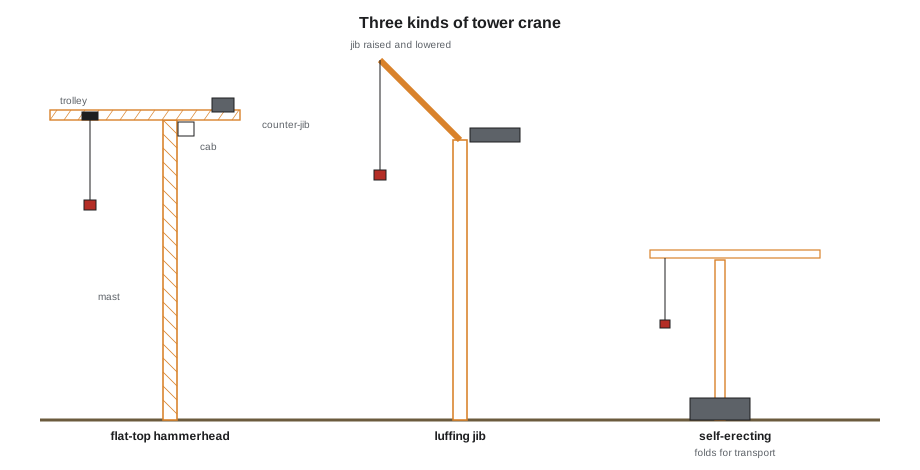
- A hammerhead or saddle-jib crane has a horizontal jib with a trolley that runs in and out along it to change the radius. A flat-top crane is a hammerhead with no tower head or pendants above the jib, which makes it easier to erect and lets several cranes work close together at different heights.
- A luffing-jib crane changes its radius by raising and lowering the jib, like a mobile crane's boom. It can work on a crowded site where a horizontal jib would swing over neighbouring buildings, and it can lift heavy loads close in, but it is slower and costs more.
- A self-erecting crane folds up for transport and unfolds itself on site. It is used on low and mid-rise jobs and is rarely large enough for structural steel on a tower.
All of them have a mast or tower of lattice sections, a slewing unit at the top that turns the upper works, a jib, a counter-jib carrying the counterweights and the hoist machinery, and a cab. They stand on a concrete foundation with anchor bolts or a cast-in base, or on a mobile chassis or rails.
Standing, tied and climbing
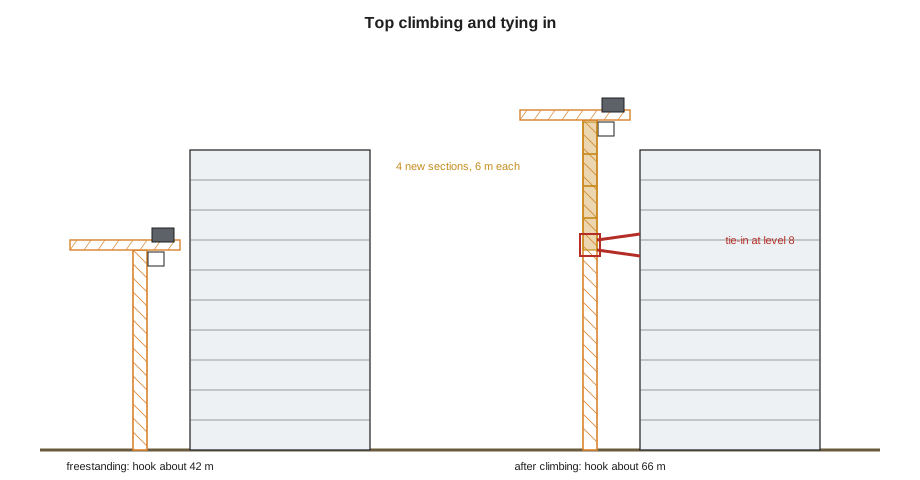
A tower crane can stand free only up to a height the maker sets for its mast and foundation, because wind on the mast and jib bends the tower. Above that height, the mast is tied to the building with collars and struts at floor levels the crane engineer designs, and the building must be strong enough to take the tie forces, which the structural engineer checks.
To get higher, the crane climbs. In top climbing, a climbing frame on the mast lifts the upper works with hydraulic jacks, a new mast section is slid in under them, and the frame repeats the process. In inside climbing, the crane stands in the building, usually in an elevator shaft or an opening in the floors, and the whole crane jacks itself up through the building on climbing collars, leaving the floors below free. Climbing is a planned operation with its own procedure, a trained climbing crew from the crane supplier, a low wind limit and no other work under the crane.
Larkmont's crane stood freestanding beside the north face with a hook height of about 42 m when steel started. In July 2025, the crane supplier top-climbed it with four mast sections of 6 m each, to a hook height of about 66 m, and tied it to the building at level 8 with a collar and two struts. Crossbeam's part was to erect the tie beams the engineer had designed into the level 8 floor framing and to stay out from under the crane for the day of the climb.
Reading a tower crane chart
A tower crane chart is simpler to read than a mobile crane's. For each jib length and reeving, it gives the maximum load at each radius along the jib. Close in, the capacity is limited by the hoist and the structure to a maximum load; farther out, it falls as the radius grows, because the load moment, the load times its radius, is what bends the jib and the mast. At the tip, the capacity is the lowest on the chart. Charts are in kilograms or tonnes in Canada and pounds in the United States, and the radius is measured from the centre of slewing to the hook.
| Radius (m) | Capacity (kg) |
|---|---|
| up to 22 | 8,000 |
| 30 | 5,850 |
| 35 | 4,950 |
| 40 | 4,250 |
| 45 | 3,700 |
| 50 | 3,250 |
| 55 (tip) | 2,900 |
The weight on the hook includes everything below the hook block: the load, the slings, shackles, spreader bars, tag lines and anything attached to the piece, such as bolt bags or a float. A tower crane is fitted with a load moment limiter, which warns the operator and then stops the hoist and the trolley-out motion when the load moment reaches the chart, and a maximum load limiter. The limiters are a last defence, not a way of finding out what a piece weighs.
Worked problem
The transfer girder pick
The heaviest pick at Larkmont was a transfer girder over the lobby, a W920×289 section 12.0 m long. Its rigging, with a short spreader, weighed about 180 kg. It was set at a radius of 40 m. Using the SAMPLE chart, what share of the capacity did it use?
Show solution
- Girder weight = 289 kg/m × 12.0 m = 3,468 kg.
- Total load = 3,468 + 180 = 3,648 kg.
- Capacity at 40 m = 4,250 kg.
- Share = 3,648 ÷ 4,250 ≈ 0.86, or about 86 in 100.
Answer: Over 75 in 100, so it was a critical lift under Crossbeam's rules, with a written lift plan, the weight confirmed from the fabricator's shop records, a calm-weather window and the area below cleared. When the girder came off the truck and the load moment limiter warned at a lower radius than expected, Ewan stopped. The shipping ticket had listed the girder without its two heavy stiffened bearing plates and a welded cap plate. The real weight, checked with the fabricator, was about 3,900 kg (8,600 lb). With the rigging, that used about 96 in 100 of the chart: still within it, but with no margin for error, so the lift went ahead only on a revised plan, in still air, with the radius checked twice.
Operators and signal persons
In Ontario, operating a tower crane is the compulsory trade of Hoisting Engineer – Tower Crane Operator (339B): the operator must hold a certificate of qualification or be a registered apprentice under supervision. The trade is about 3,000 hours, three levels of in-school training, and part of the Red Seal program as Tower Crane Operator. Tower cranes in Canada are also made, erected and inspected to CSA Z248. Ontario's construction regulation requires a signaller wherever the operator cannot see the load or its path, and the signaller must be competent, in clear view or radio contact, and doing nothing else while signalling.
On a tower, the operator usually cannot see the hook once a load drops below the top of the building, so almost every steel pick is signalled by radio. The connector or a designated signal person on the floor talks the load in, and the operator talks back. Lesson 7 of IRW-120 covers radio signalling. On Larkmont, the steel gang had its own channel, separate from the concrete crew and the general contractor, and every pick started with the signal person stating who they were and what was coming.
Sharing the crane
Because the general contractor owns or rents the crane for everyone, steel gets the crane only in its booked hours, and the schedule is negotiated every week. A good erector plans so that the crane never waits for the steel: pieces rigged and tagged before the hook arrives, connectors in place, bolts on the floor. Carla's rule at Larkmont was "the hook never comes back empty": when a piece was set, the connectors sent back the slings with the next set of rigging ready to be hooked, and the ground crew had the next piece rigged.
The erector also has duties to the crane. Steel must not be landed on or tied to the crane's mast or ties. Tag lines must not snag on the mast. Pieces must not be dragged or side-loaded, because a tower crane's jib and slewing unit are not designed for side loads. And the erector must tell the operator, through the signal person, about anything that changes the lift: a piece heavier than the ticket, a sling changed, wind picking up on the floor.
Inspections and the daily check
The crane supplier and the operator inspect the crane before each shift and keep a logbook. The ironworkers have their own checks: the rigging is inspected every day, and the hook, the latch and the hook block are looked at whenever the gang hooks on. Anything unusual, such as a hook latch that does not close, a sling with a broken wire or a noise from the crane, is reported to the operator at once. At Larkmont, Ewan's logbook recorded two stops for the anemometer, one for a limit switch fault and one when a deck bundle's banding broke and the bundle was lowered, opened and re-banded on the ground.
When the crane must not work
- Wind above the maker's in-service limit, measured by the anemometer on the crane, or a lower limit for loads with a large surface. Lesson 10 covers wind.
- Lightning in the area, because a tower crane is the tallest thing on the site.
- A limiter or a safety device that is faulty or bypassed.
- Climbing, erection or dismantling of the crane in progress, when no other lifting is allowed.
- Any doubt about the weight, the rigging or the path of a load.
Out of service, a tower crane is left free to slew, so that the jib can turn with the wind like a weathervane and present its smallest face to it. Nothing may be left on the hook, and the trolley is parked where the maker says. Ironworkers must never tie anything to a crane left in free slew.
Mobile cranes on tower jobs
Even on a tower job, mobile cranes do work the tower crane cannot. A large mobile crane erects and dismantles the tower crane, and may set the heaviest pieces of a podium or transfer level before the tower crane is installed. On Larkmont, a 300 t (330-ton) all-terrain crane erected the tower crane in two days in February 2025, and a smaller mobile crane later set the heaviest lobby girders on a Saturday when the street could be closed. Each mobile crane on a tower site needs its own setup, outrigger mats and lift plans, and it must be coordinated with the tower crane so the two never swing into each other.
Working at the top of the crane's reach
Picks near the end of the jib are the most sensitive on a tower crane, because the capacity is lowest there and a small error in radius makes a large difference. At Larkmont the far corner columns were picked at about 52 m (170 ft), close to the tip. Carla's gang marked the pick radius for every far-corner piece on the lift sheet, and the signal person told Ewan the piece mark and weight before every pick in that corner, so that he could check the chart and the limiter display before the trolley went out. Pieces for the far corner were rigged with the shortest slings that would work, because every kilogram of rigging counted against a small capacity.
Near the mast, the opposite problem appears: capacity is high, but the load path passes close to the crane's own structure and to the building's edge, and a swinging load can strike the mast. Tag lines are used to keep pieces turned along the path, and nobody stands between a load and the mast.
Hoists and the crane
Most towers also have a construction hoist, a rack-and-pinion elevator on the outside of the building that carries workers and small materials. It frees the crane for heavy picks and gets the crew to the top quickly. The hoist has its own rated load, and bolts, tools and small parts go up on it rather than on the crane hook. When the hoist is stopped, by wind or a fault, the crew must have another way down, usually the stair towers, which is part of the emergency plan in lesson 1.
Common mistakes
MistakeUsing the tower crane's limiter to find out what a piece weighs.
InsteadConfirm the weight before the lift; the limiter is a last defence.
MistakeSide-loading or dragging a piece with a tower crane.
InsteadLift vertically; the jib and slewing unit are not built for side loads.
MistakeTying material or tag lines to the mast or ties.
InsteadKeep everything clear of the crane's structure.
MistakeWorking under a crane that is climbing.
InsteadKeep all work clear during climbing, erection and dismantling.
MistakeSignalling without radio contact when the load is out of the operator's sight.
InsteadUse a designated signal person in constant radio contact.
Summary and key terms
- Tower cranes stand on a small footprint, reach the whole building and grow with it.
- Hammerhead and flat-top cranes use a trolley; luffing-jib cranes raise and lower the jib; self-erecting cranes are for smaller jobs.
- Above its freestanding height, a crane is tied to the building and climbed by top climbing or inside climbing.
- Capacity falls with radius because of load moment; load moment and maximum load limiters are a last defence.
- Tower crane operators in Ontario must be certified in the compulsory trade 339B, and cranes follow CSA Z248.
- The erector shares the crane: plan picks so the hook never waits, report anything that changes a lift, and never tie to the crane.
- Hammerhead crane
- A tower crane with a horizontal jib and a trolley that changes the radius.
- Luffing-jib crane
- A tower crane that changes its radius by raising and lowering the jib.
- Top climbing
- Raising a tower crane by jacking up its upper works and inserting new mast sections underneath.
- Inside climbing
- Raising a tower crane standing inside the building by jacking it up through the floors.
- Tie-in
- A collar and struts that tie a tower crane's mast to the building.
- Load moment limiter
- A device that stops the crane when load times radius reaches the chart.
- Free slew
- The out-of-service setting that lets the jib turn with the wind.
Practice problems
Work each problem on paper first, then reveal the answer to check.
Using the SAMPLE chart, what is the capacity at 45 m?
Show answer
3,700 kg.
A beam of 2,100 kg with 120 kg of rigging is set at 50 m. What share of the 3,250 kg chart value?
Show answer
2,220 ÷ 3,250 ≈ 68 in 100.
Four 6 m mast sections are added to a 42 m hook height. What is the new hook height?
Show answer
42 + 24 = 66 m.
What is left on the hook when the crane is out of service?
Show answer
Nothing; the crane is left in free slew.
Who may operate a tower crane in Ontario?
Show answer
A certified Hoisting Engineer – Tower Crane Operator (339B) or a registered apprentice under supervision.
Lesson quiz · 5 questions
Score 60% or more to complete this lesson.
Create a free account to save your progress, take quizzes and earn a certificate.