
INS-320 · Lesson 8 of 12 · 23 min
Cryogenic systems and multi-layer insulation
▶ Video coming soon A video version of this lesson is on the way.
In mid-October, Lou Brisebois called Raj Sandhu with a question. Kellerton's dessert line freezes its product in a tunnel freezer that sprays liquid nitrogen, supplied from a bulk tank in the yard through a vacuum-jacketed line run by the gas supplier. A short length of that line, near the freezer, had started to frost, and Lou wanted to know whether Coldstream could insulate it. Raj passed the call to Marcel, who had spent two years, early in his career, on the insulation crew of an air separation plant in southwestern Ontario. His answer surprised Lou. "Don't let anybody wrap that," he said. "Frost on vacuum-jacketed pipe means the vacuum is going. That's for the gas supplier to fix. If we insulate over it, you'll stop seeing the symptom and the line will keep getting worse." The supplier found a failed seal on one section and replaced the section the following week.
This lesson covers the coldest service insulators work on: cryogenic systems, which handle liquefied gases at temperatures below about −150 °C (−238 °F). It explains the cryogens an insulator may meet, the special hazards of very low temperatures, the main insulation systems used on cryogenic piping and vessels, including multi-layer insulation in vacuum-jacketed pipe, and what an insulator should and should not do around them.
Cryogenic liquids
At atmospheric pressure, the common industrial gases boil, and can be kept as liquids, only at very low temperatures. Storing them as liquids takes far less space than storing them as gas, which is why they are shipped and stored that way.
| Liquid | Boiling point at atmospheric pressure | Approximate gas volume from one volume of liquid | Where it is used |
|---|---|---|---|
| Liquefied natural gas (LNG) | About −162 °C (About −260 °F) | About 600 | Gas storage and transport, peak-shaving plants, fuel |
| Liquid argon | −186 °C (−303 °F) | About 840 | Welding gas, metals, electronics |
| Liquid oxygen | −183 °C (−297 °F) | About 860 | Hospitals, steel making, cutting |
| Liquid nitrogen | −196 °C (−320 °F) | About 690 | Food freezing, labs, inerting, electronics |
| Liquid hydrogen | −253 °C (−423 °F) | About 850 | Rocket fuel, some industrial and energy uses |
| Liquid helium | −269 °C (−452 °F) | About 750 | Magnets in imaging machines, research |
Insulators meet cryogenic systems at air separation plants, which make liquid oxygen, nitrogen and argon from air; at LNG terminals and the peak-shaving plants some gas utilities use to store gas for winter; at hospitals and industrial gas installations with bulk liquid tanks; in food plants with nitrogen freezers; and in research, medical and electronics facilities.
Why cryogenic work is different
Everything in the earlier lessons still applies at cryogenic temperatures, but the margins are smaller and some new hazards appear.
- The vapour drive is at its maximum. At cryogenic temperatures the vapour pressure at the pipe is effectively zero, so the full vapour pressure of the air pushes inward, and any water that enters freezes immediately.
- Air itself can condense. Air liquefies at about −191 °C (−312 °F). On a bare or poorly insulated liquid nitrogen or helium line, air condenses on the cold surface and drips off as a liquid. Because oxygen condenses at a higher temperature than nitrogen, that dripping liquid is enriched in oxygen. Oxygen-enriched liquid or air can make ordinary combustible materials, such as asphalt-based mastics, some foams and adhesives, oil and grease, wood and clothing, catch fire easily and burn violently.
- Movement is large. Steel and stainless steel shrink far more between room temperature and cryogenic temperatures than between room temperature and a freezer, so contraction joints and flexible vapour retarders are essential (lesson 9).
- Materials must stay sound. Many materials become brittle, crack or lose their bond at cryogenic temperatures. Only materials rated for the service, by the standards and by the maker, may be used.
- The gases are hazards in their own right. Nitrogen, argon and helium displace oxygen; oxygen speeds up fires; natural gas and hydrogen burn.
For these reasons, cryogenic insulation is designed by specialist engineers, materials are chosen to the owner's and the gas industry's requirements, and the specification often restricts which mastics, adhesives, foams and jackets may be used near oxygen service or where liquid air could form. An insulator follows the specification exactly and does not substitute materials.
Multi-layer rigid insulation systems
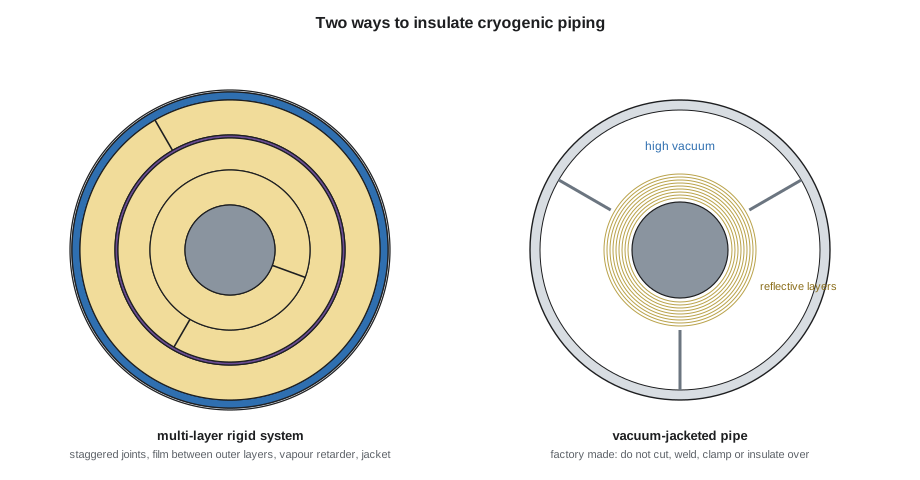
Cryogenic piping and vessels that are not vacuum-insulated are usually insulated with rigid closed-cell materials in several layers. Two families are common.
- Cellular glass systems. Cellular glass is usable at cryogenic temperatures and is non-combustible, which makes it a common choice for LNG piping and near oxygen. It is installed in two or more layers, often with an anti-abrasive coating on the bore of the inner layer, joints staggered and sealed with sealants rated for the temperature, contraction joints at intervals, a vapour retarder outside and a metal jacket over it.
- Polyisocyanurate and polyurethane systems. Rigid foam pipe sections in two or three layers, with a vapour barrier film between the outer layers as a second line of defence, an outer vapour retarder, contraction joints packed with flexible material, and a jacket. Foam systems are lighter and lower in conductivity, but are combustible and shrink more than steel, so their design must allow for both.
On both, every detail must be designed: supports with high-density load-bearing inserts, valves and flanges with removable or specially built covers, instruments and relief valves left accessible, and vapour stops at every termination. Flexible aerogel blankets with laminated vapour retarders are also used, especially where space is tight or shapes are complex, wrapped in several layers with staggered seams.
Vacuum insulation and multi-layer insulation
Heat can travel by conduction through solids, by convection through gases and by radiation across space. Ordinary insulation slows the first two by trapping gas in small cells or between fibres. At cryogenic temperatures, the best way to stop conduction and convection through the gas is to remove the gas altogether: put the cold pipe inside an outer pipe and pump the space between them down to a high vacuum. That leaves radiation, which travels even through a vacuum.
Multi-layer insulation (MLI) stops radiation. It consists of many thin layers of highly reflective foil or metallized plastic film, each separated from the next by a very thin spacer of fibreglass paper, net or similar material, wrapped around the inner pipe inside the vacuum space. Each reflective layer sends most of the radiation back, and the spacers keep the layers from touching and conducting heat between them. In a good vacuum, a wrap of MLI only a few centimetres thick insulates far better than any foam. MLI is also what protects spacecraft and many scientific instruments.
A vacuum-jacketed (VJ) pipe is made in a factory: an inner pipe for the cryogen, MLI around it, spacers to keep it centred, an outer jacket pipe and a sealed vacuum space, with field joints and bayonet connections designed by the maker. Bulk cryogenic tanks use the same idea, with a vacuum and often a fine perlite powder or MLI in the space between an inner and outer tank. These systems are installed, joined and repaired only by the maker or the gas supplier.
For an insulator, the rules around vacuum-jacketed equipment are simple:
- Do not drill, cut, weld, clamp, band, screw or strap anything to a vacuum jacket. A puncture or a weld can destroy the vacuum, and the outer pipe is part of a pressure-tested assembly.
- Do not insulate over a vacuum-jacketed line. It does not need it, and covering it hides the most important warning sign.
- Report frost, sweating or cold spots on a vacuum jacket. They mean the vacuum has been lost or a spacer is touching, and the maker or supplier must repair it.
- Insulate only the parts that are not vacuum-jacketed, such as some valves and short connections, and only as the owner and supplier specify.
How much difference the insulation makes
At cryogenic temperatures, every watt of heat that leaks into a line boils off some of the liquid. That loss can be measured directly, which makes the value of good insulation easy to see.
Worked problem
Boil-off from a liquid nitrogen line
A 30 m liquid nitrogen line is vacuum-jacketed, with a heat leak of about 1 W per metre. A similar line insulated with a foam system might gain about 15 W per metre. Liquid nitrogen absorbs about 199 kJ for each kilogram it boils, and has a density of about 808 kg/m³. How much liquid does each line boil off in a day?
Show solution
- Vacuum-jacketed: heat leak = 1 × 30 = 30 W = 30 J/s.
- Boil-off = 30 ÷ 199,000 = 0.000151 kg/s; per day, 0.000151 × 86,400 = 13.0 kg, which is 13.0 ÷ 808 = 0.0161 m³, or about 16 L.
- Foam system: heat leak = 15 × 30 = 450 W; boil-off = 450 ÷ 199,000 × 86,400 = 195 kg a day, or about 242 L.
Answer: About 16 L a day from the vacuum-jacketed line against about 242 L from the foam-insulated line.
The heat-leak figures are typical round values for illustration; real values depend on the size, the system and its condition. They show why liquid nitrogen and oxygen supply lines are usually vacuum-jacketed, and why a vacuum-jacketed line that starts to frost is costing the owner liquid every hour.
Safety around cryogens
Cryogenic gases are usually not toxic, but they cause harm in other ways.
- Oxygen deficiency. A small amount of liquid nitrogen, argon or helium makes a large volume of gas, which pushes the oxygen out of a room, pit or tank. People in an oxygen-deficient atmosphere can lose consciousness with little or no warning. Rooms with cryogenic equipment, such as Kellerton's nitrogen tunnel freezer room, have oxygen monitors and alarms; never ignore or disable them. Atmospheres with less than 19.5 in 100 oxygen are treated as oxygen-deficient under Ontario's confined spaces regulation.
- Oxygen enrichment. Around liquid oxygen, and where liquid air drips, the extra oxygen makes clothing, oil and many materials burn fiercely. Keep oil, grease and incompatible materials away, follow the specification's material rules and never smoke or use open flames near oxygen equipment.
- Cold burns. Contact with cryogenic liquids, cold gas or uninsulated cold metal freezes skin and eyes in an instant. Wear the eye and face protection and loose, insulated gloves the owner requires, and never touch bare cryogenic piping.
- Pressure. Liquid trapped between two closed valves warms, boils and can build enough pressure to burst the pipe, which is why cryogenic lines have relief devices. Never cover, insulate over or block a relief valve or its discharge.
- Confined spaces with perlite. The "cold boxes" of air separation plants and the spaces between the walls of some cryogenic tanks are filled with loose perlite powder. These are confined spaces where a person can sink into the powder or be engulfed, and entry is only under the owner's confined space procedures.
Worked problem
How much oxygen does a spill push out?
A 10 L dewar of liquid nitrogen tips over in a small storage room 3 m × 4 m × 2.7 m with no ventilation running. Liquid nitrogen makes about 694 times its volume of gas at room temperature. If the gas mixes evenly with the room air and displaces the same volume of air, what oxygen level results?
Show solution
- Room volume = 3 × 4 × 2.7 = 32.4 m³.
- Gas made = 10 L × 694 = 6,940 L = 6.94 m³.
- Air left = 32.4 − 6.94 = 25.46 m³; normal air is 20.9 in 100 oxygen.
- Oxygen = 20.9 × 25.46 ÷ 32.4 = 16.4 in 100.
Answer: About 16 to 17 in 100, well below the 19.5 in 100 limit. In real spills the gas is cold and heavy at first and collects low, so the level near the floor can be far worse; that is why monitors, ventilation and the owner's procedures matter.
What an insulator may be asked to do
On cryogenic projects, insulators most often install multi-layer rigid or aerogel systems on piping, valves and vessels that are not vacuum-jacketed; insulate the warm ends of cryogenic equipment and transitions; build removable covers for valves and instruments; and repair damaged jacketing and vapour retarders on existing systems. The work is done to detailed specifications, often with inspection and testing of each stage, and the crew is trained in the site's hazards, including the oxygen and confined space rules. Marcel's advice from his air separation plant years was short: "Read the spec twice, use only what it lists, and if something frosts that shouldn't, tell somebody."
Common mistakes
MistakeInsulating over a frosting vacuum-jacketed line.
InsteadReport it to the owner and supplier; frost means the vacuum is failing.
MistakeStrapping, clamping or screwing anything to a vacuum jacket.
InsteadLeave vacuum-jacketed pipe untouched; only the maker or supplier works on it.
MistakeSubstituting a mastic, adhesive or foam on a cryogenic job.
InsteadUse only the specified materials; some are unsafe near oxygen or at cryogenic temperatures.
MistakeIgnoring an oxygen monitor alarm in a cryogenic equipment room.
InsteadLeave the area and report it; oxygen-deficient air gives little warning.
MistakeCovering a relief valve or its discharge with insulation.
InsteadKeep relief devices and their discharges clear and accessible.
Summary and key terms
- Cryogenic systems handle liquefied gases below about −150 °C, from LNG at about −162 °C to liquid nitrogen at −196 °C and colder.
- The vapour drive is at its maximum, air can condense on bare surfaces and the condensed liquid is enriched in oxygen.
- Cryogenic insulation uses multi-layer cellular glass or foam systems with contraction joints and excellent vapour retarders, or aerogel blankets, all to specialist specifications.
- Vacuum-jacketed pipe removes the gas to stop conduction and convection, and multi-layer insulation of reflective foils stops radiation.
- Insulators never cut, weld, clamp, band or insulate over vacuum-jacketed pipe; frost on it means lost vacuum and must be reported.
- Good cryogenic insulation shows directly in reduced boil-off.
- Cryogens cause oxygen deficiency, oxygen enrichment, cold burns and pressure hazards; perlite-filled spaces are confined spaces with engulfment risk.
- Cryogenic
- Describing temperatures below about −150 °C, at which gases such as nitrogen and oxygen are liquids.
- Cryogen
- A liquefied gas kept at a cryogenic temperature.
- Vacuum-jacketed pipe
- A factory-made pipe with an inner pipe inside an outer jacket and a high vacuum between them.
- Multi-layer insulation
- Many thin reflective layers separated by spacers, used in a vacuum to block radiant heat.
- Boil-off
- Cryogenic liquid lost to vapour because of heat leaking in.
- Oxygen deficiency
- An atmosphere with less oxygen than is safe to breathe, below 19.5 in 100.
- Oxygen enrichment
- An atmosphere or liquid with more oxygen than normal, which makes materials burn more easily and fiercely.
- Perlite
- A light volcanic mineral expanded into a powder used as loose-fill insulation in cold boxes and tank walls.
Practice problems
Work each problem on paper first, then reveal the answer to check.
Why can liquid dripping from a bare liquid nitrogen line be dangerous?
Show answer
It is condensed air enriched in oxygen, which makes combustible materials burn fiercely.
What does frost on a vacuum-jacketed line usually mean?
Show answer
The vacuum has been lost or a spacer is touching; the supplier must repair it.
A line leaks 60 W into liquid nitrogen (199 kJ/kg). How many kilograms boil off per hour?
Show answer
60 ÷ 199,000 × 3,600 = 1.09 kg per hour.
A 5 L spill of liquid nitrogen in a sealed 20 m³ room: what oxygen level results if the gas mixes evenly?
Show answer
Gas = 5 × 694 = 3.47 m³; oxygen = 20.9 × (20 − 3.47) ÷ 20 = 17.3 in 100.
Why must perlite-filled cold boxes only be entered under the owner's procedures?
Show answer
They are confined spaces where a person can sink into the powder or lack oxygen.
Lesson quiz · 5 questions
Score 60% or more to complete this lesson.
Create a free account to save your progress, take quizzes and earn a certificate.