
INS-320 · Lesson 4 of 12 · 22 min
Materials for cold service
▶ Video coming soon A video version of this lesson is on the way.
For the October 19 session, Marcel laid out six samples on the training-room table, each about the size of a brick: cellular glass, flexible elastomeric foam, polyisocyanurate, phenolic foam, a strip of flexible aerogel blanket, and a section of glass fibre pipe insulation with its white all-service jacket. He handed Priya a cup of water and asked her to pour a little on each and wait. On the glass fibre, with its jacket slit open, the water vanished into the fibres. On the cut face of the polyisocyanurate it sat in the broken cells at the surface and slowly soaked in. On the cellular glass, the elastomeric and the aerogel it beaded and ran off. "That is the first question for any cold job," Marcel said. "When the vapour retarder fails, and one day somewhere it will, what does the insulation do with the water?"
INS-120 introduced insulation materials and their standards, and INS-310 listed the closed-cell materials preferred on cold equipment. This lesson looks at the materials used on cold, refrigeration and cryogenic systems in more detail: what each is, its temperature range and properties, where it is used and what to watch for when installing it, and how to compare materials of different conductivities. The values given are typical; the maker's data sheet and the specification govern.
What a cold material must do
A material for cold service is chosen on more than its thermal conductivity. The main properties are:
- Temperature range. The material must stay sound and stable at the lowest temperature the system reaches, including upsets, and at the highest, including warm-up, defrost and cleaning.
- Thermal conductivity at the mean temperature. The conductivity, or k-value, of most insulation falls as its temperature falls, so the value at the system's mean temperature, halfway between the pipe and the surface, is the one that matters. Data sheets give tables or curves.
- Resistance to water vapour and water. Closed-cell materials resist vapour and do not take up or wick water. Open-cell and fibrous materials depend entirely on their vapour retarder.
- Compressive strength. Insulation under supports, on vessel bottoms, under walkways or in floors must carry loads without crushing.
- Dimensional stability. Materials shrink as they cool. Some shrink much more than the pipe, opening joints; lesson 9 covers this.
- Fire performance. Building codes limit the flame spread and smoke of insulation in many spaces, and some foam plastics need a protective covering or are not allowed at all in certain locations.
- Compatibility. Adhesives, sealants, coatings and jacketing must suit the material; some solvents attack foams, and some materials need a coating against chlorides or corrosion where they touch the pipe.
- Cleanability and hygiene, in food plants and health care, which mostly affects the jacket chosen over the insulation.
Cellular glass
Cellular glass is made by foaming crushed glass into a mass of sealed glass cells, then cutting it into blocks and fabricating pipe sections, curved segments, fitting covers and boards. It is covered by ASTM C552. Its key properties for cold work are that it is completely closed-cell and impermeable to water vapour, does not absorb water, does not burn, and is rigid and strong in compression, typically several hundred kilopascals, around 600 kPa (90 psi) for standard grades. It is usable from cryogenic temperatures to well above any refrigeration system, so it is a standard choice for ammonia, brine and cryogenic piping and vessels.
Its weaknesses are that it is rigid and somewhat brittle, so it cracks if forced, dropped or loaded at a point; that its joints must be sealed, because the material is tight but the joints between pieces are not; and that on lines that vibrate or move, its inner surface can wear against the pipe and itself, so makers offer an anti-abrasive bore coating and specify it for those services. Cellular glass also has a distinctive smell when cut, from gases trapped in its cells, which is harmless but noticeable. On cold work it is usually installed in two or more layers with staggered joints, with every joint sealed with the specified joint sealant, then covered with a vapour retarder mastic and fabric or a vapour retarder jacket, and finally a metal or PVC jacket.
Flexible elastomeric foam
Flexible elastomeric foam is a closed-cell rubber-based foam made as tube, sheet and roll, covered by ASTM C534. It is flexible, fits around small pipe and odd shapes, bonds with contact adhesive, and has a low permeance of its own, so a well-bonded elastomeric system is its own vapour retarder in many building applications. It is the usual material for refrigerant lines in buildings, chilled water piping and equipment in mechanical rooms, and small cold lines. The standard's grades cover use from very low temperatures up to about 104 °C (220 °F) for the common grade; makers' data sheets give the minimum use temperature for each product.
Its limits are that it is combustible, so its thickness and use in some spaces are limited by fire codes; that it needs protection outdoors from sunlight and weather, by a coating or jacket; that it shrinks over time if stretched, so it must never be stretched to close a seam; and that on low-temperature work in humid spaces, the thicknesses needed may call for several layers. Seams and butt joints must be bonded across their full depth with the maker's adhesive. On very cold systems, some makers require an additional vapour retarder over the elastomeric.
Rigid foam plastics: polyisocyanurate, polyurethane and phenolic
Polyisocyanurate (PIR), covered by ASTM C591, and polyurethane (PUR) are rigid closed-cell foams made in large buns and fabricated into pipe sections, segments, fitting covers and boards. They have very low thermal conductivity, about 0.022 to 0.027 W/m·K (0.15 to 0.19 Btu·in/h·ft²·°F) at room temperature, so they reach a given thermal resistance with less thickness than most other materials. They are widely used on chilled water, brine, refrigeration and liquefied gas lines, always with a separate vapour retarder, because their permeance is far higher than cellular glass. The standard covers use down to cryogenic temperatures for suitable grades.
Phenolic foam, covered by ASTM C1126, is similar in form and has even lower conductivity in some products, with good fire and smoke performance. Some phenolic foams made in the past were linked to corrosion of steel pipe when they became wet; current products are formulated to avoid this, and makers give guidance on pipe coatings, which must be followed.
All of these rigid foams are combustible to some degree, and building codes limit where they may be used without protection. They also shrink as they cool more than steel does, so long cold runs need contraction joints. High-density versions are made into load-bearing inserts for supports, as lesson 10 explains.
Flexible aerogel blanket
Aerogel blankets are thin, flexible fibre mats filled with silica aerogel, a material made mostly of nanometre-sized pores. They have very low thermal conductivity, around 0.014 W/m·K (0.10 Btu·in/h·ft²·°F) at low temperatures in one cryogenic product, so a thin wrap gives the same resistance as much thicker conventional insulation. Products for cold and cryogenic service come with a vapour retarder laminated to them and are used where space is tight, on complex shapes and on cryogenic piping. One cryogenic product's data sheet lists a maximum use temperature of 125 °C (257 °F) and conductivity values measured down to −129 °C (−200 °F), and describes it as flexible at cryogenic temperatures. Cutting aerogel releases a fine dust, so the maker's guidance on dust control and protective equipment must be followed.
Glass fibre and mineral fibre
Glass fibre pipe insulation with a factory all-service jacket (ASJ) that meets a vapour retarder standard is common on chilled water and domestic cold water in buildings, where the line is above freezing, the space is conditioned, and the jacket and its laps and butt strips can be sealed perfectly. At Mountview, the chilled water mains were insulated this way, with PVC fitting covers and inserts at hangers. Because the fibres themselves pass vapour freely and soak up water, any breach in the jacket lets moisture spread through the insulation, so most specifications do not allow fibrous insulation on systems below freezing, on outdoor cold lines or in very humid spaces.
Polystyrene
Expanded and extruded polystyrene boards and pipe sections, covered by ASTM C578, are used in some cold storage and building applications, and extruded polystyrene board is the usual insulation under freezer floors and ice-rink slabs. They are limited to moderate temperatures, roughly −54 to 74 °C (−65 to 165 °F) in the standard, are combustible and are attacked by many solvents, so they are not common on industrial cold piping.
| Material | Standard | Typical use range | Vapour resistance | Notes |
|---|---|---|---|---|
| Cellular glass | ASTM C552 | −268 to 427 °C (−450 to 800 °F) | Effectively impermeable | Rigid, strong, non-combustible; seal all joints |
| Flexible elastomeric | ASTM C534 | About −183 to 104 °C (About −297 to 220 °F) by grade and maker | Low | Bond seams fully; protect outdoors; fire limits |
| Polyisocyanurate | ASTM C591 | −183 to 149 °C (−297 to 300 °F) | Moderate; needs retarder | Low k; contraction joints; fire limits |
| Phenolic | ASTM C1126 | −179 to 125 °C (−290 to 257 °F) | Moderate; needs retarder | Low k, low smoke; follow maker on pipe coating |
| Flexible aerogel | Maker's data | Cryogenic to about 125 °C (257 °F) (one product) | Laminated retarder | Thin, very low k; dust control |
| Glass fibre with ASJ | ASTM C547 | Chilled and cold water above freezing | Depends on jacket | Sealed jacket essential; not below freezing |
| Polystyrene | ASTM C578 | −54 to 74 °C (−65 to 165 °F) | Moderate | Floors, cold storage; solvent-sensitive |
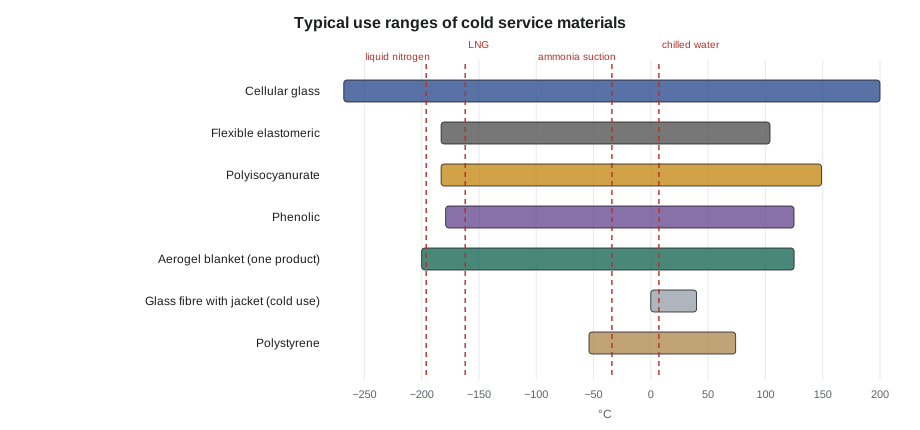
Comparing materials of different conductivity
Specifications sometimes allow a choice of materials, or an insulator proposes an alternative where space is tight. The materials are not interchangeable at the same thickness: a lower-conductivity material needs less thickness for the same thermal resistance. On flat surfaces, thermal resistance is thickness divided by conductivity, so equal resistance means the thickness is in proportion to the conductivity.
Worked problem
Equal thermal resistance with different materials
A specification calls for 76 mm of cellular glass on a flat vessel surface. Using typical mean-temperature conductivities of 0.040 W/m·K for cellular glass, 0.024 for PIR, 0.036 for elastomeric and 0.017 for aerogel blanket, what thickness of each alternative gives the same thermal resistance?
Show solution
- Required thickness = 76 × (k of alternative ÷ k of cellular glass).
- PIR: 76 × 0.024 ÷ 0.040 = 45.6 mm.
- Elastomeric: 76 × 0.036 ÷ 0.040 = 68.4 mm.
- Aerogel blanket: 76 × 0.017 ÷ 0.040 = 32.3 mm.
Answer: About 46 mm of PIR, 68 mm of elastomeric or 32 mm of aerogel blanket match 76 mm of cellular glass on a flat surface; real products come in set thicknesses, so the next size up would be used.
On pipe the comparison is not exactly proportional, because the outer layers of insulation have more area than the inner ones, and a thinner material also has a smaller outer surface. The simple ratio is a good first check; the equivalent thickness for pipe should be worked out with the method in INS-410 or a calculation program, and any substitution must be approved by the engineer. Thermal resistance is also not the only property: a thinner material is no substitute if it lacks the vapour resistance, strength or fire rating the job needs.
Matching material to service
Marcel finished with his own rules of thumb, which match many specifications Coldstream works to, though each job's specification governs.
- Chilled water in conditioned buildings: glass fibre with a sealed vapour retarder jacket, elastomeric, or PIR with a vapour retarder jacket, with PVC fitting covers and inserts at supports.
- Chilled water in humid or unconditioned spaces and outdoors: closed-cell materials, cellular glass, elastomeric or PIR, with a sealed vapour retarder and a protective metal or PVC jacket.
- Refrigerant lines in buildings: elastomeric tube or sheet, bonded and protected.
- Brine, glycol and ammonia in plants and rinks: cellular glass or PIR in multiple layers, sealed joints, vapour retarder mastic or jacket, and a protective jacket. Kellerton's plant standard calls for cellular glass with a stainless steel jacket on all ammonia suction lines.
- Freezers and low-temperature lines: cellular glass or PIR in two or three layers, contraction joints where needed, inserts at supports and an excellent vapour retarder.
- Cryogenic lines: cellular glass, PIR or PUR systems designed for the service, aerogel blankets, or factory vacuum-jacketed pipe, with special attention to contraction and vapour sealing (lesson 8).
Receiving and storing cold materials
Cold-service materials are only as good as their condition when installed. Check deliveries against the specification: material, grade, size, thickness and facing. The Kellerton outage showed why; the cellular glass for the suction line repair arrived for NPS 3 pipe instead of NPS 4, and it was caught on the Monday only because the crew checked. Store materials indoors or covered, off the ground and away from sunlight, which degrades foam surfaces. Keep adhesives and sealants within the temperature range on their labels; most will not cure properly if they freeze or are applied below their minimum temperature. Handle cellular glass so it does not crack, and keep elastomeric away from solvents. Any material that has been wet goes back, not onto a cold line.
Common mistakes
MistakeSubstituting a material at the same thickness because it is "also insulation".
InsteadMatch thermal resistance using conductivities, and get the engineer's approval for any substitution.
MistakeUsing glass fibre on a line below freezing.
InsteadUse closed-cell materials with a sealed vapour retarder below freezing.
MistakeForcing cellular glass onto a pipe or loading it at a point.
InsteadFit it carefully; it is rigid and cracks; use inserts at supports.
MistakeStretching elastomeric sheet to close a seam.
InsteadCut it to the measured size and bond the seam under slight compression.
MistakeLeaving foam insulation unprotected outdoors.
InsteadProtect it with a jacket or coating against sunlight and weather.
Summary and key terms
- Cold materials are chosen for temperature range, conductivity at the mean temperature, vapour and water resistance, strength, stability, fire performance and compatibility.
- Cellular glass is impermeable, non-combustible and strong but rigid; its joints must be sealed.
- Flexible elastomeric foam is closed-cell and easy to fit; seams must be bonded and it must be protected outdoors.
- PIR, PUR and phenolic foams have very low conductivity but need a separate vapour retarder and contraction joints.
- Aerogel blankets are thin and very low in conductivity, with laminated retarders for cold and cryogenic use.
- Glass fibre with a sealed jacket suits chilled water in buildings but not systems below freezing.
- Equal thermal resistance means thickness in proportion to conductivity on flat surfaces; pipe needs a proper calculation and approval.
- Cellular glass
- A rigid, closed-cell insulation made by foaming glass; impermeable to water vapour (ASTM C552).
- Flexible elastomeric foam
- A closed-cell rubber-based insulation in tube and sheet form (ASTM C534).
- Polyisocyanurate
- A rigid closed-cell foam plastic insulation with low conductivity (ASTM C591).
- Phenolic foam
- A rigid foam insulation with low conductivity and low smoke (ASTM C1126).
- Aerogel blanket
- A thin, flexible fibre blanket filled with silica aerogel, with very low conductivity.
- All-service jacket
- A factory-applied paper, foil and scrim jacket on fibrous pipe insulation, often with a self-sealing lap.
- Anti-abrasive bore coating
- A coating on the inner surface of cellular glass that resists wear against the pipe.
- Mean temperature
- The average of the inner and outer temperatures of an insulation layer, at which its conductivity is taken.
Practice problems
Work each problem on paper first, then reveal the answer to check.
Why is the conductivity at the mean temperature used?
Show answer
Conductivity changes with temperature; the mean temperature gives the value that fits the whole layer.
A specification calls for 50 mm of elastomeric at k 0.036. What thickness of PIR at k 0.024 gives the same flat-surface resistance?
Show answer
50 × 0.024 ÷ 0.036 = 33 mm, so the next size up.
Why must cellular glass joints be sealed if the material is impermeable?
Show answer
The material is tight, but vapour and air pass freely through the joints between pieces.
Which material is normally used under ice-rink slabs?
Show answer
Extruded polystyrene board.
Name two reasons fibrous insulation is not used below freezing.
Show answer
It passes vapour freely and soaks up and wicks water, so any breach spreads moisture that then freezes.
Lesson quiz · 5 questions
Score 60% or more to complete this lesson.
Create a free account to save your progress, take quizzes and earn a certificate.