
INS-320 · Lesson 6 of 12 · 22 min
Chilled water and refrigeration piping
▶ Video coming soon A video version of this lesson is on the way.
Devon's first two months at Coldstream gave him both ends of this lesson. At Mountview Hospital he insulated chilled water mains and branches in the ceilings and the penthouse, a building system at about 7 °C where a single untaped joint means a stained ceiling tile. Then, in the first week of November, he spent two days in the Kellerton Foods engine room, where the ammonia suction lines run at about −34 °C and the plant's orientation began with the ammonia alarm, the muster points and the escape route. "Same rules, different stakes," Marcel told him on the scissor lift. "On chilled water, a mistake costs a ceiling. In here, if you damage the wrong thing, it can cost a lot more."
This lesson covers the two main families of cold piping an insulator meets: chilled water and other secondary coolants such as glycol and brine, and refrigerant piping, from small copper refrigerant lines in buildings to the steel ammonia and carbon dioxide piping of industrial plants. It explains which lines are cold and need insulation, how each is insulated, and what an insulator must know about working safely around refrigeration systems.
Chilled water systems
A chilled water system uses a chiller to cool water, typically to about 6 to 7 °C (43 to 45 °F), and pumps it through piping to air handlers, fan coils and process equipment, where it picks up heat and returns several degrees warmer, often around 12 to 13 °C (54 to 55 °F). Both the supply and the return are usually below the dew point of the spaces they pass through, so both are insulated with a vapour retarder. Where the water must not freeze, for example in outdoor piping or process systems, a solution of glycol and water is used instead, and it may run below freezing.
Insulation on chilled water piping has two jobs: limiting heat gain, which energy codes require, and preventing condensation, which the specification requires. The energy codes set minimum insulation thicknesses for chilled water piping by pipe size and fluid temperature. In Ontario, the Building Code's energy efficiency requirements (Supplementary Standard SB-10) allow compliance through recognized energy standards such as ASHRAE 90.1 and the National Energy Code of Canada for Buildings, which contain those tables. Thickness to prevent condensation depends on the space's design conditions and may be greater. The engineer chooses the larger of the two, and the specification states it.
Mountview's schedule is typical: 25 mm (1 in) on chilled water up to NPS 1 1/4 and 38 mm (1 1/2 in) on larger sizes, with glass fibre and a sealed all-service jacket in the ceilings, PVC fitting covers over insulated fittings, inserts at the hangers, vapour stops about every 3 m (10 ft), and elastomeric with a PVC jacket on the penthouse equipment. Devon also learned there that the chilled water lines that cause the most trouble are not the big mains but the small ones: the branch to a fan coil, the coil connections, the drain from a cooling coil's pan, the stub of an air vent or a pressure gauge. Each has fittings, each is easy to skip, and each will drip.
Condenser water, which carries heat from the chiller to a cooling tower, runs warmer than the room and is not usually insulated indoors, except where it must be protected from freezing outdoors. Condensate drains from cooling coils carry cold water and are often insulated to stop them sweating, as specifications require.
Refrigerant piping in buildings
Split air conditioners, heat pumps, variable refrigerant flow systems and walk-in coolers have copper refrigerant lines running between an outdoor unit and indoor units. Copper refrigerant tube is sized by its actual outside diameter, which differs from the nominal size of copper water tube, so insulation must be ordered for the tube's real outside diameter (INS-130). The lines are:
- The suction line, the larger line, carrying cold refrigerant vapour back to the compressor. It is cold in cooling mode and is always insulated.
- The liquid line, the smaller line, carrying warm liquid from the condenser to the expansion device. In simple cooling-only systems it is often not insulated; in heat pumps and many variable refrigerant flow systems both lines are insulated, because the roles switch and the lines can be hot or cold depending on the mode.
Refrigerant lines are usually insulated with flexible elastomeric tube, slipped on before the joints are brazed or slit and bonded after, with every butt joint and seam bonded and fittings covered with mitred tube or sheet. On heat pump lines, the hot gas in heating mode can be well above the room, so the elastomeric grade must be rated for the highest temperature the line reaches. Outdoors, elastomeric must be protected from sunlight with the maker's coating or a jacket, and the lines are often run in a cover. Where lines pass through walls and roofs, the insulation must be continuous through the opening and the opening sealed, or the line will drip inside the wall.
How a refrigeration plant works
Industrial refrigeration plants, like the one at Kellerton or at an ice arena, use the same basic cycle as a home refrigerator, at a much larger scale:
- The compressor draws in cold, low-pressure refrigerant vapour and compresses it to a high pressure, which makes it hot.
- The condenser removes heat from the hot gas, usually with an evaporative condenser on the roof or a water-cooled condenser, and the refrigerant condenses to a warm, high-pressure liquid, collected in a receiver.
- An expansion device drops the liquid's pressure, and with it its temperature, so it boils at a low temperature.
- In the evaporators, such as freezer coils, chillers and rink chillers, the cold liquid boils as it absorbs heat from the product, the room or the brine.
- The cold vapour returns through the suction lines to the compressor.
Large plants add vessels and lines to this cycle. A low-pressure receiver or recirculator holds cold liquid, which pumps send to the evaporators; the mixture of vapour and liquid that comes back is called wet suction. Two-stage plants for low temperatures add an intercooler between compressor stages. Hot gas defrost lines carry hot vapour to evaporators to melt their frost. Each line runs at its own temperature, and the insulation schedule follows.
| Line or vessel | Typical condition | Insulation |
|---|---|---|
| Low-temperature suction and wet suction return | Cold vapour or vapour and liquid, −30 to −45 °C (−22 to −49 °F) | Yes, cold insulation with vapour retarder |
| Pumped liquid to evaporators | Cold liquid | Yes, cold insulation |
| Low-pressure receivers, recirculators, accumulators, intercoolers | Cold vessels | Yes, cold insulation on shell, heads and nozzles |
| High-stage suction (two-stage plants) | Cold, warmer than low stage | Yes, cold insulation |
| High-pressure liquid from the receiver | Warm liquid, near room temperature | Usually no, unless specified |
| Compressor discharge and hot gas defrost | Hot gas | No cold insulation; personnel protection where specified |
| Condenser water and evaporative condenser piping | Warm | Usually no |
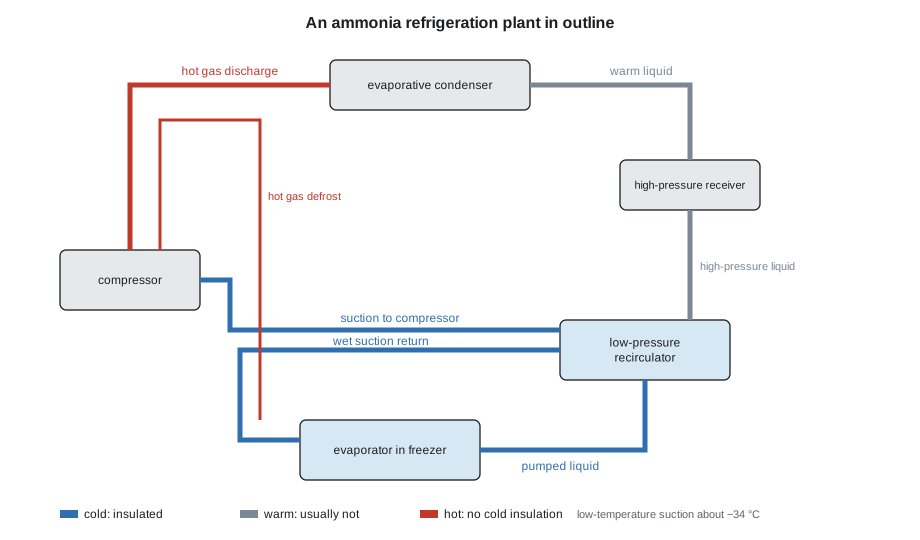
Insulating industrial refrigeration piping
Industrial refrigerant piping is welded steel, usually carbon steel and sometimes stainless, and is insulated with closed-cell rigid materials, mostly cellular glass or PIR, in one or more layers, with sealed joints, a vapour retarder of mastic and fabric or a factory jacket, vapour stops and a protective metal or PVC jacket. Kellerton's plant standard is cellular glass with a stainless steel jacket on all ammonia suction lines. Two points matter more on refrigeration than on chilled water:
- Valves, controls and instruments must stay usable. Refrigeration lines have many valves, strainers, control valves, solenoids and pressure taps. Operators must be able to reach and read them. Valve bonnets and actuators are usually left out of fixed insulation and covered with removable, sealed covers, or insulated so the stems and handwheels stay free.
- Labels must stay visible. Ammonia piping is marked with labels showing the refrigerant, the line's service, its pressure level and the direction of flow, following IIAR guidance for identifying ammonia piping. Labels on the old jacket that must be removed are recorded and replaced on the new jacket in the same places, and new insulation must never cover existing labels, valve tags or signs.
Worked problem
Heat gain and dew point on the Kellerton suction line
The Kellerton suction line is NPS 4 (outside radius 57.15 mm) at −34 °C, insulated with 51 mm of cellular glass, so the outer radius is 108.15 mm. Using k = 0.034 W/m·K and a surface film coefficient of 8 W/m²·K, find the heat gain per metre and the jacket surface temperature in a 25 °C engine room. Is the surface above the dew point at 60 and at 80 in 100 RH?
Show solution
- For a cylinder, the insulation resistance per metre is ln(r₂ ÷ r₁) ÷ (2π × k) = ln(108.15 ÷ 57.15) ÷ (2π × 0.034) = 0.6379 ÷ 0.2136 = 2.986.
- The surface film resistance per metre is 1 ÷ (h × 2π × r₂) = 1 ÷ (8 × 2π × 0.10815) = 1 ÷ 5.436 = 0.184.
- Heat gain = (25 − (−34)) ÷ (2.986 + 0.184) = 59 ÷ 3.170 = 18.6 W per metre.
- Surface temperature = 25 − 18.6 × 0.184 = 25 − 3.4 = 21.6 °C.
- Dew point at 25 °C and 60 in 100 = 16.7 °C: margin 4.9 °C, safe. At 80 in 100 = 21.3 °C: margin 0.3 °C, so the jacket would be on the edge of sweating.
Answer: About 18.6 W/m of heat gain and a surface at 21.6 °C, safe on a normal day but marginal if the engine room becomes humid.
This is why Kellerton's newer low-temperature lines are insulated thicker than the old ones, and why plant engineers watch humidity in engine rooms: a summer day with the dock doors open can push a marginal system over the edge. INS-410 covers the design method for choosing thickness against condensation.
Carbon dioxide systems
Carbon dioxide (CO₂, refrigerant R-744) is increasingly used in supermarkets, food plants and newer ice rinks, either alone or as the cold stage of a system with ammonia on the warm side. Its low-temperature lines can run colder than ammonia, down to about −50 °C (−58 °F) in some systems, and the insulation follows the same principles. CO₂ systems run at much higher pressures than ammonia systems, so their piping, valves and relief devices are heavier and must be left accessible; and in some systems the hot discharge lines are much hotter than in ammonia plants. CO₂ is not toxic in the way ammonia is, but it displaces oxygen in enclosed spaces at high concentration, so CO₂ machinery rooms have their own detection and ventilation.
Working safely around ammonia
Ammonia (refrigerant R-717) is an efficient refrigerant used in most large industrial plants and many ice rinks. It is a colourless gas with a sharp, suffocating smell that most people notice at concentrations far below harmful levels. It boils at about −33 °C (−28 °F) at atmospheric pressure, is lighter than air, and is toxic and corrosive to the eyes, skin and lungs; liquid ammonia also causes cold burns. It can burn in air at high concentrations, roughly 15 to 28 in 100 by volume. NIOSH recommends exposure limits of 25 ppm averaged over a work shift and 35 ppm for short exposures, and lists 300 ppm as immediately dangerous to life or health. Ontario's occupational exposure limits for ammonia are 25 ppm as an eight-hour average and 35 ppm for short-term exposure.
Insulators do not work on the refrigeration system itself, but they work on and around its piping, so they follow the plant's rules. At Kellerton, and at most plants, those include:
- Orientation first. Every contractor completes the plant's orientation: the ammonia alarm and what it sounds like, escape routes, muster points, wind direction for outdoor muster, eyewash and shower locations, and who to call.
- Permits and the plant's refrigeration staff. Work on or near refrigeration piping needs the plant's permit, and the plant's refrigeration technician confirms which lines are live, which are isolated, and what may be touched.
- Hands off the system. Insulators never open, close or adjust valves, never stand on, hang from or lean ladders against refrigeration piping, and never cut or pry insulation off a valve, flange or control without the plant's approval, because a leaking valve may be under it.
- Report any smell at once. An ammonia smell, a hiss or frost where there should not be any is reported immediately to the plant, and the crew follows the plant's instruction, which may be to leave the area upwind.
- Escape respirators, where the plant requires them, are carried and their use is understood.
- Machinery room rules. Ammonia machinery rooms have detectors, alarms, emergency ventilation and controlled entry. Follow the posted rules and never prop doors that are meant to stay closed.
The design and safety of refrigeration systems are governed by CSA B52, the Mechanical Refrigeration Code, whose 2023 edition the TSSA adopted in Ontario effective October 1, 2024; refrigeration plants above a set size are also registered with the TSSA and must be operated by certified operators under Ontario's regulation for operating engineers. These are the owner's and the refrigeration contractor's responsibility; the insulator's part is to respect the plant's procedures and to leave the system as accessible, labelled and inspectable as it was found.
Common mistakes
MistakeInsulating over valve bonnets, controls and labels on a refrigeration line.
InsteadLeave them usable and visible; use removable sealed covers and replace labels on the new jacket.
MistakeLeaving small chilled water branches, drains and gauge connections uninsulated.
InsteadInsulate and seal every cold connection; small details drip first.
MistakeOrdering pipe-size insulation for copper refrigerant tube.
InsteadOrder insulation for the tube's actual outside diameter.
MistakeUsing an elastomeric grade on heat pump lines without checking the hot gas temperature.
InsteadUse a grade rated for the highest temperature the line reaches.
MistakeOpening insulation on a valve in an ammonia plant without the plant's approval.
InsteadGet the permit and the plant technician's confirmation first; never touch the system.
Summary and key terms
- Chilled water supply and return are both cold and need insulation with a sealed vapour retarder; glycol and brine may run below freezing.
- Energy codes set minimum thickness for heat gain; condensation control may need more, and the engineer specifies the larger.
- Building refrigerant suction lines are always insulated; heat pump and variable refrigerant flow lines usually have both lines insulated.
- In industrial plants, suction, wet suction, pumped liquid and low-pressure vessels are cold; high-pressure liquid, discharge and hot gas are not cold-insulated.
- Valves, controls, instruments and labels on refrigeration lines must stay usable and visible.
- CO₂ systems use the same insulation principles but run at higher pressures and sometimes colder.
- Around ammonia, insulators follow the plant's orientation, permits and alarms, never touch the system and report any smell at once.
- Chilled water
- Water cooled by a chiller and pumped through a building or process to absorb heat.
- Glycol
- An antifreeze mixed with water so a cooling loop can run below freezing.
- Suction line
- The refrigerant line carrying cold vapour from an evaporator back to the compressor.
- Liquid line
- The refrigerant line carrying liquid from the condenser or receiver toward the expansion device.
- Evaporator
- The heat exchanger in which cold refrigerant boils as it absorbs heat.
- Recirculator
- A low-pressure vessel holding cold refrigerant liquid that is pumped to the evaporators.
- Wet suction
- The cold mixture of vapour and liquid returning from pumped evaporators.
- Hot gas defrost
- Hot refrigerant vapour sent to an evaporator to melt its frost.
Practice problems
Work each problem on paper first, then reveal the answer to check.
Why are both the supply and return of a chilled water system insulated?
Show answer
Both are usually below the dew point of the spaces they pass through.
On a heat pump lineset, why are both lines usually insulated?
Show answer
The lines switch roles between modes, so either can be cold or hot.
Is the high-pressure liquid line from an ammonia receiver normally cold-insulated?
Show answer
No; it carries warm liquid near room temperature, unless the specification says otherwise.
At 25 °C and 70 in 100 RH (dew point 19.1 °C), is a jacket at 21.6 °C safe?
Show answer
It is 2.5 °C above the dew point, which is just within a typical margin.
You smell ammonia while working in a plant. What do you do?
Show answer
Stop, report it to the plant at once and follow the plant's instruction, which may be to leave the area upwind.
Lesson quiz · 5 questions
Score 60% or more to complete this lesson.
Create a free account to save your progress, take quizzes and earn a certificate.