
INS-210 · Lesson 10 of 12 · 23 min
Insulating cold fittings without gaps
▶ Video coming soon A video version of this lesson is on the way.
Marcel showed Devon the problem on a chilled water valve in the Mountview penthouse that another contractor had insulated two years earlier on the hospital's original building, across the roof. The valve's bonnet had a neat PVC cover, but the cover stopped short of the stem, and the gap around the stem was stuffed with loose glass fibre. In the summer, Hollis Brandt told them, the stuffing had been wet every day, and the water had run down inside the cover and out along the pipe until the ceiling tile under it stained. "On hot work, a gap costs heat," Marcel said. "On cold work, a gap costs the whole job."
Cold systems, such as chilled water, refrigeration, cold domestic water in humid spaces and process cooling, fail in a different way from hot ones. Water vapour in the air moves toward the cold pipe, condenses on any surface below its dew point, soaks the insulation and, on lines below freezing, turns to ice. INS-130 explained vapour drive, dew point and the need for a continuous vapour retarder on straight pipe, and INS-320 will cover refrigeration and cryogenic systems in depth. This lesson is about the fittings, where cold insulation most often fails: how to build cold fitting insulation with no voids, no gaps and a vapour retarder that is continuous from the pipe on one side to the pipe on the other.
Why cold fittings fail
On straight pipe, the vapour retarder is a factory jacket with one sealed seam and a sealed butt joint every section. On a fitting, there are many more joints in a small space: between pieces of insulation, between the fitting insulation and the pipe insulation, around stems, at removable covers and under bands and fasteners. Every one of them is a possible leak. Vapour that gets through a leak finds the coldest surface it can reach, which is the metal of the fitting, and condenses there. Once water is inside, it spreads: fibrous insulation wicks it along the pipe, and on refrigeration lines it freezes, expands and breaks the insulation from the inside.
A second cause of failure is thin insulation. Fittings are irregular, and it is tempting to squeeze less insulation onto a valve body or a flange than onto the pipe. On cold work, the outside of thin insulation can be below the dew point of the room, and then the surface of the insulation itself sweats.
Worked problem
How thin is too thin?
The Mountview penthouse is designed for summer air at 27 °C and 70 in 100 relative humidity, a dew point of about 21 °C. Chilled water is at 7 °C. A heat transfer calculation for NPS 2 pipe with glass fibre insulation gives these approximate surface temperatures: 38 mm thick, 25.5 °C; 12 mm, 22.3 °C; 6 mm, 19.0 °C. Where would the surface sweat?
Show solution
- Compare each surface temperature with the 21 °C dew point.
- 38 mm: 25.5 − 21 = 4.5 °C above the dew point. No condensation.
- 12 mm: 22.3 − 21 = 1.3 °C above. Dry on a design day, but with almost no margin for a more humid day or a damaged jacket.
- 6 mm: 19.0 °C, which is 2 °C below the dew point. The surface sweats.
Answer: Where a valve body squeezes the insulation down to 6 mm, the outside of the insulation will sweat even with a perfect vapour retarder. Full thickness everywhere is the first rule of cold fittings. If a fitting is so close to a wall or another pipe that full thickness will not fit, report it; do not squeeze.
Materials for cold fittings
The materials used on cold fittings are the same as on the pipe they are part of, chosen as INS-120 described:
- Glass fibre with a factory vapour retarder jacket: common on commercial chilled water above about 4 °C (40 °F). The fibre itself does not stop vapour, so the vapour retarder on the fitting must be perfect: PVC covers sealed at every seam and end, or vapour retarder mastic and fabric.
- Flexible elastomeric: common on chilled water, refrigerant lines and cold domestic water. The closed-cell material is its own vapour retarder in moderate conditions, as long as every seam and joint is glued with the maker's adhesive. Preformed elastomeric fittings and sheet gores make elbows and tees.
- Cellular glass: used on low-temperature and refrigeration work and anywhere a rigid, impermeable insulation is needed. Fittings are fabricated from block or covering, every joint is sealed with a joint sealant as it is assembled, and the outside is finished with vapour retarder mastic and fabric or a jacket.
- Polyisocyanurate and similar foams: used on chilled water and refrigeration, fabricated into fittings in the shop, with sealed joints and a vapour retarder jacket or mastic.
Whatever the material, the fitting insulation must be the same thickness as the pipe insulation, and the materials must be compatible: the joint sealant, the adhesive, the mastic and the tape must all be ones the insulation maker approves for that product and that temperature.
No voids
A void is an air space inside the insulation, around the fitting, where the insulation does not touch the metal. On hot work, a void costs a little heat. On cold work, a void is a small room full of air that will cool to the temperature of the fitting, and if any vapour reaches it, it fills with water. Cold fitting insulation must be built tight to the metal:
- Cut pieces to the shape of the fitting, so they meet the metal and each other with no gaps.
- Fill irregular spaces, such as the crotch of a valve body between the bonnet and the flanges, with pieces of the same insulation cut to fit, or with an insulation filler the maker approves for cold service; never with loose stuffing that leaves air spaces.
- On cellular glass and other rigid fittings, butter every joint with the specified joint sealant as the pieces are assembled, so the joint is filled through its full depth, not just sealed at the surface.
- On elastomeric fittings, coat both faces of every joint with adhesive, let it tack and press the joint closed along its full length.
A continuous vapour retarder
The vapour retarder on a cold fitting must join the vapour retarder on the pipe on each side with no gaps, and it must be sealed wherever anything passes through it. Methods depend on the finish:
- PVC covers: seal every seam and both ends with PVC adhesive or vapour retarder tape, lapping onto the pipe jacket. On a valve, seal around the bonnet or stem at the top of the cover.
- Mastic and fabric: apply vapour retarder mastic in two coats with reinforcing fabric between, at the specified wet thickness, overlapping the pipe jacket by at least 50 mm (2 in) on each side and sealing the end of the jacket under the mastic.
- Elastomeric: the glued joints are the vapour retarder; where the line runs in a humid space or outdoors, the specification may call for a coating or jacket over it as well.
- Jacketing over a vapour retarder: metal or PVC jackets over cold fittings protect the vapour retarder but are not themselves the vapour retarder. Never screw or rivet a jacket through the vapour retarder underneath; use bands.
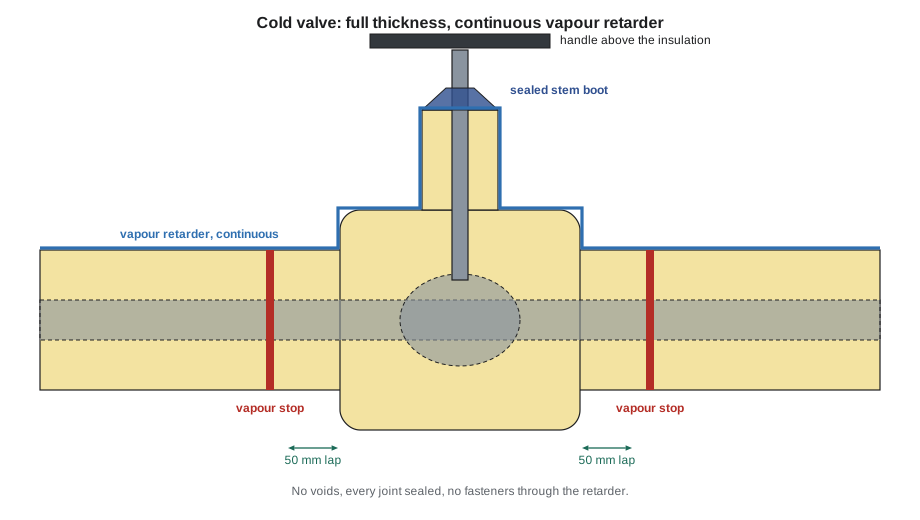
Stems, operators and removable covers
The hardest places to seal on a cold fitting are where something moves or must be reached. Valve stems turn; handles must be clear; strainer caps, flanges and some valves must be opened. Each needs a detail that can be sealed and, where it will be opened, resealed:
- Stems: carry the insulation up the stem extension to just below the operator, and seal it to the extension with a flexible sealant or a preformed boot, so the stem can turn without breaking the seal.
- Valves without extended stems: report them before insulating, as lesson 5 explained.
- Removable sections on cold fittings, such as strainer caps and flanges: make them with their own complete vapour retarder, and seal the joint between the removable section and the permanent insulation with a tape or gasket that can be resealed. Mark them so maintenance knows they must be resealed.
- Removable covers made for cold service: some makers supply cold-service valve and flange covers with sealed outer skins and closures designed to be resealed. Use them where the specification calls for them, and install them exactly as the maker says.
Every removable cold section is a promise that someone will reseal it after maintenance. Coldstream tags them with a label that reads "cold service: reseal after opening", and the Mountview specification requires the same label.
Vapour stops
However well a cold system is built, some day a jacket will be damaged or a seal will fail. A vapour stop limits the damage. It is a seal between the insulation and the pipe, made by coating the end of a section of insulation and the pipe surface with vapour retarder mastic or sealant, so vapour and water that get in at one place cannot travel along the pipe under the insulation. On cold systems, vapour stops are usually required on each side of valves, flanges and other fittings that may be opened, at the ends of the insulation, at penetrations and at intervals along straight runs. The spacing on straight runs is set by the specification; for cellular glass and other rigid cold systems, it is often every few metres.
Worked problem
Counting vapour stops
A 30 m run of NPS 6 chilled water in the Mountview penthouse has four items that may be opened: two isolation valves, a balancing valve and a strainer, at 4 m, 9 m, 18 m and 26 m from the start of the run. The specification calls for vapour stops on each side of every such item and at no more than 6 m apart on straight pipe. How many vapour stops are needed between the start and the end of the run?
Show solution
- Two stops at each item: 4 × 2 = 8.
- Straight lengths between items: 0 to 4 m (4 m), 4 to 9 m (5 m), 9 to 18 m (9 m), 18 to 26 m (8 m), 26 to 30 m (4 m).
- Lengths over 6 m need one extra stop in the middle: 9 to 18 m and 18 to 26 m, so 2 more.
- Total: 8 + 2 = 10.
Answer: Ten vapour stops, not counting any at the ends of the run, where the specification calls for stops wherever the insulation ends. Marcel has Devon mark each one on the pipe with a felt marker before the insulation goes on, so none is missed.
Hangers, supports and other penetrations
INS-130 showed that on cold lines, no metal may pass through the insulation from the cold pipe to the outside, and that hangers sit on insulated inserts with shields outside. Near fittings, the same rule applies to every penetration: hanger rods, clamps, instrument tubing, thermometer wells, heat-trace leads and support steel. Where something passes through the vapour retarder, seal around it with mastic and fabric or a sealant boot, and insulate along it far enough that its outer end does not sweat, as the specification requires. A thermometer well on chilled water, for example, needs its insulation sealed to the well and its head clear above the insulation.
Working conditions for cold sealing
Adhesives, sealants and mastics for cold work have minimum application temperatures and need dry surfaces. In practice, that means:
- Install and seal cold fitting insulation while the line is warm, before the chilled water or refrigeration is started, wherever the schedule allows. Sealing a fitting that is already sweating traps the water inside.
- If a line must be insulated while cold, dry the surface and keep it dry while working, and use only products made for application to cold surfaces.
- Seal each fitting the day it is insulated. A cold fitting left unsealed overnight collects moisture.
- Check the products' temperature ranges against the room, especially in unheated buildings in winter.
Common mistakes
MistakeStuffing loose insulation into the gap around a cold valve stem.
InsteadCarry full-thickness insulation up the stem extension and seal it with a flexible sealant or boot.
MistakeSqueezing thin insulation onto a cold valve body.
InsteadUse full thickness everywhere; report fittings where it will not fit.
MistakeLeaving voids inside cold fitting insulation.
InsteadCut pieces tight to the metal and fill irregular spaces with the same insulation.
MistakeSealing joints only at the surface on cellular glass.
InsteadButter every joint with sealant through its full depth as the pieces are assembled.
MistakeLeaving out vapour stops at fittings that will be opened.
InsteadInstall vapour stops on each side of every such fitting and at the specified spacing.
MistakeSealing a cold fitting that is already wet.
InsteadInsulate and seal before the system runs cold, or dry the surface first.
Summary and key terms
- Cold fittings fail when vapour reaches cold metal through a gap or when thin insulation lets the surface fall below the dew point.
- Fitting insulation on cold work must be full thickness, with no voids, and every joint filled and sealed.
- The vapour retarder must be continuous from the pipe jacket on one side to the other, lapped at least 50 mm (2 in), and never pierced by fasteners.
- Stems are sealed with flexible sealant or boots; removable cold sections must have their own vapour retarder and be resealed after opening.
- Vapour stops on each side of fittings and at intervals along the pipe limit damage from any leak.
- Penetrations are sealed, and cold fittings are best insulated and sealed before the system runs cold.
- Dew point
- The temperature at which water vapour in the air begins to condense on a surface.
- Void
- An air space inside insulation, where the insulation does not touch the metal or itself.
- Joint sealant
- A sealant applied to the joints of rigid cold insulation as it is assembled.
- Vapour stop
- A seal between the insulation and the pipe that stops vapour and water from travelling along the pipe.
- Stem boot
- A flexible seal around a valve stem extension that keeps the vapour retarder closed.
- Vapour retarder
- A layer or coating with very low permeance that slows the movement of water vapour.
Practice problems
Work each problem on paper first, then reveal the answer to check.
Why is a void more serious on cold work than on hot work?
Show answer
It cools to the fitting temperature and fills with water if any vapour reaches it.
The dew point is 21 °C and a thin spot on a fitting has a surface at 20 °C. What happens?
Show answer
The surface sweats, because it is below the dew point.
A 14 m straight length needs vapour stops at no more than 6 m apart. How many stops are needed between its ends?
Show answer
Two, dividing it into three lengths of under 6 m.
How is a valve stem sealed on cold service?
Show answer
Insulation carried up the extension and sealed with a flexible sealant or a boot.
When is the best time to insulate and seal cold fittings?
Show answer
Before the system runs cold, while surfaces are warm and dry.
Lesson quiz · 5 questions
Score 60% or more to complete this lesson.
Create a free account to save your progress, take quizzes and earn a certificate.