
INS-130 · Lesson 9 of 12 · 25 min
Insulating hot water and heating piping
▶ Video coming soon A video version of this lesson is on the way.
In INS-110, Devon learned what it feels like when a line warms up under your hands. The mechanical contractor at Mountview had started the medium-pressure steam to the sterilizer room without telling the insulation crew, and the pipe Devon was working beside went from cold to too hot to touch in a few minutes. Nobody was hurt, and the site adopted a sign-off rule for start-ups. Three weeks later, the heating water mains on the second and third floors were filled and started properly, with Bernie's signature on the sheet, and Devon got to see what insulation on a hot system is supposed to do.
Hot systems are the classic insulation job. Insulation on heating water, steam and condensate piping saves energy, keeps the fluid at the temperature the system needs and keeps surfaces safe to touch. This lesson covers the hot services found in commercial buildings, the materials and thicknesses commonly used on them, how to work around movement from thermal expansion, and the safety points that come with insulating hot piping.
Hot services in commercial buildings
Most buildings like Mountview have several hot piping systems:
- Heating hot water (HHW), in supply and return pairs, from boilers or heat exchangers to coils, radiators, fan coils and reheat coils. Conventional systems supply water at about 82 °C (180 °F); systems with condensing boilers often run cooler, at 50 to 70 °C (120 to 160 °F). Some heating systems use a glycol and water mix to prevent freezing in coils exposed to outdoor air.
- Low-pressure steam, at up to 103 kPa (15 psig), common in older buildings and for humidifiers and some heating.
- Medium- and high-pressure steam, for sterilizers, kitchens, laundries and process equipment. Hospitals often have medium-pressure steam for sterilizers; at Mountview it runs at about 415 kPa (60 psig).
- Steam condensate, the hot water that forms when steam gives up its heat, returning to the boiler plant through traps and condensate piping.
- Domestic hot water and recirculation, covered in lesson 8.
Saturated steam has a fixed temperature at each pressure, so the pressure on the drawing tells the insulator the pipe temperature:
| Steam pressure (gauge) | Saturated temperature |
|---|---|
| 103 kPa (15 psig) | 121 °C (250 °F) |
| 415 kPa (60 psig) | 153 °C (307 °F) |
| 1,035 kPa (150 psig) | 186 °C (366 °F) |
Materials and thicknesses
On commercial heating piping, the usual material is glass fibre pipe covering with ASJ and SSL, which is well within its temperature limit on heating water and low-pressure steam. On medium- and high-pressure steam, many specifications call for mineral wool or calcium silicate instead, for their higher temperature limits and toughness, with a field-applied jacket. INS-120 covered these materials and their limits. At Mountview, the specification called for glass fibre with ASJ on heating water and low-pressure condensate, and mineral wool on the medium-pressure steam, with calcium silicate inserts at all supports on steam and condensate.
The thickness depends on the fluid temperature and the pipe size. Energy codes set minimums in tables by temperature range and size, and project specifications often call for more. The insulation schedule in the Mountview specification, a typical one, read like this for the hot services:
| Service | Pipe sizes | Thickness |
|---|---|---|
| Heating hot water supply and return | Up to and including NPS 1 1/4 | 38 mm (1 1/2 in) |
| Heating hot water supply and return | NPS 1 1/2 and larger | 51 mm (2 in) |
| Low-pressure steam condensate | All sizes | 38 mm (1 1/2 in) |
| Medium-pressure steam | Up to and including NPS 3 | 51 mm (2 in) |
| Medium-pressure steam | NPS 4 and larger | 76 mm (3 in) |
| Medium-pressure condensate | All sizes | 51 mm (2 in) |
Worked problem
Reading the schedule
Devon's work list for one morning includes: an NPS 1 heating water branch to a reheat coil, an NPS 2 heating water main, an NPS 1 1/2 low-pressure condensate line and an NPS 4 medium-pressure steam line. What thickness does each get?
Show solution
- NPS 1 heating water: up to NPS 1 1/4, so 38 mm.
- NPS 2 heating water: NPS 1 1/2 and larger, so 51 mm.
- NPS 1 1/2 low-pressure condensate: all sizes, 38 mm.
- NPS 4 medium-pressure steam: NPS 4 and larger, so 76 mm.
Answer: 38, 51, 38 and 76 mm. Four lines, three thicknesses and two materials: four different cartons to check against the schedule.
Heating water branches to terminal units, such as the reheat coils above the Mountview patient rooms, end at control valves, balancing valves and flexible hose connections. Specifications usually insulate up to the coil connections and leave valve actuators, unions and test ports accessible. The heating coil itself, inside the air-handling unit or the reheat box, is not part of the pipe insulation.
Thermal expansion
Pipes grow when they are heated and shrink when they cool. The amount depends on the material, the length and the temperature change:
where α is the coefficient of thermal expansion of the pipe material. Carbon steel expands about 0.0000117 per kelvin (0.0000065 per degree Fahrenheit), and copper about 0.0000169 per kelvin (0.0000094 per degree Fahrenheit), about half as much again as steel.
Worked problem
Expansion of a heating water riser
The Mountview heating water supply riser is NPS 3 steel, 30 m tall, installed at 10 °C and operating at 82 °C. How much does it grow?
Show solution
- Temperature change: 82 − 10 = 72 K (a change of 72 °C).
- Length in millimetres: 30 m = 30,000 mm.
- Growth: 0.0000117 × 30,000 × 72 ≈ 25.3 mm.
Answer: About 25 mm. The pipefitters allow for it with anchors, guides and an expansion joint or offset; the insulators must not stop it from moving.
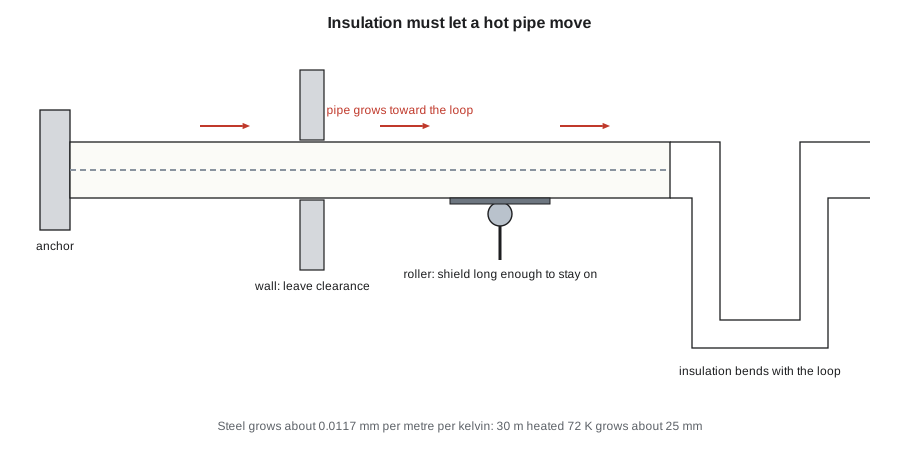
Piping systems are designed to take expansion in a controlled way. Anchors hold the pipe fixed at chosen points; guides let it slide along its length but not sideways; and expansion loops, offsets and expansion joints absorb the growth. Insulation has to let all of this happen:
- Do not pack insulation tight against walls, floors, beams or other pipes where the pipe will move. Leave the clearance the pipe needs, and finish the end of the insulation so it can slide.
- At expansion loops and offsets, the insulation bends with the pipe. Fibrous covering with an ASJ handles small movements; where the movement is large, specifications may call for flexible blanket at the bends or a slip joint in the jacket.
- At expansion joints, the joint itself is usually insulated with a removable cover so it can be inspected, with the insulation on each side stopped clear of the moving parts.
- At roller supports and guides, the shield moves with the pipe. It must be long enough, and placed so, that it stays on the roller over the full movement. Some specifications call for the shield to be offset at installation, toward the anchor, by the expected movement.
- On risers, the pipe moves up and down through the floors. Insulation at the riser clamps and through floor sleeves must allow the movement, and the firestop at each floor must be a listed system that permits it.
Worked problem
Copper hot water expansion
A 25 m run of copper domestic hot water piping is installed at 15 °C and runs at 60 °C. How much does it grow, and why does that matter at a wall penetration near the end of the run?
Show solution
- Temperature change: 60 − 15 = 45 K.
- Growth: 0.0000169 × 25,000 × 45 ≈ 19.0 mm.
- If the insulation is packed tight against the wall sleeve, the moving pipe will push it, tear the jacket and eventually pull the insulation open at a joint.
Answer: About 19 mm. Leave the insulation able to slide at the sleeve, or carry it through the sleeve if the sleeve is sized for it.
Personnel protection
Hot pipes that people can touch must be insulated, or guarded, so that the surface will not burn. INS-110 and INS-120 explained the safe-to-touch target of about 60 °C (140 °F) for short contact on metal surfaces under ASTM C1055. On commercial work, the insulation schedule usually covers this by requiring insulation on all hot piping, but there are places where the schedule is silent and the insulator should ask: short pieces of hot piping left bare at equipment connections, steam trap stations at low level, and condensate drip legs and vents near walkways. Some specifications call for personnel protection insulation, insulation applied only to keep the surface safe, on piping that would otherwise be left bare, such as hot drains and blowdown piping in boiler rooms.
Jacket choice also affects how hot a surface feels. INS-120 explained that low-emittance shiny metal jackets run hotter than painted or fabric finishes on the same pipe. On a mechanical room steam line with an aluminum jacket, the jacket surface may be warmer than the same insulation with a PVC or canvas finish.
Working on hot systems safely
On new construction, insulation normally goes on before the system is started. Even so, insulators work around hot systems all the time: lines that were started early for temporary heat, lines in occupied parts of a building, and nearly everything on maintenance and renovation work. The rules from INS-110 apply:
- Know the temperature of every line you will touch, and treat any line as hot until you know otherwise.
- On new work, follow the site's start-up sign-off rule. No system should be filled or started while the insulation crew is on it, and the foreperson should sign off that the crew is clear.
- On existing systems, ask for lines to be isolated, locked out and cooled where possible; where they cannot be, use heat-resistant gloves and sleeves, plan the work to keep hands and arms away from bare hot metal and take breaks in cool air.
- Do not use adhesives, mastics or tapes on a surface hotter than their rated temperature; some solvent-based products can flash on hot surfaces.
- Expect the binder in new fibrous insulation to burn off on the first heat-up of hot systems such as steam, with smoke and odour for a short time. Warn the mechanical contractor and the building operator, as INS-120 explained.
Valves, strainers and specialties on hot lines
Hot piping systems are full of things that are not straight pipe: isolation and control valves, strainers, steam traps, unions, flanges, balancing valves, air vents and thermometers. Each needs a decision. Some, such as steam traps and their test valves, are usually left uninsulated so they can work and be maintained. Others, such as large valve bodies and strainers on steam, are insulated with removable covers so they can be serviced. INS-210 covers these in detail. On straight-pipe work, the insulator's job is to stop the pipe covering neatly at the right point, leave the specified clearance for bolts and handles, and finish the exposed end of the insulation with a cap or a wrap of jacket so it does not unravel.
Dual-temperature and low-temperature heating systems
Some systems carry hot water in winter and chilled water in summer through the same piping. These dual-temperature systems, common in older schools and in buildings with two-pipe fan coils, are insulated as cold work: a sealed, continuous vapour retarder on every lap, joint and fitting, inserts at hangers and vapour stops at terminations, with a material rated for the hot-season temperature. A dual-temperature line insulated like heating water will soak its insulation the first summer it runs cold.
Heating systems with condensing boilers and heat pumps often run at lower supply temperatures, 35 to 50 °C (95 to 120 °F) in some systems. Low temperatures do not mean insulation matters less; they usually mean the system was designed for high efficiency, and the energy code still sets minimum thicknesses by temperature range. Glycol heating loops for coils that see outdoor air are insulated like heating water.
The medium-pressure steam at Mountview reached the sterilizer room and the air-handling unit humidifiers through mineral wool, with calcium silicate inserts at each support. On the first heat-up after insulation, as INS-120 described, the crew warned Harcourt Mechanical and the building operator about the brief smoke and odour from binder burnout, and the plant opened the louvres in the mechanical room for the afternoon.
Common mistakes
MistakeStarting work on a line without knowing whether it is hot.
InsteadCheck the start-up sheet and the line's status, and treat it as hot until confirmed.
MistakePacking insulation tight against walls and structure on a line that will move.
InsteadLeave clearance and let the insulation slide.
MistakeUsing a short shield on a roller support of a long hot run.
InsteadUse a shield long enough, and placed so, that it stays on the roller over the full movement.
MistakeApplying the heating water thickness to steam because the pipe is the same size.
InsteadRead the schedule by service and size; steam usually needs more.
MistakeCovering steam traps and their test valves.
InsteadLeave traps accessible unless the specification says otherwise.
MistakeNot warning anyone before first heat-up of new fibrous insulation.
InsteadWarn the contractor and operator about binder burnout smoke and odour.
Summary and key terms
- Commercial hot services include heating water, low- and medium-pressure steam, condensate and domestic hot water.
- Saturated steam temperature follows its pressure: about 121 °C (250 °F) at 103 kPa (15 psig) and 153 °C (307 °F) at 415 kPa (60 psig).
- Glass fibre with ASJ is usual on heating water; mineral wool or calcium silicate is common on medium- and high-pressure steam; thickness comes from the schedule by service and size.
- Pipes grow by ΔL = α × L × ΔT; copper grows about half as much again as steel.
- Insulation must let pipes move: clearances at structure, flexibility at loops, removable covers on expansion joints and long enough shields on rollers.
- Insulate or guard surfaces people can touch; low-emittance jackets run hotter.
- Follow start-up sign-off, know line temperatures and respect product temperature limits.
- Heating hot water
- Water heated in boilers or heat exchangers and circulated to heating coils and terminal units; HHW.
- Saturated steam
- Steam at the boiling temperature for its pressure.
- Condensate
- Water formed when steam gives up its heat, returned to the boiler plant.
- Coefficient of thermal expansion
- The change in length per unit length for each degree of temperature change.
- Anchor
- A support that holds a pipe fixed at a point.
- Guide
- A support that lets a pipe slide along its length but not sideways.
- Expansion loop
- A U-shaped bend in a pipe that flexes to absorb thermal expansion.
- Personnel protection insulation
- Insulation applied to keep a hot surface safe to touch.
Practice problems
Work each problem on paper first, then reveal the answer to check.
What is the temperature of saturated steam at 1,035 kPa?
Show answer
About 186 °C.
How much does 40 m of steel pipe grow from 10 °C to 150 °C?
Show answer
0.0000117 × 40,000 × 140 ≈ 65.5 mm.
Under the Mountview schedule, what thickness goes on NPS 3 medium-pressure steam?
Show answer
51 mm.
Why must shields on roller supports of hot pipe be long enough?
Show answer
The pipe and shield move with expansion and must stay on the roller.
Name two items on hot lines usually left accessible or with removable covers.
Show answer
Any two of: steam traps, valves, strainers, expansion joints, unions, test ports, balancing valves.
Lesson quiz · 5 questions
Score 60% or more to complete this lesson.
Create a free account to save your progress, take quizzes and earn a certificate.