
INS-110 · Lesson 8 of 12 · 27 min
Dust, fibres and respiratory protection
▶ Video coming soon A video version of this lesson is on the way.
Every apprentice on Bernie's crew hears the story once. Her uncle Gérard was an insulator from the 1960s to the 1990s. He mixed asbestos cement for fitting covers, sawed asbestos pipe sections and block, and swept up the dust at the end of every shift. He wore no respirator for most of those years, because nobody told him he needed one. In 2009, years after he retired, he became short of breath. Two years later he died of mesothelioma, a cancer of the lining of the chest caused almost only by asbestos. "He was the best insulator I ever saw," Bernie told Devon. "And the dust killed him forty years after he breathed it. That's why I'm the way I am about this."
Insulation work makes dust and fibres, and some of the older insulation insulators remove or work beside contains asbestos, one of the deadliest materials ever used in construction. This lesson explains the kinds of dust and fibres insulators meet, how they harm the lungs, the special rules for asbestos and silica, the ways dust is controlled and how respirators work, are chosen and are fitted. It is awareness-level training: it teaches you to recognize the hazards and protect yourself, not to remove asbestos, which is done by specially trained and, in many cases, licensed workers.
How dust and fibres harm the lungs
The lungs have good defences against large particles. Hairs and mucus in the nose and throat trap most of them, and the airways are lined with tiny hairs that sweep mucus and trapped dust up and out. Particles small enough to reach the deepest part of the lung, the air sacs where oxygen enters the blood, are called respirable. They are usually smaller than about 10 µm (micrometres; a human hair is about 50 to 100 µm thick), too small to see individually.
Fibres are particles much longer than they are wide. Thin, long fibres can travel deep into the lungs, lodge there and resist the body's attempts to clear or dissolve them. What makes a fibre dangerous is a combination of how thin and long it is, how long it stays in the lung before dissolving (its biopersistence) and how much of it is breathed in over time. Asbestos fibres are very thin, split lengthwise into even thinner fibrils and last for decades in the lung; that is why they cause disease long after exposure.
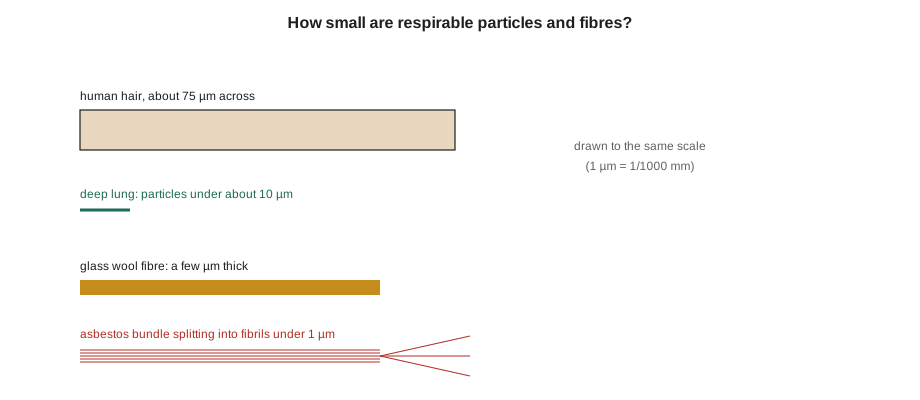
Lung diseases from dust often appear many years after the exposure, when it is too late to prevent them. That delay, called the latency period, is often 20 to 40 years for asbestos diseases and many years for silicosis. It is the main reason workers underestimate dust: nothing seems to happen.
Man-made mineral fibres
Most modern fibrous insulation is made of glass wool (fibreglass) or stone and slag wool (mineral wool). For high temperatures, insulators also use refractory ceramic fibre and newer alkaline earth silicate wools. Together these are called man-made mineral fibres or synthetic vitreous fibres.
- Glass wool and stone and slag wool are the common pipe, duct and equipment insulations. In 2001 the International Agency for Research on Cancer (IARC) reviewed them and placed them in Group 3, not classifiable as to carcinogenicity in humans, because modern fibres dissolve in the lung relatively quickly. Their main effects are temporary irritation of the skin, eyes, nose and throat.
- Refractory ceramic fibre, used for very high-temperature blankets and boards, is more biopersistent and is classified by IARC as Group 2B, possibly carcinogenic to humans. After long service at high temperature it can partly change into crystalline silica (cristobalite). It needs stricter controls, including respirators during removal.
- Alkaline earth silicate wools were developed to replace refractory ceramic fibre in many uses because they dissolve faster in the lung.
The American Conference of Governmental Industrial Hygienists recommends keeping exposure to respirable synthetic vitreous fibres to an average of no more than 1 fibre per cubic centimetre of air over a shift, and manufacturers and their industry associations publish safe work practices aimed at the same level. Good practice keeps exposure low: cut with knives rather than power saws where possible, keep material in its packaging until needed, avoid tearing and shaking product, clean up with a vacuum fitted with a high-efficiency particulate air (HEPA) filter rather than sweeping or blowing, and wear a respirator, usually a filtering facepiece rated N95 or better, for dusty tasks such as overhead work, removal of old insulation and work in confined spaces.
Silica
Crystalline silica, mainly quartz, is found in sand, stone, concrete, mortar, brick and some insulation and fireproofing products. Breathing respirable crystalline silica dust can cause silicosis, an incurable scarring of the lungs, as well as lung cancer, kidney disease and chronic obstructive lung disease. Insulators meet silica when cutting or drilling concrete and masonry for penetrations, when firestopping, when cutting some cement-based and mineral products and when removing old refractory or high-temperature insulation that has changed over years of heat.
In Ontario, the Ministry of Labour's guideline Silica on Construction Projects sets out the controls the ministry expects for silica-producing tasks, such as wet methods, local exhaust ventilation and respirators matched to the task and duration. Employers must take every precaution reasonable in the circumstances under the Occupational Health and Safety Act, and the construction regulation requires dust control and protective equipment where dust is a hazard. Exposure is normally compared with the American Conference of Governmental Industrial Hygienists' recommended limit of 0.025 mg/m³ for respirable quartz.
Insulators rarely make the dustiest silica cuts; core drilling is usually done by other trades. But they work in the same areas, and they firestop the holes others make. The rule is to know which tasks create silica dust, keep out of the dust others make and use the controls when you make it yourself.
Asbestos
Asbestos is a group of natural mineral fibres that were used in thousands of building and industrial products until the 1980s, and in some products later. Insulators used it more than almost anyone. Asbestos was found in:
- Pipe insulation: preformed sections of asbestos-containing magnesia or calcium silicate, and asbestos paper and cloth wraps.
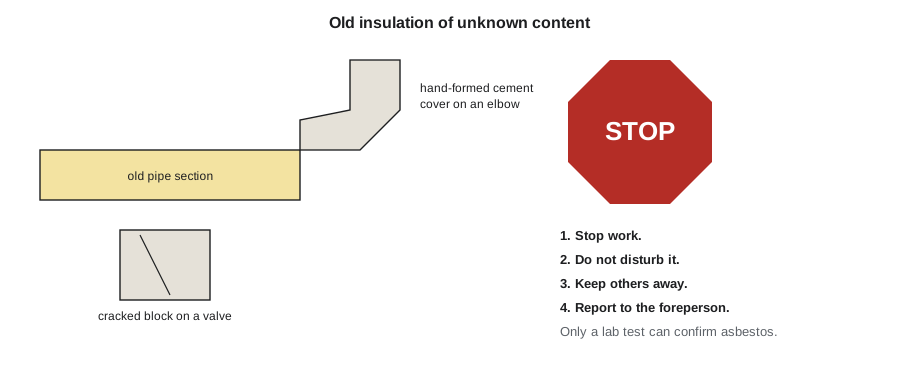
- Fitting insulation: hand-applied insulating cement, often called mud, on elbows, tees, valves and flanges, sometimes on top of non-asbestos pipe sections.
- Block insulation on boilers, tanks, breechings and ducts, and insulating cements on equipment.
- Gaskets, rope packing, cloth, tapes, mastics and coatings.
- Fireproofing, acoustic plaster, ceiling tiles, floor tiles and cement board, among many non-insulation products.
Breathing asbestos fibres can cause asbestosis (scarring of the lungs), lung cancer and mesothelioma, as well as some other cancers. There is no known safe level of exposure; risk rises with the amount breathed. Smoking multiplies the lung cancer risk from asbestos many times over.
Asbestos that is intact, sealed and left alone releases few fibres. The danger comes when it is disturbed: cut, broken, sanded, scraped, drilled or allowed to deteriorate. Friable asbestos, which can be crumbled by hand pressure, releases fibres most easily, and much old pipe and fitting insulation is friable. You cannot tell asbestos insulation by looking at it. Only laboratory analysis of a sample can confirm whether a material contains asbestos.
In Ontario, asbestos on construction projects and in buildings is controlled by the designated substance regulation for asbestos, O. Reg. 278/05. The Occupational Health and Safety Act requires the owner of a project to prepare a list of designated substances present at the project, including asbestos, and to give it to bidders before a contract is awarded; the contractor must pass it on to subcontractors. O. Reg. 278/05 sorts asbestos work into Type 1, Type 2 and Type 3 operations, from lowest to highest risk, each with its own precautions, training, respirators and enclosures. Removing more than a small area of friable asbestos-containing material is a Type 3 operation, which requires full enclosure, specially trained and certified workers and air monitoring. A material counts as asbestos-containing in Ontario if it has 0.5 per cent or more asbestos by dry weight. Ontario's occupational exposure limit for asbestos is 0.1 fibres per cubic centimetre of air.
| Rule | What it means for an insulator |
|---|---|
| Read the asbestos survey before starting | The designated substance report shows where asbestos is known; work only where the scope is clear. |
| Treat unknown old insulation as asbestos | Anything old, unlabelled and not in the survey is presumed hazardous until a sample proves otherwise. |
| Do not disturb | Do not cut, break, scrape, drill or remove suspect material, even a small piece. |
| Stop and report | Stop work in the area, keep others away and tell the foreperson immediately. |
| Leave removal to the trained | Asbestos removal is done under O. Reg. 278/05 by trained workers with the right type of operation. |
| Never take it home | Contaminated clothing and tools never leave the work area without decontamination. |
Coldstream does not do asbestos abatement. On Kellerton's boiler house job, the plant's asbestos survey identified asbestos cement on several 1960s valve and flange covers, and the owner hired a licensed abatement contractor to remove them in a sealed enclosure before Coldstream's crew started. Lesson 12 describes what happened when Devon found one that was not on the survey.
Controlling dust
Dust is controlled in the same order as every other hazard. Respirators come last, after the work itself has been made as clean as possible.
- Choose low-dust products and methods: preformed sections instead of loose fill, knife cutting instead of power sawing, pre-cut fitting covers from the shop.
- Use engineering controls: band saws and power tools with dust extraction, local exhaust ventilation in the shop and in confined spaces, wet methods where the product allows.
- Use good work practices: keep material packaged until needed, do not throw or shake insulation, cut at waist height below the face, work upwind outdoors.
- Clean up with a HEPA vacuum or wet methods. Never dry sweep dusty areas and never use compressed air to blow dust off surfaces or clothing; both put fine dust back into the air.
- Keep waste bagged and closed, and dispose of it as the site requires.
- Wash hands and face before eating, drinking or smoking, and keep food out of the work area.
Respirators: how they work
Respirators protect the wearer by cleaning the air they breathe or by supplying clean air from elsewhere. Air-purifying respirators pull air through filters or cartridges; supplied-air respirators bring breathing air through a hose or from a tank. Only respirators approved by the US National Institute for Occupational Safety and Health (NIOSH) are accepted in both Canada and the United States.
- Filtering facepiece respirators, often called dust masks or N95s, are disposable half masks made of filter material. An N95 filters at least 95 in 100 of the test particles. They are common for fibrous insulation dust.
- Elastomeric half-face respirators have a rubber or silicone facepiece and replaceable filters or cartridges. With P100 filters (the purple ones) they filter at least 99.97 in 100 of particles and resist oil mist.
- Full-face respirators also protect the eyes and fit more tightly, giving more protection.
- Powered air-purifying respirators (PAPRs) use a battery-powered fan to push filtered air into a hood or facepiece, which is cooler and easier to breathe through in hot work.
- Supplied-air respirators and self-contained breathing apparatus are used where the air is short of oxygen or the contaminant is too concentrated for filters, such as some confined spaces and emergency response.
Filters are for particles: dust, fibres, mist and fumes. Cartridges are for gases and vapours, such as solvent vapours from adhesives. A particulate filter does nothing against vapours, and a vapour cartridge does little against dust. Some cartridges combine both. Choose them from the safety data sheet and the hazard assessment.
Each type of respirator has an assigned protection factor (APF), a number that says how much it reduces exposure when it is used correctly in a proper program. A respirator with an APF of 10 should keep the concentration inside the facepiece to one-tenth of the concentration outside.
| Respirator type | Typical assigned protection factor |
|---|---|
| Filtering facepiece (for example N95) | 10 |
| Elastomeric half-face with filters | 10 |
| Loose-fitting PAPR hood | 25 |
| Full-face with filters | 50 |
| Tight-fitting full-face PAPR | 1,000 |
| Self-contained breathing apparatus, pressure-demand | 10,000 |
Worked problem
Is the respirator good enough?
An air sample taken while a pipefitter cut concrete near Devon's work area showed respirable quartz at 0.15 mg/m³, averaged over the shift. The recommended limit is 0.025 mg/m³. What minimum assigned protection factor is needed, and would a half-face respirator with P100 filters do?
Show solution
- Hazard ratio = measured concentration ÷ limit = 0.15 ÷ 0.025 = 6.
- The respirator must have an APF of at least 6.
- A half-face respirator has an APF of 10, which is more than 6.
- Expected concentration inside the mask = 0.15 ÷ 10 = 0.015 mg/m³, below the limit.
Answer: Yes, if it fits and is worn correctly the whole time. The better answer is to control the dust at the saw with water or vacuum extraction, so nobody nearby needs a respirator at all.
Fit, fit testing and seal checks
A tight-fitting respirator protects only if it seals to the face. Air takes the easiest path, and any gap between the facepiece and the skin lets unfiltered air straight in. That is why the law and standards require fit testing.
In Ontario, respirator programs follow CSA Z94.4, Selection, use, and care of respirators. It requires the employer to have a written respiratory protection program, assess the hazards, select suitable respirators, screen workers' health for respirator use, train them and fit test them with each make, model and size of tight-fitting respirator they will use, at least every two years and whenever something changes, such as a large weight change, dental work or facial scarring. Many employers, including Coldstream, fit test every year.
- Facial hair, stubble or anything else that comes between the sealing surface and the skin prevents a seal. Workers who must wear tight-fitting respirators must be clean-shaven where the seal sits. A PAPR with a loose hood is the usual option for workers who cannot be clean-shaven for religious or medical reasons.
- Before every use, do a user seal check. For a negative pressure check, cover the filters or inlets and breathe in gently: the facepiece should pull in slightly and stay collapsed. For a positive pressure check, cover the exhalation valve and breathe out gently: the facepiece should bulge slightly without leaks. If it leaks, adjust it and try again; if it still leaks, do not use it.
- Replace filters when breathing becomes hard or they are damaged, and cartridges on the schedule set by the program. Clean, inspect and store reusable respirators in a clean bag or container, away from dust, heat and sunlight.
Respirators also make work harder: breathing through filters takes effort, and hot weather makes masks uncomfortable. That is not a reason to take them off in a dusty area. It is a reason to plan breaks out of the dust and to choose PAPRs for long, hot jobs.
Worked problem
Counting respirator fit test intervals
Devon was fit tested on September 10, 2026. Under CSA Z94.4, when is his next fit test due at the latest, and when will Coldstream's yearly policy have him tested?
Show solution
- CSA Z94.4: at least every two years, so by September 10, 2028.
- Coldstream policy: every year, so by September 10, 2027.
- Either way, he must be retested sooner if he changes respirator model or size, or his face changes enough to affect the seal.
Answer: By September 10, 2027 under Coldstream's policy; the standard's outside limit would be September 10, 2028.
Common mistakes
MistakeThinking you can recognize asbestos by looking at it.
InsteadOnly a lab test confirms asbestos. Treat old, unknown insulation as asbestos until it is tested.
MistakeBreaking off a small piece of old insulation to check what it is.
InsteadDo not disturb it. Stop, keep others away and report it.
MistakeDry sweeping or blowing dust off with compressed air.
InsteadClean up with a HEPA vacuum or wet methods.
MistakeWearing a respirator over stubble.
InsteadBe clean-shaven where the seal sits, or use a loose-fitting PAPR.
MistakeUsing a particulate filter for adhesive vapours.
InsteadChoose cartridges for vapours and filters for particles from the SDS and hazard assessment.
MistakeSkipping the seal check because the respirator fit yesterday.
InsteadDo a user seal check every time you put it on.
Summary and key terms
- Respirable particles and thin, long, biopersistent fibres reach the deep lung and can cause disease decades later.
- Modern glass and mineral wool are IARC Group 3 and mainly irritate; refractory ceramic fibre needs stricter controls.
- Crystalline silica causes silicosis and cancer; control silica dust with water, extraction and respirators.
- Asbestos causes asbestosis, lung cancer and mesothelioma; it was widely used in old pipe, fitting and equipment insulation.
- In Ontario, O. Reg. 278/05 controls asbestos work by Type 1, 2 and 3 operations, and owners must list designated substances.
- Apprentices never disturb suspect material: stop, keep others away and report.
- Control dust at the source first; respirators come last and must be the right type, fit tested and seal checked.
- Respirable
- Small enough to reach the gas-exchange region deep in the lungs.
- Biopersistence
- How long a fibre stays in the lung before being cleared or dissolved.
- Friable
- Able to be crumbled, pulverized or reduced to powder by hand pressure.
- Mesothelioma
- A cancer of the lining of the chest or abdomen caused almost only by asbestos.
- HEPA filter
- A high-efficiency particulate air filter that captures very fine particles.
- Assigned protection factor
- The expected reduction in exposure from a type of respirator used correctly in a proper program.
- Fit test
- A test that checks whether a specific respirator seals properly to a worker's face.
- User seal check
- A quick positive and negative pressure check a wearer does each time a respirator is put on.
Practice problems
Work each problem on paper first, then reveal the answer to check.
Why do asbestos diseases often appear decades after exposure?
Show answer
Asbestos fibres persist in the lung and the diseases develop slowly; the latency is often 20 to 40 years.
Name three places asbestos was used in old insulation.
Show answer
Any three of: pipe sections, fitting cement (mud), block on boilers and tanks, cloth and paper wraps, gaskets and packing.
A dust is measured at 0.4 mg/m³ and its limit is 0.1 mg/m³. What APF is needed?
Show answer
0.4 ÷ 0.1 = 4, so at least 4; a half-face respirator (APF 10) would do.
How often must fit tests be repeated under CSA Z94.4?
Show answer
At least every two years, and whenever something changes that could affect the fit.
What should you do if you find old insulation not listed on the designated substance report?
Show answer
Stop, do not disturb it, keep others away and report it to the foreperson.
Lesson quiz · 5 questions
Score 60% or more to complete this lesson.
Create a free account to save your progress, take quizzes and earn a certificate.