
INS-110 · Lesson 12 of 12 · 35 min
Case study: a first week on a plant job
▶ Video coming soon A video version of this lesson is on the way.
This lesson follows Devon Marsh through his first week at Kellerton Foods, from Monday, November 2 to Friday, November 6, 2026. It brings together everything in this course: the trade and its sectors, tools and power tools, protective equipment, heights, hot and cold hazards, dust and asbestos, specifications, site organization and working with other trades. As you read, notice the decisions Devon and his crew make, and ask yourself what you would have done at each point. The questions at the end of each day are worth answering before you read on.
The job
Kellerton Foods processes and freezes prepared meals. Its boiler house supplies steam at about 1,035 kPa (150 psig) and 186 °C (366 °F) to cookers, kettles and washdown systems through an NPS 8 main header. Its engine room houses the ammonia refrigeration compressors, which serve blast freezers and cold storage rooms at about −30 °C (−22 °F), with low-temperature suction lines at about −34 °C (−30 °F). The plant runs around the clock, six days a week.
For the week of November 2, the plant scheduled a partial outage of the boiler house: one boiler and a 12 m (40 ft) section of the steam header would be isolated while a mechanical contractor replaced two header valves. Coldstream's scope, under its maintenance contract, was to:
- Remove the existing insulation from the isolated header section and the two valves, after the plant's asbestos survey confirmed which parts were asbestos-free and after a licensed abatement contractor removed the parts that were not.
- Reinsulate the header with 76 mm (3 in) mineral wool and aluminum jacket, as Kellerton's insulation standard requires, and fit removable insulation covers on the two new valves.
- Repair a section of ammonia suction line in the engine room where ice had built up on the jacket, using cellular glass with a vapour retarder and stainless steel jacket, as the standard requires for ammonia suction lines.
The crew was Bernie Valois as foreperson, Devon, Tessa Moreau and a journeyperson, Marcel Ouellet, who would lead the engine room repair. Mei Zhou, Coldstream's safety coordinator, prepared the paperwork with the plant.
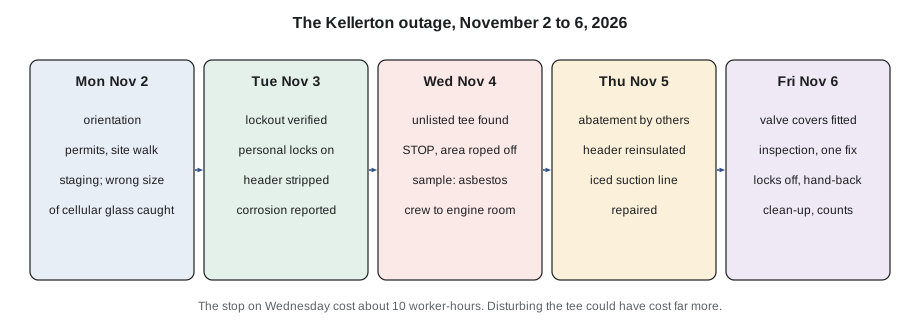
Monday: orientation, permits and staging
The day began at 6:00 in a training room beside the plant gate. Kellerton's contractor orientation took two hours: plant layout and muster points, the ammonia emergency procedure and alarms, food safety rules, forklift traffic routes, lockout and permit procedures, hot work rules and the plant's PPE requirements. Every worker signed in, showed proof of training (fall protection, WHMIS, respirator fit test and lockout), and received a contractor badge. Devon's hard hat got a Kellerton sticker. His glass-cased tape measure went back to the truck; the plant allowed only tape measures on its approved list.
At 8:30 the crew met the plant's maintenance planner and the mechanical contractor's foreperson in the boiler house. They walked the job: the header section to be isolated, the two valves, the access (a rolling scaffold erected by the plant's scaffold contractor and a fixed platform), the waste route and the laydown area outside the boiler house door. Bernie asked the questions she always asks: what is the temperature, what is isolated and how, what hazards are nearby, where are the exits and eyewash and who do we call if something goes wrong?
The plant issued a general work permit for the week and told the crew that lockout would be applied on Tuesday morning, once the boiler was off line and the header section had cooled. Mei walked Bernie through the plant's asbestos survey. It showed asbestos-containing cement on the bodies of the two old valves and on one flange pair, removed the previous Friday by the abatement contractor, with clearance air tests passed. The rest of the header insulation was listed as mineral wool installed in 2004, asbestos-free.
In the afternoon, the crew staged material: mineral wool sections, aluminum jacket rolls, bands and seals, cellular glass sections, vapour retarder mastic and stainless steel jacket for the engine room, plus a HEPA vacuum and waste bags. Devon checked the delivery against the material list and found that the cellular glass sections had been delivered for NPS 3 pipe, while the suction line was NPS 4. Raj had the correct size brought from Coldstream's shop by Tuesday afternoon.
Worked problem
Planning the header jacket
The header section is 12 m of NPS 8 pipe (219.1 mm OD) with 76 mm of insulation. The aluminum jacket comes in 914 mm wide rolls and will be applied in pieces 914 mm wide around the pipe, with a 50 mm circumferential overlap and a 50 mm longitudinal lap. How long is each piece, and how many pieces are needed?
Show solution
- Insulated OD = 219.1 + 2 × 76 = 371.1 mm.
- Piece length (around the pipe) = π × 371.1 + 50 ≈ 1,165.8 + 50 = 1,215.8 mm, say 1,216 mm.
- Each piece covers 914 − 50 = 864 mm of pipe length, after its overlap with the next piece.
- Pieces = 12,000 ÷ 864 ≈ 13.9, so 14 pieces.
- Jacket length from the roll = 14 × 1.216 m ≈ 17.0 m, before allowing for the valves.
Answer: 14 pieces about 1,216 mm long, about 17 m of jacket. Tomasz pre-cut and beaded them in the shop on Monday afternoon so the crew could install them quickly on Thursday.
Questions for Monday: Why does a plant require its own orientation when everyone has already done their own employer's training? What would have happened if Devon had not caught the wrong size of cellular glass until Thursday?
Tuesday: lockout and removal
At 7:00 the plant's operator took the boiler off line and isolated the header section, closing and locking the valves on each side, opening the drains and bleeding the pressure. At 9:30, after the header had cooled, the operator and Bernie walked the isolation together and verified it: gauges at zero, drains open and quiet, the pipe cool to a gloved hand and to the infrared thermometer, which read 34 °C (93 °F) on the old jacket. Each member of the Coldstream crew put a personal lock and tag on the group lockout box, as the plant's procedure required. Devon wrote the lock number in his notebook.
Then the removal began. The crew wore half-face respirators with P100 filters, disposable coveralls over their FR clothing, gloves and goggles, because removing old fibrous insulation is dusty even when it is asbestos-free. They cut the bands, peeled off the old aluminum jacket, cut the mineral wool into manageable pieces and bagged it at the work, with a HEPA vacuum running. Nobody threw insulation down from the scaffold; bags went down on a rope. By 2:00 the crew had stripped 9 m (30 ft) of header.
Under the old jacket, Bernie found the reason the plant had wanted the header reinsulated: water. A failed jacket seam at the top of the pipe had let rain from a leaking roof drain soak into the insulation for years. The bottom of the pipe was pitted with corrosion under insulation. Bernie photographed it and reported it to the maintenance planner, who called in the plant's inspector to check the wall thickness before the new insulation went on. The inspector measured the pipe on Wednesday and accepted it, and the roofing contractor was booked to fix the drain.
Worked problem
How much water was in the old insulation?
A removed piece of wet mineral wool insulation weighed 4.8 kg. After drying in the shop, it weighed 1.9 kg. How much water had it held, and what is that as a multiple of the dry weight?
Show solution
- Water = wet weight − dry weight = 4.8 − 1.9 = 2.9 kg, about 2.9 L.
- As a multiple of the dry weight: 2.9 ÷ 1.9 ≈ 1.5.
- So the piece held about one and a half times its own dry weight in water.
Answer: Wet insulation conducts heat many times better than dry, so this part of the header had been wasting energy for years, as well as corroding the pipe.
Questions for Tuesday: Why did each crew member put on a personal lock, when the operator had already locked the valves? Why did Bernie report the corrosion instead of just insulating over it?
Wednesday: the fitting that was not on the survey
On Wednesday morning, Devon and Tessa were removing the last 3 m (10 ft) of old header insulation, near the far end of the isolated section where it met a short branch line. As Devon cut back the jacket, he exposed a fitting cover on a tee that did not look like the mineral wool around it: a hard, grey-white cement shell, cracked at one end, with a fibrous layer underneath. It was not mentioned on the survey drawing, which showed the tee as part of the 2004 mineral wool work.
Devon stopped. He did not cut it, break off a piece to look at or brush the dust off. He told Tessa to stop too, stepped back and called Bernie over. Bernie looked, agreed, and stopped all work in that part of the boiler house. They roped off the area around the tee with caution tape, closed the HEPA vacuum and set it aside without emptying it, and Bernie called Mei and the plant's maintenance planner.
Within an hour, the plant's asbestos consultant arrived, took a sample of the fitting cover under controlled conditions, wetted and wrapped the damaged end and arranged for a rush laboratory analysis. The crew, meanwhile, took off their coveralls in the designated area, bagged them, cleaned their respirators and moved to the engine room to start the suction line repair, which was in a separate area and not affected.
At 4:00 the laboratory reported that the fitting cover contained chrysotile asbestos, well above the 0.5 per cent level that makes a material asbestos-containing in Ontario. The tee had evidently been missed when the rest of the header was reinsulated in 2004; the old cover had been left in place and jacketed over. Because Devon had stopped before disturbing it, no fibres had been released into the crew's work area; the consultant's air samples, taken that afternoon, confirmed it. The abatement contractor returned on Thursday morning and removed the cover as a Type 2 operation under O. Reg. 278/05, using a glove bag on the small area involved, and the consultant updated the plant's designated substance report.
Bernie told the story at the next Coldstream toolbox talk. "He did exactly what we teach," she said. "Stop, don't disturb, keep people away, report. That's the job. The survey was wrong, and the only thing between that dust and our lungs was a first-year apprentice who knew what he was looking at." Devon was embarrassed. He also kept the lab report.
Worked problem
What did the stop cost?
Stopping work in the boiler house cost the crew about 3 hours on Wednesday afternoon. The crew of four moved to the engine room, where about 2 of those hours were useful work, and the abatement on Thursday delayed the header reinsulation by another 2 hours for three workers. How many worker-hours were lost in total, and how does that compare with the 60 worker-hours in the week's plan?
Show solution
- Wednesday: 4 workers × 3 hours = 12 worker-hours disrupted, of which 4 × 2 = 8 were recovered in the engine room, so 12 − 8 = 4 worker-hours lost.
- Thursday: 3 workers × 2 hours = 6 worker-hours lost.
- Total lost = 4 + 6 = 10 worker-hours.
- Compared with the plan: 10 ÷ 60 ≈ 0.17, about one-sixth of the planned hours.
- The crew made up most of it with a longer shift on Thursday, agreed with the plant.
Answer: About 10 worker-hours, roughly a sixth of the week's plan, most of it made up later. The alternative, disturbing asbestos, could have cost four people their health decades from now.
Questions for Wednesday: What exactly did Devon do right, and in what order? Why did the crew leave the HEPA vacuum unopened? What should a crew do if it suspects it has already disturbed asbestos?
Thursday: the header and the iced suction line
With the tee removed and the area cleared by air testing, the header crew went back to work at 10:00. Bernie and Tessa installed 76 mm (3 in) mineral wool sections, wired them in place, fitted mineral wool on the new valves' flanges and then installed Tomasz's pre-cut aluminum jackets, laps facing down and away from the weather side, with bands at the specified spacing. The roof drain had not yet been repaired, so Bernie added a sealant bead to the top laps under the leak and recorded it for the planner.
In the engine room, Marcel and Devon worked on the iced suction line. The NPS 4 line ran 4 m (13 ft) above the floor along a wall, reached from a scissor lift. A section about 5 m (16 ft) long was covered in a thick sleeve of ice over the stainless steel jacket. Before they started, the plant's refrigeration technician confirmed that the line would stay in service, at about −34 °C (−30 °F), because the freezers could not be stopped. That meant working on a live cold line: insulated gloves, eye protection, no bare skin on metal and great care not to damage the pipe.
When they cut away the ice and jacket, the cause was clear. The old cellular glass insulation was cracked at a hanger, where the hanger clamped directly on the pipe instead of on an insert, and the vapour retarder mastic had split along the crack. Warm, humid air from the engine room had been getting in for years, freezing inside the insulation and on the jacket. Marcel and Devon removed the wet and iced material, let the pipe surface frost dry as best they could with a heat gun held well away from the jacket of the next section, then installed new cellular glass sections in two layers with staggered joints, sealed every joint with the specified sealant, applied vapour retarder mastic with reinforcing fabric and finished with stainless steel jacket. The pipefitters fitted a proper insert and shield at the hanger, as described in Lesson 11.
Worked problem
How heavy was the ice?
The ice sleeve was about 5 m long and about 60 mm thick over a jacket with an outside diameter of about 216 mm. Ice has a density of about 917 kg/m³. What did the ice weigh?
Show solution
- Outer diameter of the ice = 216 + 2 × 60 = 336 mm = 0.336 m; inner diameter = 0.216 m.
- Cross-section area of the ice = π ÷ 4 × (0.336² − 0.216²) = 0.7854 × (0.1129 − 0.0467) = 0.7854 × 0.0662 ≈ 0.0520 m².
- Volume = 0.0520 × 5 = 0.260 m³.
- Mass = 0.260 × 917 ≈ 238 kg.
Answer: About 238 kg of ice was hanging on that section of pipe and its hangers, far more than they were designed for. The ice was removed in small pieces from the lift, never allowed to fall in large chunks, with the area below barricaded.
Questions for Thursday: Why does the repair use two layers of cellular glass with staggered joints, rather than one thick layer? What would happen if the hanger were left clamped on the pipe?
Friday: covers, inspection and hand-back
On Friday morning, the crew fitted the removable insulation covers on the two new valves. The covers, made by a fabricator to measurements Bernie had taken on Tuesday, were sewn blankets of insulation in a high-temperature cloth, with straps and buckles so the plant's maintenance staff could remove and refit them without tools. Devon learned to check each cover's tag against the valve tag and to make sure the straps were tight and the cover sat clear of the valve stem packing, where steam leaks are most likely.
At 11:00, the plant's maintenance planner, the mechanical contractor's foreperson and Bernie inspected the work together. They checked the header insulation thickness, jacket laps and bands, the valve covers, the engine room repair and the clean-up. The planner found one deficiency: two band tails on the header pointing outward at shoulder height. Devon trimmed and folded them in five minutes. Then the planner signed the work off, and the crew removed their personal locks from the group box, one by one, before the operator removed the plant's locks and brought the header back into service. Nobody stood near the header as it warmed.
The crew spent the afternoon cleaning up: HEPA vacuuming the work areas, bagging and labelling waste, returning unused material to the truck, loading the tools, signing out and handing in contractor badges. Devon's last job was to count the band seals and screws left over against the number taken in, because the plant's food safety rules required it. The count matched.
Worked problem
Heat saved by the valve covers
Before the outage, the two old valves had been bare after an earlier repair. Kellerton's energy consultant estimates that each bare NPS 8 steam valve lost about 2.2 kW, and that the removable covers cut that to about 0.25 kW each. The header runs 8,200 hours a year. How much energy do the covers save in a year?
Show solution
- Saving per valve = 2.2 − 0.25 = 1.95 kW.
- For two valves = 2 × 1.95 = 3.9 kW.
- Per year = 3.9 kW × 8,200 h = 31,980 kWh.
Answer: About 32,000 kWh a year from two valve covers. Removable covers also get put back after maintenance, which is why plants specify them.
Looking back on the week
On the drive home on Friday, Bernie asked Devon what he had learned. He thought about it and listed five things in his notebook, which he later showed his in-school instructor.
| Lesson from the week | Where it came up | Course lesson |
|---|---|---|
| Surveys and drawings can be wrong; treat unknown old insulation as hazardous | The unlisted asbestos tee | Lesson 8 |
| Verify isolation yourself and put on your own lock | Tuesday lockout | Lesson 7 |
| Check material against the specification on delivery | Wrong size of cellular glass | Lessons 9 and 10 |
| On cold lines, every hanger and joint matters | The iced suction line | Lessons 1 and 11 |
| Report problems you find under the insulation | Corrosion and the leaking roof drain | Lessons 2 and 11 |
| Plant rules add to the law and your employer's rules | Orientation, approved tools, food safety counts | Lesson 2 |
| Plan the PPE for each task | Respirators and coveralls for removal; insulated gloves on the cold line | Lessons 5 and 8 |
Bernie added one more: "You were never in a hurry when it mattered." Devon was not sure that was true. He had wanted to get the header done on Wednesday, and stopping had felt like failure for about ten minutes. But he understood what she meant. In this trade, the work that counts most is often the work you decide not to do until it is safe.
Devon's next course, INS-120, explains the heat transfer and materials behind what he installed that week: why mineral wool on the steam header and cellular glass on the ammonia line, why wet insulation fails, and how thickness is chosen. INS-130 then teaches the craft of insulating straight pipe and simple fittings properly, the skill the whole trade is built on.
Common mistakes
MistakeWorking before the lockout is verified.
InsteadVerify isolation with the operator and apply your own lock before touching an isolated line.
MistakeTrusting the asbestos survey completely.
InsteadTreat anything that does not match the survey as suspect: stop, do not disturb, report.
MistakeEmptying a HEPA vacuum after possibly picking up suspect dust.
InsteadSeal it and leave it for the abatement contractor or consultant.
MistakeInsulating over corroded pipe without reporting it.
InsteadPhotograph and report it so the owner can inspect the pipe.
MistakeLetting ice fall in large chunks.
InsteadBarricade below and remove ice in small pieces.
MistakeLeaving band tails sticking out on finished work.
InsteadTrim and fold them under before the inspection.
Summary and key terms
- Plant jobs start with orientation, permits, a site walk and careful staging.
- Lockout must be verified, and each worker applies a personal lock before work on isolated lines.
- Removing old insulation needs respirators, coveralls, HEPA vacuums and bagging at the source.
- When old insulation does not match the survey, stop, do not disturb, isolate the area and report; abatement is done by others.
- Iced cold lines usually mean a broken vapour retarder or a thermal bridge such as a hanger on the pipe.
- Final inspection, deficiency correction, lock removal and clean-up complete the job.
- The safest decision is sometimes to stop, and good crews treat that as part of the work.
- Outage
- A planned period when part of a plant is taken out of service for maintenance.
- Group lockout
- A lockout in which isolation keys are kept in a lock box, and each worker applies a personal lock to the box.
- Corrosion under insulation
- Corrosion of pipe or equipment caused by water trapped under insulation.
- Glove bag
- A sealed plastic bag with built-in gloves used to remove small amounts of asbestos from pipe.
- Removable insulation cover
- A reusable insulation blanket that can be taken off and refitted without tools.
- Deficiency
- An item found at inspection that does not meet the requirements and must be corrected.
- Clearance air test
- Air sampling after asbestos removal to confirm the area is safe to reoccupy.
Practice problems
Work each problem on paper first, then reveal the answer to check.
What four steps did Devon take when he found the unlisted fitting?
Show answer
He stopped, did not disturb it, kept others away and reported it to his foreperson.
A piece of wet insulation weighs 3.6 kg and 1.2 kg dry. How much water did it hold?
Show answer
3.6 − 1.2 = 2.4 kg, twice its dry weight.
Why did each crew member apply a personal lock?
Show answer
So that the line cannot be returned to service until every worker has removed their own lock.
What caused the ice on the suction line?
Show answer
A hanger clamped directly on the pipe cracked the insulation and split the vapour retarder, letting humid air in.
A jacket piece covers 864 mm of pipe. How many are needed for 8 m?
Show answer
8,000 ÷ 864 ≈ 9.3, so 10 pieces.
Lesson quiz · 5 questions
Score 60% or more to complete this lesson.
Create a free account to save your progress, take quizzes and earn a certificate.