
INS-110 · Lesson 2 of 12 · 25 min
Where insulators work: commercial, industrial and marine
▶ Video coming soon A video version of this lesson is on the way.
By the end of September, Devon could find his way around the Mountview Hospital addition blindfolded. He knew which ceiling spaces held the chilled water mains, which shafts carried the domestic water risers and where the steam line to the sterilizer room ran. Then, at a Friday crew meeting, Walt Lowery announced that Coldstream had won a maintenance contract at Kellerton Foods, a food processing plant in Hamilton's east end, and that some of the hospital crew would move there for a boiler house outage in November.
"Plant work is a different world," Bernie told Devon afterward. "Same trade, same knives. But the pipes are bigger, the temperatures are higher, the rules are stricter and the plant doesn't stop because you're there. You'll see."
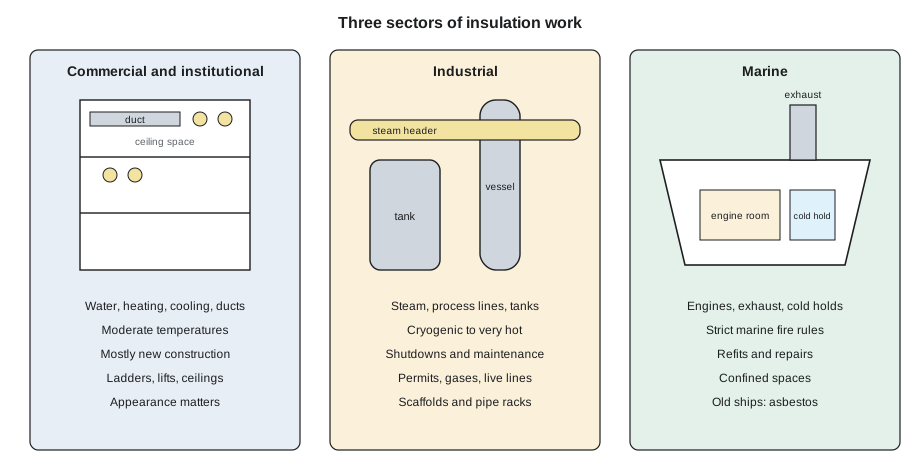
Insulators work in three broad sectors: commercial and institutional buildings, industrial plants and marine work on ships. Most insulators work in more than one over a career, and many contractors, like Coldstream, work in all three. This lesson describes each sector: the systems found there, the conditions, the hazards and the expectations. Knowing the sector helps an apprentice predict what a job will need before arriving.
Commercial and institutional work
Commercial work covers offices, stores, hotels, apartment towers and other buildings where people live, work and shop. Institutional work covers hospitals, schools, universities, long-term care homes, arenas, airports and government buildings. Together they are the largest share of insulation work in most cities, and they are where most apprentices start.
The systems in these buildings serve people's comfort, health and safety:
- Domestic water: cold water, hot water and hot water recirculation lines that serve sinks, showers and kitchens. Cold lines are insulated against condensation; hot lines are insulated to save energy and keep water hot at the tap.
- Heating: heating hot water from boilers to air handlers, fan coils and radiators, and in some buildings low- or medium-pressure steam and condensate.
- Cooling: chilled water from chillers to air handlers and fan coils, condenser water to cooling towers, and refrigerant lines for split systems. Chilled water and refrigerant suction lines need vapour-sealed insulation.
- Air distribution: supply, return, outdoor air and exhaust ductwork. Supply ducts carrying cooled air need insulation with a vapour retarder; outdoor air ducts need it to prevent condensation in winter; kitchen exhaust ducts may need fire-rated wraps.
- Plumbing drains: roof drain bodies and horizontal storm piping, which carry cold rainwater and snowmelt and sweat inside warm ceiling spaces.
- Fire protection and life safety: firestopping where pipes and ducts pass through fire separations, and in some cases insulation on sprinkler lines in cold spaces.
Commercial work is usually done during construction, as part of a new building or renovation. The insulation contractor works for the mechanical contractor, and the schedule is driven by the general contractor: ceilings cannot close until the insulation above them is done and inspected. That means steady pressure to finish areas on time, plenty of ladder and scissor lift work and close coordination with drywallers, electricians and ceiling installers.
Temperatures are moderate: chilled water at about 6 °C (43 °F), heating water at 60 to 90 °C (140 to 194 °F), domestic hot water at 49 to 60 °C (120 to 140 °F). Materials are mostly fibreglass pipe and duct insulation with factory-applied jackets, flexible elastomeric insulation on refrigerant lines and PVC fitting covers. Appearance matters a great deal in exposed areas such as mechanical rooms, parking garages and kitchens.
Hospitals have extra rules. Work in an occupied hospital needs infection control measures, which may include dust barriers, negative-pressure enclosures and sticky mats at the doors, because dust and mould spores can harm patients with weak immune systems. Canadian hospitals commonly follow CSA Z317.13 for infection control during construction and renovation in health care facilities, which sets the precautions by the type of work and the patients nearby. At Mountview, the addition is new construction, but the connections to the existing hospital pass through a corridor where patients are treated, and Coldstream's crew works there only behind a sealed hoarding.
Industrial work
Industrial work covers plants of every kind: power generation, steel mills, oil refineries and terminals, chemical and petrochemical plants, pulp and paper mills, pharmaceutical plants, food and beverage plants, breweries, mines and processing plants, and the utilities that serve them. Insulators in this sector work on steam and condensate systems, process piping carrying oils, chemicals and food products, tanks and vessels, boilers, turbines, heat exchangers, exhaust ducts and stacks, and refrigeration systems.
The scale is bigger. Pipes up to 600 mm (24 in) in diameter or larger, vessels several storeys tall and long runs on pipe racks outdoors are common. Temperatures range from cryogenic liquefied gases at −160 °C (−260 °F) and colder up to superheated steam and process lines above 500 °C (930 °F). Materials include mineral wool, calcium silicate, cellular glass, perlite, high-temperature blankets and many kinds of metal jacketing.
Industrial work is often maintenance rather than new construction. Insulation is removed so other trades can repair or inspect pipe and equipment, then replaced. A lot of this happens during shutdowns, also called turnarounds or outages, when part or all of a plant is stopped for a planned period. Shutdowns run around the clock with large crews and tight schedules, because every hour the plant is down costs the owner money. They pay well and teach a lot, but they are tiring and demanding.
The hazards are greater, and so are the safety rules. Plants have their own orientation, permits and procedures on top of the law. Insulators work near live lines carrying steam, hot oil, acids, caustics, ammonia, flammable gases or toxic gases. Many plants require flame-resistant clothing, gas monitors that detect hydrogen sulphide or other gases, and special training before a worker may enter. Work permits, lockout and isolation, confined space entry and hot work controls are part of daily life. Lessons 6, 7 and 8 cover the main hazards.
| Plant type | Typical insulated systems | Special hazards or rules |
|---|---|---|
| Power and steam plants | Steam, feedwater, boilers, turbines, ducts and stacks | High temperatures, high-pressure steam, noise |
| Refineries and chemical plants | Process lines, tanks, vessels, heat-traced lines | Flammable and toxic gases, flame-resistant clothing, gas monitors |
| Steel mills | Steam, gas mains, furnace equipment | Very high heat, molten metal, mobile equipment, dust |
| Food and beverage plants | Steam, hot water, ammonia refrigeration, product lines | Ammonia, food safety rules, washdown areas, cold rooms |
| Pharmaceutical plants | Clean steam, process water, chilled lines | Cleanroom rules, strict cleanliness and documentation |
| Pulp and paper mills | Steam, process lines, digesters and tanks | Chemicals, heat, humidity, moving machinery |
Food plants like Kellerton have rules that surprise new workers. Glass and brittle plastic may be banned from production areas, so tape measures with plastic cases may need to stay outside or be on an approved list. Jewellery, loose items in shirt pockets and food are not allowed. Workers may wear hairnets, beard nets and clean coveralls. Some areas are washed down with hot water and chemicals every night, so insulation there needs sealed, cleanable jackets that will not hold water or bacteria. Every piece of tape, every screw and every band must be accounted for, because anything that falls into a product line can trigger a recall.
Worked problem
How big is a plant pipe?
At Kellerton, the main steam header is NPS 8, with an outside diameter of 219.1 mm. The specification calls for 76 mm thick insulation. What is the outside diameter of the insulated pipe, and what length of metal jacket is needed to go once around it with a 50 mm overlap?
Show solution
- Insulated outside diameter = pipe OD + 2 × thickness = 219.1 + 2 × 76 = 371.1 mm.
- Circumference = π × 371.1 ≈ 1,165.8 mm.
- Add the overlap: 1,165.8 + 50 = 1,215.8 mm.
- Round up to a practical cut length: about 1,216 mm, or 1.22 m.
Answer: The insulated pipe is about 371 mm across, and each jacket piece is cut about 1,216 mm long. Compare that with a typical NPS 1 domestic water line in a hospital, which is only 33.4 mm across before insulation.
Marine work
Marine insulators work on ships: freighters, tankers, ferries, naval vessels, icebreakers, research ships, tugboats and barges. A ship is a floating plant and a floating building at once. It has an engine room with diesel engines or turbines, exhaust systems that run very hot, boilers and steam lines on some vessels, fuel oil lines that must be kept warm, refrigerated cargo holds and provision rooms, accommodation spaces that need heating and cooling, and fire-rated bulkheads and decks.
Marine work has its own rules. Insulation and fire protection on ships must meet international and national marine rules, which are stricter about fire than most building codes, because a fire at sea cannot be escaped by walking out the door. Products must be approved for marine use. Spaces are cramped, ladders are steep, compartments may be confined spaces, and many vessels were built when asbestos was common, so asbestos surveys are especially important on older ships.
Hamilton's harbour has long seen Great Lakes freighters lay up for the winter, when the St. Lawrence Seaway closes. Coldstream sends small crews in January and February to repair exhaust lagging, steam lines and accommodation insulation on ships tied up for maintenance, and to work in a shipyard in the region on new builds and refits. Marine work is a small part of Coldstream's business, but the crews who do it like the variety.
Comparing the sectors
The same basic skills apply everywhere: measuring, cutting, fitting, sealing and jacketing. What changes from sector to sector is the scale, the temperatures, the materials, the hazards and the rules around the work.
| Commercial and institutional | Industrial | Marine | |
|---|---|---|---|
| Typical temperatures | About 4 to 120 °C | About −160 to above 500 °C | About −30 to above 400 °C |
| Common materials | Fibreglass, elastomeric, PVC covers, duct wrap and liner | Mineral wool, calcium silicate, cellular glass, perlite, metal jacket | Marine-approved mineral wool, fire-rated blankets, exhaust lagging |
| Kind of work | Mostly new construction and renovation | Much maintenance and shutdown work | Refits, repairs and new builds |
| Typical access | Ladders, scissor lifts, ceiling spaces | Scaffolds, boom lifts, pipe racks | Ladders, cramped compartments, scaffolds in holds |
| Main hazards | Heights, dust, cuts, housekeeping | Heat, pressure, chemicals, gases, asbestos, permits | Confined spaces, fire, heat, asbestos on older vessels |
| Appearance | Very important in exposed areas | Weatherproofing comes first, neatness still matters | Fire rating and durability first |
Reading a job before you arrive
Experienced insulators can predict most of what a job will need from a few facts: what kind of building or plant it is, which systems are being insulated, the service temperatures and whether the work is new construction or maintenance. Before Devon moved to Kellerton, Bernie made him answer five questions about it. They are a good habit for any new job.
- What are the systems and their temperatures? At Kellerton: steam at about 185 °C (366 °F), condensate, hot water and ammonia suction lines at about −34 °C (−30 °F). That tells you to expect burn hazards, high-temperature materials on the steam side and vapour-sealed cold work on the ammonia side.
- Is the plant running? Yes, except for the boiler house section being shut down. That means live lines beside you, permits for every task and lockout before anyone touches the isolated header.
- What hazards does the owner know about? The owner's hazard information package lists ammonia, steam, noise, forklift traffic and asbestos-containing insulation on some 1960s fittings.
- What access will you use? Fixed ladders, a rolling scaffold in the boiler house and a boom lift for the pipe rack.
- What extra rules apply? Food safety rules (no glass, no loose items, hairnets), a plant orientation, hot-work permits, ammonia awareness and confined space rules for the boiler drum area.
Devon wrote the answers in his notebook. A week later, during the outage, almost everything on the list came up. Lesson 12 tells the story of that week.
Worked problem
Estimating a commercial insulation quantity
On Mountview's third floor, the drawings show 145 m of NPS 1 domestic hot water pipe, 120 m of NPS 1 domestic cold water pipe and 60 m of NPS 2 heating water pipe. Preformed sections are 0.91 m long, and Raj adds 5 in 100 for waste on straight pipe. How many sections of each size should be ordered?
Show solution
- NPS 1 total (hot + cold, assuming the same insulation thickness on both) = 145 + 120 = 265 m.
- With waste: 265 × 1.05 = 278.25 m. Sections = 278.25 ÷ 0.91 ≈ 305.8, so order 306.
- NPS 2: 60 × 1.05 = 63 m. Sections = 63 ÷ 0.91 ≈ 69.2, so order 70.
- Check: the specification may call for different thicknesses on hot and cold lines, so confirm before combining.
Answer: Order about 306 sections for NPS 1 and 70 for NPS 2, always rounding up, and confirm the thicknesses on the insulation schedule first. Lesson 9 shows how to read that schedule.
Travel, shifts and working life
Where an insulator works shapes the working life as much as the work. Commercial work is usually day shift, close to home, with steady hours for months on one building. Industrial maintenance may be day shift too, but shutdowns often run 10- or 12-hour shifts, six or seven days a week, sometimes with night shifts, for two to six weeks at a time. Big industrial projects, such as a new power plant, refinery unit or mine processing plant, can mean travel and camp or hotel living for months. Marine work can mean working on a ship far from home, in cramped and noisy spaces.
Each has rewards. Commercial work offers stable hours and the satisfaction of watching a building take shape. Industrial work offers higher pay during shutdowns, technically challenging systems and a chance to learn high-temperature and cold work. Marine work offers variety and very specialized skills. Many insulators move between sectors as their lives change, and an apprentice who learns all three becomes more valuable to an employer.
Fatigue is a real hazard on long shutdown shifts. A tired worker misjudges a ladder, forgets a step in a lockout or cuts a hand. Coldstream limits consecutive shifts during outages, schedules breaks, and expects crew members to tell their foreperson when they are too tired to work safely. Bernie's rule: "The plant will still be there tomorrow. Make sure you are too."
Common mistakes
MistakeAssuming plant work follows the same rules as building construction.
InsteadPlants add their own orientation, permits, procedures and PPE to the law. Learn the plant's rules before starting work.
MistakeBringing glass, food or loose items into a food plant production area.
InsteadFollow the plant's food safety rules: approved tools only, nothing in shirt pockets, hairnets where required, and account for every screw and band.
MistakeIgnoring infection control in an occupied hospital.
InsteadWork behind the required dust barriers and follow the hospital's infection control measures, because dust can harm vulnerable patients.
MistakeTreating a shutdown schedule as more important than rest.
InsteadReport fatigue to the foreperson. Tired workers make the mistakes that cause injuries.
MistakeOrdering insulation without checking the schedule.
InsteadConfirm sizes, thicknesses and materials on the insulation schedule before ordering or combining quantities.
Summary and key terms
- Insulators work in commercial and institutional buildings, industrial plants and on ships.
- Commercial work insulates domestic water, heating, cooling, ductwork and drains, mostly during construction, with appearance and schedule pressures.
- Hospitals add infection control requirements to commercial work.
- Industrial work involves larger pipes, wider temperature ranges, much maintenance and shutdown work, and stricter plant safety rules.
- Food plants have special rules about glass, loose items, hygiene and cleanable jackets.
- Marine work must meet strict marine fire rules and often involves confined spaces and old asbestos.
- Before a new job, ask about systems and temperatures, whether the plant is running, known hazards, access and extra rules.
- Commercial work
- Insulation in offices, stores, hotels and similar buildings.
- Institutional work
- Insulation in hospitals, schools, universities and government buildings.
- Industrial work
- Insulation in plants such as power stations, refineries, mills and food plants.
- Shutdown
- A planned period when part or all of a plant is stopped for maintenance; also called a turnaround or outage.
- Infection control
- Measures that keep construction dust and contaminants away from patients in health care facilities.
- Pipe rack
- A steel structure that carries many pipes overhead between parts of a plant.
- Lagging
- An older word for insulation and its covering, still used for exhaust and marine work.
Practice problems
Work each problem on paper first, then reveal the answer to check.
Name three systems insulators work on in a hospital.
Show answer
Any three of: domestic hot and cold water, heating water, chilled water, steam, ductwork, roof drains and firestopping.
What is a shutdown, and why are shutdown schedules so tight?
Show answer
A planned stop of part or all of a plant for maintenance; every hour the plant is down costs the owner money.
An NPS 4 pipe (114.3 mm OD) gets 50 mm of insulation. What is the insulated outside diameter?
Show answer
114.3 + 2 × 50 = 214.3 mm.
Why do food plants ban glass from production areas?
Show answer
Broken glass could get into the product and cause injury or a recall.
Why are asbestos surveys especially important on older ships?
Show answer
Many vessels were built when asbestos insulation was common, and the cramped spaces make exposure worse.
Lesson quiz · 5 questions
Score 60% or more to complete this lesson.
Create a free account to save your progress, take quizzes and earn a certificate.