
INS-110 · Lesson 3 of 12 · 28 min
Hand tools and their care
▶ Video coming soon A video version of this lesson is on the way.
On his first day at Mountview, Devon reached into his bag for a utility knife to cut a section of fibreglass pipe insulation. Bernie stopped him. "Not with that," she said, and handed him a long, thin knife with a wooden handle and a serrated edge. "A utility knife tears the fibres and leaves a ragged joint. This cuts clean. Keep it sharp, keep it in its sheath and never cut toward yourself." By the end of the week Devon had bought his own insulation knife, a sharpening stone and a leather sheath, and he had learned why insulators guard their knives the way chefs do.
Insulators use a large set of hand tools: knives and saws for cutting insulation, measuring and layout tools, snips and seamers for metal jacketing, banding and wiring tools, fastening tools and general tools such as hammers and pliers. Each has a correct use, a correct way to hold it and a correct way to look after it. This lesson describes the main hand tools, the injuries they can cause and the care that keeps them safe and accurate. Power tools are covered in Lesson 4.
Your own tools and the company's tools
In most insulation shops, apprentices are expected to buy and maintain a basic kit of hand tools, and the employer supplies larger or specialized tools such as banding tensioners, rivet guns, power tools and shop machines. The exact list depends on the employer and, for union members, on the collective agreement. Coldstream gives each new apprentice a printed tool list and expects the kit to be complete by the end of the first month.
A good basic kit is not expensive, but it must be good quality. Cheap knives do not hold an edge, cheap tape measures stretch or break, and cheap snips bend. Bernie's advice to Devon was to buy fewer tools and better ones, mark every tool with his initials and replace anything that becomes unsafe.
| Tool group | Typical apprentice kit | Usually supplied by the employer |
|---|---|---|
| Cutting insulation | Insulation knife (serrated), straight knife, utility knife with retractable blade, sharpening stone | Long blade knives for large blankets, insulation saw for rigid board |
| Measuring and layout | Tape measure, flexible steel rule, combination square, dividers, scriber, marker | Large compass, circumference tape (pi tape), templates |
| Metal jacketing | Aviation snips (left, right and straight), hand seamer, crimping pliers | Rivet gun, shop brake, roll former, beader |
| Banding and wiring | Side cutters, lineman's pliers, wire twister | Band tensioner, band crimper or sealer |
| General | Claw or tack hammer, screwdrivers, nut driver, flashlight, tool belt or pouch | Stapler for jackets, glue guns, mastic tools |
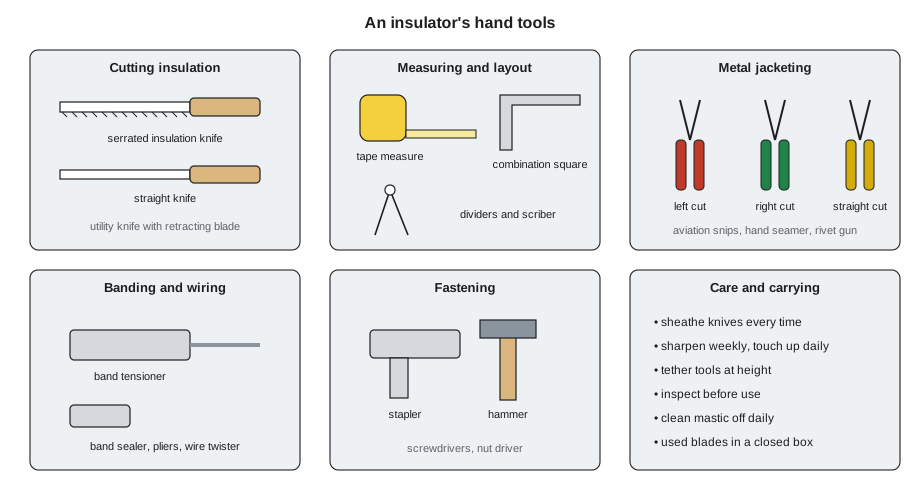
Knives
The knife is the insulator's most important tool. Insulators cut most fibrous and flexible insulation by hand, and the quality of the cut decides the quality of the joint. A clean, square cut makes a tight butt joint that does not leak heat or vapour; a ragged cut leaves gaps that must be stuffed or sealed, and on cold work a poor joint is the start of a failure.
- A serrated insulation knife has a long, thin blade with fine teeth, often 250 to 350 mm (10 to 14 in) long. It saws through fibreglass and mineral wool sections, blankets and board without crushing them. Many insulators keep one or two, and some modify an ordinary bread knife.
- A straight-edged knife, kept razor sharp, is used for flexible elastomeric insulation, foam plastics and facing materials, where a serrated edge would leave a rough surface.
- A utility knife with a retractable or self-retracting blade is used for jackets, tape, paper facings and small trimming jobs. Retractable blades reduce cuts when the knife is dropped or carried.
Knives cause more injuries to insulators than any other hand tool. Most cuts happen when a worker cuts toward the body or the other hand, uses a dull blade that slips or jumps, reaches for a knife left on a pipe or carries an unsheathed knife in a pocket. Cut-resistant gloves help, but they do not make a careless cut safe.
Safe knife rules at Coldstream are short and strict:
- Cut away from your body and keep your free hand behind the blade, never in front of it.
- Cut on a firm surface or a board, not on your knee or against your hand.
- Keep the blade sharp. A sharp blade needs less force and is less likely to slip.
- Sheathe or retract the blade every time you put the knife down. Never leave a bare knife on a pipe, ladder step or scaffold plank.
- Never hand someone a knife blade first; place it down and let them pick it up, or pass it handle first with the blade pointing down and away.
- Do not use a knife as a screwdriver, pry bar or scraper. Use the right tool.
- Wear cut-resistant gloves on the hand that holds the material.
Sharpening is part of the job. Serrated knives are touched up with a tapered round file or a ceramic rod, one tooth at a time, on the bevelled side only. Straight knives are sharpened on a stone or with a pull-through sharpener and finished on a leather strop. Bernie sharpens her knives at the start of every week and touches them up at lunch on heavy cutting days. Utility knife blades are cheap; change them when they start to drag, and put used blades in a closed container, not loose in the garbage where someone emptying it can be cut.
Measuring and layout tools
Bernie's favourite saying is "Measure the pipe, not the drawing." Drawings show where pipe should be, but the installed pipe may be a different size, in a slightly different place or with extra fittings. Insulators measure what is actually there.
- A tape measure, usually 7.5 m or 8 m long, measures lengths of pipe and duct. Many insulators use a tape marked in both metric and imperial units, because pipe sizes and some products are still sold in imperial sizes in Canada.
- A flexible steel rule or a cloth tape is wrapped around insulated pipe to measure the circumference for jacketing. A circumference tape, also called a pi tape, reads the diameter directly when wrapped around a pipe.
- A combination square marks square cuts and checks that ends are square. A protractor head or bevel gauge marks angles for mitred fittings.
- Dividers and a scriber transfer measurements and mark curves on metal for fitting covers. A large compass or trammel points lay out circles for tank heads.
- Markers, chalk lines and soapstone mark insulation and metal. Insulators avoid pencils on metal jacketing because graphite can promote corrosion on some metals, and they avoid markers containing chlorides on stainless steel.
Accurate measuring saves material. A cut that is 6 mm (1/4 in) too short on a pipe section leaves a gap that must be filled; a cut 6 mm (1/4 in) too long makes the joint bulge or buckle. On metal jacketing, an error in the circumference means the jacket will not close or will overlap too much.
Worked problem
Measuring circumference with a wrap tape
Devon wraps a flexible rule around insulated pipe and reads 452 mm. What is the outside diameter, and how long should he cut the aluminum jacket if the specification calls for a 50 mm overlap?
Show solution
- Diameter = circumference ÷ π = 452 ÷ 3.1416 ≈ 143.9 mm.
- Jacket length = measured circumference + overlap = 452 + 50 = 502 mm.
- Check against the schedule: NPS 2 pipe (60.3 mm OD) with 38 mm insulation gives 60.3 + 76 = 136.3 mm; the measured 143.9 mm suggests the insulation is a little thicker or sits loose. Bernie checks the section label before cutting.
Answer: About 144 mm across; cut the jacket about 502 mm long. Measuring the actual insulated pipe, not the drawing, catches differences like this before metal is wasted.
Snips, seamers and metal tools
Metal jacketing protects insulation from weather, damage and washdown. Insulators cut and form aluminum, stainless steel and galvanized steel sheet, mostly in thin gauges, with hand tools in the field and machines in the shop.
- Aviation snips come in three patterns. Left-cut snips curve the cut to the left and usually have red handles; right-cut snips curve to the right and usually have green handles; straight-cut snips usually have yellow handles. Use the pattern that lets the waste curl away from the cut, so your hand is not forced against the sharp edge.
- Tin snips with long, straight blades cut long straight lines in thin sheet.
- A hand seamer has wide, flat jaws for bending and flattening edges, closing seams and forming small hems.
- Crimping pliers or a hand crimper form small corrugations so one piece of round jacket slides inside the next.
- A hand rivet gun sets blind rivets, also called pop rivets, to fasten jacket seams and fitting covers.
- A hand punch or awl makes holes for rivets and screws.
Cut sheet metal is extremely sharp, and the edges and burrs cause deep cuts. Always wear cut-resistant gloves when handling sheet metal, and long sleeves when carrying it. Hold the sheet so the waste curls away, never against your wrist. Deburr or fold sharp edges where people will touch them. Store cut scraps in a bin, never on the floor, and carry sheets by the edges with gloves, not by sliding them through your hands.
Snips stay sharp longer if they are used only on metals they are rated for: aviation snips for aluminum and mild steel, heavy-duty snips for stainless steel. Do not cut wire, bands or screws with snips; use side cutters or bolt cutters. Keep the pivot lightly oiled and the blades clean, and adjust the pivot bolt so the blades meet without a gap.
Banding and wiring tools
Insulation and jackets are often held in place with bands or wire. Bands are thin strips of stainless steel or aluminum, typically 13 to 19 mm (1/2 to 3/4 in) wide, wrapped around the jacket and pulled tight with a band tensioner. The band is then locked with a seal or a wing seal crimped by a sealer, or with a preformed band clip. Wire, often soft annealed stainless steel or galvanized steel, holds insulation sections and blankets on pipe and equipment before jacketing, twisted tight with pliers or a wire twister.
A band tensioner stores a lot of energy. If a band breaks or slips while it is tight, it can whip back and cut the operator or someone nearby. Keep your face and body out of line with the band, do not over-tension, cut the tail of the band cleanly and bend it back or under so no sharp end sticks out. Band ends and wire ends left sticking out are one of the commonest causes of cuts for other trades walking past finished insulation.
Worked problem
Band spacing and band length
A 6.3 m straight run of NPS 8 steam pipe at Kellerton is insulated to an outside diameter of 371 mm and jacketed in aluminum. The specification calls for bands at 300 mm centres and 50 mm from each jacket end, with 150 mm added to each band for the seal and tensioning. Jacket sections are 900 mm long, with one band over each lap. How many bands are needed, and how much banding material?
Show solution
- Each 900 mm jacket section has a band 50 mm from each end. The span between those end bands is 900 − 100 = 800 mm. One band between them would leave two spaces of 400 mm, over the 300 mm limit; two bands leave three spaces of about 267 mm, within it. So each section has 2 end bands and 2 intermediate bands.
- Where sections meet, the end bands of neighbouring sections would sit side by side, so the specification puts one band over each lap instead of two. Sections = 6,300 ÷ 900 = 7.
- Bands = 7 × 2 intermediate bands + 6 lap bands + 2 end bands = 14 + 6 + 2 = 22 bands.
- Band length = π × 371 + 150 ≈ 1,165.5 + 150 = 1,315.5 mm, or about 1.32 m each.
- Total banding = 22 × 1.32 ≈ 29 m.
Answer: About 22 bands and about 29 m of banding. A tensioner that slips on just one of those 22 bands can cut a hand, so each one is pulled with care.
Fastening and general tools
Insulators also use staplers for jacket laps on fibreglass pipe insulation with factory-applied jackets, using outward-clinching staples that do not puncture the pipe side of the vapour retarder; hammers for setting pins and tapping fittings into place; screwdrivers and nut drivers for sheet metal screws on jackets; and adhesive and mastic tools such as brushes, trowels, caulking guns and gloves. Every one of these has a correct use. Using a screwdriver as a chisel, a hammer on a hardened tool or pliers as a wrench damages the tool and can injure the user.
Hand tools used near live electrical equipment need to be insulated and rated for the work, but insulators should not be working on or near exposed live electrical parts at all. If heat tracing cables or electrical equipment must be worked around, the electrician isolates it first. Lesson 11 covers coordination with electricians.
Carrying, storing and inspecting tools
Tools hurt people when they are carried carelessly, dropped from height or left lying around. Coldstream's rules:
- Carry knives sheathed and snips closed, in a pouch or tool belt, not loose in pockets.
- Tether tools when working at height over people, equipment or open areas. A tape measure dropped from 6 m (20 ft) hits hard enough to injure someone below; lanyards and tool tethers stop that. Many plants require tool tethering above a set height.
- Use a bucket or bag on a rope to raise and lower tools; do not carry them up a ladder in your hands.
- Keep tools off walkways, stairs and scaffold platforms when not in use.
- Inspect tools before use: loose handles, cracked or mushroomed heads, bent or chipped blades, frayed tape measures and damaged insulation on handles are all reasons to tag a tool out and repair or replace it.
- Clean tools at the end of the day. Mastic and adhesive harden on tools quickly; clean them with the solvent or water the manufacturer recommends, following the safety data sheet.
A tool kit in good order also makes a worker faster. Bernie can find any tool in her pouch without looking, because each one goes back in the same place every time. Devon copied her layout within a month.
Worked problem
How hard a dropped tool hits
A 0.5 kg tape measure falls from a scaffold platform 6 m above a walkway. Ignoring air resistance, how fast is it moving when it lands, and how much energy does it carry?
Show solution
- Speed at impact: v = √(2 × g × h) = √(2 × 9.81 × 6) = √117.7 ≈ 10.8 m/s.
- That is 10.8 × 3.6 ≈ 39 km/h.
- Energy = mass × g × height = 0.5 × 9.81 × 6 ≈ 29.4 J.
- For comparison, about 30 J is roughly the energy of a hammer swung firmly at a nail.
Answer: About 39 km/h and about 29 J. A hard hat helps, but tethering the tool and keeping people out from under the work is the real protection.
Common mistakes
MistakeCutting insulation with a utility knife.
InsteadUse a serrated insulation knife for fibrous insulation and a sharp straight knife for elastomeric and foam, so joints are clean and tight.
MistakeCutting toward the body or the free hand.
InsteadCut away from yourself on a firm surface, with the free hand behind the blade and a cut-resistant glove on it.
MistakeLeaving a bare knife on a pipe or plank.
InsteadSheathe or retract the blade every time you put the knife down.
MistakeUsing the wrong snips so the waste curls into your hand.
InsteadChoose left, right or straight snips so the waste curls away from the cut and your hand.
MistakeLeaving band tails and wire ends sticking out.
InsteadCut tails cleanly and bend them under so nobody passing is cut.
MistakeMarking stainless steel with a pencil or chloride marker.
InsteadUse markers approved for stainless steel; graphite and chlorides can cause corrosion.
Summary and key terms
- Apprentices usually supply a basic hand tool kit; employers supply larger and specialized tools.
- The insulation knife is the main tool; serrated knives cut fibrous insulation and sharp straight knives cut elastomeric and foam.
- Knives cause the most hand-tool injuries: cut away from yourself, keep blades sharp and sheathed and wear cut-resistant gloves.
- Measure the installed pipe, not the drawing; jacket length is the measured circumference plus the overlap.
- Aviation snips are colour-coded for left, right and straight cuts; choose the pattern that curls the waste away.
- Band tensioners store energy; keep out of line with the band and finish tails safely.
- Tether tools at height, carry them safely, inspect them before use and clean them daily.
- Serrated knife
- A knife with a toothed edge that saws cleanly through fibrous insulation.
- Aviation snips
- Compound-lever snips for cutting sheet metal, made in left, right and straight patterns.
- Hand seamer
- A plier-like tool with wide flat jaws for bending and closing sheet metal seams.
- Band tensioner
- A tool that pulls a metal band tight around a jacket before it is sealed.
- Blind rivet
- A rivet set from one side with a rivet gun; also called a pop rivet.
- Pi tape
- A tape that reads diameter directly when wrapped around a pipe.
- Tool tether
- A lanyard that attaches a tool to the worker or structure so it cannot fall.
Practice problems
Work each problem on paper first, then reveal the answer to check.
Which knife should be used on fibreglass pipe insulation, and why?
Show answer
A serrated insulation knife, because it saws cleanly without tearing fibres or crushing the section.
A wrap tape reads 380 mm around insulated pipe. How long is the jacket with a 50 mm overlap?
Show answer
380 + 50 = 430 mm.
What handle colour usually marks right-cut aviation snips?
Show answer
Green.
Why should a band tensioner operator stay out of line with the band?
Show answer
If the band breaks or slips, it can whip back and cut the operator.
Name two reasons to tag out a hand tool.
Show answer
Any two of: loose handle, cracked or mushroomed head, bent or chipped blade, damaged insulation, frayed tape.
Lesson quiz · 5 questions
Score 60% or more to complete this lesson.
Create a free account to save your progress, take quizzes and earn a certificate.