
INS-110 · Lesson 4 of 12 · 24 min
Power tools and cutting equipment
▶ Video coming soon A video version of this lesson is on the way.
Devon's first shop day at Coldstream came in the third week of September, when rain stopped the Mountview crew from receiving a delivery and Bernie sent him to help Tomasz Nowicki in the jacketing shop. Tomasz ran the shop like a ship's engine room: every machine had a guard, a sign-off sheet and a laminated card of rules beside it, and nobody touched a machine until he had shown them how. "A band saw doesn't care how good an insulator you are," he said. "It cuts fingers exactly as well as it cuts foam glass."
Insulators use power tools in the field and machines in the shop. In the field the most common are cordless drills and screw guns, reciprocating saws, jigsaws, oscillating multi-tools, angle grinders and electric shears. In the shop they include band saws for rigid insulation, shears, brakes, roll formers and beading and crimping machines for metal jacketing. This lesson covers the safe use of these tools, the electrical and dust hazards they bring and the habits that prevent injuries. It is an introduction: every worker must also be trained on each specific tool by the employer and must follow the manufacturer's instructions.
The rules that apply to every power tool
Power tools multiply a worker's strength, and they multiply mistakes the same way. Before using any power tool, a worker must be trained on it and authorized by the employer. Most injuries with power tools come from the same few causes: guards removed or wedged open, the wrong tool or blade for the job, loose clothing or gloves caught in moving parts, damaged cords or batteries, poor footing, and starting a cut before checking what is behind the material.
In Ontario, the Regulation for Construction Projects, O. Reg. 213/91, requires that tools be maintained in good condition, used only for their intended purpose and fitted with the guards they were designed with, and that workers be trained in their use. The Occupational Health and Safety Act requires the employer to provide instruction and supervision and to make sure equipment is safe. Machine guarding in Coldstream's own shop also falls under the Regulation for Industrial Establishments, R.R.O. 1990, Reg. 851, because the shop is an industrial workplace, not a construction project.
Whatever the jurisdiction, the habits are the same:
- Inspect the tool before use: housing, cord or battery, switch, guard, blade or bit. Tag out and remove anything damaged.
- Use the right tool, blade and speed for the material. A blade for wood will not cut metal jacket cleanly, and a coarse blade will tear foam insulation.
- Keep guards in place and working. Never wedge, tape or remove a guard.
- Wear eye protection always, and face shields, hearing protection and gloves as the task requires. Gloves can be caught by rotating parts on some tools; follow the tool rules for when gloves are allowed.
- Secure the work with clamps or a vise so both hands can control the tool.
- Keep your stance balanced and your hands out of the line of the cut.
- Unplug the tool or remove the battery before changing blades or bits, clearing jams or making adjustments.
- Let the tool stop completely before setting it down.
Electrical safety
Corded tools bring electricity onto jobsites that are often wet, dusty and full of metal. Insulators work around sprinkler water, condensation on cold pipes, washdown in food plants and steel structures everywhere, all of which make a shock more dangerous.
- Use ground fault protection. Ontario's construction regulation requires ground fault circuit interrupter (GFCI) protection for portable tools used outdoors or in wet locations on construction projects, and most sites require it for all temporary power. A GFCI trips when it senses current leaking to ground, faster than a fatal shock can develop.
- Inspect cords and extension cords every day. Look for cuts, crushed spots, exposed conductors, missing ground pins and makeshift repairs. Remove damaged cords from service.
- Use cords rated for the tool and for hard or extra-hard construction use, and keep them out of water, off sharp edges and away from traffic.
- Never carry a tool by its cord or unplug it by pulling the cord.
- Double-insulated tools, marked with a square inside a square, do not need a ground pin, but they still need GFCI protection and inspection.
Battery tools have largely replaced corded drills and screw guns for insulators. They remove the cord hazards, but lithium-ion batteries bring their own: a damaged, crushed or overheated battery can catch fire. Use only the manufacturer's batteries and chargers, keep batteries away from hot pipes and steam, never charge them on insulation or near flammable adhesives and solvents, and take damaged batteries out of service.
Drills and screw guns
Cordless drills and screw guns fasten metal jacketing with sheet metal screws, drill holes for rivets and pins and drive fasteners into duct and equipment. Screw guns with depth-setting nose pieces drive screws to the same depth every time, which keeps jacket seams tight without stripping. When drilling through jacketing on installed insulation, set the depth so the bit and screw cannot reach the pipe or a vapour retarder underneath, and never drill into a pipe or duct carrying fluid. A screw through a vapour retarder on cold work is a leak path; a screw into a heat tracing cable is an electrical hazard.
Drill bits can grab and spin the tool, especially as they break through metal. Hold the tool with both hands for larger bits, clamp small parts and keep the side handle on when the tool has one.
Saws for cutting insulation
Fibrous insulation is cut by hand, but rigid insulations such as calcium silicate, cellular glass, perlite, rigid foam and thick boards are often cut with saws. Each material has its preferred blade and method; INS-120 covers the materials in detail.
- Band saws in the shop cut rigid pipe sections, fitting segments and board accurately and with less dust than hand sawing. They are the main machine for fabricating elbow segments from rigid sections.
- Reciprocating saws and jigsaws cut rigid insulation and jacketing in the field. Use a fine-tooth blade for metal and a long, fine or knife-edge blade for foam and cellular glass.
- Hand saws with fine teeth are still widely used on cellular glass and calcium silicate in the field, because they make less dust than power saws.
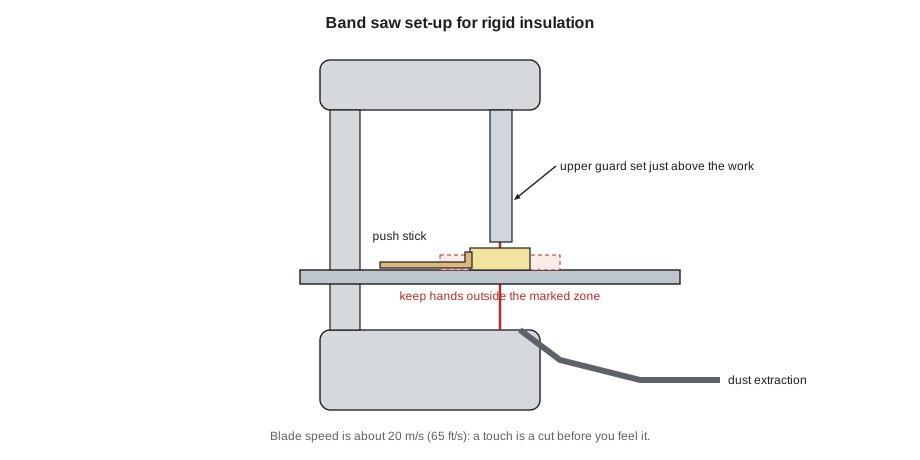
Band saws are among the most dangerous machines an insulator uses. The blade runs continuously and is hard to see when it is moving. Tomasz's band saw rules:
- Adjust the upper blade guard so it sits just above the work, about 6 mm (1/4 in) clear, before every cut.
- Use a push stick or a sled for small pieces; never feed small pieces by hand close to the blade.
- Keep fingers at least 100 mm (4 in) from the blade, in the safe zone marked on the table.
- Never reach across or behind the blade, and never pull work back through a moving blade.
- Do not wear gloves near the blade unless the shop rules allow a specific type; loose gloves can be pulled in.
- Use the dust extraction connected to the saw, and wear eye protection and, where required, a respirator.
- Stop the saw and wait for the blade to stop before clearing scraps from the table.
Worked problem
Band saw blade speed
Tomasz's band saw has wheels 457 mm in diameter turning at 830 revolutions per minute. How fast does the blade move in metres per second?
Show solution
- Distance per revolution = π × 0.457 m ≈ 1.436 m.
- Blade speed = 1.436 m × 830 rev/min ≈ 1,192 m/min.
- Per second: 1,192 ÷ 60 ≈ 19.9 m/s.
- That is about 19.9 × 3.6 ≈ 72 km/h.
Answer: About 20 m/s, or 72 km/h. A finger that touches the blade at that speed is cut before the brain registers the touch.
Angle grinders and oscillating tools
Angle grinders with cut-off wheels cut bands, threaded rod, pins and metal jacketing, and grinders with flap discs remove burrs and rust. They are fast, loud and dangerous. A cut-off wheel spins at many thousands of revolutions per minute, and a wheel that shatters throws fragments with great force. Grinder kickback, when the wheel binds and the tool jumps back toward the user, causes serious injuries to hands, arms and faces.
- Check that the wheel's maximum rated speed is equal to or higher than the grinder's speed, and that the wheel is the right size and type for the grinder.
- Inspect wheels for cracks or chips before mounting, and stand to one side when starting a grinder with a new wheel.
- Keep the guard on and positioned between the wheel and your body.
- Hold the grinder with both hands, side handle fitted, and do not force the cut.
- Wear a face shield over safety glasses, hearing protection and gloves suited to the task.
- Grinding and cutting metal make sparks, which makes them hot work. Most sites and all plants require a hot-work permit and a fire watch, and sparks must be kept away from insulation facings, adhesives and solvents. Lesson 7 covers hot work.
Oscillating multi-tools, with blades that vibrate back and forth rapidly, are useful for trimming insulation in tight spots and cutting openings in jacketing. They are safer than grinders for many small cuts and make no sparks with the right blade.
Shop machines for metal jacketing
Coldstream's shop has a foot-operated or powered shear for cutting sheet, a brake for bending straight lines, a slip roll or roll former for rolling sheet into cylinders, a beading machine that forms a small bead near one edge so jackets lap and seal neatly, and a crimping machine that crimps one end of a jacket so it slides into the next. Fitting covers for elbows are made from segments cut and joined in the shop or bought preformed.
Each machine has pinch points and shearing points where hands can be caught. Shears and brakes must have guards or devices that keep fingers out of the danger zone, such as fixed guards, two-hand controls or light curtains. Only trained and authorized workers may run them, and only one person operates a foot-pedal shear: a second person reaching in to hold the sheet while the first steps on the pedal is a classic way to lose fingers. Before clearing a jam or changing dies, the operator follows the shop's lockout procedure, so the machine cannot start unexpectedly.
Noise, vibration and dust from tools
Power tools are loud. Grinders, saws and shop shears can exceed 100 dBA, well above the level where hearing damage begins with daily exposure. Wear hearing protection whenever a tool or the area is loud, and remember that hearing loss from noise is permanent and painless. Lesson 5 covers hearing protection.
Vibrating tools used for long periods can damage the nerves and blood vessels in the hands, causing white fingers, numbness and loss of grip. Use low-vibration tools where possible, keep tools maintained, take breaks and keep hands warm.
Cutting insulation and metal also makes dust. Power sawing of rigid insulation, cutting cement-based products and grinding create fine particles that can be inhaled. Use dust extraction, cut by hand or with low-dust methods where practical, wet the material where the manufacturer allows it and wear a respirator when the hazard assessment calls for it. Never use power tools on old insulation that might contain asbestos. Lesson 8 explains why.
Worked problem
Adding up noise exposure
Devon runs a shop shear at about 94 dBA for 2 hours, works near a band saw at about 88 dBA for 3 hours and spends the rest of an 8 hour shift in quieter areas below 80 dBA. Using the 3 dB exchange rate, the allowed time at 85 dBA is 8 hours, at 88 dBA is 4 hours and at 94 dBA is 1 hour. What fraction of his daily allowance has he used without hearing protection?
Show solution
- The dose is the sum of time spent ÷ time allowed at each level.
- Shear: 2 h ÷ 1 h = 2.0.
- Band saw: 3 h ÷ 4 h = 0.75.
- Quiet areas below 80 dBA add almost nothing.
- Total dose = 2.0 + 0.75 = 2.75, or 275 in 100 of the allowance.
Answer: A dose of 2.75, nearly three times the daily limit. With earmuffs or earplugs the dose drops well below 1, which is why hearing protection is required in the shop.
Before, during and after: a power tool checklist
Coldstream's shop and field crews use the same short checklist. It takes a minute and catches most problems before they become injuries.
| When | Check |
|---|---|
| Before | Trained and authorized on this tool; tool, cord or battery, switch and guard inspected; right blade or bit fitted; area clear; PPE on; work clamped; hot-work permit if sparks |
| During | Both hands in control; stance balanced; hands out of the cut line; guard in place; dust extraction running; others kept clear |
| After | Tool stopped before setting down; unplugged or battery removed before cleaning or adjustment; blade covered; scraps and dust cleaned up; damage reported |
Common mistakes
MistakeRemoving or wedging a guard to make a cut easier.
InsteadKeep every guard in place. If a cut cannot be made with the guard working, use a different tool or method.
MistakeChanging a blade with the tool plugged in or the battery fitted.
InsteadDisconnect the power first, every time.
MistakeUsing a grinder near insulation facings, adhesives or solvents without a permit.
InsteadTreat grinding and cutting metal as hot work: get the permit, set up a fire watch and protect combustibles.
MistakeTwo people working a foot-operated shear.
InsteadOne trained person operates; nobody else reaches into the machine.
MistakeDrilling through jacketing into a vapour retarder or heat tracing.
InsteadSet the depth stop and know what is under the jacket before drilling.
MistakeUsing a power saw on old insulation of unknown content.
InsteadStop. Old insulation may contain asbestos. Do not cut it; report it.
Summary and key terms
- Every worker must be trained and authorized on a power tool before using it.
- Inspect tools before use, use the right blade and keep guards in place.
- Use GFCI protection, inspect cords daily and handle lithium-ion batteries with care.
- Band saws need the guard set just above the work, push sticks for small pieces and hands outside the safe zone.
- Grinders need the right wheel, both hands, a face shield and a hot-work permit where sparks are produced.
- Shop machines have pinch and shear points; only the trained operator runs them, and lockout applies before clearing jams.
- Control noise, vibration and dust from tools, and never power-cut insulation that might contain asbestos.
- GFCI
- Ground fault circuit interrupter: a device that cuts power when it detects current leaking to ground.
- Double insulated
- A tool built with two layers of insulation so it needs no ground pin; marked with a square in a square.
- Kickback
- A sudden violent movement of a tool back toward the user when the blade or wheel binds.
- Push stick
- A stick or block used to feed small pieces into a saw so hands stay clear of the blade.
- Pinch point
- A place where a body part can be caught between moving parts or between a moving and a fixed part.
- Brake
- A machine for bending sheet metal along a straight line.
- Beading machine
- A machine that forms a small raised bead near the edge of a jacket so laps fit and seal neatly.
Practice problems
Work each problem on paper first, then reveal the answer to check.
Name three things to inspect on a corded power tool before use.
Show answer
Any three of: housing, cord and plug, ground pin, switch, guard, blade or bit.
Why should only one person work a foot-operated shear?
Show answer
A second person reaching in while the first steps on the pedal can lose fingers.
Saw wheels 400 mm across turn at 900 rev/min. What is the blade speed in m/s?
Show answer
π × 0.4 × 900 ÷ 60 ≈ 18.8 m/s.
Why is grinding usually treated as hot work?
Show answer
It throws sparks that can ignite insulation facings, adhesives and solvents.
What should you do before clearing a jam in a shop machine?
Show answer
Stop it and follow the lockout procedure so it cannot start.
Lesson quiz · 5 questions
Score 60% or more to complete this lesson.
Create a free account to save your progress, take quizzes and earn a certificate.