
HSE-406 · Lesson 2 of 12 · 22 min
Legal duties of host companies and contractors
A week after the fire, Aisha Grant, the company lawyer, joined the leadership meeting at Harrowgate Foods Ltd. in Truro. Rachel Okoye had asked her a direct question: 'When a contractor's worker is hurt on our site, whose problem is it legally?' Aisha's answer was that it is almost always more than one company's problem. Safety law gives duties to everyone who can influence the work, and it does not let any of them hand those duties to someone else by signing a contract. This lesson sets out who owes what, and why the old idea that a host can protect itself by staying hands-off is wrong in law as well as in practice.
The lesson covers the general duties that apply at most workplaces. Construction projects carry additional rules about the prime contractor or controlling employer, which are covered in HSE-375 and HSE-402. A plant shutdown with major installation work may count as a construction project for some purposes, and the company's lawyer or safety advisor should decide that question early, before contracts are signed.
Why the law spreads duties
Safety law has always started with the employer, because the employer directs the work and controls the workplace. Contracting breaks that simple picture. The host controls the site, its processes and its hazards. The contractor controls its crew, its methods and its tools. A subcontractor controls a smaller piece. A worker standing on a platform above the bakery oven line may be employed by one company, directed by a second and exposed to hazards created by a third. If the law gave duties only to the direct employer, the companies with the most knowledge of the site's hazards could ignore them. Modern safety law closes that gap by giving duties to each party according to its role and its control.
The Nova Scotia framework
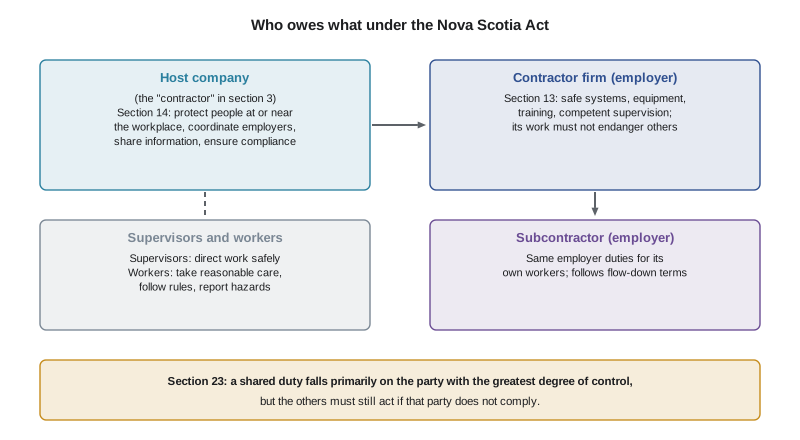
Nova Scotia's Occupational Health and Safety Act defines a contractor, in section 3, as a person who contracts for work to be performed at the premises of the person contracting to have the work performed. It does not include a constructor, which is the term used for the party in charge of a construction project, or a dependent contractor. In other words, when Harrowgate Foods Ltd. hires Bayview Mechanical to install a freezer in its own plant, the Act calls Harrowgate Foods Ltd. the contractor. Bayview, and every subcontractor under it, is an employer in its own right. This course uses host company for the party the Act calls the contractor, but anyone reading the Act, an officer's order or a court decision must keep the statutory meaning in mind.
Section 14 of the Act sets out the contractor's duties. The host company must take every precaution that is reasonable in the circumstances to ensure that:
- the health and safety of persons at or near the workplace is protected;
- the activities of employers and self-employed persons at the workplace are coordinated;
- health and safety information is shared between the employers and self-employed persons at the workplace;
- the measures and procedures required by the Act and the regulations are carried out at the workplace; and
- every employer, employee and self-employed person at the workplace complies with the Act and the regulations.
Those five duties are broad. Coordination and information sharing are the ones most often missing when contractor incidents happen, and both were missing during last August's shutdown. Nobody coordinated Coastal's hot work with the sanitation crew below, and nobody shared Northline's lockout plan with plant maintenance.
Each hired firm also carries the full duties of an employer under section 13 of the Act for its own workers: providing safe equipment and systems of work, information, instruction, training and supervision, competent supervisors, and the protective equipment the work needs. Employers must also make sure their work does not endanger other people at or near the workplace. Self-employed persons, such as an independent electrician hired directly, have their own duties under the Act to protect themselves and others. Workers have duties to take reasonable care, to follow the law and the employer's procedures, and to report hazards. Supervisors, a term that includes contractor foremen, have duties of their own.
Shared duties and the greatest degree of control
Several provisions of the Act place the same duty on more than one party. Section 23 sets out how such duties are shared. A duty imposed on more than one person is meant to be imposed primarily on the person with the greatest degree of control over the matter. If that person does not comply, the others who share the duty must comply as far as they are able. A party is excused from a shared duty only while the person with the greatest control is complying, where duplicating the effort would be unnecessary, and where safety is not put at risk by only one party complying.
Section 23 is easy to misread as a way out: 'the contractor has the most control over its crew, so the duty is theirs.' The section works the other way. If Bayview's crew is about to do hot work without a permit, Bayview has the greatest degree of control over its own crew's methods, but Harrowgate Foods Ltd. still shares the duty to make sure the regulations are followed at its workplace, and must act if it knows Bayview is not complying. And for some matters, such as the plant's own ammonia system or its fire protection, the host clearly has the greatest degree of control.
The Act's requirement that the host coordinate and share information is reinforced in Nova Scotia's Workplace Health and Safety Regulations for specific hazards. The rules for confined space entry, lockout and hot work expect the parties to know each other's procedures and to plan the work so that one employer's activity does not create a hazard for another. Those rules are covered in HSE-211, HSE-210 and HSE-216, and Lesson 8 shows how a permit-to-work system brings them together on a contractor job.
Applying the framework to last August
Aisha walked the leadership team through the fire and the near miss to show how the framework applies. Her point was not to assign blame after the fact, but to show where each party had a duty it could have met.
# Who held which duty in the hot work fire? (simplified map)
parties = {
    "Host (plant)":     {"knew site hazards": True,  "could stop work": True,  "directed crew": False},
    "Bayview (prime)":  {"knew site hazards": False, "could stop work": True,  "directed crew": False},
    "Coastal (sub)":    {"knew site hazards": False, "could stop work": True,  "directed crew": True},
    "Welder":           {"knew site hazards": False, "could stop work": True,  "directed crew": False},
}
duties = {
    "coordinate trades in the space": ["Host (plant)", "Bayview (prime)"],
    "share site hazard information":  ["Host (plant)", "Bayview (prime)"],
    "issue and enforce hot work permit": ["Host (plant)"],
    "plan safe work method and fire watch": ["Coastal (sub)", "Bayview (prime)"],
    "follow rules and report hazards": ["Welder"],
}
for duty, holders in duties.items():
    print(f"{duty:<38} -> {', '.join(holders)}")
print()
for p, f in parties.items():
print(f"{p:<17} could stop the work: {f['could stop work']}")coordinate trades in the space -> Host (plant), Bayview (prime) share site hazard information -> Host (plant), Bayview (prime) issue and enforce hot work permit -> Host (plant) plan safe work method and fire watch -> Coastal (sub), Bayview (prime) follow rules and report hazards -> Welder Host (plant) could stop the work: True Bayview (prime) could stop the work: True Coastal (sub) could stop the work: True Welder could stop the work: True
The map is simplified, but it shows the pattern. Every party, including the welder himself, had a duty it could have met, and every one of them had the power to stop the work. The host held the duties that depended on knowing the site: the flour dust, the cardboard on the ceiling panels, the sanitation crew working below. A contractor cannot protect its workers from hazards nobody tells it about.
Worked problem
Who should have done what before the valve was opened
Show solution
- The engine room near miss involved two employers working on the same ammonia system: the plant's maintenance staff and Northline Refrigeration.
- Under section 14, the host company had to coordinate the two employers' activities and share health and safety information between them, including how each would isolate the system.
- Northline, as an employer, had to make sure its own lockout procedure protected its workers and did not endanger the plant mechanic working downstream.
- The plant's ammonia system is under the host's greatest degree of control, so under section 23 the primary duty to make sure isolation was coordinated sat with the host company.
Answer: Both employers had duties, but the duty to coordinate the two lockouts and share the procedures sat first with the host. A shared lockout board and a single isolation plan, both added to the new program, meet that duty directly.
You cannot contract out of a safety duty
Contracts are important, and Lesson 6 covers what they should say. But a contract cannot remove a duty the law places on a party. A clause that says 'the contractor is solely responsible for the safety of its workers and of the work' may allocate costs between the parties if something goes wrong, and it may make the contractor's obligations clearer. It does not stop a regulator from issuing orders or citations to the host, and it does not stop a court from finding that the host failed to take reasonable precautions.
Aisha also warned against what she called the hands-off myth: the belief that a host is safer, legally, if it knows as little as possible about how a contractor works, so that it cannot be said to have controlled the work. The belief is wrong in both countries. A host that deliberately avoids knowing does not escape its own duties to coordinate, share information and keep its site safe. And a host that knows nothing cannot show it took reasonable care. The safer position, legally and practically, is to be clear about who controls what, to exercise the control the host does have and to keep records showing it did so.
Due diligence and criminal liability
Charges under the Act are strict liability offences. Once the Crown proves the prohibited act, the accused must show it took every precaution reasonable in the circumstances to avoid it. For a host, that means showing a working contractor program: prequalification, orientation, permits, supervision and follow-up, with records. A binder of forms nobody used will not show due diligence. HSE-402 covers due diligence in detail.
section 217.1 of the Criminal Code places a legal duty on everyone who undertakes, or has the authority, to direct how another person does work to take reasonable steps to prevent bodily harm to that person or anyone else arising from the work. That wording is not limited to employers. It can reach a host that directs how a contractor's work is done, and a contractor supervisor who directs a subcontractor's crew. Organizations can be convicted of criminal negligence through the conduct of their senior officers. The duty was added after the Westray mine disaster in Nova Scotia, and it is the reason Harrowgate Foods Ltd.'s leadership takes contractor oversight seriously at the senior level.
Workers' compensation is a separate question
Workers' compensation is a separate system from safety law. Each contractor firm must register with the Workers' Compensation Board of Nova Scotia (WCB) and pay assessments for its own workers. If a contractor's worker is hurt at the host's site, the claim goes to the contractor's account. But the Workers' Compensation Act can make a firm that hires a contractor responsible for the contractor's unpaid assessments, which is why hosts ask for a WCB clearance letter showing the firm is in good standing before work starts and again before final payment. Lesson 6 covers clearance letters.
What the duties mean in practice
Aisha closed her briefing with a list of what the duties require in practice. Elena used it as the outline for the new program, and each item maps to a later lesson in this course.
- Know who is on site, including every subcontractor (Lessons 7 and 10).
- Plan the work and share the site's hazards with contractors before they start (Lessons 4 and 7).
- Select contractors able to do the work safely, and keep the evidence (Lesson 5).
- Make roles, rules and expectations clear in the contract (Lesson 6).
- Coordinate high-hazard work and simultaneous activities through permits (Lesson 8).
- Supervise and audit the work, and act on what is found (Lesson 9).
- Evaluate performance and use the results (Lesson 11).
- Learn from incidents, including contractor incidents that never appear in the host's own records (Lesson 12).
None of these duties requires the host to tell a skilled refrigeration technician how to braze a joint. The host's job is to manage the interface: the place where its site, its processes and its people meet the contractor's crew, methods and tools. That is where the law puts the host's duties, and it is where most contractor incidents begin.
Common mistakes
MistakeBelieving a contract clause transfers all safety responsibility to the contractor.
InsteadUse contracts to clarify roles, but keep meeting the host's own legal duties.
MistakeStaying deliberately unaware of how contractors work to avoid being seen as in control.
InsteadExercise the control you have and keep records showing reasonable care.
MistakeReading section 23 as letting the host off whenever the contractor has more control over its crew.
InsteadRecognize that shared duties remain shared, and the host must act when it knows another party is not complying.
MistakeAssuming construction-project rules settle every contractor question at a plant.
InsteadCheck early whether major work is a construction project, and apply both sets of duties where they overlap.
MistakeTreating workers' compensation coverage as the same thing as safety compliance.
InsteadCheck coverage separately and manage safety duties on their own terms.
Summary and key terms
- Nova Scotia's Act calls the party that hires work at its own premises the contractor, and section 14 requires it to protect people, coordinate employers, share information and ensure compliance.
- Hired firms are employers with full duties for their own workers, and supervisors, self-employed persons and workers have duties too.
- Section 23 places shared duties primarily on the party with the greatest degree of control, but the others must act if that party does not comply.
- A contract cannot remove a legal duty, and deliberately knowing little about contractor work does not reduce liability.
- Workers' compensation coverage is a separate question from safety compliance, and hosts check it before work and before final payment.
- The host's duties centre on managing the interface between its site and the contractor's work.
- Contractor (under the Nova Scotia Act)
- The party that contracts for work to be performed at its own premises; in this course, the host company.
- Constructor
- Under the Nova Scotia Act, the party in charge of a construction project.
- Greatest degree of control
- The test in section 23 for which party a shared duty falls on primarily.
- Due diligence
- Taking every precaution reasonable in the circumstances, the defence to a strict liability charge.
- Coordination
- Planning the activities of different employers at a workplace so that one does not endanger another.
Practice problems
Work each problem on paper first, then reveal the answer to check.
Under the Nova Scotia Act, which party is the contractor when the plant hires Bayview to install a freezer?
Show answer
The plant, because it contracted for work at its own premises. Bayview is an employer.
Name three of the duties in section 14.
Show answer
Any three of: protect persons at or near the workplace, coordinate employers, share information, ensure required measures are carried out, ensure everyone complies.
What does section 23 say about a duty shared by several parties?
Show answer
It falls primarily on the party with the greatest degree of control, but others must comply as far as they can if that party does not.
Why does the Criminal Code duty matter for a host company?
Show answer
It applies to anyone who directs how another person does work, which can include a host directing contractor work.
Why do hosts ask for WCB clearance letters?
Show answer
Because a firm that hires a contractor can become responsible for the contractor's unpaid assessments.
Lesson quiz · 5 questions
Score 60% or more to complete this lesson.
Create a free account to save your progress, take quizzes and earn a certificate.