
HSE-406 · Lesson 1 of 12 · 22 min
Why contractors are at higher risk
Every August the main plant of Harrowgate Foods Ltd. in Truro shuts down for two weeks. The ovens cool, the spiral freezers are defrosted and the production floor fills with people who do not normally work there. Last August there were twenty-six contractor firms on site and, on the busiest day, 151 contractor workers, more than a third of the number of employees who normally work a day shift. They were installing a new spiral freezer, rebuilding a section of roof, replacing the ammonia valve station in the engine room, rewiring two mixers, recoating the floor in the frozen meals room and cleaning ductwork above the bakery.
On day six, a welder working for a small fabrication shop cut a bracket off a steel platform above the bakery oven line. He was not employed by the plant. He was not even employed by the firm Harrowgate Foods Ltd. had hired: Bayview Mechanical, the installer of the new freezer, had subcontracted the steelwork to Coastal Fab and Weld, and nobody at the plant knew Coastal's crew were on site that morning. There was no hot work permit. Sparks dropped onto years of flour dust and cardboard on top of a ceiling panel. The fire watch, a Coastal apprentice, left for his break eleven minutes after the cutting stopped. Twenty minutes later the smoke detectors went off and a sprinkler head opened. Two sanitation workers were treated for smoke inhalation, and the clean-up delayed the restart by four days.
Three days after that, a refrigeration technician from Northline Refrigeration began opening an isolation valve in the engine room while a plant mechanic was working downstream on a line he believed was locked out. The mechanic smelled ammonia, shouted and left; the technician closed the valve. Nobody was hurt. Both men had followed their own company's procedure. Neither had seen the other's.
Elena Novak, the health and safety manager, wrote both events up for Rachel Okoye, the vice-president of operations. Her summary was short: 'Our own people work under a safety program that has taken five years to build. For two weeks every year, a third of the people on site work under whatever program their employer happens to have, and we have no idea what that is.' Rachel asked Elena to build a contractor safety program before the next shutdown. This course follows that work, from the first risk review to the plan for next August.
What a contractor is in this course
A contractor, in everyday safety language, is a firm or self-employed person that a company hires to do work, usually on the company's premises, under a contract for a result rather than an employment relationship. Contractors include large construction firms, specialist trades such as refrigeration, electrical and roofing, maintenance and service providers who come for a day, cleaning and sanitation firms who work every night, pest control, equipment vendors who install and commission machines, and consultants who walk the floor taking measurements.
Nova Scotia's Act uses the word contractor in a way that surprises many people. In the Act, the contractor is the party that contracts for work to be performed at its own premises: in other words, Harrowgate Foods Ltd. itself. The firms it hires are employers in their own right, and the Act gives each of them duties too. Lesson 2 looks at this closely. To keep things clear, this course calls the company whose site it is the host company, and calls the firms it hires contractors, which is how most people speak on the plant floor.
Temporary agency workers are a related but different case. An agency worker is supplied by a staffing firm but works under the host's direction, side by side with its employees, on its tasks. Most of what this course says about information, orientation and supervision applies to them as well, but the host usually directs their work day to day, so they are often treated, for practical purposes, like the host's own workers. Contractors usually direct their own crews. That difference shapes almost everything that follows.
Why contractor work is riskier
Contractor work carries more risk than routine operations for reasons that have little to do with the skill or care of individual contractor workers. Many contractor crews are highly skilled. The risk comes from the situation.
- The work itself is often hazardous. Companies hire contractors for jobs their own staff do not do: work at height, hot work, confined space entry, high-voltage electrical work, heavy lifts, demolition, ammonia system work. Much of it is non-routine, done once a year or once a decade.
- The workers do not know the site. A contractor crew may not know where the ammonia lines run, which conveyors start automatically, where the eyewash stations are, what the alarms sound like or where to muster.
- The site does not know the workers. The host often does not know who is on site, what training they have, what procedures they follow or who supervises them.
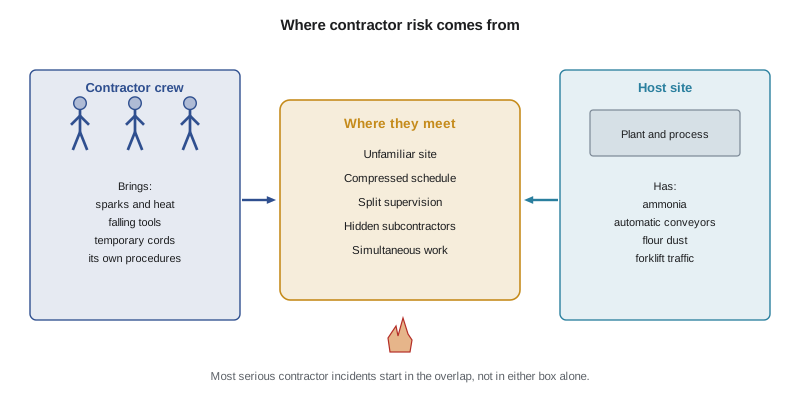
- Two sets of hazards meet. The contractor brings its own hazards, such as sparks, falling tools and temporary electrical cords, into a site that has its own, such as ammonia, moving equipment and flammable dust. Each side tends to see its own hazards and not the other's.
- Work is compressed. Shutdowns, outages and installations run against a fixed restart date. Many trades work in the same space at once, often on long shifts, under pressure to finish.
- Supervision is thin or split. Contractor supervisors may manage several sites. Host staff may assume the contractor is supervising; the contractor may assume the host is.
- Contracting chains hide people. Subcontractors, and their subcontractors, may arrive without the host knowing, as Coastal's crew did.
What the data show
Injury data on contractors are harder to find than data on employees, because injury records are kept by employer, not by site. A contractor worker hurt at a food plant appears in the contractor's records, not the plant's. Even so, the pattern in the data that do exist is consistent: contractor workers are over-represented in serious injuries and deaths, especially in high-hazard work.
In the United States, the Bureau of Labor Statistics began identifying contracted workers in its census of fatal work injuries in 2011. In 2015, for example, it counted 829 deaths of contracted workers, roughly one in six of all work deaths that year, and just under 60 percent of the construction laborers who died at work were contracted workers. Process industries tell a similar story. Investigations of refinery and chemical plant accidents repeatedly find contractor workers among the people killed, often because they were doing maintenance and turnaround work close to hazardous processes.
Canadian compensation data are kept by employer and industry, so contractor injuries are spread across construction, trades and service categories rather than counted as a group. Provincial reviews of serious incidents, however, show the same pattern found elsewhere: maintenance, installation and shutdown work done by outside firms features heavily among serious injuries at industrial sites.
# Who was on site at the main plant during last August's shutdown?
employees_day = 410          # plant staff on a normal day shift
contractor_firms = 26
contractor_peak = 151        # busiest day
contractor_hours = 9820      # all contractor hours over the 14 days
employee_hours = 23400       # plant staff hours over the same 14 days (reduced crews)

share_people = contractor_peak / (employees_day + contractor_peak)
share_hours = contractor_hours / (contractor_hours + employee_hours)
print(f"contractor share of people on the peak day: {share_people:.0%}")
print(f"contractor share of hours during the shutdown: {share_hours:.0%}")

# Incidents during the shutdown, by who was involved
incidents = {"contractor": 7, "employee": 3}
for who, n in incidents.items():
    hrs = contractor_hours if who == "contractor" else employee_hours
    rate = n * 200000 / hrs
print(f"{who:<11} incidents {n}, rate per 200,000 hours {rate:.0f}")contractor share of people on the peak day: 27% contractor share of hours during the shutdown: 30% contractor incidents 7, rate per 200,000 hours 143 employee incidents 3, rate per 200,000 hours 26
Elena's numbers were rough, but they made the point to the leadership team. Contractors did about 30 percent of the hours during the shutdown and were involved in seven of the ten recorded incidents. Their incident rate per 200,000 hours was more than five times that of plant staff during the same two weeks. None of those incidents had appeared in the plant's own injury statistics.
Common patterns in contractor incidents
When serious contractor incidents are investigated, a handful of patterns appear again and again. Recognizing them is the first step in designing a program to prevent them.
- Unknown energy. A contractor works on equipment that is energized, pressurized or connected to a process because lockout was incomplete or the two parties used different lockout systems, as in the engine room near miss.
- Hot work in the wrong place. Welding or cutting near combustible material, insulation, dust or flammable vapour without a permit, an adequate fire watch or gas testing.
- Falls. Roof work, mezzanines, ladders and platforms, often with temporary edges created by the work itself.
- Confined spaces. Entries into tanks, pits, ducts, silos or spiral freezers without testing, ventilation or a rescue plan. Would-be rescuers, sometimes from another firm, are often among the dead.
- Struck-by and caught-in. Contractor workers near forklifts, conveyors and moving machinery they do not know will start.
- Simultaneous operations. Two crews working above and below each other, or one crew's work creating a hazard for another, with no one coordinating the two.
The Truro fire and the engine room near miss fitted two of these patterns exactly. Neither needed a new technology to prevent it. Both needed the host and its contractors to know who was on site, what they were doing and what controls were in place.
Worked problem
Sorting last August's contractor jobs by risk
Show solution
- Elena and Luis Ortega, the maintenance lead, listed every contractor job from the shutdown, all forty-one of them.
- For each job they asked three questions: does it involve a high-hazard activity (hot work, height, confined space, energy isolation, ammonia, heavy lifts)? Does it take place near plant hazards? Will other crews be working in the same space at the same time?
- Jobs with yes to the first question went into the high-risk group: fourteen jobs, including the freezer installation, the valve station, the roof and the duct cleaning.
- Jobs with no high-hazard activity but plant hazards nearby, such as the floor recoating near ammonia lines, went into the medium group. Low-risk jobs, such as delivering parts or calibrating scales, went into the low group.
Answer: Fourteen of forty-one jobs carried most of the risk. The program would put most of its effort there, rather than spreading the same paperwork evenly across every vendor.
What a contractor safety program has to do
A contractor safety program is not a binder of forms. It is a set of steps that runs from the moment someone decides work needs doing to the moment the contractor leaves and its performance is reviewed. Lesson 3 sets out the full lifecycle. In outline, a program must make sure that:
- the work is planned and its hazards are known before anyone is hired;
- only contractors able to do the work safely are selected;
- contracts make safety duties, roles and expectations clear;
- every contractor worker knows the site's hazards, rules and emergency arrangements before starting;
- high-hazard work is controlled through permits and coordination;
- someone is watching the work and acting on what they see;
- contractors' performance is measured, reviewed and used for future decisions; and
- lessons from incidents feed back into the program.
Each of those steps is covered in its own lesson. Throughout, the course follows Elena, Luis, the procurement manager Kevin Doucette and the people they work with at Harrowgate Foods Ltd., and the contractors who return to Truro every August.
Contractors are partners, not just risks
It would be easy to read this lesson as a list of reasons to distrust contractors. That would be a mistake. The best contractor firms often have stronger safety programs than the hosts that hire them: specialist refrigeration and electrical contractors, for example, live with high-hazard work every day. A good program treats contractors as partners, learns from them and gives them what they need to work safely: accurate information about site hazards, enough time and space to do the job, clear points of contact and a quick answer when they raise a concern.
Several of the most useful ideas in Harrowgate Foods Ltd.'s new program came from contractors themselves. Northline's service manager suggested a shared lockout board in the engine room so that both companies' locks would hang in the same place. Bayview's site supervisor, Jen MacLeod, admitted that she had not known Coastal's crew were starting early that morning either, and asked for a daily coordination meeting with every crew on site. Neither idea cost much. Both addressed exactly the gaps that last August had exposed.
Common mistakes
MistakeAssuming a skilled contractor will manage all the risks of working on your site.
InsteadRecognize that contractors do not know your site's hazards; share them and coordinate the work.
MistakeJudging the site's safety by the host's own injury records.
InsteadTrack contractor hours and incidents on site, because they do not appear in the host's records.
MistakeTreating every contractor job the same way.
InsteadSort jobs by risk and put most of the effort into high-hazard and simultaneous work.
MistakeSeeing contractors only as a source of risk.
InsteadTreat them as partners who often bring expertise and good ideas.
MistakeAssuming only the firms you hired are on site.
InsteadFind out about every subcontractor before it arrives.
Summary and key terms
- Contractors often do the most hazardous, least routine work, on sites they do not know, under time pressure.
- Risk comes from the meeting of two sets of hazards and two management systems, not from contractor workers being careless.
- Contractor injuries usually appear in the contractor's records, not the host's, so hosts must track them separately.
- Common patterns include unknown energy, hot work, falls, confined spaces, struck-by events and uncoordinated simultaneous work.
- A contractor safety program covers the whole lifecycle, from planning and selection to close-out and learning.
- Good programs treat contractors as partners and put most of their effort into high-risk work.
- Host company
- The company whose site or premises the contracted work is done on.
- Contractor
- A firm or self-employed person hired to do work under a contract for a result, usually directing its own crew.
- Subcontractor
- A firm hired by a contractor, rather than by the host, to do part of the work.
- Temporary agency worker
- A worker supplied by a staffing firm who works under the host's day-to-day direction.
- Shutdown
- A planned period when production stops so that maintenance, repairs and installations can be done.
Practice problems
Work each problem on paper first, then reveal the answer to check.
Why did nobody at the plant know Coastal Fab and Weld was on site?
Show answer
Bayview had subcontracted the steelwork to Coastal without telling the plant, and there was no system to find out who was arriving.
Give three reasons contractor work carries more risk than routine operations.
Show answer
Any three of: hazardous non-routine work, unfamiliar site, host does not know the workers, two sets of hazards meeting, compressed schedules, split supervision, hidden subcontractors.
Why might a host's injury statistics look good even when contractors are being hurt on its site?
Show answer
Contractor injuries are recorded by the contractor's employer, not the host.
What was the contractor share of hours during the shutdown, and of incidents?
Show answer
About 30 percent of hours and seven of ten incidents.
Name two patterns that the Truro fire and the engine room near miss fitted.
Show answer
Hot work in the wrong place and unknown energy (incomplete or uncoordinated lockout).
Lesson quiz · 5 questions
Score 60% or more to complete this lesson.
Create a free account to save your progress, take quizzes and earn a certificate.