
HSE-406 · Lesson 3 of 12 · 22 min
The contractor management lifecycle
When Elena Novak started on the contractor program, she began by collecting every document Harrowgate Foods Ltd. already had. There was a two-page contractor rules sheet from 2014, a purchasing policy that required three quotes for jobs over a set value, an insurance form, a hot work permit pad, a sign-in book at the security desk and a folder of certificates that someone in accounts payable kept. Each piece had been written by a different department for a different reason. None of them connected to the others. A contractor could be chosen by a maintenance planner, approved by purchasing on price, signed in by security and paid by accounts, without anyone asking whether it could do the job safely or checking how it performed once it arrived.
What was missing was a lifecycle: a single path that every contractor job follows from the moment someone decides work needs doing until the contractor leaves and its performance is recorded. This lesson describes that path, the people responsible at each stage and the way the stages feed into each other.
The stages of the lifecycle
Different organizations divide the lifecycle in different ways, but the stages are much the same everywhere. Harrowgate Foods Ltd. settled on eight:
- 1. Plan and scope. Define the work, identify its hazards and the site hazards around it, and decide the job's risk level.
- 2. Prequalify. Check that a contractor has the safety program, record, competence and documents needed for work at that risk level, before it is invited to bid.
- 3. Select and contract. Choose a contractor on safety as well as price and schedule, and write safety requirements into the contract.
- 4. Orient and authorize. Give every contractor worker the site orientation, check training and documents, and issue site access.
- 5. Plan the job and issue permits. Agree the work method, coordinate with other crews and plant operations, and issue permits for high-hazard tasks.
- 6. Monitor the work. Supervise, inspect and audit the work while it is under way, and act on what is found.
- 7. Close out. Confirm the work is complete and safe to hand back, permits are closed, the area is restored and the site is returned to operations.
- 8. Evaluate and feed back. Rate the contractor's safety performance, record lessons learned and use both in future selection and planning.
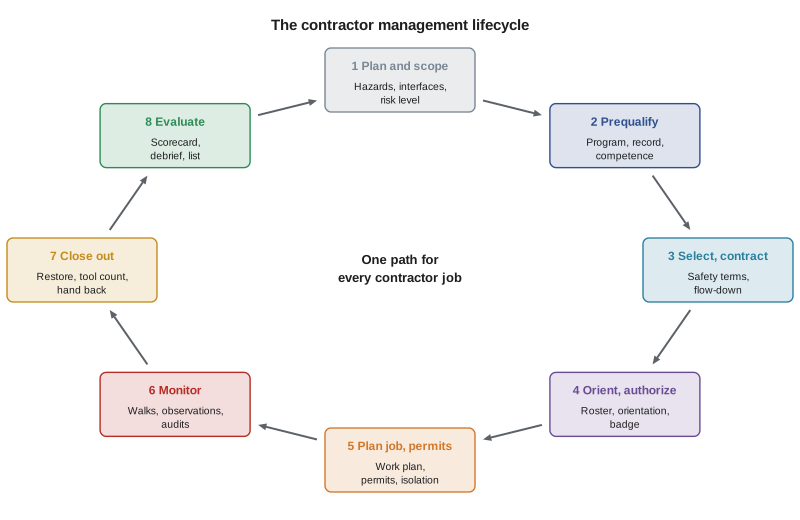
The stages are not new ideas. Most of them already existed at Harrowgate Foods Ltd. in some form. What the lifecycle adds is order and connection. Prequalification uses the risk level set at the planning stage. Orientation uses the hazard list from the scope. The evaluation at the end goes back into the approved contractor list that prequalification draws on. Each stage takes information from the one before and passes something to the one after.
Management system standards describe the same idea. ISO 45001, the international standard for occupational health and safety management systems, has a clause on contractors within its section on procurement. It requires an organization to coordinate its procurement processes with contractors in order to identify hazards and assess and control risks arising from the contractor's activities that affect the organization, from the organization's activities that affect the contractor's workers, and from the contractor's activities that affect other interested parties. It also requires the organization to define and apply health and safety criteria for selecting contractors and to make sure contractors and their workers meet the organization's requirements. Harrowgate Foods Ltd. is not certified to ISO 45001, but Elena used the standard as a check that the program covered the expected ground.
Who is responsible at each stage
The most common reason contractor programs fail is not missing paperwork. It is unclear ownership. Everyone assumes someone else checked the insurance, ran the orientation or was watching the work. Elena's draft gave every stage a named owner. The person who owns a contractor job from start to finish, called the job owner at Harrowgate Foods Ltd., is the manager or planner who asked for the work. The job owner does not do every task personally, but is accountable for making sure every stage happens.
| Stage | Job owner | Purchasing | Health and safety | Area owner |
|---|---|---|---|---|
| Plan and scope | Leads | Informed | Advises on risk level | Identifies area hazards |
| Prequalify | Informed | Runs the process | Reviews safety files | Informed |
| Select and contract | Recommends | Awards the contract | Sets safety terms | Informed |
| Orient and authorize | Arranges | Informed | Delivers general orientation | Delivers area orientation |
| Plan job and permits | Leads | None | Reviews high-risk plans | Issues permits |
| Monitor | Leads | None | Audits | Watches the area daily |
| Close out | Leads | Releases final payment | Confirms permits closed | Accepts the area back |
| Evaluate | Completes the rating | Updates the list | Reviews trends | Gives input |
The area owner is the production or maintenance supervisor who controls the part of the plant where the work happens: the engine room, the bakery hall or the frozen meals room. The area owner knows the area's hazards and decides when equipment can be released for work and when it can be returned. Kevin Doucette, the purchasing manager, owns the approved contractor list and the contract templates. Elena's team sets the standards, runs general orientation, reviews high-risk plans and audits the work, but it does not own contractor jobs. That point mattered to her: 'If safety owns contractors, everyone else stops thinking about them.'
Different kinds of contractor relationships
Not every contractor arrives for a shutdown. Harrowgate Foods Ltd. found five kinds of relationship, and the lifecycle had to work for all of them:
- Project contractors come for a defined job, such as the freezer installation or the roof replacement, and then leave. They go through every stage once per project.
- Recurring service contractors come regularly for short visits: the pest control technician every two weeks, the forklift service technician monthly, the fire sprinkler inspector each quarter. They are prequalified and oriented once a year, with a quick check-in at each visit.
- Resident contractors work on site every day or every night as part of normal operations, such as the contract sanitation crew that cleans the bakery hall each night. Their crews are effectively part of the workforce and need to be included in the site's own safety meetings, inspections and incident reporting.
- Emergency call-outs are contractors called at short notice to fix a breakdown, such as a refrigeration technician called at two in the morning when a compressor fails. The lifecycle has to work in hours, not weeks.
- Vendors and visitors who do work, such as an equipment supplier's technician commissioning a new mixer. They are often treated as visitors when they are really doing contractor work.
The fast path for emergency call-outs was one of the hardest parts to design. Elena's answer was to prequalify a short list of emergency contractors in advance for each critical system: refrigeration, electrical, boilers and the main conveyors. Each one had current documents on file and had been through a full orientation. When the call came at two in the morning, the night supervisor could call only a contractor already on the list, use a one-page emergency orientation checklist at the gate and issue permits through the on-call maintenance lead. Speed came from the work done in advance, not from skipping steps.
Linking the lifecycle to purchasing and payment
A lifecycle only works if work cannot easily bypass it. At most companies, the strongest control points are not safety documents but purchasing and payment. Kevin suggested two simple rules that turned out to be the backbone of the program:
- No purchase order for on-site work can be issued to a contractor that is not on the approved list for the job's risk level. The purchasing system checks the contractor's status automatically.
- No final payment is released until the job owner confirms close-out and the contractor's performance rating has been entered.
The first rule stopped the most common bypass: a supervisor calling a contractor he knew personally and asking for a quick job on a credit card or an open purchase order. The second rule made the last two stages happen. Before it, close-out and evaluation were the steps most often skipped, because the job was finished and everyone had moved on. With payment tied to them, they happened within a week.
Security was the third control point. The sign-in book at the gate was replaced by a check against the list of workers who had completed orientation. A contractor worker not on the list could not be issued a badge. Kevin and Elena agreed that the security guard's job was not to judge safety but to check that the earlier stages had been done, and to call the job owner if they had not.
# Lifecycle tracker: which stages are complete for each shutdown job?
STAGES = ["scope", "prequal", "contract", "orient", "permits", "monitor", "closeout", "evaluate"]
jobs = {
    "Spiral freezer install (Bayview)": ["scope", "prequal", "contract", "orient"],
    "Ammonia valve station (Northline)": ["scope", "prequal", "contract"],
    "Roof section (Atlantic Roofing)": ["scope", "prequal", "contract", "orient", "permits"],
    "Duct cleaning (AirPro)": ["scope"],
}
for job, done in jobs.items():
    nxt = next((s for s in STAGES if s not in done), "complete")
    gaps = [s for s in STAGES[:STAGES.index(nxt)] if s not in done] if nxt != "complete" else []
    print(f"{job:<36} {len(done)}/{len(STAGES)} done, next: {nxt}")
blocked = [j for j, d in jobs.items() if "prequal" not in d]
print("cannot be issued a purchase order yet:", blocked)Spiral freezer install (Bayview) 4/8 done, next: permits Ammonia valve station (Northline) 3/8 done, next: orient Roof section (Atlantic Roofing) 5/8 done, next: monitor Duct cleaning (AirPro) 1/8 done, next: prequal cannot be issued a purchase order yet: ['Duct cleaning (AirPro)']
Elena ran a version of this tracker every week in the months before the shutdown. It made the status of every job visible to the leadership team, and it made the late jobs obvious: the duct cleaning contract had been scoped but the firm had not yet been prequalified, three months before it was due to start.
Worked problem
Following one job through the lifecycle
Show solution
- Plan and scope: Luis Ortega, as job owner, defined the ammonia valve station replacement, listed its hazards (ammonia release, energy isolation, hot work, work in a process area) and rated it high risk.
- Prequalify and select: Kevin sent the job to three refrigeration contractors already on the high-risk list. Elena's team reviewed each firm's safety program, record and ammonia training. Northline was selected on safety, experience and price.
- Contract, orient and plan: the contract included the site rules and the requirement for a joint isolation plan. Northline's crew completed general and engine room orientation, and Luis and Northline's lead wrote the isolation plan together.
- Permits, monitoring and close-out: the area owner issued line-break, lockout and hot work permits each day; Elena's team audited the work twice; at close-out the area owner accepted the system back after a leak test.
- Evaluate: Luis rated Northline's performance, including the near miss from the previous year and the improvement this year, and the rating went into the approved list.
Answer: Every stage had an owner and a record, and the evaluation at the end fed directly into the next time the plant chose a refrigeration contractor.
Scaling the lifecycle to the risk
A lifecycle that demands the same effort for a scale calibration and an ammonia valve replacement will either collapse under its own weight or be ignored. Harrowgate Foods Ltd.'s program uses the risk level set at the planning stage to scale every later stage. Low-risk jobs need basic documents, a short orientation and a sign-in. Medium-risk jobs add a review of the contractor's safety program and a job hazard analysis. High-risk jobs add a full prequalification review, a written work plan reviewed by the safety team, permits, daily coordination and more frequent audits. Lesson 4 explains how jobs are rated.
Scaling to risk also keeps the program credible with contractors. A pest control technician who is asked to fill in a forty-page questionnaire to place bait stations soon concludes the program is about paperwork, and so do the people inside the company. A refrigeration contractor asked for a detailed isolation plan for an ammonia job sees that the host understands the work.
Writing the program down
Elena wrote the program as a short standard, eleven pages long, with forms and checklists in an appendix. It set out the lifecycle, the owners, the risk levels and the requirements at each level, and the control points in purchasing, security and payment. It replaced the 2014 rules sheet and the separate departmental forms. The joint occupational health and safety committee reviewed the draft, and several of its comments came from workers who had worked alongside contractors: a request that the plant's own workers be told which contractors would be in their area each day, and a request that anyone, employee or contractor, could stop a contractor job they believed was unsafe without having to find the job owner first. Both went into the final version.
The standard was approved by Rachel Okoye and issued in January, seven months before the shutdown. That gave time to prequalify the contractors, rewrite the contracts and train the job owners, who were the people most affected. Most of them had never thought of themselves as responsible for contractor safety. The training session for job owners was two hours long and used last August's fire as its case study.
Common mistakes
MistakeLeaving each department to manage its own piece of contractor control.
InsteadConnect the pieces into one lifecycle with a named owner for every stage.
MistakeMaking the safety department the owner of every contractor job.
InsteadMake the manager who asked for the work the job owner, with safety as advisor and auditor.
MistakeDesigning the program only for large projects.
InsteadMake it work for recurring, resident, emergency and vendor work too.
MistakeSkipping close-out and evaluation once the work is done.
InsteadTie final payment to close-out and the performance rating.
MistakeApplying the same requirements to every job.
InsteadScale each stage to the job's risk level.
Summary and key terms
- A contractor lifecycle connects planning, prequalification, selection, orientation, permits, monitoring, close-out and evaluation into one path.
- Each stage uses information from the one before and feeds the one after, and the final evaluation feeds future selection.
- Every stage needs a named owner; the job owner is accountable for the whole job.
- The lifecycle must cover project, recurring, resident, emergency and vendor work.
- Purchasing, security and payment are strong control points that stop work bypassing the program.
- The effort at each stage is scaled to the job's risk level.
- Contractor lifecycle
- The sequence of stages every contractor job follows, from planning to evaluation.
- Job owner
- The manager or planner who asked for the work and is accountable for every stage of the contractor job.
- Area owner
- The supervisor who controls the part of the site where the work happens and releases and accepts equipment.
- Approved contractor list
- The list of contractors prequalified for work at each risk level.
- Resident contractor
- A contractor that works on site every day or night as part of normal operations.
Practice problems
Work each problem on paper first, then reveal the answer to check.
List the eight stages of the lifecycle used at the plant.
Show answer
Plan and scope, prequalify, select and contract, orient and authorize, plan the job and issue permits, monitor, close out, evaluate and feed back.
Why did Elena refuse to make the safety department the owner of contractor jobs?
Show answer
Because others would stop thinking about contractor safety; the person who asks for the work must own it.
How does the program handle a breakdown at two in the morning?
Show answer
By using emergency contractors prequalified and oriented in advance, with a short checklist at the gate and permits through the on-call lead.
Which two purchasing rules became the backbone of the program?
Show answer
No purchase order to a contractor not approved for the risk level, and no final payment until close-out and rating are done.
Which kind of contractor relationship is often mistaken for a visit?
Show answer
Vendors' technicians who install or commission equipment.
Lesson quiz · 5 questions
Score 60% or more to complete this lesson.
Create a free account to save your progress, take quizzes and earn a certificate.