
HSE-406 · Lesson 2 of 12 · 22 min
Legal duties of host employers and contractors
A week after the fire, Aisha Grant, the company lawyer, joined the leadership meeting at Harrowgate Foods Inc. in Gainesville. Rachel Okoye had asked her a direct question: 'When a contractor's worker is hurt on our site, whose problem is it legally?' Aisha's answer was that it is almost always more than one company's problem. Safety law gives duties to everyone who can influence the work, and it does not let any of them hand those duties to someone else by signing a contract. This lesson sets out who owes what, and why the old idea that a host can protect itself by staying hands-off is wrong in law as well as in practice.
The lesson covers the general duties that apply at most workplaces. Construction projects carry additional rules about the prime contractor or controlling employer, which are covered in HSE-375 and HSE-402. A plant shutdown with major installation work may count as a construction project for some purposes, and the company's lawyer or safety advisor should decide that question early, before contracts are signed.
Why the law spreads duties
Safety law has always started with the employer, because the employer directs the work and controls the workplace. Contracting breaks that simple picture. The host controls the site, its processes and its hazards. The contractor controls its crew, its methods and its tools. A subcontractor controls a smaller piece. A worker standing on a platform above the bakery oven line may be employed by one company, directed by a second and exposed to hazards created by a third. If the law gave duties only to the direct employer, the companies with the most knowledge of the site's hazards could ignore them. Modern safety law closes that gap by giving duties to each party according to its role and its control.
The federal framework
The OSH Act gives every employer two general duties in section 5(a): to provide a workplace free from recognized hazards that are causing or likely to cause death or serious physical harm, and to comply with OSHA standards. Section 5(b) requires employees to comply with standards that apply to their own conduct. Nothing in the Act itself talks about contractors or hosts. The way OSHA applies those duties when several employers share a worksite is set out in its multi-employer citation policy, issued as an OSHA directive in 1999 and still in force. The policy applies to all industries, not only construction.
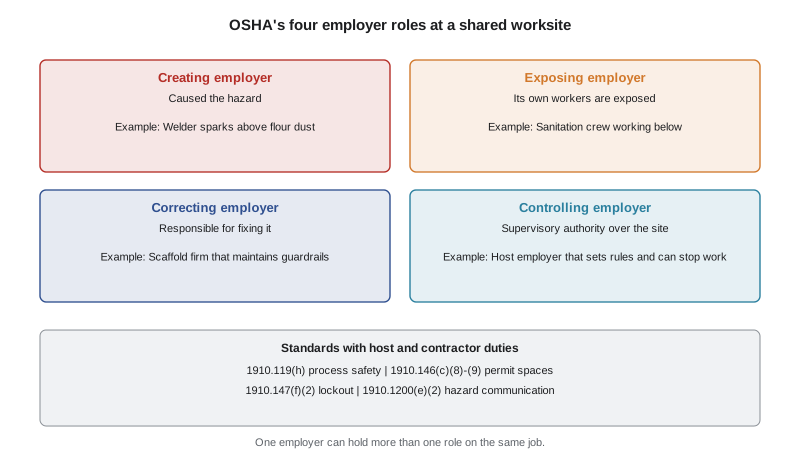
Under the policy, OSHA first asks which category each employer falls into at the site, and then whether that employer met its obligations for that role. An employer may fall into more than one category. The four categories are:
- Creating employer: the employer that caused the hazardous condition. A creating employer can be cited even if only other employers' workers are exposed.
- Exposing employer: an employer whose own employees are exposed to the hazard. If it did not create the hazard, it must still take reasonable steps, such as asking the creating or controlling employer to fix it, removing its workers or protecting them in other ways.
- Correcting employer: an employer responsible for correcting a hazard, such as a firm hired to install and maintain guardrails or fire protection.
- Controlling employer: an employer with general supervisory authority over the worksite, including the power to correct hazards or require others to correct them, whether by contract or by actual practice.
A controlling employer is not expected to inspect as often or as thoroughly as the employer whose workers do the work. It must exercise reasonable care to prevent and detect violations. OSHA looks at factors such as the scale and nature of the project, how fast the work changes, the controlling employer's knowledge of the contractor's safety history and practices, and how often it inspects. A controlling employer that knows a contractor has a poor record is expected to watch more closely.
Federal appeals courts have generally upheld the policy, including a 2018 decision of the Fifth Circuit that confirmed OSHA can cite a controlling employer for hazards to which only another employer's workers were exposed. Harrowgate Foods Inc. therefore assumes it can be treated as a controlling employer for contractor work at its plants, because it decides what work is done, when, where and under which site rules, and can stop the work.
Specific standards that address contractors
Several OSHA standards spell out what host employers and contractors must do for each other. They apply on top of the general multi-employer policy, and each is covered in detail in its own course:
- Process safety management, 29 CFR 1910.119(h). At a covered process, such as Gainesville's ammonia refrigeration system with roughly 14,000 lb of ammonia, above the 10,000 lb threshold, the host must obtain and evaluate information about a contractor's safety performance and programs before selecting it, inform contractors of the known hazards of the process, explain the emergency action plan, control entry to and exit from process areas, periodically evaluate contractor performance and keep a log of contractor injuries and illnesses related to work in process areas. The contractor must train its workers in the work practices and hazards, document that training, make sure its workers follow the site's safety rules and tell the host about any unique hazards its work presents or finds.
- Permit-required confined spaces, 29 CFR 1910.146(c)(8) and (9). The host must tell entry contractors that the space is a permit space, explain the hazards it knows of and the precautions it has taken, coordinate entry when both work in or near the space, and debrief the contractor at the end. The contractor must obtain that information, coordinate and tell the host about its procedures and any hazards it found.
- Lockout, 29 CFR 1910.147(f)(2). When outside servicing personnel do lockout work, the host and the outside employer must inform each other of their lockout procedures, and the host must make sure its own employees understand and follow the outside employer's program.
- Hazard communication, 29 CFR 1910.1200(e)(2). Employers at a multi-employer site must tell each other about hazardous chemicals their workers may be exposed to, where safety data sheets are kept and which precautions are needed.
For temporary workers supplied by a staffing agency, OSHA treats the agency and the host as jointly responsible, with the host usually responsible for site-specific hazards and training because it controls the work. That is a different arrangement from contractors who direct their own crews, but many host employers manage both through the same program.
Applying the framework to last August
Aisha walked the leadership team through the fire and the near miss to show how the framework applies. Her point was not to assign blame after the fact, but to show where each party had a duty it could have met.
# Who held which duty in the hot work fire? (simplified map)
parties = {
    "Host (plant)":     {"knew site hazards": True,  "could stop work": True,  "directed crew": False},
    "Bayview (prime)":  {"knew site hazards": False, "could stop work": True,  "directed crew": False},
    "Coastal (sub)":    {"knew site hazards": False, "could stop work": True,  "directed crew": True},
    "Welder":           {"knew site hazards": False, "could stop work": True,  "directed crew": False},
}
duties = {
    "coordinate trades in the space": ["Host (plant)", "Bayview (prime)"],
    "share site hazard information":  ["Host (plant)", "Bayview (prime)"],
    "issue and enforce hot work permit": ["Host (plant)"],
    "plan safe work method and fire watch": ["Coastal (sub)", "Bayview (prime)"],
    "follow rules and report hazards": ["Welder"],
}
for duty, holders in duties.items():
    print(f"{duty:<38} -> {', '.join(holders)}")
print()
for p, f in parties.items():
print(f"{p:<17} could stop the work: {f['could stop work']}")coordinate trades in the space -> Host (plant), Bayview (prime) share site hazard information -> Host (plant), Bayview (prime) issue and enforce hot work permit -> Host (plant) plan safe work method and fire watch -> Coastal (sub), Bayview (prime) follow rules and report hazards -> Welder Host (plant) could stop the work: True Bayview (prime) could stop the work: True Coastal (sub) could stop the work: True Welder could stop the work: True
The map is simplified, but it shows the pattern. Every party, including the welder himself, had a duty it could have met, and every one of them had the power to stop the work. The host held the duties that depended on knowing the site: the flour dust, the cardboard on the ceiling panels, the sanitation crew working below. A contractor cannot protect its workers from hazards nobody tells it about.
Worked problem
Who should have done what before the valve was opened
Show solution
- The engine room near miss involved two employers working on the same ammonia system: the plant's maintenance staff and Northline Refrigeration.
- Under 1910.147(f)(2), the host and Northline had to inform each other of their lockout procedures, and the host had to make sure its own employees understood Northline's.
- Because the ammonia system is a covered process, 1910.119(h) also required the host to inform Northline of the process hazards and control entry to the process area, and required Northline to follow the site's safety rules.
- Under the multi-employer policy, the host was both an exposing employer (its mechanic was exposed) and a controlling employer (it controlled the system and the schedule).
Answer: Both employers had duties, but the duty to coordinate the two lockouts and share the procedures sat first with the host. A shared lockout board and a single isolation plan, both added to the new program, meet that duty directly.
You cannot contract out of a safety duty
Contracts are important, and Lesson 6 covers what they should say. But a contract cannot remove a duty the law places on a party. A clause that says 'the contractor is solely responsible for the safety of its workers and of the work' may allocate costs between the parties if something goes wrong, and it may make the contractor's obligations clearer. It does not stop a regulator from issuing orders or citations to the host, and it does not stop a court from finding that the host failed to take reasonable precautions.
Aisha also warned against what she called the hands-off myth: the belief that a host is safer, legally, if it knows as little as possible about how a contractor works, so that it cannot be said to have controlled the work. The belief is wrong in both countries. A host that deliberately avoids knowing does not escape its own duties to coordinate, share information and keep its site safe. And a host that knows nothing cannot show it took reasonable care. The safer position, legally and practically, is to be clear about who controls what, to exercise the control the host does have and to keep records showing it did so.
Penalties and criminal liability
OSHA penalties are assessed per violation and are adjusted every year for inflation. Willful and repeated violations carry much higher maximums than serious ones. Contractor incidents often produce citations for several employers at once: the creating employer, the exposing employer and the controlling employer may each be cited for the same hazard, each for failing in its own role.
The OSH Act's criminal provision, in section 17(e), applies when a willful violation of a standard causes the death of an employee. Federal prosecutors have also used other federal laws, such as those covering false statements and obstruction, in workplace death cases. State prosecutors have charged companies and individuals under state manslaughter and reckless endangerment laws after contractor deaths. Leadership at Harrowgate Foods Inc. takes contractor oversight seriously because the consequences reach well beyond fines.
Workers' compensation is a separate question
Workers' compensation is a separate system from safety law, run under state law. Each contractor must normally carry workers' compensation insurance for its own employees. If a contractor's worker is hurt at the host's site, the claim goes to the contractor's insurer. Under Georgia's statutory employer rules, a principal contractor can become liable for compensation to a subcontractor's employees if the subcontractor has no coverage, which is why hosts and prime contractors ask for a certificate of insurance showing workers' compensation and liability coverage before work starts. Lesson 6 covers insurance documents.
What the duties mean in practice
Aisha closed her briefing with a list of what the duties require in practice. Elena used it as the outline for the new program, and each item maps to a later lesson in this course.
- Know who is on site, including every subcontractor (Lessons 7 and 10).
- Plan the work and share the site's hazards with contractors before they start (Lessons 4 and 7).
- Select contractors able to do the work safely, and keep the evidence (Lesson 5).
- Make roles, rules and expectations clear in the contract (Lesson 6).
- Coordinate high-hazard work and simultaneous activities through permits (Lesson 8).
- Supervise and audit the work, and act on what is found (Lesson 9).
- Evaluate performance and use the results (Lesson 11).
- Learn from incidents, including contractor incidents that never appear in the host's own records (Lesson 12).
None of these duties requires the host to tell a skilled refrigeration technician how to braze a joint. The host's job is to manage the interface: the place where its site, its processes and its people meet the contractor's crew, methods and tools. That is where the law puts the host's duties, and it is where most contractor incidents begin.
Common mistakes
MistakeBelieving a contract clause transfers all safety responsibility to the contractor.
InsteadUse contracts to clarify roles, but keep meeting the host's own legal duties.
MistakeStaying deliberately unaware of how contractors work to avoid being seen as in control.
InsteadExercise the control you have and keep records showing reasonable care.
MistakeAssuming the multi-employer policy applies only to construction sites.
InsteadRecognize that OSHA applies it in all industries, including food plants.
MistakeAssuming construction-project rules settle every contractor question at a plant.
InsteadCheck early whether major work is a construction project, and apply both sets of duties where they overlap.
MistakeTreating workers' compensation coverage as the same thing as safety compliance.
InsteadCheck coverage separately and manage safety duties on their own terms.
Summary and key terms
- OSHA's multi-employer citation policy applies the OSH Act's duties at shared worksites through four roles: creating, exposing, correcting and controlling employers.
- Specific standards for process safety, permit spaces, lockout and hazard communication set out what hosts and contractors must tell each other.
- A controlling employer must exercise reasonable care to prevent and detect violations, scaled to the job and the contractor's record.
- A contract cannot remove a legal duty, and deliberately knowing little about contractor work does not reduce liability.
- Workers' compensation coverage is a separate question from safety compliance, and hosts check it before work and before final payment.
- The host's duties center on managing the interface between its site and the contractor's work.
- Multi-employer citation policy
- The OSHA directive that explains when more than one employer at a site can be cited for a hazard.
- Controlling employer
- An employer with general supervisory authority over the worksite and the power to correct hazards or require others to correct them.
- Creating employer
- The employer that caused a hazardous condition.
- Exposing employer
- An employer whose own employees are exposed to a hazard.
- Correcting employer
- An employer responsible for correcting a hazard.
Practice problems
Work each problem on paper first, then reveal the answer to check.
Name the four employer roles in the multi-employer citation policy.
Show answer
Creating, exposing, correcting and controlling.
Does the multi-employer policy apply only to construction?
Show answer
No. OSHA applies it in all industries.
What must a controlling employer do?
Show answer
Exercise reasonable care to prevent and detect violations, with the level of care depending on the job and the contractor.
Which standard requires host and outside employers to tell each other about their lockout procedures?
Show answer
29 CFR 1910.147(f)(2).
Why do hosts ask for certificates of insurance?
Show answer
Because under statutory employer rules a principal contractor can become liable for compensation to an uninsured subcontractor's workers.
Lesson quiz · 5 questions
Score 60% or more to complete this lesson.
Create a free account to save your progress, take quizzes and earn a certificate.