
HSE-405 · Lesson 4 of 12 · 21 min
Training committee members and representatives
Jasmine Clarke's first committee meeting at the distribution centre was a lesson in how much new members are expected to know. Within an hour she heard references to the hierarchy of controls, a lockout audit, a recordable injury, a near-miss trend, the 21-day rule and something called a refusal investigation. Everyone else seemed to know what these meant. Afterwards she told Sam Pellerin she had understood about half of it. 'That's about how I felt my first year,' he said. 'Nobody ever trained me either. I just picked it up.'
Picking it up is how most committee members at Harrowgate Foods Ltd. had learned their role. It produced some excellent members, like Sam, and many who never felt confident enough to speak, inspect or challenge a manager. The self-assessment in lesson 1 had found weak scores for investigations at every site, and no site had a structured training program. Elena made training the next priority.
Why training matters
Committee members are asked to do things that require skill. They inspect workplaces and must recognize hazards they may not have seen before. They take part in investigations and must interview people without blaming them. They receive concerns and must judge which ones are urgent. They write recommendations that must persuade managers to spend money. They may investigate work refusals, where getting it wrong could put someone in danger. And they must do all of this while working alongside managers who often have more confidence, more information and more practice speaking up.
Training does three things. It gives members the knowledge to do the job, such as how the law works and how to assess risk. It gives them skills, such as interviewing and writing recommendations. And it gives them confidence, which matters as much as either. A worker member who knows what the law says about committee duties is far more likely to insist on a written response than one who is not sure whether she is allowed to ask.
What the law requires
Nova Scotia's Act requires employers to provide committee members and representatives with training so they can carry out their duties, and to let them take that training during working hours with pay. It does not prescribe a specific course or number of hours. Nova Scotia's committee guide suggests topics such as the internal responsibility system, the Act and regulations, hazard identification, inspections, incident investigation, handling complaints, work refusals and the committee's rules of procedure.
Other provinces are more specific. Ontario requires at least one worker member and one management member of each committee at larger workplaces to be certified, which means completing approved Part One and Part Two certification training. British Columbia requires initial training for new committee members and gives every member an annual entitlement to educational leave for health and safety training. These requirements are worth knowing because they show what a structured program looks like, even where the law does not demand one.
Designing the core program
Elena designed a core program with the committees, not for them. She asked the main plant committee, which had the most experienced members, what they wished they had known when they started. Their list became the outline. The core program has seven modules, delivered over four half-days, with practical exercises at the workplace rather than slides in a classroom.
| Module | What members learn | Practical exercise |
|---|---|---|
| 1. Roles and the law | The internal responsibility system, the Act, the committee's duties, workers' rights, section 34 responses | Find three committee duties in the Act and match them to the terms of reference |
| 2. Hazard recognition | Hazard categories, the hierarchy of controls, risk rating | Hazard hunt in a mock-up area with 20 planted hazards |
| 3. Inspections | Planning, checklists, talking to workers, ranking and reporting | Inspect one real area with an experienced member |
| 4. Investigations | The committee's role, interviewing without blame, causes and corrective actions | Role-play witness interviews from a past incident |
| 5. Concerns and refusals | Receiving concerns, judging urgency, the work refusal process | Walk through a refusal scenario from start to finish |
| 6. Recommendations | Writing persuasive recommendations, costs and benefits, tracking | Rewrite three weak recommendations from old minutes |
| 7. Meetings and teamwork | Agendas, minutes, consensus, dealing with conflict | Run a mock meeting with a difficult agenda item |
The program is delivered jointly by Elena and an experienced worker member from another site, never by a manager alone. Having a worker co-deliver the training sends a message that the committee is not a management tool, and worker trainers are often better at answering the questions new worker members are embarrassed to ask a manager.
Training worker and management members together
There was a debate about whether worker and management members should train together. Some worker members said they would speak more freely without managers in the room. Some managers said they already knew the material. Elena chose joint training for most modules, because members must work together afterwards and joint exercises build that habit. Two short sessions were kept separate: one for worker members on handling pressure from supervisors and raising concerns confidently, and one for management members on listening, responding to recommendations and not dominating meetings.
The management session turned out to be one of the most valuable. Several managers had not realized how often they spoke first at meetings, which tends to shut down worker members, or how a quick 'we looked at that before' could end a discussion that deserved more time. Owen Fraser said afterwards that he had changed one habit: he now asked worker members for their view before giving his own.
Beyond the core program
Core training gives members a foundation. Members also need training on the hazards specific to their workplace, and refresher training as the workplace and the law change. Harrowgate Foods Ltd.'s program adds:
- Site-specific modules on the main hazards at each site: lockout and machine guarding at the main plant, forklifts and cold stress at the distribution centre, chemicals and noise at the sauces plant.
- An annual refresher of half a day covering changes in the law, lessons from the year's incidents across the company and a practice inspection.
- Co-chair training on running meetings, following up recommendations and representing the committee to senior management.
- Specialist training for members who want it, such as ergonomics assessment or incident investigation methods, often shared across sites.
Tracking training
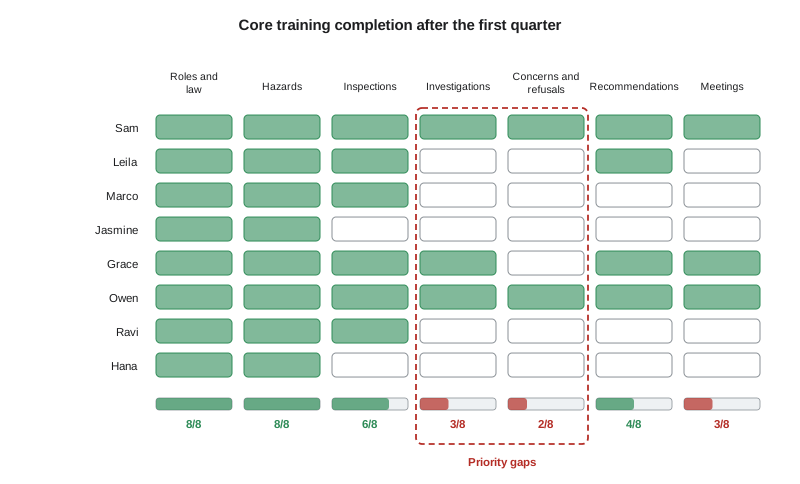
A training program only works if someone knows who has completed what. Elena set up a simple record for each member and alternate showing which modules they had completed and when. Each quarter, the co-chairs review it and book training for anyone who is behind. The first review at the distribution centre showed how far the committee had to go.
# Core training completion at the distribution site after the first quarter.
modules = ["roles and law", "hazards", "inspections", "investigations",
           "concerns and refusals", "recommendations", "meetings"]
done = {
    "Sam":     [1, 1, 1, 1, 1, 1, 1],
    "Leila":   [1, 1, 1, 0, 0, 1, 0],
    "Marco":   [1, 1, 1, 0, 0, 0, 0],
    "Jasmine": [1, 1, 0, 0, 0, 0, 0],
    "Grace":   [1, 1, 1, 1, 0, 1, 1],
    "Owen":    [1, 1, 1, 1, 1, 1, 1],
    "Ravi":    [1, 1, 1, 0, 0, 0, 0],
    "Hana":    [1, 1, 0, 0, 0, 0, 0],
}
total = len(modules) * len(done)
complete = sum(sum(v) for v in done.values())
print(f"overall completion {complete}/{total} = {complete / total:.0%}")
for i, m in enumerate(modules):
    n = sum(v[i] for v in done.values())
    print(f"{m:<22} {n}/{len(done)}")
behind = [p for p, v in done.items() if sum(v) < 4]
print("book training for:", ", ".join(behind))overall completion 34/56 = 61% roles and law 8/8 hazards 8/8 inspections 6/8 investigations 3/8 concerns and refusals 2/8 recommendations 4/8 meetings 3/8 book training for: Marco, Jasmine, Ravi, Hana
Every member had completed the first two modules, which covered the law and hazard recognition. Investigations and concerns and refusals lagged badly: only three members had done them. That was a real risk, because a work refusal or a serious incident could happen at any time, and the committee needed trained members on every shift to respond. The co-chairs scheduled the two lagging modules for the next month and arranged a night session so night members could attend without staying late.
Learning on the job
Formal training is only part of how members learn. The best learning happens on the job, alongside experienced members. Harrowgate Foods Ltd. pairs every new member with an experienced one for their first three inspections and their first investigation. New members lead a section of an inspection by their second month and write their first recommendation by their third, with feedback from the co-chairs. Members also visit other sites: Jasmine spent a morning with the main plant committee during its lockout audit, and came back with three ideas for the distribution centre's battery charging area.
Representatives at small workplaces have a harder time learning on the job because they work alone. Harrowgate Foods Ltd. links the satellite warehouse representative to the sauces plant committee, so she attends its meetings as a guest, joins some of its inspections and can call its co-chairs for advice. She completed the same core training as committee members.
Making training stick
Training that is never used fades quickly. Elena built practice into the committee's routine: every meeting includes a ten-minute skills slot, where a member walks through a recent inspection finding, an investigation or a recommendation and the group discusses what went well and what could be better. Over a year, those slots added up to more practice than the core course itself.
She also asked members, six months after their core training, what they had used and what they had not. The answers led to changes. Members said the module on the law was useful but too long, and that they wanted more practice writing recommendations. The next version of the program cut the law module by half an hour and doubled the recommendation exercise.
Worked problem
Is this member ready to investigate a work refusal?
Show solution
- At 2 a.m. a night picker refuses to use a pallet jack with a sticking brake. The supervisor checks it, disagrees with the picker, and calls for a committee member.
- The member on shift is Marco, who has completed the roles and law, hazards and inspections modules, but not concerns and refusals.
- Does Marco know the steps of a refusal investigation, what the worker is entitled to while it happens, and when the matter must go further?
- Is another trained member reachable? Owen, the management co-chair, is on nights and fully trained, but a worker member should also take part.
Answer: Marco can take part with Owen's guidance, but the gap is a warning: the committee should make sure at least one fully trained worker member is available on every shift, and should book Marco's refusal training urgently.
Training alternates and agency workers
Alternates are easy to forget. They attend only when a member cannot, so they are often the least trained people in the room on the day they are needed most. At the distribution centre, the first time an alternate stood in for Leila on a night inspection, she had never seen the checklist and did not know how to record a finding. Harrowgate Foods Ltd.'s standard now treats alternates exactly like members for core training, and pairs each alternate with the member they cover so they shadow at least one inspection a quarter.
Agency workers raise a different question. They are not committee members, but they are often the workers most exposed to hazards and least likely to report them. The committee cannot train every agency worker, but it can make sure the orientation they receive explains what the committee is, who the members are on their shift and how to raise a concern. Jasmine rewrote the orientation slide about the committee in plain language, added photos of the night members and asked the agency to show it in every orientation. Within two months, three concerns came from agency workers, compared with none in the previous year.
Paying for training and protecting time
Training takes members off the floor, and supervisors under pressure to hit production targets sometimes push back. Harrowgate Foods Ltd. treats committee training as part of the cost of running the site, not as a perk. Training time is booked into the shift schedule a month in advance, backfill is arranged before the session, and a supervisor who cancels a member's training must explain why to the site manager. In the first year, only one session was cancelled, because of a refrigeration failure that needed every available worker.
The cost was modest. Four half-days of core training for eight members, plus an annual refresher, came to fewer than 300 paid hours a year at the distribution centre. Elena compared that with the cost of a single lost-time injury, which at the company's average was several times higher, and the managers stopped asking.
Common mistakes
MistakeAssuming new members will pick up the role as they go.
InsteadGive every member structured core training within a few months of joining.
MistakeHaving managers deliver all the training.
InsteadCo-deliver with an experienced worker member.
MistakeTraining only in a classroom.
InsteadUse practical exercises at the workplace and pair new members with experienced ones.
MistakeNever tracking who has completed what.
InsteadKeep a simple record and review it each quarter.
MistakeLeaving shifts without a member trained in refusals and investigations.
InsteadPlan coverage so every shift has trained members available.
Summary and key terms
- Committee work requires knowledge, skills and confidence; training builds all three.
- Nova Scotia requires training during paid working hours but does not set a course; other provinces are more specific.
- A core program covers roles and law, hazards, inspections, investigations, concerns and refusals, recommendations and meetings.
- Joint training builds teamwork; short separate sessions help worker and management members with their particular challenges.
- Track completion and close gaps, especially for refusals and investigations.
- Learning on the job, skills slots in meetings and feedback make training stick.
- Core training
- The basic program every committee member and alternate completes soon after joining.
- Certified member
- In Ontario, a committee member who has completed approved certification training.
- Mentoring
- Pairing a new member with an experienced one for inspections and investigations.
- Skills slot
- A short part of each meeting used to practise and discuss committee skills.
- Training record
- A record of which modules each member has completed and when.
Practice problems
Work each problem on paper first, then reveal the answer to check.
Name three things training gives committee members.
Show answer
Knowledge, skills and confidence.
What does Nova Scotia law require about committee training?
Show answer
That employers provide training so members can do their duties, during working hours with pay.
Why co-deliver training with a worker member?
Show answer
It shows the committee is not a management tool and helps new worker members ask questions.
Which two modules lagged at the distribution site?
Show answer
Investigations, and concerns and refusals.
How can a representative at a small workplace learn on the job?
Show answer
By linking to a nearby committee, attending its meetings and inspections and calling its co-chairs for advice.
Lesson quiz · 5 questions
Score 60% or more to complete this lesson.
Create a free account to save your progress, take quizzes and earn a certificate.