
HSE-340 · Lesson 5 of 12 · 23 min
Ladders, step stools and working at height in stores
Falls from height in stores rarely involve great heights. They happen from a step stool, the second step of a ladder, the bottom shelf of a gondola, a stack of boxes or the edge of a display base. Most are under 2 m (6.5 ft). They are still dangerous: a fall from a step stool onto a hard store floor can break a wrist, a hip or a skull, and workers are seriously injured every year in falls of less than a metre. This lesson covers the climbing equipment found in stores and the habits that keep people safe when they work above the floor. HSE-213 covers portable ladders and scaffolds in depth, and HSE-212 covers fall protection.
Why people climb in stores
Stores are full of things just out of reach: top shelves, overstock on top of gondolas, signs, price rails, holiday decorations, lighting and high displays. Climbing becomes a hazard when the right equipment is not nearby, so workers improvise with whatever is at hand: the bottom shelf, a shopping cart, a milk crate, a stack of cases, or a chair from the staff room. The single most effective control is simple: enough of the right climbing equipment, kept where the work is done, so that nobody is tempted to improvise.
Climbing equipment in stores
| Equipment | Typical use | Key safety points |
|---|---|---|
| Round step stool (kick stool) | Reaching the top shelf in an aisle | Spring-loaded casters retract when stood on so it does not roll; use on level floors; one person at a time |
| Folding step stool with handrail | Short tasks at top shelves or displays | Fully open and locked; do not stand on any surface marked not a step |
| Platform step ladder | Signs, decorations, high shelves | Stand on the platform with the guard rail at waist level; never on the top cap |
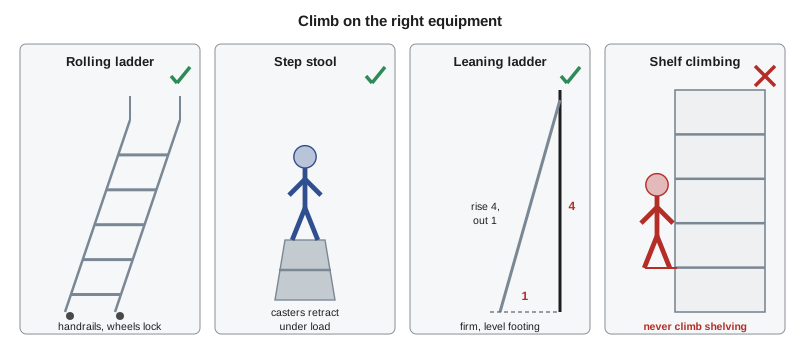
| Rolling ladder (mobile ladder stand) | Top-stock and high shelving in big-box stores and backrooms | Wheels lock or retract when loaded; handrails on both sides; climb facing the steps |
| Portable step ladder or extension ladder | Maintenance, lighting, signage | Inspect before use; correct angle for leaning ladders; see HSE-213 |
| Aerial work platform or order picker | Very high racking in warehouse-style stores | Trained and authorized operators only; fall protection as required; see HSE-218 and HSE-220 |
Portable ladders sold for workplace use in Canada are generally built to CSA Z11, and rolling ladders and mobile stands are often built to the US ANSI A14.7 standard for mobile ladder stands. Provincial regulations require ladders to be suitable for the work, in good condition and used as the manufacturer intends. BC's regulation, for example, sets rules for ladder design, inspection and use, and WorkSafeBC publishes guidance on step stools and rolling ladders for retail. Check the duty rating on the label and match it to the weight of the worker plus anything carried.
Three points of contact
When climbing or descending any ladder, keep three points of contact: two hands and one foot, or two feet and one hand, on the ladder at all times. Face the ladder or steps when climbing up or down. Do not carry items in your hands while climbing; use a tool belt or apron for small tools, slide items onto the platform before climbing, or have a coworker hand items up. On a rolling ladder, hold the handrails and do not lean out to the side.
Reaching and overreaching
Many ladder falls happen not while climbing but while reaching. A worker stretches sideways to grab one more box rather than climbing down and moving the ladder. A useful rule is to keep your belt buckle, or the middle of your body, between the side rails. If you cannot reach without leaning out, climb down and move the ladder or stool. Pushing or pulling hard while standing on a ladder, for example to free a stuck box from top-stock, can also tip the ladder or throw you off balance.
What not to stand on
- Shelves, rack beams and display bases: they are not designed for a person's weight, can tip or collapse, and offer nothing to hold.
- Shopping carts and stocking carts: they roll and tip.
- Milk crates, pails, stacks of cases or boxes: they crush, slide or tip.
- Chairs, especially office chairs with wheels.
- The top cap of a step ladder or the step below it, unless the ladder is designed for it.
- A step stool on an uneven floor, a mat or a slope.
Inspecting ladders and step stools
Before each use, look over the ladder or stool. Check that feet and caps are present, rails and steps are not bent, cracked or loose, spreaders lock, casters retract on step stools and lock on rolling ladders, and steps are clean and dry. Damaged equipment should be tagged out of service and removed so nobody uses it by mistake. Northfield keeps a step stool in every grocery aisle and a rolling ladder in each backroom, and checks them during the weekly safety walk.
Leaning ladders: the 4 to 1 rule
Leaning ladders are less common on a sales floor but are used for signage, lighting and maintenance. HSE-213 covers setup in detail. The key rule is the angle: for every 4 units of height to the point where the ladder rests, the base should be 1 unit out from the wall. An extension ladder used to reach a roof or landing should extend about 1 m (3 ft) above it. The ladder should be on firm, level footing, secured against slipping and kept away from doorways unless the door is locked or guarded.
The program below checks a few ladder setups against the 4 to 1 rule and picks a step stool or ladder for some common store reaching tasks.
# Ladder angle check and step selection for store tasks (metric).
def angle_ok(height_m, base_m):
    ratio = height_m / base_m
    return ratio, 3.5 <= ratio <= 4.5

for h, b in [(3.2, 0.8), (3.2, 0.4), (4.0, 1.4)]:
    r, ok = angle_ok(h, b)
    print(f"Rest height {h} m, base {b} m: ratio {r:.1f} to 1 -> {'OK' if ok else 'reset ladder'}")

# Highest standing step of each item (top cap never counts).
equipment = {"round step stool": 0.40, "2-step folding stool": 0.48,
             "3-step platform ladder": 0.72, "rolling ladder, 5 steps": 1.27}
chest = 1.30   # comfortable working height above the feet for an average adult
for task, height in [("top grocery shelf", 1.75), ("price rail on top-stock", 2.10),
                     ("hanging sign", 2.90)]:
    need = height - chest
    pick = next((n for n, s in sorted(equipment.items(), key=lambda x: x[1]) if s >= need), None)
print(f"{task:<24} {height:.2f} m: stand at {max(need, 0):.2f} m -> {pick or 'use a taller ladder or lift'}")Rest height 3.2 m, base 0.8 m: ratio 4.0 to 1 -> OK Rest height 3.2 m, base 0.4 m: ratio 8.0 to 1 -> reset ladder Rest height 4.0 m, base 1.4 m: ratio 2.9 to 1 -> reset ladder top grocery shelf 1.75 m: stand at 0.45 m -> 2-step folding stool price rail on top-stock 2.10 m: stand at 0.80 m -> rolling ladder, 5 steps hanging sign 2.90 m: stand at 1.60 m -> use a taller ladder or lift
The first ladder is set at about 4 to 1 and is fine. The second has its base too close to the wall, so it is too steep and could tip backward; the third is too shallow and its feet could slide out. The step selection shows that a two-step folding stool is enough for the top grocery shelf, the price rail on top-stock needs the rolling ladder, and the hanging sign is beyond the store's step equipment. That last task needs a taller ladder used by trained maintenance staff, or an aerial lift, not a worker stretching from a stool.
Working at height in big-box and warehouse-style stores
Some stores keep overstock on high steel racking above the sales floor, reached with rolling ladders, order pickers or reach trucks. These are serious fall and falling-object hazards. Only trained and authorized workers should operate lift equipment, the aisle should be closed to customers while product is moved overhead, and fall protection is needed on equipment that requires it. HSE-342 covers racking and HSE-218 and HSE-220 cover powered equipment and aerial platforms. On the sales floor, the main rules are to keep customers out from under overhead work and to keep top-stock light and secured.
Seasonal and display work
Holiday decorations, seasonal displays and store resets bring extra climbing: hanging signs from the ceiling grid, building tall displays and moving fixtures. This work is often done by temporary staff or contractors under time pressure. Plan it: decide what equipment is needed, check it in advance, keep customers clear and assign trained people. Never stand on a display fixture to reach a sign, and do not let ceiling-hung decorations interfere with sprinklers, lights or exit signs.
For supervisors: removing the reasons to climb
Walk each department and ask where people reach above shoulder height. Make sure there is a step stool within a few steps of every place someone needs one. Check that top-stock is light, low and within reach of the equipment you have. Replace damaged stools at once. Watch for workers standing on shelves or carts and treat it as a sign that equipment is missing, not just a rule broken. Assign high work, such as ceiling signs, to trained staff with the right ladder or lift.
Worked problem
A fall from the bottom shelf
A stocker at Northfield's sister store stood on the bottom shelf of a gondola to reach a box of paper towels on top-stock. The shelf tipped forward, and she fell backward, hitting her head. The nearest step stool was in the next aisle, behind a pallet. What went wrong, and what should change?
Show solution
- The immediate act was standing on a shelf, which is never safe; it tipped because it was not designed to carry a person's weight or a pulling force.
- The underlying cause was equipment: the nearest stool was blocked, and the store had fewer stools than aisles.
- The top-stock was also a factor: bulky items stored above the top shelf invite climbing.
- Fixes: a step stool in every aisle on a hook or marked spot, top-stock limited to light items within reach from a stool, and a quick reminder at the next team huddle.
- The gondola should also be checked by maintenance to confirm it is assembled and anchored as the manufacturer specifies.
Answer: Blaming the stocker misses the point. The store made climbing the shelf the easiest option; providing stools in every aisle and limiting top-stock removes that option.
Common mistakes
MistakeStanding on the bottom shelf, a cart or a stack of cases to reach something high.
InsteadUse a step stool or ladder every time, and ask for more stools if they are not nearby.
MistakeCarrying a box up a ladder in both hands.
InsteadKeep three points of contact and hand items up or place them on the platform first.
MistakeLeaning out sideways to avoid moving the ladder.
InsteadKeep your belt buckle between the rails; climb down and move the ladder.
MistakeUsing a damaged step stool because it is the only one nearby.
InsteadTag it out of service, remove it and get a sound one.
MistakeLetting customers walk under overhead stocking.
InsteadClose the aisle or section while product is moved above the floor.
Summary and key terms
- Most falls in stores are from low heights but can still cause serious injuries.
- The best control is enough of the right climbing equipment kept where the work is done.
- Never climb shelves, racks, carts, crates, boxes or chairs.
- Keep three points of contact, face the ladder and do not carry items in your hands while climbing.
- Keep your body between the rails and move the ladder instead of overreaching.
- Inspect ladders and stools before use and remove damaged ones from service.
- Leaning ladders follow the 4 to 1 rule; very high work needs trained staff and the right ladder or lift.
- Step stool
- A short, self-supporting climbing aid with one to three steps, often with casters that retract under load.
- Mobile ladder stand
- A rolling ladder with handrails and wheels that lock or retract when it is loaded.
- Three points of contact
- Keeping two hands and one foot, or two feet and one hand, on the ladder at all times.
- Duty rating
- The maximum load a ladder is designed to carry, including the user and anything they carry.
- Top cap
- The top of a step ladder, which is not a step and must not be stood on.
- 4 to 1 rule
- For a leaning ladder, the base should be 1 unit out for every 4 units of height to the support point.
- Overreaching
- Leaning beyond the ladder rails to reach something, a common cause of ladder falls.
Practice problems
Work each problem on paper first, then reveal the answer to check.
Why do workers climb shelves and carts?
Show answer
Usually because the right climbing equipment is not nearby, so they improvise.
What are three points of contact?
Show answer
Two hands and one foot, or two feet and one hand, on the ladder at all times.
A ladder rests 3.6 m (12 ft) up a wall. How far out should the base be?
Show answer
About 0.9 m (3 ft), using the 4 to 1 rule.
Name four things you should never stand on to reach a high shelf.
Show answer
Any four of: shelves, rack beams, display bases, carts, crates, pails, boxes, chairs, the top cap of a step ladder.
What should happen to a step stool with a cracked step?
Show answer
Tag it out of service and remove it so nobody uses it.
What is the belt buckle rule?
Show answer
Keep the middle of your body between the side rails; if you cannot reach, move the ladder.
Who should hang signs from a high ceiling grid?
Show answer
Trained staff using a suitable ladder or aerial lift, not a worker stretching from a stool.
Why should top-stock be limited to light items?
Show answer
Heavy or bulky top-stock invites climbing and overreaching and can fall on people.
Lesson quiz · 5 questions
Score 60% or more to complete this lesson.
Create a free account to save your progress, take quizzes and earn a certificate.