
HSE-340 · Lesson 10 of 12 · 24 min
Displays, carts, doors and crowds
The sales floor is designed to sell, and the features that attract customers can also hurt workers and shoppers: tall displays of stacked product, pallet displays in the aisles, lines of shopping carts, automatic doors and, a few days a year, crowds of people rushing in for a sale. This lesson covers how to build and maintain displays that do not fall, how to collect and move carts safely, how to keep doors and escalators safe, and how to plan for big crowds. Lesson 9 covered spills and trips, and HSE-341 covers aggressive customers, which often go hand in hand with crowding and long lines.
Falling merchandise
Being struck by falling objects is a common retail injury, and customers are hurt too. Cans tumble from over-stacked end caps, boxes slide off top-stock, heavy items fall when a customer pulls one from the bottom of a pile, and tall stacks of cases topple when bumped by a cart. Most of these incidents can be prevented by how displays are built and kept.
- Stack heavy items low and light items high, as in Lesson 3.
- Keep stacks within the height the display is designed for; many stores set a maximum stack height for loose cases and round or slippery items.
- Interlock cases on pallet displays, keep the stack square and use corner boards or wrap where needed.
- Put round items, such as melons, bottles and cans, in bins, trays or behind lips so they cannot roll off.
- Keep top-stock light, stable, back from the edge and behind a fence or lip.
- Rebuild displays as they are shopped down, so customers are not pulling items from the bottom of a leaning pile.
- Keep product off the floor in front of displays, where it becomes a trip hazard.
Tall fixtures and seasonal displays
Freestanding fixtures, such as tall shelving units, bike racks, ladders on display, mattress stands and seasonal towers, can tip over if they are top-heavy, overloaded, bumped or climbed by children. Fixtures should be assembled and anchored to the floor or to each other as the manufacturer specifies, and loaded with heavy items at the bottom. Seasonal displays are often built quickly by temporary staff or vendor representatives, so the store should check them before they open to customers: is the fixture stable, are heavy items low, is anything sticking out into the aisle at head height, and are exits, fire equipment and sprinklers clear?
Vendor representatives who build their own displays in the store should follow the store's safety rules, including the rules on ladders, box cutters and blocking aisles. Their displays should be checked like any other.
Shopping carts
Carts injure workers in two main ways: collecting carts from the parking lot, and moving long lines of carts back into the store. Cart collection combines pushing heavy loads, walking long distances, traffic, weather and sometimes uneven or icy surfaces.
- Limit the number of carts pushed by hand in one line; Northfield's limit is 10 by hand. Longer lines need a motorized cart pusher operated by a trained worker.
- Push, do not pull, and steer from the back where you can see the whole line.
- Wear a high-visibility vest in the parking lot and watch for drivers, who often do not expect someone behind a line of carts.
- Avoid slopes where the line could run away, and do not try to stop a runaway line with your body.
- Dress for the weather and wear slip-resistant footwear or ice cleats in winter (Lesson 9); take breaks in extreme heat or cold (HSE-243).
- Report damaged carts, such as those with broken wheels or bent frames, and take them out of service.
Cart corrals in the parking lot should be placed so that carts are easy to return and do not block driving lanes. Inside, carts should be stored so that they do not block exits or fire equipment.
Automatic doors and other doors
Automatic sliding and swinging doors are convenient for customers but can strike or trap people if their sensors fail or are badly adjusted, especially children, older customers and people using mobility aids. They should be inspected regularly by a qualified technician and checked daily by store staff: do the doors open fully when someone approaches, stay open while someone stands in the doorway, and close smoothly? Any door that hesitates, closes on people or makes unusual noises should be reported and, if necessary, switched to manual or locked open until it is fixed. Revolving doors need a working emergency stop and a way to fold the leaves for evacuation, and overhead doors in receiving or the garden centre are covered in HSE-342.
Escalators and moving walkways
Larger stores and shopping centres may have escalators or inclined moving walkways designed for carts. Workers should know where the emergency stop buttons are and when to use them, for example when someone falls or clothing is caught. Carts and strollers should only be used on walkways designed for them. Escalators should be inspected by qualified elevating device inspectors as the province or state requires, and any damage, missing comb teeth or unusual noise reported at once.
Garden centres and outdoor sales
Seasonal garden centres bring their own hazards: heavy bags of soil and mulch, large pots and trees, pallets outside, wet floors and hoses, pesticides and fertilizers, and heat in summer. Bagged goods should be sold from pallets or low stacks, with carts and team lifts for carry-outs. Hoses should be coiled when not in use. Pesticide and fertilizer products must be stored and handled according to their labels and safety data sheets (HSE-102), with spills cleaned up using the right method (HSE-251). Workers outdoors need water, shade and breaks on hot days (HSE-243).
Crowds and big sales
A few days a year, stores face crowds far larger than normal: Black Friday and other door-buster events, Boxing Day sales, product launches, holiday weekends and emergencies such as approaching storms. Large crowds create risks of crushing, trampling, falls, aggression and blocked exits.
The risk is real. On 28 November 2008, at a Walmart store in Valley Stream, New York, a crowd of shoppers broke through the doors at opening time for a Black Friday sale and knocked down and trampled a temporary worker, Jdimytai Damour, who died. Several shoppers were also injured. US OSHA cited the store for failing to protect workers from crowd-related hazards and later published crowd management guidelines for retailers that are widely used in Canada too.
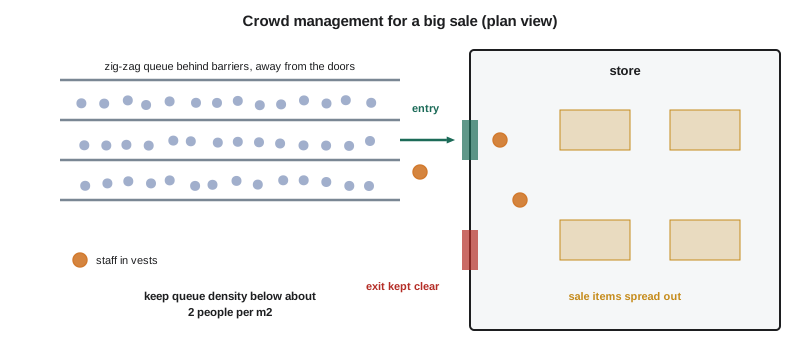
Good crowd management starts days before the event.
- Plan: estimate the crowd, decide how many staff are needed, assign trained crowd managers, and contact local police and fire officials for large events.
- Queue: set up barriers so the line starts away from the entrance and does not press against the doors, and consider tickets, wristbands or online reservations for the most popular items.
- Entry: open doors in a controlled way, let people in in small groups, keep staff away from the doors at the moment they open, and never let the crowd push against closed doors.
- Layout: spread sale items through the store instead of piling them at the entrance, keep aisles and exits clear, and remove displays that could be knocked over.
- Capacity: know the store's occupant load from the fire code, count people in, and stop entry when the limit is reached.
- Emergencies: brief staff on emergency procedures, keep exits unlocked and clear, and have first aid and a way to call for help ready.
- Communicate: tell customers in advance how entry will work, and use announcements to keep people informed during the event.
How crowded is too crowded
Crowd safety specialists use crowd density, measured in people per square metre, to judge risk. At about 1 person per square metre, people can move freely. At around 2 people per square metre, movement slows but is still comfortable. Above about 4 to 5 people per square metre, people lose control of their own movement and pressure can build in waves that knock people down. A queue outside a store should stay well below the dangerous range. The program below estimates density and entry time for a door-buster event at Northfield.
# Crowd density in a queue area and time to admit people at a controlled rate (metric).
queue_area_m2 = 300        # barrier-lined queue area outside the entrance
people = 900               # estimated crowd at opening
groups_per_min = 2         # groups admitted per minute
group_size = 20

def density(n, area):
    return n / area

d = density(people, queue_area_m2)
print(f"Density in queue area: {d:.1f} people per m2")
for label_, limit in [("free movement", 1), ("comfortable", 2), ("dangerous", 4)]:
    print(f"   {label_:<14} at about {limit} per m2 -> area needed {people / limit:,.0f} m2")
rate = groups_per_min * group_size
print(f"Controlled entry: {rate} people per minute -> all inside in {people / rate:.0f} minutes")Density in queue area: 3.0 people per m2 free movement at about 1 per m2 -> area needed 900 m2 comfortable at about 2 per m2 -> area needed 450 m2 dangerous at about 4 per m2 -> area needed 225 m2 Controlled entry: 40 people per minute -> all inside in 22 minutes
With 900 people in a 300 m² (3,200 ft²) queue area, the density is about 3 people per square metre: above comfortable and too close to the dangerous range. Northfield's plan is to double the queue area by extending the barriers along the side of the building and to hand out numbered tickets for the most popular items so that people do not need to be at the front. Controlled entry at 40 people a minute gets everyone in within about 22 minutes, which is much safer than letting 900 people push through the doors at once.
For supervisors: before a big sale
Walk the sales floor the day before and check that displays are stable and not overloaded, exits and aisles are clear and fire equipment is visible. Brief every worker, including temporary staff, on their role, the entry plan and emergency procedures. Keep workers away from the doors at opening. Assign someone to monitor crowd density and stop entry if it gets too high. After the event, hold a short debrief and record what worked and what did not for next time.
Worked problem
A toppled end cap
During a weekend promotion, a stack of 24-packs of canned soda on an end cap at Northfield toppled when a customer pulled a case from near the bottom. Several cases hit a child's foot. The stack was about 1.8 m (6 ft) high, built by a vendor representative without interlocking the cases. What should change?
Show solution
- The stack was too high and unstable for loose cases; set a maximum height, for example about 1.2 m (4 ft), for loose case stacks on end caps.
- The cases were not interlocked; build stacks in an interlocking pattern or use a pallet display with corner boards and wrap.
- Customers were pulling from the bottom of a shopped-down stack; assign a worker to rebuild displays during busy periods.
- The vendor built the display without a store check; require the department lead to sign off on vendor displays before they open.
- Record the incident and check other promotional displays in the store the same day.
Answer: Lower, interlocked stacks, regular rebuilding during busy times and a store check on vendor displays prevent a repeat.
Common mistakes
MistakeStacking heavy or round items high on an end cap.
InsteadKeep heavy and round items low and contained, and limit stack heights.
MistakePushing a line of 20 carts by hand across a busy parking lot.
InsteadFollow the store limit, use a motorized cart pusher for long lines and wear a high-visibility vest.
MistakeIgnoring an automatic door that hesitates before opening.
InsteadReport it at once and switch it to manual or lock it open until it is fixed.
MistakeStarting the queue for a big sale right against the store doors.
InsteadStart the queue away from the entrance behind barriers and admit people in controlled groups.
MistakePutting staff in front of the doors at opening time.
InsteadKeep staff to the side of the doors and inside, away from the crowd surge.
Summary and key terms
- Falling merchandise injures workers and customers; keep heavy and round items low, limit stack heights and rebuild displays as they are shopped down.
- Tall fixtures and seasonal displays must be stable, anchored and checked before customers use them, including vendor-built displays.
- Cart collection needs limits on line length, motorized pushers for long lines, high-visibility vests and weather precautions.
- Automatic doors need daily checks and regular professional inspection; faulty doors should be taken out of automatic use.
- Garden centres bring heavy bags, pots, hoses, chemicals and heat.
- Crowds at big sales can crush and trample; plan queues, controlled entry, layout, capacity and emergency procedures in advance.
- Keep crowd density well below about 4 to 5 people per square metre, where people lose control of their movement.
- End cap
- A display at the end of an aisle, often used for promotions.
- Pallet display
- Product displayed on its pallet, usually in an aisle or open area.
- Interlocking stack
- A stacking pattern where each layer is turned or offset to tie the stack together.
- Cart pusher
- A motorized device for moving long lines of shopping carts.
- Crowd density
- The number of people per unit of area, used to judge crowd safety.
- Occupant load
- The maximum number of people the fire code allows in a space.
- Crowd manager
- A trained person responsible for monitoring and controlling a crowd during an event.
Practice problems
Work each problem on paper first, then reveal the answer to check.
Give four ways to prevent falling merchandise.
Show answer
Any four of: heavy items low, limit stack heights, interlock cases, contain round items, light and secured top-stock, rebuild shopped-down displays, keep floors clear.
Why should vendor-built displays be checked by the store?
Show answer
They may be built quickly without the store's rules, and the store is responsible for customer and worker safety.
What is Northfield's limit for carts pushed by hand?
Show answer
Ten carts; longer lines need a motorized cart pusher.
What should a daily automatic door check look for?
Show answer
That doors open fully on approach, stay open while someone is in the doorway and close smoothly.
What happened at Valley Stream in 2008?
Show answer
A Black Friday crowd broke through the doors and trampled a temporary worker, who died.
Where should a queue for a big sale start?
Show answer
Away from the entrance, behind barriers, so the crowd does not press against the doors.
Calculate the density of 600 people in a 250 m2 area.
Show answer
2.4 people per square metre.
At about what density do people lose control of their movement?
Show answer
Above about 4 to 5 people per square metre.
Lesson quiz · 5 questions
Score 60% or more to complete this lesson.
Create a free account to save your progress, take quizzes and earn a certificate.