
HSE-340 · Lesson 1 of 12 · 25 min
Hazards in retail work
Stores look like safe places to work. There is no heavy machinery on the sales floor, no hard hats and no scaffolding, and customers walk through the same aisles every day. Yet retail is one of the largest sources of workplace injuries in North America simply because so many people work in it, and because the work combines lifting, reaching, repetitive motion, sharp tools, cold rooms, wet floors and the public in a single shift. This course is about those everyday hazards and the simple habits and controls that prevent them.
This is the first course in the retail sites track. It covers the sales floor, the checkouts, the cold rooms and the food counters. HSE-341 follows with robbery prevention and aggressive customers, and HSE-342 covers receiving, pallet jacks, racking, balers and compactors in the backroom. Where a topic is taught in depth elsewhere, this course points to it rather than repeating it: HSE-106 for slips, trips and falls in general, HSE-107 for manual handling and the NIOSH lifting equation, HSE-213 for ladders, HSE-243 for heat and cold stress, HSE-102 for WHMIS and chemical labels, and HSE-105 for fire safety and evacuation.
Throughout the course we follow an invented store, Northfield Market in Kamloops, British Columbia. Northfield is a grocery and general merchandise store with about 90 workers, many of them part-time students. It has a sales floor of about 3,700 m² (40,000 ft²), a deli, an in-store bakery, two walk-in coolers, a walk-in freezer, eight staffed checkouts, six self-checkouts and a garden centre that opens each spring. You will meet its store manager, Priya Nair, its assistant manager and safety lead, Marco Delgado, and several of its workers.
Who works in retail
Retail workers are younger and newer to their jobs than workers in most industries. Many are students working evenings and weekends, many are in their first job, and turnover is high, so a large share of the staff in any store have been there less than a year. Stores also hire many seasonal workers for the holiday rush and the spring garden season. Part-time schedules mean a worker may only be in the store two or three shifts a week, so habits form slowly and supervisors see each person less often.
This matters for safety because new workers of any age are injured more often than experienced ones, especially in their first month. They do not yet know where the hazards are, they may not want to ask questions, and they may feel they have to keep up with experienced coworkers. A good store safety program is built around that reality: short, practical training on the first day, close supervision in the first weeks, and a culture where asking is normal.
How retail workers get hurt
Injury data from compensation boards and labour statistics agencies tell a consistent story about retail. A few kinds of events cause most of the injuries, and almost all of them are predictable.
- Overexertion and bodily reaction: strains and sprains from lifting cases, pushing loaded carts, reaching overhead, twisting at checkouts and bending to low shelves. This is usually the largest group.
- Slips, trips and falls: wet floors, spilled products, ice at entrances, cords and pallets in aisles, and falls from step stools and ladders.
- Contact with objects: cuts from box cutters and knives, being struck by falling merchandise, caught-in injuries at doors and carts, and burns at bakery ovens and fryers.
- Repetitive motion: wrist, hand, shoulder and neck problems from scanning, bagging and stocking for hours.
- Violence and aggression: assaults, threats and verbal abuse from customers, covered in HSE-341.
In the United States, the Bureau of Labor Statistics reported about 339,800 nonfatal injuries and illnesses in retail trade in 2024, a rate of 3.0 cases for every 100 full-time workers, compared with 2.3 for private industry as a whole (BLS data released in January 2026). In Canada, each province's compensation board publishes its own figures, and retail consistently appears among the sectors with the most accepted time-loss claims because of its size, with strains and sprains the most common injury type. The exact numbers change each year, but the pattern does not.
| Event | Typical retail example | Main controls | Lesson |
|---|---|---|---|
| Overexertion | Lifting a case of water from the floor to a top shelf | Heavy items stored at waist height, carts and team lifts, smaller case sizes | 3 |
| Repetitive motion | Scanning and bagging for a whole shift | Checkout layout, sit/stand options, rotation and breaks | 4 |
| Fall from height | Standing on a shelf or the top of a step stool | Proper step stools and rolling ladders, never climbing shelving | 5 |
| Cut | Box cutter slipping while opening a case | Safety knives, cutting away from the body, cut-resistant gloves | 6 |
| Cold injury | Long stocking session in the walk-in freezer | Insulated clothing, time limits, warm-up breaks | 7 |
| Food area injury | Slicer cut or oven burn | Guards, cleaning procedures, age rules, training | 8 |
| Slip or trip | Wet produce floor or melted ice at the entrance | Spill response, mats, cleaning schedules, footwear | 9 |
| Struck by | Merchandise falling from a high display | Display design, stacking limits, carts and corrals | 10 |
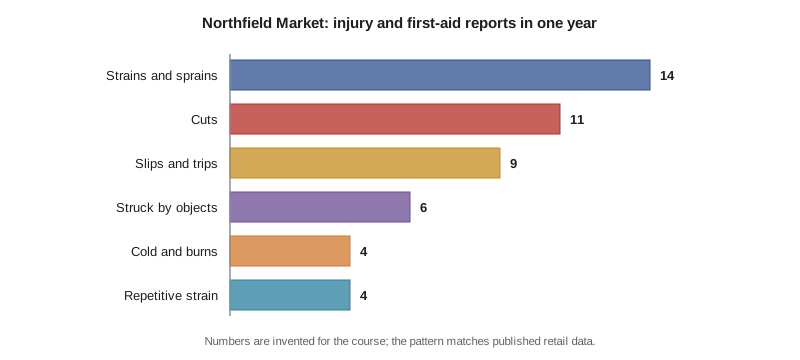
Why small injuries matter
Many retail injuries look minor at first: a cut finger, a sore back, a bruise from a falling can. Most are treated with first aid and the worker goes back to the floor. But minor injuries are worth taking seriously for three reasons.
First, the same hazard that causes a small injury today can cause a serious one tomorrow. A box cutter that nicks a finger can sever a tendon; a puddle that causes a stumble can cause a broken hip for an older worker or customer. Second, small injuries add up. Back and shoulder strains often build over weeks of lifting and reaching until one ordinary lift is the last straw, and these injuries can keep a person off work for months. Third, a pattern of first-aid cases is the best early warning a store has. If the first-aid log shows four cuts in the same department in one month, something about the tools, the packaging or the training needs fixing before someone needs stitches.
Hazards that come with the job, not the person
It is tempting to blame retail injuries on carelessness: the worker who did not watch the floor or lifted the wrong way. Investigations usually show that the hazard was built into the job. Heavy products were stored on top shelves because that was where the shelf plan put them. A stocker climbed a shelf because the only step stool was across the store. A cashier twisted all shift because the scanner was in the wrong place. A spill sat for twenty minutes because nobody was assigned to check that aisle.
The most effective fixes therefore change the job, not just the worker's attention. This follows the hierarchy of controls taught in HSE-103: remove the hazard if you can, then engineer it out, then change how the work is organized, and only then rely on training and personal protective equipment. In a store, that might mean asking suppliers for smaller cases, moving heavy items to waist-height shelves, buying more step stools, installing safety knives, putting mats at entrances and assigning floor walks on a schedule.
Northfield's injury record
To see where to start, Marco pulled Northfield's injury records for last year. The store's workers worked about 172,000 hours in total. There were five injuries serious enough to need medical treatment beyond first aid or to cause restricted or lost work: a box cutter laceration that needed stitches, a back strain from lifting flats of water, a wrist fracture from a slip in the produce department, wrist tendinitis in a cashier, and a cold-related hand injury after a long freezer shift. Three of the five led to time away from work or restricted duties.
Canadian compensation boards and many employers describe injury performance with a lost-time frequency, often expressed as lost-time claims for every 100 workers or for every 200,000 hours worked. The program below calculates both for Northfield.
# Injury rates for an invented store (Canadian style).
hours = 172_000          # total hours worked in the year
workers_fte = hours / 2000
lost_time_claims = 3     # claims with time away from work
medical_aid = 2          # treated by a health care provider, no lost time

per_200k = lost_time_claims * 200_000 / hours
per_100 = lost_time_claims / workers_fte * 100
print(f"Full-time equivalent workers: {workers_fte:.0f}")
print(f"Lost-time claims per 200,000 hours: {per_200k:.2f}")
print(f"Lost-time claims per 100 FTE workers: {per_100:.2f}")
print(f"All claims (lost time + medical aid) per 200,000 hours: "
f"{(lost_time_claims + medical_aid) * 200_000 / hours:.2f}")Full-time equivalent workers: 86 Lost-time claims per 200,000 hours: 3.49 Lost-time claims per 100 FTE workers: 3.49 All claims (lost time + medical aid) per 200,000 hours: 5.81
Northfield's rate of 3.49 lost-time claims per 200,000 hours is a starting point, not a verdict. A small store's rate jumps around from year to year because one or two claims make a large difference. Rates are most useful for comparing a store with itself over several years and with similar stores in the same company or industry classification, and they say nothing about which hazards to fix first. For that, Marco needs the details of every injury and near miss, which is where the rest of this course begins.
Leading and lagging measures
Injury rates are lagging measures: they count harm after it has happened. Leading measures count the things a store does to prevent harm. Examples include the share of new workers who complete orientation on their first shift, the number of hazard reports made and closed, the number of safety walks completed, the time it takes to clean up a reported spill, and whether step stools are where the shelf plan says they should be. A store that only watches injury rates finds out about problems late. A store that also watches leading measures can see risk building before anyone is hurt. HSE-407 covers safety metrics in depth.
For supervisors: where to look first
If you are new to supervising in a store, start with three questions. Where do the heavy and awkward items live, and who moves them? Where do people climb, and what do they stand on? Where does water, ice or product end up on the floor, and how long does it stay there? The answers usually point to the two or three changes that will prevent the most injuries in your department.
How this course is organized
Lesson 2 explains your rights, the roles of workers, supervisors, committees and the employer, and how to report a hazard. Lessons 3 and 4 cover lifting, stocking and checkout work. Lesson 5 covers ladders and step stools, Lesson 6 box cutters and knives, Lesson 7 coolers and freezers, and Lesson 8 the deli and bakery. Lessons 9 and 10 cover customer areas: spills, displays, carts, doors and crowds. Lesson 11 covers store emergencies, and Lesson 12 puts everything together in a new-worker orientation and a store safety walk at Northfield.
Worked problem
Reading the first-aid log
Northfield's first-aid log for March shows eleven entries: four cuts in the produce department, two bruises from falling cans in grocery, two minor burns in the bakery, two sore backs after unloading a dairy order and one twisted ankle at the entrance on a wet day. What should Marco look at first?
Show solution
- Group the entries by department and type, not by person. Four cuts in produce in one month is a cluster.
- Ask what produce workers were cutting. A visit shows they were opening shrink-wrapped cases with standard utility knives, and a new supplier had changed the packaging.
- Check the tool and the method. The fix is safety knives with self-retracting blades and a quick demonstration of cutting away from the body, not a reminder to be careful.
- Look at the next cluster. The falling cans point to over-stacked displays (Lesson 10), and the sore backs point to how dairy orders are moved (Lessons 3 and HSE-342).
- Record what was done and check the log again next month to see if the cuts stopped.
Answer: The produce cuts are the clearest pattern, and the likely cause is the tool and the new packaging rather than the workers. Fixing the tool should come first, followed by the displays and the dairy unloading.
Common mistakes
MistakeTreating retail as a low-risk workplace that needs little safety training.
InsteadPlan for the injuries retail actually produces: strains, cuts, slips, falls, cold, burns and aggression.
MistakeBlaming injuries on careless workers.
InsteadLook for the hazard built into the job, such as heavy items stored high or too few step stools, and fix that first.
MistakeIgnoring first-aid cases because nobody lost time.
InsteadUse first-aid entries and near misses as early warnings and look for clusters.
MistakeJudging a small store by one year's injury rate.
InsteadCompare rates over several years and use leading measures alongside them.
MistakeGiving new and seasonal workers the same brief talk as everyone else and leaving them alone.
InsteadTrain new workers on their first shift and supervise them closely in their first weeks.
Summary and key terms
- Retail produces many injuries because it employs so many people and combines lifting, reaching, repetition, sharp tools, cold rooms, wet floors and the public.
- Overexertion, slips and falls, contact with objects and repetitive motion cause most retail injuries; violence is covered in HSE-341.
- New, young and part-time workers are injured more often and need first-day training and close supervision.
- Small injuries and first-aid cases are early warnings; clusters point to hazards built into the job.
- The best fixes change the job: storage heights, tools, step stools, mats and scheduled floor walks.
- Lost-time frequency is a lagging measure; leading measures such as orientation completion and hazard report close-out show risk before harm.
- Overexertion
- An injury caused by lifting, pushing, pulling, carrying or reaching beyond what the body can safely handle.
- Near miss
- An event that could have caused injury or damage but did not.
- First-aid case
- An injury treated on site with simple first aid and no further medical care.
- Lost-time injury
- An injury that keeps a worker away from work beyond the day it happened.
- TRIR
- Total recordable incident rate: recordable cases for every 200,000 hours worked.
- Leading measure
- A count of actions that prevent harm, such as training completed or hazards fixed.
- Lagging measure
- A count of harm that has already happened, such as injuries or claims.
- Hierarchy of controls
- The order of preference for controlling hazards: eliminate, substitute, engineer, organize, then personal protective equipment.
Practice problems
Work each problem on paper first, then reveal the answer to check.
Name the four kinds of events that cause most retail injuries.
Show answer
Overexertion, slips, trips and falls, contact with objects (cuts, struck by, burns) and repetitive motion.
Why are new retail workers injured more often?
Show answer
They do not yet know the hazards, may not ask questions, may feel pressure to keep up and are often young or in their first job.
Calculate the rate per 200,000 hours for 2 cases in 80,000 hours.
Show answer
2 x 200,000 / 80,000 = 5.0.
Give two examples of leading safety measures in a store.
Show answer
Any two of: share of new workers oriented on day one, hazard reports made and closed, safety walks completed, spill clean-up time, step stools in place.
Why can a small store's injury rate change a lot from one year to the next?
Show answer
With few hours worked, one or two injuries make a large difference to the rate.
A department has three cuts in a month. What should the supervisor check first?
Show answer
The tools, packaging and cutting method being used, rather than simply reminding workers to be careful.
Which course covers manual handling and the NIOSH lifting equation in depth?
Show answer
HSE-107.
Which courses in the retail track cover robbery and the backroom?
Show answer
HSE-341 covers robbery prevention and aggression; HSE-342 covers receiving, pallet jacks, racking, balers and compactors.
Lesson quiz · 5 questions
Score 60% or more to complete this lesson.
Create a free account to save your progress, take quizzes and earn a certificate.