
HSE-340 · Lesson 11 of 12 · 24 min
Store emergencies
Emergencies in stores are rare, but when they happen the stakes are high because a store may hold hundreds of people who do not know the building, including children, older adults and people with disabilities. Workers are the ones customers look to for direction. A cashier who knows where the exits are, how to sweep an aisle, what the alarm means and where to meet outside can save lives. This lesson covers the emergencies a store should plan for and the part every worker plays. HSE-105 covers fire safety and evacuation in general, HSE-222 covers fire wardens, and HSE-110 and HSE-111 cover first aid and CPR.
The emergency plan
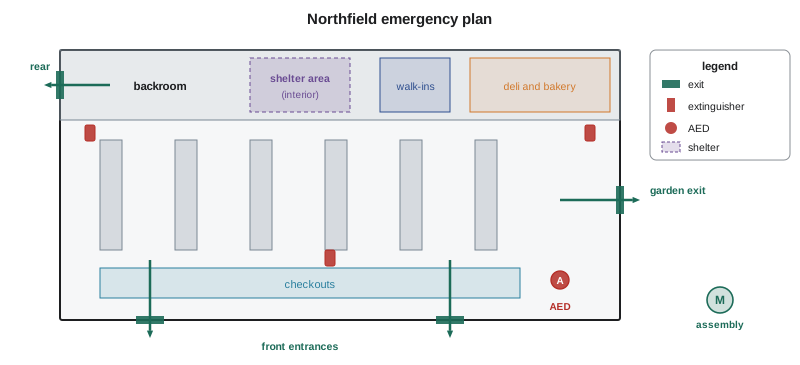
Every store should have a written emergency plan that covers the emergencies it could face, who does what, how people are warned, how the building is evacuated or people are sheltered, where people meet, how everyone is accounted for, and how emergency services are called and met. The plan should be practical and short enough that workers can learn their part. Northfield's plan names a person in charge on every shift, usually the most senior manager present, assigns floor wardens to zones of the store, and gives every other worker a simple role: help customers out of your area, check washrooms, fitting rooms and cold rooms if assigned, and go to the assembly point.
Exits that are always clear
The most basic emergency rule in retail is also one of the most often broken: exits, the routes to them and the doors themselves must be kept clear and unlocked from the inside whenever the store is occupied. Backrooms crowded with deliveries, pallets parked in front of rear exits, boxes stacked against exit doors and fire doors propped open or chained shut are common findings in store inspections.
Provincial fire codes and safety regulations require exits and access to exits to be kept clear and fire doors to work as designed, and fire inspectors and safety officers routinely cite stores for blocked exits. US enforcement shows how common the problem is in retail: OSHA has repeatedly cited one national discount chain for blocked exits, stacked merchandise and blocked electrical panels, with more than $16 million in proposed penalties since 2017 by early 2023 and placement in OSHA's Severe Violator Enforcement Program. The lesson for every store is the same: a busy backroom must never be allowed to block a way out.
Sprinklers also need space to work. Product stacked too close to sprinkler heads can block the water spray; many fire codes require a clearance of at least about 45 cm (18 in) below sprinkler deflectors, and the store's fire protection plan may require more. Fire extinguishers, hose cabinets, fire alarm pull stations and electrical panels must also stay visible and reachable.
Fire and evacuation
When the fire alarm sounds, the store evacuates unless the person in charge has confirmed a false alarm through the alarm company or fire department. Do not wait to see smoke. The plan should tell workers what to do in the first minute.
- Stop what you are doing, make cash and equipment safe only if it takes seconds, and leave cash behind.
- Direct customers in your area to the nearest exit calmly and firmly, using plain language such as please leave the store now by this exit.
- If assigned, sweep your zone: check aisles, washrooms, fitting rooms, the walk-in coolers and freezer and the staff room, and close doors behind you.
- Help people who need assistance, or tell the person in charge where they are.
- Do not use elevators. Do not go back for belongings.
- Go to the assembly point and report to your floor warden so everyone can be accounted for.
Workers should use fire extinguishers only if trained, the fire is small, the exit is behind them and the employer's plan allows it. HSE-105 covers extinguisher use.
How long does evacuation take
The time it takes to empty a store depends on how quickly people start moving after the alarm and how fast they can flow through the exits. Customers often keep shopping or head for the checkout or the door they came in through, so firm direction from staff makes a large difference. The program below gives a rough estimate for Northfield on a busy Saturday, using an illustrative flow rate per metre of exit width. It is a teaching sketch, not a fire engineering calculation.
# Rough evacuation time estimate for a store (illustrative values only).
people = 650                       # customers and staff on a busy Saturday
flow = 1.3                         # people per second per metre of clear exit width
exits_m = {"front left": 1.8, "front right": 1.8, "garden side": 1.2, "rear": 0.9}
pre_move_s = {"staff direct customers": 60, "customers left to decide": 180}

def flow_time(widths):
    total_w = sum(widths)
    return people / (flow * total_w)

all_open = flow_time(exits_m.values())
one_blocked = flow_time([w for k, w in exits_m.items() if k != "front left"])
for label_, pre in pre_move_s.items():
    print(f"{label_:<26} all exits {(pre + all_open) / 60:4.1f} min, "
f"front left blocked {(pre + one_blocked) / 60:4.1f} min")staff direct customers all exits 2.5 min, front left blocked 3.1 min customers left to decide all exits 4.5 min, front left blocked 5.1 min
Two things stand out. First, the time before people start moving matters more than the time spent walking through the doors: when staff actively direct customers, the store empties in a little over a minute and a half of flow plus the start-up time, but if customers are left to decide for themselves, the total almost doubles. Second, losing one front exit, for example to a fire near the entrance, adds noticeably to the flow time, which is why the side and rear exits must be just as clear as the front doors.
Severe weather and natural hazards
Stores in different regions face different natural hazards, and the plan should cover the ones that apply. Canada records dozens of tornadoes every year, most in Ontario, Quebec and the Prairies, and severe thunderstorms with hail and damaging winds are common across the country. Interior British Columbia, including Kamloops, faces wildfire smoke and evacuation alerts most summers, and coastal BC faces earthquake risk.
- Tornadoes and severe wind: shelter in the designated interior area, away from windows and the large open sales floor, whose wide roof spans are vulnerable. Washrooms, interior corridors and small interior rooms are usually best. Do not shelter in a walk-in freezer unless the plan specifically allows it, because people can be trapped.
- Earthquakes: drop, cover and hold on, away from tall shelving and displays; shelves and stacked merchandise are the main hazard. Evacuate only after the shaking stops and only if the building is damaged or the plan calls for it.
- Wildfire smoke: watch air quality reports, switch the ventilation system to the settings in the plan, limit outdoor work such as cart collection, and provide respirators for workers who must work outside if the employer's program allows. Follow official evacuation orders without delay.
- Floods and power outages: emergency lighting should come on, automatic doors may stop, and refrigeration will be lost. Guide customers out if lighting is poor, and keep everyone out of walk-ins while doors and lights are unreliable.
Medical emergencies
Medical emergencies are the most common emergency in stores: customers or workers collapse, fall, have heart attacks, seizures, allergic reactions or diabetic emergencies, and some stores see drug overdoses in washrooms. The first steps are to call emergency services, get the first aid attendant or a trained worker, and send someone for the automated external defibrillator (AED) if there is one. HSE-110 and HSE-111 cover first aid, CPR and AEDs.
BC's regulation sets first aid requirements based on the number of workers on a shift, the hazard rating of the workplace and travel time to hospital, and requires a written first aid procedure. Stores should know who the first aid attendants are on each shift, where the first aid kit and AED are, and how to direct paramedics to the right place. Many stores now also keep naloxone kits to reverse opioid overdoses, and train workers who are willing to use them.
Threats, lockdowns and suspicious items
Stores may face bomb threats, suspicious packages, violent incidents nearby or an active attacker. Most of these are covered in HSE-341, but the emergency plan should include them. In brief: take threats seriously and follow the plan for calling police; do not touch or move suspicious items; know the difference between an evacuation and a lockdown or hold-and-secure order; and in an active attack, get out if you can, hide and lock or barricade if you cannot, and only as a last resort act to protect yourself.
Chemical and gas incidents
Damaged containers of pool chemicals, bleach, drain cleaners and fertilizers can react if they mix, producing toxic gases. Natural gas leaks and refrigerant leaks (Lesson 7) can also force an evacuation. If you smell gas or chemical fumes, feel unwell, or see a reacting spill, move people away, do not operate light switches or electrical equipment near a gas smell, tell the person in charge and call for help. HSE-251 covers spill response.
Drills and training
An emergency plan only works if people know it. New workers should learn the exits, assembly point, alarm sounds and their role in orientation (Lesson 12). The store should run evacuation drills at least as often as the fire code requires and practise shelter-in-place for the hazards it faces, debrief afterwards and fix what went wrong. Drills on different shifts make sure night crews and weekend staff know the plan too. Announcements should use plain language that customers understand rather than codes alone.
For supervisors: the shift-start check
At the start of each shift, the person in charge should know who is working and in which zone, who the first aid attendants are, and that the exits, fire doors, extinguishers and electrical panels are clear. A two-minute walk of the backroom and rear exits catches the most common problem in retail emergencies before it matters.
Worked problem
The Saturday alarm
At 2 p.m. on a busy Saturday, Northfield's fire alarm sounds. Many customers keep shopping and some head for the checkouts. The rear exit is partly blocked by a dairy delivery waiting to be put away. How should the store respond, and what should it learn?
Show solution
- The person in charge confirms evacuation over the public address system in plain language and calls the alarm company to confirm the fire department is coming.
- Cashiers close their lanes and direct customers out the nearest exits, leaving purchases behind; floor wardens sweep their zones, including washrooms, fitting rooms and walk-ins.
- A receiver moves the dairy carts clear of the rear exit as she leaves; the delivery should never have been there.
- Everyone gathers at the assembly point, wardens report their zones clear and the person in charge briefs firefighters.
- Afterwards, the store reviews why customers were slow to move and adds a backroom exit check to the receiving procedure so deliveries never block the rear exit again.
Answer: Plain-language announcements, active direction by staff, zone sweeps and a headcount make the evacuation work; the blocked rear exit is the lesson to fix.
Common mistakes
MistakeParking deliveries or pallets in front of the rear exit "just for a few minutes".
InsteadKeep every exit, exit route and exit door clear and unlocked from inside whenever the store is occupied.
MistakeWaiting to see smoke before evacuating when the alarm sounds.
InsteadEvacuate on the alarm unless the person in charge confirms it is false.
MistakeLetting customers keep shopping or line up to pay during an evacuation.
InsteadDirect customers firmly to the nearest exit and leave purchases behind.
MistakeSheltering from a tornado in the middle of the open sales floor.
InsteadUse the designated interior shelter area away from windows and wide roof spans.
MistakeForgetting to check washrooms, fitting rooms and walk-ins during a sweep.
InsteadInclude every enclosed space in the zone sweep and close doors behind you.
Summary and key terms
- A store emergency plan names a person in charge, assigns floor wardens and gives every worker a simple role.
- Exits, exit routes, exit doors, fire equipment and electrical panels must always be clear; blocked exits are a common and serious retail violation.
- On a fire alarm, stop, direct customers out, sweep assigned zones including washrooms and walk-ins, and report at the assembly point.
- Active direction by staff greatly shortens evacuation time; every exit, not just the front doors, must be usable.
- Plan for the regional natural hazards: tornadoes, earthquakes, wildfire smoke, floods and outages.
- Medical emergencies are the most common store emergency; know the first aid attendants, kit, AED and naloxone locations.
- Practise the plan with drills on every shift and use plain-language announcements.
- Emergency plan
- A written plan describing how a workplace will respond to emergencies, including roles, warnings, evacuation, shelter and accounting for people.
- Floor warden
- A worker assigned to sweep a zone during an evacuation and report it clear.
- Assembly point
- A safe place outside where people gather after evacuating so they can be counted.
- Exit route
- A continuous, unobstructed path from any point in a building to a safe place outside.
- Shelter in place
- Staying inside in a designated safe area during hazards such as tornadoes or smoke.
- AED
- Automated external defibrillator, a device that can restart the heart during cardiac arrest.
- Naloxone
- A medicine that can temporarily reverse an opioid overdose.
Practice problems
Work each problem on paper first, then reveal the answer to check.
Name three things a store emergency plan should cover.
Show answer
Any three of: the emergencies it may face, roles, warning methods, evacuation and shelter, assembly point, accounting for people, calling and meeting emergency services.
Why are blocked exits such a common retail violation?
Show answer
Busy backrooms fill with deliveries, pallets and boxes that get parked in front of exits.
What clearance below sprinkler deflectors do many fire codes require?
Show answer
At least about 45 cm (18 in), or more if the store's fire protection plan requires it.
List three places a floor warden should check during a sweep.
Show answer
Any three of: aisles, washrooms, fitting rooms, walk-in coolers and freezers, staff rooms.
In the evacuation example, what made the biggest difference to total time?
Show answer
How quickly customers started moving; staff direction almost halved the total time.
Where should people shelter from a tornado in a store?
Show answer
In the designated interior area away from windows and wide roof spans, such as washrooms or interior corridors.
What should you do during an earthquake in a store?
Show answer
Drop, cover and hold on away from tall shelving and displays, and evacuate only after shaking stops if needed.
What three things should you do first in a medical emergency?
Show answer
Call emergency services, get a first aid attendant or trained worker, and send someone for the AED.
Lesson quiz · 5 questions
Score 60% or more to complete this lesson.
Create a free account to save your progress, take quizzes and earn a certificate.