
HSE-340 · Lesson 3 of 12 · 25 min
Stocking, shelving and manual handling
Stocking shelves is the heart of retail work, and it is where most retail strains and sprains begin. A stocker on a night crew may handle several thousand kilograms of product in a shift, one case at a time, lifting from carts and pallets, bending to bottom shelves, reaching to top shelves and twisting to keep up with the pace. Each lift is ordinary. Together they add up to the most common injury in the industry. This lesson applies the manual handling principles of HSE-107 to the sales floor: where products are stored, how they get there, and what a stocker and a supervisor can change to make the work easier on the body.
What makes a lift risky
HSE-107 explains how loads injure the back, shoulders and arms. The short version is that risk grows with how heavy the load is, how far it is held from the body, how low or high it starts and ends, how far it travels, how much the body twists, how often the lift is repeated and how well the load can be gripped. A light case held close at waist height is easy. The same case picked up from the floor at arm's length, lifted overhead and pushed onto a top shelf with a twist is several times harder on the body.
In a store, almost every one of those factors is set by decisions made before the stocker arrives: the size and weight of the case the supplier ships, the shelf plan (often called a planogram) that decides which product goes on which shelf, the height of the cart or pallet the product comes on, and how many cases must be stocked before the store opens. That is why the most effective fixes are usually made by managers and planners rather than stockers.
Common heavy items in a store
| Product | Typical weight | Where it often ends up | Better practice |
|---|---|---|---|
| Case of 24 bottles of water (500 mL) | About 12.5 kg (27 lb) | Bottom shelf or stacked on the floor | Keep on a pallet or low display base, sell from the case, stock with a cart at the same height |
| Bag of dog food | About 14 to 18 kg (30 to 40 lb) | Bottom or top shelf | Store heavy bags at knee to waist height; smaller bags on top |
| Cat litter jug or box | About 9 to 18 kg (20 to 40 lb) | Bottom shelf | Keep low but not on the floor; use a cart and slide rather than lift |
| Bag of soil, salt or ice melt | About 18 to 23 kg (40 to 50 lb) | Pallets in the garden centre or entrance | Sell from the pallet; use team lifts or carts for carry-outs |
| Case of canned goods | About 8 to 12 kg (18 to 26 lb) | Every shelf height | Open the case on a cart at waist height and stock cans in smaller handfuls |
| Case of liquid laundry detergent | About 15 kg (33 lb) | Middle or top shelf | Move to waist height; ask suppliers for smaller cases |
The power zone
The easiest place to handle anything is between the knees and the shoulders, close to the body. Ergonomists often call this the power zone or the golden zone. Lifts that start or end below the knees force the back to bend; lifts that end above the shoulders force the arms and shoulders to hold the load far from the body. Both are much harder than a lift that stays inside the zone.
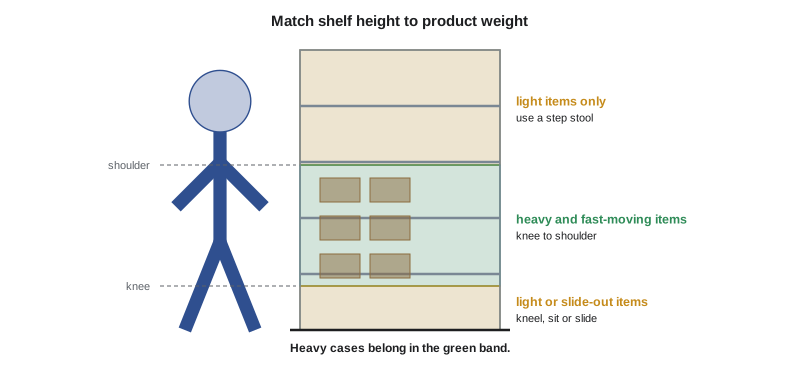
The shelf plan can use the power zone to cut injuries without anyone working harder. Heavy items such as water, pet food, detergent and large juice containers go on the middle shelves. Light items such as paper towels, chips and cereal go on the top shelf, where a stocker can reach them from a step stool without lifting much weight. The bottom shelf holds items of medium weight that can be slid rather than lifted. Many retailers now treat case weight as part of the shelf plan, and some ask suppliers to ship heavy products in smaller cases.
Getting product to the shelf
Most of the work of stocking happens before the case reaches the shelf: breaking down pallets, loading carts, pushing them through the store and unloading them at the aisle. HSE-342 covers receiving and pallet jacks in the backroom. On the sales floor, the key tools are carts.
- U-boats and stocking carts: narrow carts with a low deck and upright handles. Keep loads below eye level so you can see where you are going, put heavy cases on the bottom, and push rather than pull.
- Rolling platform carts and dollies: good for heavy items such as water and pet food. Check that the wheels turn freely; a cart with a stuck wheel takes far more force to push and is a common cause of shoulder strain.
- Raised stocking carts: some stores use carts with a shelf at waist height so cases can be opened and unloaded without bending.
- Pallets on the sales floor: only when the aisle can be blocked off from customers and the pallet can be moved with the right equipment.
Pushing is usually better than pulling because you can use your body weight and see ahead. The force needed to start a loaded cart is higher than the force to keep it rolling, so start slowly, avoid sudden turns and keep wheels and floors in good repair. Carts with soft or flat tires, wheels clogged with debris or loads above shoulder height should be fixed or reloaded before use.
Stocking low and high shelves
For bottom shelves, the goal is to avoid repeated deep bending. Options include kneeling on a knee pad for short periods, sitting on a low rolling stool, sliding product from a cart at a similar height, and using a reacher for light items at the back of the shelf. For top shelves, the goal is to avoid lifting weight above the shoulders. Use a proper step stool or rolling ladder (Lesson 5) so the shelf is closer to chest height, keep top-shelf items light, and never throw products up onto a shelf or stand on the bottom shelf to reach the top.
Team lifts and when to ask for help
Some items are too heavy or awkward for one person no matter how they are lifted: televisions, furniture boxes, bags of soil on a high pallet, a full case of watermelons. Northfield's rule is simple. If an item is over about 23 kg (50 lb), is awkward to grip, or blocks your view, use a cart or get help. Team lifts work best when the two people are of similar height, agree on who calls the lift, lift and lower together and walk in step. Asking for help should be seen as good practice, not weakness, and supervisors should make it easy by scheduling enough people for heavy deliveries.
Lifting technique: what the evidence says
Many workers have been told to bend their knees and keep their back straight. That advice is not wrong, but studies of manual handling training have consistently found that training in lifting technique on its own does little to reduce back injuries. A widely cited Cochrane review found no clear evidence that technique training or lifting aids alone prevent back pain. The reason is that technique cannot fix a load that is too heavy, too far away or in the wrong place, and people under time pressure revert to whatever is quickest.
That does not mean technique does not matter. Keeping the load close, avoiding twisting by moving the feet, testing the weight before lifting and getting a good grip all help. But the main protection comes from changing the job: lighter loads, better shelf heights, carts, help for heavy items and a pace that allows people to work properly. HSE-107 covers the evidence in more depth.
Checking a lift with the NIOSH equation
The NIOSH lifting equation, taught in HSE-107, estimates a recommended weight limit for a specific lift from its geometry and frequency. The ratio of the actual load to that limit is the lifting index. A lifting index above 1 means the lift is risky for many workers; above 3 it is risky for almost everyone. The program below uses a simplified version to compare stocking a 12.5 kg (27 lb) case of water from a cart onto four different shelf heights. The frequency and coupling factors are fixed at assumed values, so the results are for comparison only.
# Simplified NIOSH lifting check for stocking a case at four shelf heights (metric).
# Frequency and coupling multipliers are assumed values for illustration.
load = 12.5      # kg, case of water
origin = 75      # cm, cart deck height
FM, CM = 0.85, 0.95
shelves = {"bottom": (15, 45), "waist": (90, 30), "shoulder": (140, 40), "top": (180, 50)}

def rwl(v_dest, h):
    if v_dest > 175:
        return 0.0                      # above reach limit: not recommended
    hm = min(1.0, 25 / h)
    vm = 1 - 0.003 * abs(v_dest - 75)
    d = max(25, abs(v_dest - origin))
    dm = min(1.0, 0.82 + 4.5 / d)
    return 23 * hm * vm * dm * FM * CM

for name, (v, h) in shelves.items():
    r = rwl(v, h)
    li = "n/a (beyond limit)" if r == 0 else f"{load / r:.2f}"
print(f"{name:<9} height {v:>3} cm reach {h} cm RWL {r:5.1f} kg lifting index {li}")bottom height 15 cm reach 45 cm RWL 7.6 kg lifting index 1.65 waist height 90 cm reach 30 cm RWL 14.8 kg lifting index 0.85 shoulder height 140 cm reach 40 cm RWL 8.3 kg lifting index 1.50 top height 180 cm reach 50 cm RWL 0.0 kg lifting index n/a (beyond limit)
The pattern is clear even with simplified numbers. Stocking the case at waist height gives a lifting index below 1. The bottom shelf, with a long reach and a deep bend, roughly doubles the index, and the shoulder shelf is also above 1. The top shelf is beyond the reach height the equation allows, which means NIOSH does not recommend the lift at all. This is the arithmetic behind the advice to keep water and other heavy cases at waist height.
Shelving that tips or collapses
Store shelving, often called gondolas, is designed to carry a certain load per shelf and must be assembled and anchored as the manufacturer specifies. Overloaded shelves can bend and drop product, and tall freestanding units can tip if someone pulls on them or climbs them. Stockers should report bent shelf brackets, missing shelf clips, shelves that sag, and units that rock. Products should be stacked so they do not overhang the shelf edge, with heavy and round items such as watermelons and bottles kept low and contained. High overstock above the top shelf, sometimes called top-stock, should be kept light, stable and behind a lip or fence. Falling merchandise is covered further in Lesson 10.
Pace, fatigue and night crews
Many stores stock overnight or early in the morning so the shelves are full when doors open. Night crews often work against a fixed deadline with a set number of cases to put out, which creates pressure to rush, skip carts and lift more at once. Fatigue makes this worse. Supervisors can reduce the risk by planning realistic case counts per person, scheduling enough people for big deliveries, rotating workers between heavy and light aisles and making sure breaks happen. A crew that finishes slightly late is better than one that finishes on time with an injured back.
For supervisors: changes that cut stocking injuries
Work with the planogram team to move the heaviest products to waist height. Track which products cause the most strain and ask suppliers about smaller cases. Count your step stools and carts and put them where the work is. Fix sticky cart wheels quickly. Plan heavy deliveries with enough people. Watch new stockers during their first shifts and coach them on carts, reaching and asking for help rather than lecturing them on bending their knees.
Worked problem
Re-planning the water aisle
Northfield's back strain last year happened when a stocker lifted 12.5 kg (27 lb) cases of water from a low cart onto the top shelf of the water aisle. The aisle has five shelves, and water, sports drinks and juice jugs fill all five. How could the aisle be re-planned?
Show solution
- Map the products by weight. Cases of water and juice jugs are the heaviest; single bottles and multipacks of small cans are light.
- Move the heavy cases to the second and third shelves, which are between knee and shoulder height, and remove water from the top shelf entirely.
- Put light multipacks and single bottles on the top shelf, where a step stool brings them to chest height.
- Sell bulk water from a low pallet display at the end of the aisle, so customers take cases directly from the pallet and stockers move it with a pallet jack rather than by hand.
- Provide a waist-height stocking cart for the aisle and recheck the lifting index for the new layout.
Answer: Keeping heavy cases between knee and shoulder height, moving bulk water to a pallet display and putting only light items on the top shelf removes the riskiest lifts without slowing the work.
Common mistakes
MistakeRelying on lifting technique training to prevent back injuries.
InsteadChange the load, the shelf height and the equipment first; technique helps but cannot fix a bad lift.
MistakePutting heavy cases on top shelves because the planogram says so.
InsteadWork with planners to keep heavy items between knee and shoulder height.
MistakePulling a heavy cart backwards through the store.
InsteadPush the cart so you can see ahead and use your body weight, and fix sticky wheels.
MistakeLifting an awkward item alone to save time.
InsteadUse a cart or ask for a team lift for items over about 23 kg (50 lb), awkward to grip or blocking your view.
MistakeStacking overstock high above the top shelf.
InsteadKeep top-stock light, stable and behind a lip, and report sagging or rocking shelves.
Summary and key terms
- Stocking causes many retail strains because each shift involves thousands of lifts, reaches and twists.
- Lift risk depends on weight, reach, height, distance, twisting, frequency and grip, most of which are set by suppliers, shelf plans and equipment.
- Keep heavy and fast-moving items between knee and shoulder height, and light items on top shelves.
- Use carts, push rather than pull, keep wheels in repair and loads below eye level.
- Technique training alone does not prevent back injuries; changing the job does.
- The NIOSH lifting equation shows why waist-height storage cuts risk and why top-shelf heavy lifts should be avoided.
- Report bent or rocking shelving, keep top-stock light and plan night crew workloads realistically.
- Planogram
- A plan showing which products go on which shelf and in what position.
- Power zone
- The area between knee and shoulder height, close to the body, where lifting is easiest.
- U-boat
- A narrow stocking cart with a low deck and upright handles at each end.
- Team lift
- A lift shared by two or more people who coordinate their movements.
- Lifting index
- The ratio of the actual load to the NIOSH recommended weight limit for a lift.
- Gondola
- A freestanding store shelving unit, often double-sided.
- Top-stock
- Overstock stored above the top shelf of a shelving unit.
Practice problems
Work each problem on paper first, then reveal the answer to check.
Name four factors that make a lift riskier.
Show answer
Any four of: weight, distance from the body, starting or ending height, travel distance, twisting, frequency and poor grip.
Where should heavy products be stored on a shelving unit?
Show answer
Between knee and shoulder height, close to the front.
Why is pushing a cart usually better than pulling it?
Show answer
You can use your body weight and see where you are going.
What did reviews find about lifting technique training on its own?
Show answer
It does little to reduce back injuries unless the job itself is also changed.
What lifting index suggests a lift is risky for many workers?
Show answer
Above 1; above 3 is risky for almost everyone.
When should a stocker use a cart or ask for a team lift at Northfield?
Show answer
When an item is over about 23 kg (50 lb), awkward to grip or blocks the view.
Give two signs of unsafe shelving.
Show answer
Any two of: bent brackets, missing clips, sagging shelves, units that rock, products overhanging the edge.
Give two ways a supervisor can reduce pressure on a night stocking crew.
Show answer
Any two of: realistic case counts, enough people for big deliveries, rotation between heavy and light aisles, protected breaks.
Lesson quiz · 5 questions
Score 60% or more to complete this lesson.
Create a free account to save your progress, take quizzes and earn a certificate.