
HSE-311 · Lesson 9 of 12 · 29 min
Management of change and pre-startup safety review
Flixborough in 1974 began with a change: a temporary bypass pipe installed to keep a plant running while a cracked reactor was removed. The pipe was designed in a chalk sketch on a workshop floor and failed two months later, killing 28 people. Since then, management of change (MOC) has been one of the central elements of every process safety framework. Plants are never static. Equipment is replaced, chemicals are substituted, set points are adjusted, software is updated and people come and go. Every change can introduce a new hazard or weaken an existing safeguard. This lesson explains what counts as a change, how an MOC process works, how temporary and organizational changes are handled, and how a pre-startup safety review (PSSR) checks that changed or new equipment is ready to run.
What counts as a change
The key idea is the replacement in kind. Replacing a pump with an identical pump, or a gasket with one of the same specification, is maintenance, not a change. Anything that is not a replacement in kind is a change and goes through MOC. The difficulty is that many changes look small. A different gasket material, a new supplier of the same chemical, a revised operating procedure, a raised alarm limit, a software patch to the control system or a reduced crew on night shift can all alter risk.
| Type of change | Examples |
|---|---|
| Equipment and materials of construction | New pump model, different gasket or valve material, added piping |
| Process chemistry and conditions | New raw material or supplier, higher throughput, new operating temperature |
| Control and safety systems | New alarm limit, trip set point change, logic change, software update |
| Procedures | Revised startup sequence, new sampling method |
| Organization and staffing | Reduced shift crew, contractor taking over maintenance, reorganization of engineering |
| Temporary changes | Temporary hose or bypass, temporary repair clamp, temporary storage of drums |
The MOC workflow
Most MOC procedures follow the same broad steps, although the paperwork and software differ. The level of review is scaled to the risk: a minor change may need a short checklist and one technical review, while a major change may need a full HAZOP.
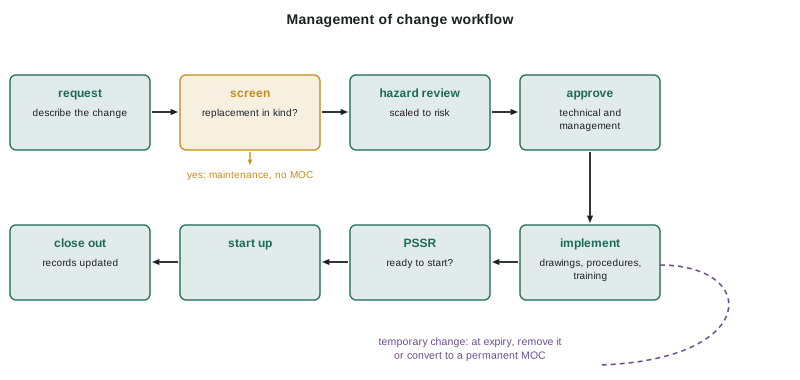
| Step | What happens | Common weakness |
|---|---|---|
| Request | Describe the change, its reason and its scope | Vague description hides the real change |
| Screening | Decide if it is a replacement in kind and what level of review is needed | Changes misclassified as maintenance |
| Hazard review | Identify new hazards and effects on safeguards; method scaled to risk | Reviewers lack the right expertise |
| Approval | Technical and management approval, with conditions | Approval by signature without reading |
| Implementation | Build the change; update drawings, procedures, PSI and training | Documents updated late or never |
| Pre-startup safety review | Check that the change is built as designed and that people are ready | Done as a paper exercise |
| Close-out | Confirm all actions are complete and records updated | MOCs left open for years |
In Canada, CSA Z767 and the CSChE PSM guide both include management of change as a core element, and federal and provincial regulators for pipelines, upstream oil and gas and pressure equipment expect it. The Canada Energy Regulator Onshore Pipeline Regulations, for example, require companies to have a process for managing change as part of their management system. Many provincial occupational health and safety regulators do not use the term MOC directly but expect hazards from changes to be assessed under the general duty to identify and control hazards.
Worked problem
Screening a change
At Larchmont Specialty Chemicals, purchasing proposes switching the acid chloride supplier for R-101 to a cheaper source with the same product specification. The new material contains up to 0.5 percent of a different impurity. Is this an MOC?
Show solution
- Ask whether it is a replacement in kind: the main component is the same, but the impurity profile differs.
- Ask whether the impurity could change the reaction: it might catalyze side reactions, change heat release or corrode equipment.
- Because the answer is not clearly no, treat it as a change and send it to MOC.
- The hazard review should include a reaction calorimetry test of a batch made with the new material, and a check of materials of construction.
- If the review shows no effect, approve with conditions, such as certificates of analysis for each delivery.
Answer: Treat it as a change. A different impurity profile can change reaction heat or corrosion, so the change needs a hazard review before use.
Temporary and emergency changes
Temporary changes are a major source of incidents because they are often done quickly and then forgotten. A temporary hose becomes part of the plant for years; a clamp on a leaking pipe stays on after the planned shutdown has come and gone. Good practice treats temporary changes as full changes, with a hazard review, an explicit expiry date and a check at expiry that the change has been removed or converted into a permanent MOC. Emergency changes made outside normal hours still need a review, even if it is shortened, and should be fully documented and reviewed afterwards.
# Find temporary changes that are past expiry or due within 14 days (seeded example data).
import random
from datetime import date, timedelta

random.seed(311)
today = date(2026, 10, 1)
mocs = []
for i in range(1, 13):
    opened = today - timedelta(days=random.randint(10, 400))
    life = random.choice([30, 60, 90, 180])
    mocs.append({"id": f"TMOC-{i:03d}", "opened": opened,
                 "expires": opened + timedelta(days=life),
                 "removed": random.random() < 0.4})

overdue = [m for m in mocs if not m["removed"] and m["expires"] < today]
due_soon = [m for m in mocs if not m["removed"] and today <= m["expires"] <= today + timedelta(days=14)]
print(f"Temporary changes open: {sum(not m['removed'] for m in mocs)} of {len(mocs)}")
for m in sorted(overdue, key=lambda m: m["expires"]):
    print(f"  OVERDUE {m['id']}  expired {m['expires']}  ({(today - m['expires']).days} days)")
for m in due_soon:
print(f" due soon {m['id']} expires {m['expires']}")Temporary changes open: 8 of 12 OVERDUE TMOC-007 expired 2025-12-28 (277 days) OVERDUE TMOC-012 expired 2025-12-31 (274 days) OVERDUE TMOC-001 expired 2026-08-07 (55 days) OVERDUE TMOC-002 expired 2026-08-09 (53 days) OVERDUE TMOC-011 expired 2026-08-20 (42 days) due soon TMOC-003 expires 2026-10-02 due soon TMOC-006 expires 2026-10-03
A simple register like this, reviewed weekly, prevents temporary changes becoming permanent by default. Long-overdue temporary changes are also a useful leading indicator of how well the MOC system is working.
Organizational change
Changes to people and organization can weaken process safety as much as changes to hardware. Reducing a shift crew from four to three may leave too few people to respond to an upset. Losing an experienced engineer may remove the only person who understands why a safeguard exists. Outsourcing maintenance may break the link between the people who inspect equipment and the people who operate it. Investigations of Texas City and other accidents found that budget cuts and reorganizations had reduced staffing and expertise without any formal review. Good practice is to run organizational changes that affect process safety roles through a management of organizational change (MOOC) process, assessing workload, competence and the coverage of critical tasks before and after the change.
| Question for an organizational change | Why it matters |
|---|---|
| Which process safety tasks does each affected role perform? | Critical tasks can be lost unnoticed |
| Can the new crew handle the worst credible upset or emergency? | Normal operation may be fine while upsets are not |
| Is there enough experience and competence on every shift? | Expertise is often concentrated in a few people |
| How will knowledge be transferred from people who leave? | The reasons behind safeguards can be forgotten |
| How will the change be monitored after implementation? | Problems may appear only months later |
Pre-startup safety review
A pre-startup safety review (PSSR) is a check carried out before introducing hazardous materials into new or modified equipment. It confirms that construction matches the design, that safety, operating, maintenance and emergency procedures are in place and adequate, that the hazard review has been done and its recommendations resolved or tracked, and that people have been trained. A PSSR is typically carried out by a small team including operations, engineering and maintenance, who walk the equipment and check documents against what they see.
CSA Z767 and the CSChE guide include pre-startup review within the management of change and asset integrity elements.
| PSSR checklist item | Example check |
|---|---|
| Built as designed | Walk the line against the updated P&ID; check valve types and materials |
| Hazard review complete | All HAZOP or MOC review actions closed or formally deferred with justification |
| Safeguards in service | Trips tested, relief devices installed with correct set pressure, gas detectors calibrated |
| Procedures updated | Operating, maintenance and emergency procedures reflect the change |
| People trained | Operators and maintainers trained and training recorded |
| Documents updated | P&IDs, PSI and equipment files updated or marked up for update |
Worked problem
A PSSR finding
During a PSSR for a new cooling water bypass on R-101, the team finds that the bypass valve was installed as a gate valve instead of the specified globe valve, and the new temperature transmitter has not yet been added to the trip logic. Startup is planned for tomorrow. What should happen?
Show solution
- Record both findings and classify them: the missing trip connection removes a credited safeguard and must be fixed before startup.
- The valve type affects controllability of the bypass. Engineering should assess whether it is acceptable or must be replaced before startup.
- Do not sign off the PSSR until the trip is connected, proof tested and the valve decision is documented.
- If startup is delayed, communicate why, so that schedule pressure does not undermine the review.
Answer: Startup must wait until the trip is connected and tested, and the valve issue is resolved or formally accepted by engineering.
Making MOC work in practice
An MOC procedure can be complete on paper and still fail. Audits and investigations point to a few recurring problems. The first is that people do not recognize a change, so it never enters the system: a maintenance planner orders a valve in a different material because the original is out of stock, or an engineer tweaks a controller tuning without thinking of it as a change. Training on what counts as a change, and a simple rule of asking when in doubt, address this. The second is that the review is done by people without the right expertise; a change to a relief system needs someone who understands relief design, and a change to reaction chemistry needs a chemist. The third is that the MOC becomes a bottleneck, so people find ways around it. A tiered process, with a fast route for low-risk changes and a full review for high-risk ones, keeps it usable.
Worked problem
Screening a control system change
An engineer wants to raise the high-temperature alarm on R-101 from 65 °C to 70 °C because it keeps sounding during normal operation. Is this a change, and what should the review consider?
Show solution
- It is a change: an alarm limit is part of the process safety information and may be credited as a safeguard.
- Check whether the alarm is credited in LOPA with a required operator response time; a higher limit leaves less time before the trip or runaway.
- Check why the alarm sounds in normal operation: the process may be running hotter than designed, which is itself a deviation to investigate.
- If the change is approved, update the alarm database, the operating limits in the procedure and the operators' training.
Answer: Treat it as an MOC. Review the response time, the reason for the nuisance alarms and the documents that must change before approving it.
Common mistakes
MistakeTreating a different supplier or gasket material as maintenance.
InsteadAnything other than a replacement in kind goes through MOC.
MistakeLetting temporary changes stay in place indefinitely.
InsteadGive every temporary change an expiry date and track it.
MistakeCutting staff without any review of process safety tasks.
InsteadRun organizational changes through a management of organizational change process.
MistakeClosing an MOC before drawings and procedures are updated.
InsteadClose out only when all documents and training are complete.
MistakeSigning a PSSR from the office.
InsteadWalk the equipment and check it against the design.
Summary and key terms
- Every change other than a replacement in kind can introduce new hazards and needs MOC.
- MOC steps are request, screening, hazard review, approval, implementation, PSSR and close-out.
- Temporary and emergency changes need the same rigour, plus expiry tracking.
- Organizational changes that affect process safety roles should be reviewed before they happen.
- A pre-startup safety review confirms that new or changed equipment, procedures and people are ready before hazardous materials are introduced.
- Management of change
- A process for reviewing and approving changes before they are made.
- Replacement in kind
- A replacement that meets the design specification of the item it replaces.
- Temporary change
- A change intended to be in place for a limited time, with an expiry date.
- Emergency change
- A change made urgently, with a shortened review and later full documentation.
- MOOC
- Management of organizational change, for staffing and organization changes.
- Pre-startup safety review
- A check before introducing hazardous materials into new or modified equipment.
- Close-out
- Confirming that all MOC actions and document updates are complete.
- Screening
- Deciding whether something is a change and what level of review it needs.
Practice problems
Work each problem on paper first, then reveal the answer to check.
What is a replacement in kind?
Show answer
A replacement that meets the design specification of the original item.
Give two examples of changes that are easy to overlook.
Show answer
A new supplier, a revised alarm limit, a software update or a reduced crew.
Why was Flixborough a management of change failure?
Show answer
A temporary bypass pipe was installed without proper design or hazard review.
List the main steps of an MOC process.
Show answer
Request, screening, hazard review, approval, implementation, PSSR, close-out.
What should happen when a temporary change reaches its expiry date?
Show answer
It should be removed or converted into a permanent MOC with full review.
Why should organizational changes be reviewed?
Show answer
They can remove critical tasks, competence or emergency capacity.
When is a PSSR required?
Show answer
Before introducing hazardous materials into new or significantly modified equipment.
Name three items checked in a PSSR.
Show answer
Built as designed, hazard review actions closed, safeguards in service, procedures updated, training done.
A trip credited in LOPA is not yet connected at PSSR. Can startup proceed?
Show answer
No; the credited safeguard must be in service and tested first.
What is a useful leading indicator for MOC?
Show answer
The number of overdue temporary changes or MOCs left open past their close-out date.
Lesson quiz · 5 questions
Score 60% or more to complete this lesson.
Create a free account to save your progress, take quizzes and earn a certificate.