
HSE-311 · Lesson 11 of 12 · 27 min
Operating discipline, procedures, alarms and human factors
Good design and well-maintained equipment are not enough on their own. Process plants are run by people, and people make decisions under time pressure, with incomplete information, at night, after long shifts and during unusual operations. Operating discipline means doing every task the right way every time: following procedures, communicating clearly at shift handover, responding correctly to alarms and keeping the plant within its safe operating limits. This lesson covers the design of procedures, non-routine operations such as startup, shift handover, fatigue, alarm management and the main types of human error. Broader human factors topics such as workplace design and safety culture surveys are covered in other courses; here we focus on what matters most for process safety.
Why non-routine operations are dangerous
Startups, shutdowns, upsets and maintenance handovers make up a small fraction of operating time, but a large share of process safety incidents happen during them. Equipment is in transitional conditions, controls may be in manual, trips may be bypassed, and operators perform tasks they do only a few times a year. At Texas City in 2005, the raffinate splitter tower was being restarted after a turnaround when it was overfilled with liquid for hours, leading to the release. At Tesoro Anacortes in 2010 the rupture happened during a hazardous, non-routine startup step. Many companies now require extra controls for non-routine work: a written, step-by-step procedure, a pre-task briefing, extra supervision, and keeping non-essential people away from the unit.
| Non-routine operation | Typical hazards | Controls |
|---|---|---|
| Startup after turnaround | Leaks from opened joints, air left in equipment, overfilling, bypassed trips | Detailed procedure with sign-offs, leak test, PSSR, extra staff |
| Planned shutdown | Pressure and temperature changes, trapped liquids, flare overload | Procedure, staged depressuring, communication with flare and utilities |
| Emergency shutdown | Fast transients, many alarms, stress | Practised emergency procedures, simple decision aids, alarm suppression by state |
| Equipment handover to maintenance | Incomplete isolation, residual chemicals | Isolation and lockout procedures, gas testing, permit to work |
| Sampling and draining | Exposure, uncontrolled release | Closed sampling systems, double valves, procedures |
Operating procedures
Written operating procedures tell operators how to carry out each phase of operation safely: initial startup, normal operation, temporary operation, emergency shutdown, emergency operation, normal shutdown and startup after a turnaround or emergency. They also state the safe operating limits for key variables, the consequences of going outside them and the steps to correct or avoid a deviation. Good procedures are accurate, current, easy to follow under stress, and written with the people who use them.
In Canada, CSA Z767 and the CSChE guide include operating procedures as part of their operations element, and provincial occupational health and safety laws require written safe work procedures for hazardous tasks. Some provinces' regulations for specific sectors, such as Alberta's upstream oil and gas requirements, add more specific rules.
| Feature of a good procedure | Why it helps |
|---|---|
| One action per step, in the order performed | Reduces skipped or reversed steps |
| Caution and danger notes placed before the step they apply to | Gives the information when it is needed |
| Operating limits with consequences and corrective actions | Explains why the limit matters |
| Checkboxes or sign-offs for critical steps | Supports place-keeping and verification |
| Diagrams and photos of the actual equipment | Reduces confusion about which valve or pump |
| Regular review by operators who use it | Keeps it accurate and practical |
Shift handover
Shift handover is a point where information can be lost. The incoming operator needs to know what is running, what is out of service, what is bypassed, what work permits are active, any abnormal conditions and what is planned. Investigations of Piper Alpha in 1988 and Texas City in 2005 both found that information was not passed on at shift change. Piper Alpha's night shift did not know that a pressure safety valve had been removed from a condensate pump on the day shift; when the standby pump was started, condensate leaked from the blind flange and ignited. Good handover uses a structured written log combined with a face-to-face conversation, ideally at the board or in the field, and covers a standard list of items.
Worked problem
A structured handover
Write the key items the outgoing R-101 operator should hand over at 18:00 on a day when the cooling water standby pump is out for repair and batch 214 is midway through feed.
Show solution
- Current status: batch 214 in feed step, 2 hours of 4 complete, temperature stable at 60 °C.
- Equipment out of service: standby cooling water pump P-201B isolated for seal repair under permit 5531; only P-201A available.
- Safeguards affected: no standby pump, so loss of P-201A would mean loss of cooling; compensating measure is to stop feed immediately on any cooling water low-flow alarm.
- Bypasses: none active; the high-temperature trip is in service.
- Planned work and expectations: maintenance expects P-201B back by 22:00; feed to finish about 20:00; do not start batch 215 until P-201B is back in service.
- Confirm understanding: the incoming operator reads back the key points and both sign the log.
Answer: A good handover covers status, equipment out of service, affected safeguards with compensating measures, bypasses, planned work and a read-back.
Fatigue
Fatigue degrades vigilance, reaction time and decision making. Process plant operators often work 12-hour shifts, rotating between days and nights, and overtime during turnarounds can stretch working hours much further. The CSB found that the Texas City board operator had worked 12-hour shifts for 29 consecutive days. API RP 755, Fatigue Risk Management Systems for Personnel in the Refining and Petrochemical Industries, recommends hours-of-service limits, such as caps on consecutive shifts and work-set hours, along with fatigue training, incident investigation that considers fatigue and a process for exceptions.
Alarm management
Alarms tell operators that something needs their attention and response. But too many alarms, alarms with no clear response, and alarms that stay active for days all reduce the chance that an operator responds correctly to the alarm that matters. In 1994 at the Texaco refinery in Milford Haven, Wales, operators faced 275 alarms in the last 11 minutes before an explosion; the UK Health and Safety Executive concluded that they had too many alarms to respond to.
The standards ANSI/ISA-18.2 and IEC 62682 set out an alarm management life cycle: an alarm philosophy, identification and rationalization of every alarm, detailed design, implementation, operation, maintenance, monitoring and assessment, management of change and audit. In rationalization each alarm is checked against a simple test: does it indicate an abnormal condition, does it require a timely operator action, and is it the best indicator of that condition? Alarms that fail the test are removed or turned into events in the log.
| Alarm performance measure | Commonly used benchmark (illustrative) |
|---|---|
| Average alarm rate per operator | About 1 per 10 minutes (6 per hour) is very likely acceptable; about 2 per 10 minutes is the maximum manageable |
| Alarm flood | More than 10 alarms in 10 minutes per operator |
| Percentage of time in flood | Less than about 1 percent |
| Top 10 most frequent alarms | Less than about 1 to 5 percent of all alarms |
| Stale alarms (active more than 24 hours) | Fewer than about 5 at any time |
| Priority distribution | About 80 percent low priority, 15 percent medium, 5 percent high |
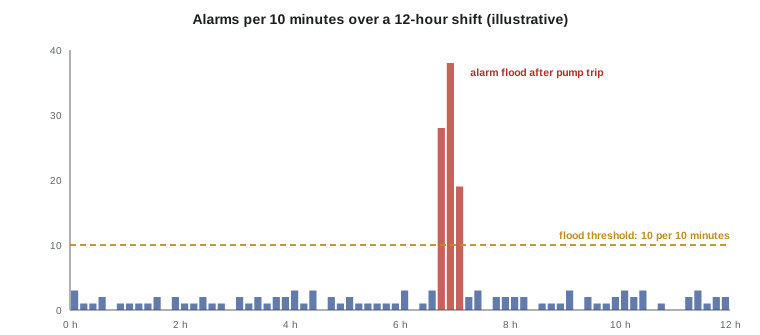
# Alarm rate analysis for one operator console over a 12-hour shift (seeded data).
import random
random.seed(311)
intervals = 72                                   # 10-minute intervals in 12 hours
counts = [random.choice([0, 1, 1, 1, 2, 2, 3]) for _ in range(intervals)]
for i, extra in zip(range(40, 43), [28, 35, 17]):   # upset: cooling water pump trip
    counts[i] += extra
total = sum(counts)
flood = [i for i, c in enumerate(counts) if c > 10]
print(f"Total alarms: {total}, average {total / 12:.1f} per hour")
print(f"Flood intervals: {len(flood)} of {intervals} ({len(flood) / intervals:.0%} of shift)")
print(f"Alarms during floods: {sum(counts[i] for i in flood)} ({sum(counts[i] for i in flood) / total:.0%})")
calm = [c for i, c in enumerate(counts) if i not in flood]
print(f"Average rate outside floods: {sum(calm) / (len(calm) / 6):.1f} per hour")Total alarms: 184, average 15.3 per hour Flood intervals: 3 of 72 (4% of shift) Alarms during floods: 85 (46%) Average rate outside floods: 8.6 per hour
The analysis shows two problems. Even outside the upset, the rate of about 8.6 alarms per hour is above the benchmark of about 6, so the console needs rationalization. And a single upset produces a flood in which almost half of the shift's alarms arrive in 30 minutes, exactly when the operator most needs to think clearly. Measures such as state-based alarming, which suppresses alarms that are expected after a known trip, and grouping of consequential alarms help keep floods manageable. Alarm priority should reflect the consequence and the time available to respond, not the order in which alarms were configured.
Human error
Human error is a normal part of human performance, not a moral failing. Understanding the types of error helps choose the right control. A widely used scheme, based on James Reason's work, separates unintentional errors (slips, lapses and mistakes) from intentional deviations (violations).
| Type | Description | Example | Better control |
|---|---|---|---|
| Slip | Right intention, wrong action | Opening the valve next to the intended one | Clear labelling, physical separation, design |
| Lapse | Forgetting a step | Not closing a drain after sampling | Checklists, place-keeping, interlocks |
| Rule-based mistake | Applying the wrong rule to a situation | Treating a real high temperature as an instrument fault | Training, procedures, decision aids |
| Knowledge-based mistake | Wrong diagnosis in a new situation | Misunderstanding an unfamiliar upset | Simulator training, expert support, clear displays |
| Violation | Deliberate deviation from a rule | Bypassing a trip to save time | Address the reasons: workable rules, resources, culture |
Most violations are well-intentioned attempts to get the job done when the rule seems unworkable or the resources are insufficient. Punishing individuals without fixing the underlying conditions drives reporting underground. A just culture distinguishes honest errors, which are learned from, from reckless behaviour, which is not tolerated, and treats at-risk behaviour as a signal to fix the system (Lesson 12).
Worked problem
Choosing a control for a recurring lapse
Twice in a year, operators have forgotten to close a bottom drain valve on the toluene tank T-100 after sampling, causing small spills. What controls would be most effective?
Show solution
- Classify the error: a lapse, forgetting a step in a routine task.
- Training alone will not fix a memory lapse in a routine task done many times.
- Better options: replace the open drain with a closed-loop sampling system; fit a spring-return (dead-man) valve that closes when released; add a second closed valve or cap on the drain.
- Supporting options: add a checklist step and sign-off; add a level alarm for unexpected drops.
Answer: Use engineering controls such as a closed sampling system or spring-return valve, supported by a checklist; do not rely on retraining alone.
Common mistakes
MistakeTreating startup as just another shift.
InsteadApply extra controls to non-routine operations.
MistakeWriting procedures in the office without operator input.
InsteadWrite and review them with the people who use them.
MistakeHanding over with a quick verbal chat.
InsteadUse a structured written log plus a face-to-face handover with read-back.
MistakeAdding an alarm for every variable.
InsteadRationalize alarms so each one needs a timely operator response.
MistakeBlaming individuals for errors and moving on.
InsteadIdentify the error type and fix the system that made it likely.
Summary and key terms
- A large share of process safety incidents happen during non-routine operations such as startup and shutdown.
- Operating procedures must cover each operating phase and state safe limits, consequences and corrective actions.
- Structured shift handover prevents loss of critical information, as Piper Alpha showed.
- Fatigue degrades performance; API RP 755 gives guidance on hours of service.
- Alarm management under ISA-18.2 and IEC 62682 rationalizes alarms and controls rates and floods.
- Slips, lapses, mistakes and violations need different controls, with engineering controls preferred.
- Operating discipline
- Performing every task the right way every time.
- Non-routine operation
- An infrequent operation such as startup, shutdown or upset response.
- Safe operating limit
- A limit on a process variable beyond which there is risk of harm.
- Shift handover
- The transfer of information and responsibility between shifts.
- Fatigue risk management
- Managing hours of work and other factors to limit fatigue.
- Alarm rationalization
- Reviewing each alarm to confirm it needs a timely operator response.
- Alarm flood
- More alarms than an operator can handle, often more than 10 in 10 minutes.
- Stale alarm
- An alarm that stays active for a long time, often more than 24 hours.
- Lapse
- An error of memory, such as forgetting a step.
- Violation
- A deliberate deviation from a rule or procedure.
Practice problems
Work each problem on paper first, then reveal the answer to check.
Why are startups particularly hazardous?
Show answer
Transitional conditions, manual control, possible bypasses and infrequently performed tasks.
List four operating phases that procedures must cover.
Show answer
Initial startup, normal operation, emergency shutdown, normal shutdown (also temporary, emergency operation, restart).
What information was lost at shift change before the Piper Alpha disaster?
Show answer
That a pressure safety valve had been removed from a condensate pump.
Name five items a shift handover should cover.
Show answer
Status, equipment out of service, bypasses, active permits, abnormal conditions, planned work.
What does API RP 755 address?
Show answer
Fatigue risk management, including hours-of-service limits.
What three questions does alarm rationalization ask?
Show answer
Is it abnormal, does it need timely operator action, is it the best indicator?
What is a common definition of an alarm flood?
Show answer
More than 10 alarms in 10 minutes per operator.
An operator opens the wrong valve next to the right one. What type of error is this?
Show answer
A slip.
Why does retraining rarely fix lapses?
Show answer
Lapses are memory failures in familiar tasks; design and checklists work better.
What does a just culture distinguish between?
Show answer
Honest errors, at-risk behaviour and reckless behaviour.
Lesson quiz · 5 questions
Score 60% or more to complete this lesson.
Create a free account to save your progress, take quizzes and earn a certificate.