
HSE-224 · Lesson 9 of 12 · 30 min
Insulated tools, test instruments and safe testing
Testing and troubleshooting are the energized tasks that qualified workers perform most often, and they are behind a large share of arc flash incidents. A meter with the wrong rating, a damaged test lead, a probe that slips between phases or a meter left on the current range can turn a routine measurement into a fault. This lesson covers how test instruments are rated, how to choose and inspect them, how insulated and insulating tools differ, and the work practices that make testing safer.
Overvoltage installation categories
Electrical systems carry not only their nominal voltage but also brief transient overvoltages, caused by lightning, switching of large loads and faults. These transients can be thousands of volts and, if they exceed what a meter can withstand, they can cause an internal flashover that becomes an arc in the worker's hands. The closer a location is to the utility supply, the higher the available fault current and the more energetic the transients. IEC 61010-1, adopted in Canada as CSA C22.2 No. 61010-1 and in the United States as UL 61010-1, classifies locations into measurement categories:
- CAT I: electronic equipment and circuits not directly connected to the mains, such as protected low-energy circuits.
- CAT II: receptacle-connected loads, such as appliances, portable tools and outlets more than about 10 m (30 ft) from a CAT III source.
- CAT III: the distribution level inside a building: panelboards, distribution boards, motor control centres, feeders, bus duct and fixed equipment such as large motors.
- CAT IV: the origin of the installation: the service entrance, utility meter, service conductors and outdoor overhead or underground lines feeding a building.
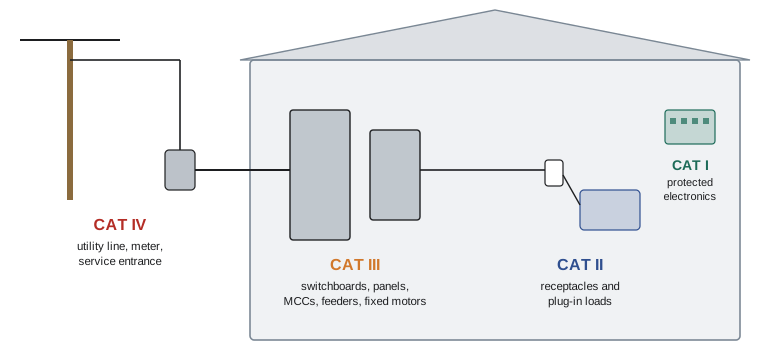
The rating marked on a meter combines a category and a voltage, such as CAT III 1000 V or CAT IV 600 V. Both matter. A higher category at a given voltage, or a higher voltage in the same category, means the meter is designed to withstand larger transients. A meter must be rated for the highest category and voltage where it will be used.
| Rating | Typical impulse withstand voltage | Typical use |
|---|---|---|
| CAT II 600 V | 4,000 V | Receptacle circuits |
| CAT III 600 V | 6,000 V | Panels and MCCs up to 600 V |
| CAT III 1000 V | 8,000 V | Distribution up to 1,000 V, including PV and 600 V systems |
| CAT IV 600 V | 8,000 V | Service entrance and utility meters up to 600 V |
| CAT IV 1000 V | 12,000 V | Service entrance up to 1,000 V |
Worked problem
Choosing a meter for the task
An electrician has two multimeters: one rated CAT II 1000 V and one rated CAT III 1000 V / CAT IV 600 V. Which should be used for (a) measuring the 600 V supply at a motor control centre and (b) checking voltage at the line side of a 347/600 V service entrance?
Show solution
- (a) An MCC is CAT III. The CAT II meter is not rated for this location even though its voltage rating is higher. Use the CAT III 1000 V meter.
- (b) The line side of the service entrance is CAT IV, and the voltage is 600 V. Use the meter rated CAT IV 600 V.
- Check that the test leads and probes carry the same or higher rating; the system is only as good as its lowest-rated part.
Answer: Use the CAT III 1000 V / CAT IV 600 V meter for both. A high voltage rating does not make up for too low a category.
Meter features that matter
Beyond the category rating, several features separate a meter that is suitable for industrial work from one that is not:
- Third-party certification to IEC 61010-1 (CSA C22.2 No. 61010-1 or UL 61010-1) by a recognized testing laboratory, shown by its mark on the meter. A printed CAT rating without certification is a claim, not proof.
- High-energy fuses on the current inputs, rated for the voltage and with an interrupting rating high enough for industrial fault levels, such as 1,000 V with an interrupting rating of 10 kA to 20 kA or more. Cheap meters may have glass fuses that cannot safely interrupt an industrial fault.
- Input protection and warnings, such as an alarm if test leads are in the current jacks while the dial is set to voltage.
- Test leads with shrouded connectors, finger guards and probe tips that can be fitted with covers so that no more than about 4 mm of metal is exposed, as required for CAT III and CAT IV use by IEC 61010-031.
- A low-impedance voltage function, which helps distinguish real voltage from ghost voltage induced on de-energized conductors.
- A design that allows the meter to be hung or held so that the worker's hands stay as far from the circuit as possible.
Worked problem
The meter left on amps
A technician measures current in a circuit using the meter's 10 A input, then forgets to move the leads back before probing a 600 V (or 480 V) bus to check voltage. The available fault current at the bus is 25 kA. What happens, and what protects the technician?
Show solution
- In the current jack, the meter presents a very low resistance between the probes, so probing across phases creates a near short circuit.
- Current flows through the leads and meter; the only device that can interrupt it inside the meter is the current-input fuse.
- A properly rated high-energy fuse (for example 1,000 V with an interrupting rating of at least 10 kA) clears the fault quickly inside its body.
- A cheap glass fuse may fail to interrupt, allowing an arc to form at the probes or inside the meter, initiating an arc flash.
- Arc-rated PPE, a meter with an input alarm and a habit of checking leads before every measurement are the layered defences.
Answer: The meter becomes a short circuit. Only a correctly rated fuse prevents an arc flash at the worker's hands, which is why meter fuses are a safety feature, not a convenience.
Inspecting test equipment
CSA Z462 requires test instruments, equipment and their accessories to be rated for the circuits and equipment where they will be used, designed for the environment, and visually inspected for external defects and damage before each use. If there is a defect or evidence of damage, the item must be removed from service. The same standards require the operation of a test instrument used to verify absence of voltage to be confirmed before and after use (the live-dead-live check in Lesson 7).
A quick pre-use check includes the meter case for cracks, the display and dial for correct function, the battery indicator, the lead insulation for cuts, nicks, melted spots and exposed conductor, the connectors for damage, the probe tips for wear and the tip guards. Many meters have a fuse test function; use it. Leads are consumable items and should be replaced whenever there is doubt.
Insulated and insulating tools
Two kinds of hand tools are used near energized parts. Insulated tools are metal tools with an insulating covering, such as screwdrivers, pliers, wrenches and cable cutters, tested and marked for live working up to 1,000 V AC and 1,500 V DC. They are made to IEC 60900 or ASTM F1505 and carry the double triangle symbol with the voltage rating. Insulating tools are made mostly of insulating material, with metal only where it is needed at the tip, and are used for tasks such as positioning conductors. Both are for use only with the rest of the required PPE and only within their ratings.
Insulated tools must be inspected before each use. If the insulation is cut, chipped, cracked or worn to the point where the inner coloured layer shows (many tools have a two-colour coating for this reason), the tool must be removed from service. Electrical tape wrapped around an ordinary screwdriver does not make it an insulated tool.
For medium and high voltage, live-line tools such as hot sticks and shotgun sticks, made of fibreglass-reinforced plastic to ASTM F711, allow qualified workers to operate switches, install grounds and test from a distance. They must be kept clean and dry, inspected before use and periodically dielectric-tested.
Safe testing practices
Good practice for testing energized circuits combines the right equipment with habits that limit the chance of a slip:
- Plan the measurement. Know the expected voltage and the points to be tested before opening anything.
- Set the meter to the correct function and range before connecting, and check the lead positions every time.
- Use the one-hand rule where practical: connect the ground or neutral lead first, keep the other hand away from the equipment, and remove the hot lead first.
- Use probe tip covers, and where possible use test points, finger-safe terminals or test blocks that avoid exposing bus.
- Position yourself to the side of the enclosure opening, not directly in front of it, and keep your face out of line with the opening where possible.
- Do not lean on the enclosure or allow your body to contact grounded metal while probing.
- Stop if the readings are unexpected. A voltage where none should exist, or none where some should, means the circuit is not what you thought.
- Use remote displays, wireless meters and permanently installed voltage indicators where available to take readings without opening equipment.
Worked problem
Using permanent test points to avoid exposure
A maintenance team takes weekly voltage and current readings at 30 MCC buckets for a predictive maintenance program. Each reading requires opening the bucket door in category 2 PPE. Propose a higher-order control.
Show solution
- Elimination of exposure: install voltage test portals or test points on the bucket doors, allowing a meter to be connected without opening the door.
- Engineering: install a power monitoring system that sends voltage and current to a central screen.
- Result: the routine readings no longer expose workers to energized parts, and the arc flash and shock risk for the weekly task is greatly reduced.
- The remaining exposure is limited to genuine troubleshooting.
Answer: Permanent test points or remote monitoring remove most of the routine exposure, which is a higher-order control than PPE.
Ghost voltage and other surprises
A high-impedance digital meter can show a voltage on a de-energized conductor that is running near energized ones, because capacitive coupling induces a small voltage that the meter's high input impedance does not load down. This ghost voltage can be several tens of volts. A low-impedance (LoZ) setting or a dedicated tester applies a load that collapses ghost voltage while showing real voltage. The difference matters: treating a real voltage as a ghost could be fatal, while treating a ghost as real leads to confusion. When in doubt, treat the conductor as energized until the source is identified.
Proving units and calibration
A tester used to verify absence of voltage must be proven before and after each use. A known live source nearby is acceptable, but it may be far from the point of work or at a different voltage. A portable proving unit, a small battery-powered device that generates a known test voltage, allows the live-dead-live check to be done at the point of work. Proving units must themselves be checked and their batteries maintained. Where a proving unit generates a voltage lower than the system voltage, the employer's procedure should confirm that it is adequate for the tester and the task.
Test instruments should also be calibrated and functionally checked at the intervals the manufacturer recommends, and whenever they have been dropped, exposed to a fault or show inconsistent readings. Calibration labels show when the next check is due. An instrument out of calibration may still indicate the presence of voltage, but it can no longer be relied on for the measurements made during troubleshooting.
Finally, keep test equipment clean and dry, store leads loosely coiled rather than tightly wrapped, and never use a meter that has been exposed to water, solvents or conductive dust until it has been inspected.
Common mistakes
MistakeChoosing a meter by its voltage rating alone.
InsteadMatch both the category and the voltage to the location.
MistakeReplacing a blown meter fuse with any fuse that fits.
InsteadUse only the manufacturer's specified high-energy fuse.
MistakeWrapping tape on a screwdriver to make it insulated.
InsteadUse tools tested and marked to IEC 60900 or ASTM F1505.
MistakeProbing a bus with leads still in the current jacks.
InsteadCheck function and lead positions before every measurement.
MistakeStanding directly in front of an open enclosure while testing.
InsteadPosition yourself to the side of the opening where practical.
Summary and key terms
- Measurement categories CAT II, III and IV reflect transient energy by location.
- Meters must be rated for both the category and the voltage, and certified by a recognized laboratory.
- High-energy current fuses and input alarms prevent a meter from becoming a short circuit.
- Inspect meters, leads and probes before each use and remove damaged items.
- Insulated tools are rated 1,000 V AC and marked with the double triangle; tape is not insulation.
- Safe testing habits include planning, one-hand technique, tip covers and body position.
- Permanent test points and remote monitoring remove routine exposure.
- Measurement category
- A classification (CAT I to IV) of locations by transient overvoltage severity.
- Transient overvoltage
- A brief voltage spike from lightning, switching or faults.
- High-energy fuse
- A meter fuse with high voltage and interrupting ratings.
- Insulated tool
- A metal tool with an insulating covering rated for live work, typically 1,000 V AC.
- Insulating tool
- A tool made mostly of insulating material.
- Ghost voltage
- A voltage reading induced on a de-energized conductor by coupling.
- Low-impedance (LoZ) mode
- A meter setting that loads the circuit to collapse ghost voltage.
- Probe tip cover
- A shroud that limits exposed probe metal to about 4 mm.
- Hot stick
- An insulated pole used to operate or test equipment from a distance.
Practice problems
Work each problem on paper first, then reveal the answer to check.
What category is a panelboard inside a building?
Show answer
CAT III.
What category is the service entrance?
Show answer
CAT IV.
Which is better for an MCC: CAT II 1000 V or CAT III 600 V?
Show answer
CAT III 600 V, because the category matches the location.
What symbol marks an insulated tool for live work?
Show answer
The double triangle with the voltage rating.
What is the typical voltage rating of insulated hand tools?
Show answer
1,000 V AC and 1,500 V DC.
Why are high-energy fuses important in a meter?
Show answer
They safely interrupt the fault if the meter is used on the current range across a voltage source.
How much probe tip metal may be exposed for CAT III and IV use?
Show answer
About 4 mm.
What causes ghost voltage?
Show answer
Capacitive coupling from nearby energized conductors.
Name two higher-order controls for routine readings.
Show answer
Voltage test portals on doors, remote monitoring or permanently installed indicators.
What should be done with a test lead with a nick in the insulation?
Show answer
Remove it from service and replace it.
Lesson quiz · 5 questions
Score 60% or more to complete this lesson.
Create a free account to save your progress, take quizzes and earn a certificate.