
HSE-224 · Lesson 11 of 12 · 31 min
Emergency response and incident investigation
Even with the best planning, electrical incidents happen. When they do, the first few minutes decide whether a shock victim survives, and the hours and days afterwards decide whether the organization learns enough to prevent the next one. This lesson covers rescue from electrical contact, first aid for shock and arc flash burns, the legal reporting duties that follow a serious electrical incident, and how to investigate electrical incidents and near misses. HSE-111 covers incident investigation methods in depth.
Planning before the work starts
Emergency response begins with the job briefing, not with the incident. NFPA 70E-2024 added a requirement that job safety planning include an emergency response plan, and CSA Z462 likewise expects the employer to plan for rescue. Before any energized work, the crew should know where the nearest disconnecting means is and how to operate it, who is trained to release a victim and to give first aid and CPR, where the nearest AED and first aid kit are, how to call emergency services from that location (including the site address and access route), and who will meet the ambulance. Ontario construction rules require a competent worker, trained in rescue and CPR and equipped with rescue equipment, to be stationed where they can see the worker doing live work at 300 V or more, other than diagnostic testing (O. Reg. 213/91 s. 191).
Releasing a victim from contact
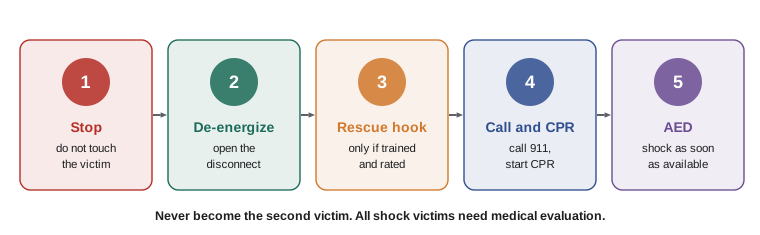
A person in contact with an energized conductor may be unable to let go, because current above the let-go threshold causes muscles to contract and grip. The rescuer's first duty is not to become a second victim. Touching the victim while current is flowing puts the rescuer in the same circuit.
- Do not touch the victim or anything in contact with them until the circuit is de-energized or you are using rated equipment.
- De-energize if you can do so quickly and safely: open the disconnect, breaker or emergency stop identified in the briefing. This is always the preferred method.
- If you cannot de-energize, and you are trained and equipped, use a rescue hook (an insulated shepherd's hook) or other insulated rescue tool rated for the voltage to pull the victim free, pulling them away from the source rather than towards yourself.
- For low voltage, if no rated tool is available, a dry, non-conductive object such as a dry wooden board or a dry rope may be used by a trained person as a last resort, keeping your own body insulated and away from the conductor.
- For high voltage, do not approach at all. Keep everyone back, call the utility or the facility's high voltage authority to de-energize, and call emergency services.
First aid for electric shock
Once the victim is free of the circuit, the rescuer checks for responsiveness and breathing. If the victim is not breathing normally, call emergency services, start CPR and send someone for an AED. Electrical current can cause ventricular fibrillation, which only defibrillation can reverse; each minute without CPR and defibrillation reduces the chance of survival substantially. An AED is safe to use on a shock victim once they are free of the circuit.
A shock victim who appears to be fine must still be medically evaluated. Electrical injury can cause delayed cardiac arrhythmias, internal tissue damage along the current path that is invisible at the skin, and kidney injury from muscle breakdown. Entry and exit wounds may be small while the internal damage is large. Many employers' procedures require any worker who has received an electric shock, however minor, to be assessed at a hospital or clinic, and to have the event reported and investigated.
Worked problem
Why the minutes matter
A worker collapses after contact with a 600 V (or 480 V) bus. The nearest AED is in the main office, 4 minutes away on foot each way. Survival from cardiac arrest is often quoted as falling by roughly 7 % to 10 % for each minute without defibrillation, less if good CPR is being given. What does this suggest about the emergency plan?
Show solution
- Without CPR, a delay of about 8 minutes for a round trip could reduce the chance of survival by roughly 55 % to 80 % compared with immediate defibrillation.
- Effective CPR slows that decline but does not stop it; the heart in fibrillation needs a shock.
- The plan should place an AED near high-risk electrical work areas, or bring one to the job site for the duration of the energized task.
- The job briefing should assign who fetches the AED and who calls emergency services.
Answer: An 8-minute round trip is too long. AEDs should be within a minute or two of energized work, and the briefing should assign roles in advance.
First aid for arc flash burns
Arc flash causes thermal burns, sometimes combined with injuries from the blast, flying metal and eye exposure to intense light. First aid priorities are to stop the burning, cool the burn and get medical help:
- If clothing is burning, smother the flames, or have the victim stop, drop and roll.
- Cool burns with cool running water for at least 20 minutes, if it can be done safely. Do not use ice.
- Remove jewellery and loose clothing near the burn, but do not pull away clothing stuck to the skin.
- Cover burns loosely with clean, dry, non-stick dressings or clean plastic film.
- Watch for shock (low blood pressure), keep the victim warm, and treat for possible blast injuries, including hearing loss, eye injury and fractures.
- Call emergency services for any burn larger than the victim's palm, any burn to the face, hands, feet, genitals or major joints, and any arc flash event.
Burns to the face and airway are especially dangerous because swelling can block breathing. Singed nasal hair, soot around the mouth, a hoarse voice or difficulty breathing are signs of airway burns that need immediate emergency care.
Worked problem
Estimating burn area with the rule of nines
After an arc flash, a worker wearing only a cotton T-shirt has burns covering the front of the torso and both arms. Using the adult rule of nines (front of torso 18 %, each arm 9 %), estimate the total body surface area burned.
Show solution
- Front of torso: 18 %.
- Two arms: \( 2 \times 9 = 18 \) %.
- Total: \( 18 + 18 = 36 \) %.
- Burns over about 20 % of body surface area in adults are generally treated as major burns needing specialist care and fluid resuscitation.
Answer: About 36 % of body surface area, a major burn requiring emergency transport to a burn centre. Arc-rated clothing would likely have limited this to the unprotected areas.
Reporting duties
Serious electrical incidents trigger legal reporting duties. In Ontario, section 51 of the Occupational Health and Safety Act requires the employer to notify a Ministry of Labour inspector, the joint health and safety committee or health and safety representative and the trade union immediately when a worker is killed or critically injured, and to send a written report within 48 hours; the scene must not be disturbed except to save life, relieve suffering or prevent further damage, until an inspector permits. Separately, Ontario Regulation 22/04 requires serious electrical incidents, including any electrical contact causing death or critical injury, any fire or explosion caused by electricity that could have caused critical injury, and some near misses, to be reported to the Electrical Safety Authority within 48 hours. Other provinces have similar requirements; in British Columbia, serious incidents are reported to WorkSafeBC immediately, and Technical Safety BC investigates electrical incidents. Workers' compensation claims are reported separately, for example on a Form 7 to the WSIB in Ontario within three days of learning of the injury.
| Event | Report to | Timing |
|---|---|---|
| Worker killed or critically injured | Ministry of Labour inspector, JHSC or representative, union | Immediately, then written report within 48 hours |
| Serious electrical incident (Ontario) | Electrical Safety Authority | Within 48 hours |
| Lost-time injury or medical aid | WSIB (Form 7) | Within 3 days of learning of it |
| Any electric shock or arc flash, however minor | Employer, under its program | Immediately, for investigation |
Worked problem
Which reports apply?
A maintenance electrician in an Ontario factory receives an arc flash burn to both hands and the face while racking a breaker, and is admitted to hospital. List the reports required.
Show solution
- Admission to hospital with serious burns is likely to meet the definition of a critical injury: immediate notice to the Ministry of Labour inspector, the joint health and safety committee and the union, followed by a written report within 48 hours.
- The arc flash is a serious electrical incident: report to the Electrical Safety Authority within 48 hours.
- WSIB Form 7 within three days.
- Preserve the scene until the inspector releases it, and start the internal investigation.
Answer: Ministry of Labour immediately and in writing within 48 hours, ESA within 48 hours, WSIB within three days, plus the internal investigation.
Investigating electrical incidents and near misses
An electrical safety program must include a procedure for investigating electrical incidents. The aim is to find out why the event happened and to fix the underlying causes, not to find someone to blame. Near misses deserve the same attention, because they reveal the same weaknesses without the injury: a tester that showed voltage on a circuit believed to be locked out, a probe that slipped and caused a spark, or a breaker that would not open.
A typical electrical investigation looks at the following questions:
- What was the task, and was it supposed to be done energized? If so, was there a permit and a valid justification?
- Were all sources identified, and was absence of voltage verified at the point of work with a proven tester?
- Were the arc flash labels current, and did the incident energy match the study? Did the protective device operate as expected?
- What PPE was worn, and did it perform as rated? Arc-rated clothing that has been exposed to an arc must be retained as evidence and then removed from service.
- What was the condition of maintenance of the equipment?
- Was the worker qualified for this task, and was supervision adequate?
- What organizational factors played a part, such as production pressure, staffing, scheduling of outages or a culture that tolerated live work?
Worked problem
Looking past the immediate cause
An electrician was shocked while replacing a lighting ballast on a circuit they had switched off at the wall switch. The circuit was a 347 V (or 277 V) lighting circuit with a shared neutral. Apply a simple why-why analysis.
Show solution
- Why was the electrician shocked? The ballast leads were energized.
- Why were they energized? The wall switch opened only the phase conductor of one circuit, and the shared neutral carried current from another circuit.
- Why was the circuit not locked out at the panel? The electrician believed ballast changes were minor work and the panel was two floors away.
- Why was that belief accepted? The site had no procedure covering lighting maintenance, and supervisors routinely allowed it to be done live.
- Corrective actions: a written procedure for lighting maintenance requiring panel lockout and testing of all conductors including the neutral, training, and supervisor accountability.
Answer: The immediate cause was an energized conductor, but the root causes were the missing procedure and an accepted practice of working live. Fixing only the individual's behaviour would leave both in place.
Investigation findings should be shared widely, without names, through safety meetings, toolbox talks and the electrical safety committee. The corrective actions should be tracked to completion and their effectiveness checked, often through the field work audits described in Lesson 2.
Common mistakes
MistakeGrabbing a victim who is still in contact with a live conductor.
InsteadDe-energize first, or use a rated rescue hook if trained and equipped.
MistakeLetting a shock victim return to work because they feel fine.
InsteadAll shock victims need medical evaluation for delayed effects.
MistakePutting ice on arc flash burns.
InsteadCool with cool running water for at least 20 minutes.
MistakeCleaning up the scene before the inspector arrives.
InsteadPreserve the scene except to save life or prevent further harm.
MistakeEnding the investigation at worker error.
InsteadLook for procedure, equipment and organizational causes.
Summary and key terms
- Plan emergency response in the job briefing: disconnect, rescuer, AED, phone and address.
- Never touch a victim in contact with a live conductor; de-energize first.
- Start CPR and use an AED quickly; fibrillation needs defibrillation.
- All shock victims need medical evaluation because of delayed and internal injuries.
- Cool arc flash burns with running water and get emergency care.
- Serious incidents trigger legal reports with strict timelines.
- Investigate incidents and near misses for root causes, not blame.
- Rescue hook
- An insulated, voltage-rated hook used to pull a victim away from a live conductor.
- AED
- An automated external defibrillator that analyzes heart rhythm and delivers a shock.
- Critical injury
- A serious injury defined in regulation that triggers immediate reporting.
- Near miss
- An event that could have caused injury or damage but did not.
- Root cause
- An underlying cause that, if corrected, prevents recurrence.
- Rule of nines
- A method of estimating burn area by dividing the body into regions of about 9 %.
- Emergency response plan
- The pre-planned actions, roles and resources for responding to an incident.
- Scene preservation
- Leaving the incident location undisturbed for investigation.
Practice problems
Work each problem on paper first, then reveal the answer to check.
What is the first step when you find someone in contact with a live conductor?
Show answer
Do not touch them; de-energize the circuit if you can do so safely.
Why must a shock victim who feels fine see a doctor?
Show answer
Delayed arrhythmias and internal tissue damage are possible.
How long should burns be cooled with water?
Show answer
At least 20 minutes.
Within what time must ESA be notified of a serious electrical incident in Ontario?
Show answer
Within 48 hours.
What signs suggest an airway burn?
Show answer
Singed nasal hair, soot around the mouth, hoarse voice or difficulty breathing.
What should happen to arc-rated clothing exposed to an arc?
Show answer
Keep it as evidence, then remove it from service.
Estimate burn area for the front of the torso and one arm.
Show answer
27 %, from 18 + 9.
Where should an AED be relative to energized work?
Show answer
Within a minute or two, or brought to the job site.
Why investigate near misses?
Show answer
They reveal the same weaknesses as injuries without the harm.
What must the job briefing include for emergencies?
Show answer
The disconnect location, rescuer roles, AED location, how to call help and the address.
Lesson quiz · 5 questions
Score 60% or more to complete this lesson.
Create a free account to save your progress, take quizzes and earn a certificate.