
HSE-224 · Lesson 8 of 12 · 32 min
Arc-rated and shock protective PPE
Personal protective equipment is the last line of defence, but for justified energized work and for the steps of establishing an electrically safe work condition, it is essential. Electrical PPE falls into two families that protect against different hazards: arc-rated equipment, which limits burn injury from an arc flash, and shock protective equipment, such as rubber insulating gloves, which prevents current from flowing through the body. This lesson explains how each is rated, how to select it and how to inspect and care for it.
Arc ratings: ATPV and EBT
Arc-rated clothing and equipment are tested by exposing fabric panels to real electric arcs and measuring the heat that passes through. The result is the arc rating, expressed in cal/cm². It is the lower of two values:
- The arc thermal performance value (ATPV) is the incident energy at which there is a 50 % probability that enough heat will pass through the fabric to cause the onset of a second-degree burn.
- The energy of breakopen threshold (EBT) is the incident energy at which there is a 50 % probability that the fabric will break open, creating holes that let heat through.
The arc rating is the value printed on the garment label. Fabric is tested to ASTM F1959, garments are specified by ASTM F1506 for flame-resistant and arc-rated textile materials, face protection by ASTM F2178, gloves by ASTM F2675 and rainwear by ASTM F1891. CSA Z462 references these ASTM standards and IEC 61482 for equipment tested to international methods. Clothing labelled only as flame-resistant (FR), for example to CAN/CGSB-155.20 for hydrocarbon flash fire, is not necessarily arc-rated; look for an arc rating in cal/cm².
Worked problem
Reading an arc rating
A shirt label shows ATPV 8.7 cal/cm². A coverall label shows EBT 12.4 cal/cm² (its ATPV was higher than its EBT). The arc flash label at the work location shows 11.2 cal/cm² at the working distance. Which garment is adequate on its own?
Show solution
- The arc rating is the lower of ATPV and EBT. For the shirt, the rating is 8.7 cal/cm²; for the coverall, 12.4 cal/cm².
- Compare with the incident energy: 8.7 is below 11.2, so the shirt alone is not adequate.
- 12.4 is above 11.2, so the coverall is adequate on its own at the stated working distance.
- Face, head, hand and foot protection must also be selected to the same exposure.
Answer: Only the coverall, rated 12.4 cal/cm², meets the 11.2 cal/cm² exposure. The shirt alone does not.
Layered systems
Arc-rated garments can be worn in layers, for example an arc-rated shirt under an arc-rated jacket, or an arc flash suit over an arc-rated shirt and trousers. The protection of the layered system is not the sum of the individual ratings; it must be determined by testing the combination. Manufacturers publish tested ratings for their layered systems. In general, layering increases protection because the air gap between layers adds insulation, but the only valid number is the tested system rating.
Everyday clothing worn under arc-rated clothing must be made of non-melting natural fibres, such as untreated cotton, wool, rayon or silk, or blends of them, or be arc-rated itself. Meltable fibres such as polyester, nylon, acrylic and polypropylene are not permitted next to the skin inside the arc flash boundary, except in small amounts that the employer has assessed, such as elastic in socks and underwear. Arc-rated garments must be the outermost layer, except for outer layers of arc-rated rainwear or other garments rated at least as high.
PPE categories
When the PPE category method is used (Lesson 5), each category specifies a set of equipment. When the incident energy method is used, the employer selects equipment with an arc rating at least equal to the incident energy, and the categories are a convenient reference. The table summarizes the typical equipment.
| PPE category | Minimum arc rating | Typical clothing | Typical head, face, hands and feet |
|---|---|---|---|
| 1 | 4 cal/cm² | Arc-rated long-sleeve shirt and trousers, or coverall | Arc-rated face shield or hood, hard hat, safety glasses, hearing protection, heavy-duty leather or rubber insulating gloves with leather protectors, leather footwear as needed |
| 2 | 8 cal/cm² | Arc-rated long-sleeve shirt and trousers, or coverall | Arc-rated face shield with balaclava, or arc flash suit hood; hard hat, safety glasses, hearing protection, gloves as above, leather footwear |
| 3 | 25 cal/cm² | Arc-rated shirt, trousers and arc flash suit jacket and trousers, or arc flash suit | Arc flash suit hood, hard hat, safety glasses, hearing protection, arc-rated gloves or rubber insulating gloves with leather protectors, leather footwear |
| 4 | 40 cal/cm² | As category 3, with a total system rating of at least 40 cal/cm² | Arc flash suit hood, hard hat, safety glasses, hearing protection, arc-rated gloves or rubber insulating gloves with leather protectors, leather footwear |
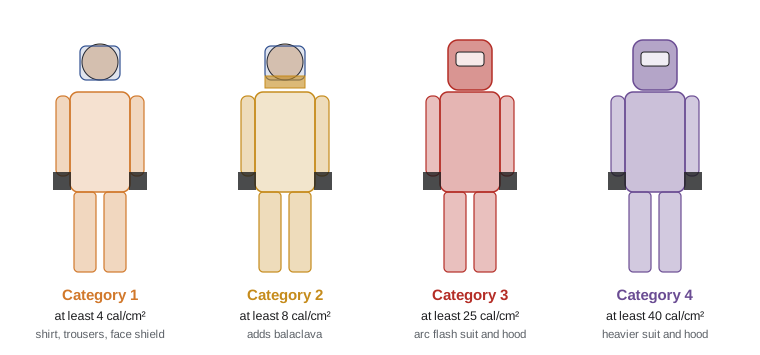
Face protection deserves particular attention. Burns to the face and head are among the most disfiguring arc flash injuries, and the face is usually the part of the body closest to the arc. A face shield must be arc-rated, must wrap around to protect the sides of the face, and must be combined with a balaclava or hood where the category requires it. Safety glasses or goggles are worn underneath, because shields can be knocked off by the blast. Hearing protection, typically ear canal inserts, is required inside the arc flash boundary.
Hand protection for arc flash can be heavy-duty leather gloves, arc-rated gloves or rubber insulating gloves with leather protectors. Rubber insulating gloves with leather protectors provide both shock and arc flash protection and are often the best choice whenever shock is also a hazard. Leather protectors have shown good arc flash performance in testing, but the gloves must not be worn without them.
Worked problem
Choosing PPE from incident energy
Labels at a facility show the following incident energies at the working distance: lighting panel, 1.9 cal/cm²; MCC, 6.4 cal/cm²; main switchboard, 22.7 cal/cm²; and a 4.16 kV switchgear lineup, 48 cal/cm². What minimum arc rating is needed at each, and what should happen at the switchgear?
Show solution
- Lighting panel: at least 1.9 cal/cm²; a category 1 set (4 cal/cm²) is adequate.
- MCC: at least 6.4 cal/cm²; a category 2 set (8 cal/cm²) is adequate.
- Main switchboard: at least 22.7 cal/cm²; a 25 cal/cm² arc flash suit is adequate.
- Switchgear: 48 cal/cm² exceeds 40 cal/cm². PPE with a higher rating exists, but blast effects become severe. Most employers prohibit energized work at this level and require de-energizing or remote operation.
Answer: 4, 8 and 25 cal/cm² sets for the first three. At 48 cal/cm², the task should be re-planned to remove workers from the hazard, for example by remote racking or de-energizing upstream.
Rubber insulating gloves
Rubber insulating gloves are the main shock protective equipment for hands and are made to ASTM D120 (and the equivalent IEC 60903). They are classified by maximum use voltage, which is the highest voltage at which the glove may be used, and each class has a coloured label on the cuff.
| Class | Maximum use voltage, AC | Maximum use voltage, DC | Label colour |
|---|---|---|---|
| 00 | 500 V | 750 V | Beige |
| 0 | 1,000 V | 1,500 V | Red |
| 1 | 7,500 V | 11,250 V | White |
| 2 | 17,000 V | 25,500 V | Yellow |
| 3 | 26,500 V | 39,750 V | Green |
| 4 | 36,000 V | 54,000 V | Orange |
Worked problem
Selecting a glove class
Select the minimum glove class for (a) voltage measurements in a 347/600 V panel, (b) a 125 V DC battery and (c) switching on a 4.16 kV motor starter, assuming exposure to phase-to-phase voltage.
Show solution
- (a) 600 V AC exceeds the 500 V limit of class 00, so class 0 (1,000 V AC) is the minimum.
- (b) 125 V DC is below the 750 V DC limit of class 00, so class 00 is adequate.
- (c) 4,160 V AC exceeds class 0's 1,000 V limit but is below class 1's 7,500 V limit, so class 1 is the minimum.
Answer: (a) Class 0, (b) class 00, (c) class 1. Many employers issue class 0 as the standard low voltage glove because 600 V systems are common in Canada.
Inspecting and caring for gloves
Gloves must be inspected visually and air tested before each day's use and immediately after any incident that may have damaged them. The air test traps air inside the glove by rolling the cuff, then squeezes it to inflate the fingers and palm while the worker looks, listens and feels for leaks. The visual inspection looks for cuts, punctures, tears, ozone cracking, embedded objects, swelling, softening, hardening, stickiness and changes in texture. A glove that fails any check is removed from service immediately.
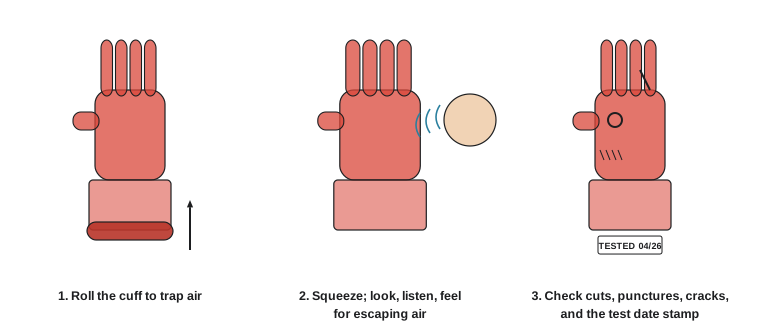
Rubber insulating gloves must also be electrically retested by a qualified test laboratory before first issue and at regular intervals. The common interval, used in CSA Z462 by reference to ASTM F496 and in many provincial rules, is every six months for gloves. Ontario construction rules (O. Reg. 213/91 s. 193) require gloves rated above 5,000 V AC to be tested every three months while in service and every six months when not. Gloves that have not been issued for twelve months must be retested before use. The test date is stamped on the cuff.
Leather protectors must be worn over rubber insulating gloves, to protect the rubber from cuts and punctures. Protectors must be shorter than the rubber gloves, leaving a minimum clearance between the protector cuff and the rubber glove cuff that increases with class: about 13 mm (½ in) for classes 00 and 0, 25 mm (1 in) for class 1, 51 mm (2 in) for class 2, 76 mm (3 in) for class 3 and 102 mm (4 in) for class 4. Gloves should be stored in a protective bag, cuff down, away from sunlight, heat, ozone sources and sharp objects, and never folded or turned inside out.
Worked problem
Is this glove in date?
On 15 October, an electrician picks up a class 0 glove whose cuff is stamped with a test date of 2 April of the same year. The glove passes the air test. Can it be used?
Show solution
- The six-month retest would be due by 2 October.
- 15 October is past that date, so the glove is out of its test interval.
- Passing the air test does not replace the dielectric test.
Answer: No. The glove must be sent for retesting before use. Daily inspection and periodic electrical testing are both required.
Other shock protective equipment
Other voltage-rated equipment includes rubber insulating sleeves for arm protection when reaching inside the restricted approach boundary, insulating blankets and line hose to cover energized parts, insulating mats, dielectric footwear (which is a supplementary protection, not a primary one) and insulated barriers. Each has its own ASTM standard and retest interval. Dielectric overshoes and insulating mats help, but the primary protection is always to avoid contact and to insulate the hands.
Care and maintenance of arc-rated clothing
Arc-rated clothing only performs as rated if it is cared for properly. It must be inspected before each use and removed from service if it is torn, has holes, is heavily soiled with flammable materials such as oil or grease, or has been repaired with non-arc-rated thread or patches. Flammable contaminants can ignite and continue burning even on arc-rated fabric. Laundering should follow the manufacturer's instructions; bleach, fabric softeners and starch can reduce the protection of some fabrics. Garments that have been exposed to an arc flash must be removed from service, even if they look intact.
Fit matters as well. Garments that are too tight compress the air gap that helps insulate the skin, while garments that are too loose can catch on equipment. Sleeves should be fastened at the wrist, shirts tucked in or covered by a coverall, and collars closed. Hoods and face shields must be compatible with the hard hat and safety glasses and must not fog in a way that tempts the worker to lift them. Employers who want arc-rated clothing worn consistently choose comfortable, well-fitting daily uniforms rated at least 8 cal/cm², so that the protection is already on when an unexpected task arises.
Common mistakes
MistakeAdding the arc ratings of layered garments together.
InsteadUse the tested rating of the layered system from the manufacturer.
MistakeWearing a polyester base layer under arc-rated clothing.
InsteadWear non-melting natural fibres or arc-rated underlayers.
MistakeUsing a glove that passed the air test but is past its retest date.
InsteadGloves must be both inspected daily and retested on schedule.
MistakeWearing rubber gloves without leather protectors.
InsteadProtectors are required over rubber insulating gloves.
MistakeAssuming FR clothing for flash fire is arc-rated.
InsteadCheck for an arc rating in cal/cm² on the label.
Summary and key terms
- Arc rating is the lower of ATPV and EBT, in cal/cm².
- Layered systems must be rated by testing the combination.
- Underlayers must be non-melting; arc-rated garments are the outer layer.
- PPE categories 1 to 4 correspond to 4, 8, 25 and 40 cal/cm².
- Glove classes 00 to 4 are rated 500 V to 36 kV AC maximum use voltage.
- Gloves are inspected and air tested daily and retested every six months.
- Leather protectors are worn over rubber gloves with class-dependent clearances.
- Arc rating
- The lower of ATPV and EBT, describing a material's arc flash protection.
- ATPV
- Incident energy with a 50 % probability of heat transfer causing onset of a second-degree burn.
- EBT
- Incident energy with a 50 % probability of fabric breakopen.
- Layered system
- Multiple arc-rated garments worn together with a tested system rating.
- Maximum use voltage
- The highest voltage at which rubber insulating equipment may be used.
- Air test
- Inflating a glove to check for leaks before use.
- Leather protector
- An outer leather glove worn over a rubber insulating glove.
- Arc flash suit
- A complete arc-rated system covering the body, including a hood.
- Balaclava
- An arc-rated hood that covers the head and neck under a face shield.
Practice problems
Work each problem on paper first, then reveal the answer to check.
A fabric has ATPV 10 and EBT 9 cal/cm². What is its arc rating?
Show answer
9 cal/cm².
What minimum glove class is needed at 600 V AC?
Show answer
Class 0.
What is the maximum AC use voltage of class 2 gloves?
Show answer
17,000 V.
How often must gloves be electrically retested?
Show answer
Every six months, and before first issue.
What protector clearance applies to class 1 gloves?
Show answer
About 25 mm (1 in).
Which PPE category is the minimum for 6.4 cal/cm²?
Show answer
Category 2 (8 cal/cm²).
Why are safety glasses worn under a face shield?
Show answer
The shield can be displaced by the blast.
Name two meltable fibres not permitted next to the skin.
Show answer
Polyester, nylon, acrylic or polypropylene.
What colour is the label on a class 0 glove?
Show answer
Red.
What should be done with a glove that shows ozone cracking?
Show answer
Remove it from service immediately.
Lesson quiz · 5 questions
Score 60% or more to complete this lesson.
Create a free account to save your progress, take quizzes and earn a certificate.