
HSE-224 · Lesson 3 of 12 · 32 min
Shock hazard and approach boundaries
Shock is the oldest electrical hazard and still a leading cause of electrical fatalities among electrical workers. This lesson looks at what determines how much current flows through a body, how the standards turn that physics into approach boundaries around exposed energized parts, and how the boundaries differ for AC and DC systems. It also connects the workplace boundaries with the separate limits of approach used for overhead power lines.
What drives current through the body
The current through a person depends on the voltage across the contact points and the total resistance of the path, which includes the skin at each contact, the internal body, any gloves or footwear, and the surface the person is standing on. Internal body resistance is low, often taken as about 500 Ω hand to foot. Skin resistance varies enormously: dry, calloused skin may present tens of thousands of ohms, while wet or broken skin, or skin under a contact that has burned through, may offer almost none. For safety calculations, a total of about 1,000 Ω hand to hand or hand to foot is a common and deliberately pessimistic assumption.
Above a few hundred volts, skin breaks down quickly and the current is limited mainly by internal resistance. That is one reason why shocks at 347 V, 480 V and 600 V are so much more dangerous than at 120 V: the voltage is higher and the resistance falls.
| Approximate 60 Hz current, hand to foot, about 1 s | Typical effect |
|---|---|
| 1 mA | Threshold of perception |
| 5 mA | Maximum harmless current for most adults; GFCI trip level is about 4 to 6 mA |
| 10 to 20 mA | Let-go threshold; muscles may lock onto the conductor |
| 50 to 100 mA | Ventricular fibrillation possible |
| 100 to 200 mA | Ventricular fibrillation likely |
| Above 1 A | Severe burns, cardiac arrest, internal tissue damage |
Direct current is generally less likely than AC to cause fibrillation at the same magnitude, because it does not repeatedly stimulate the heart during its vulnerable period. Even so, DC above about 300 mA can cause fibrillation, the onset and interruption of DC current produce strong muscle reactions, and DC causes deep burns and electrolytic tissue damage. DC let-go thresholds are less well defined because DC tends to produce a single violent contraction at contact and release rather than sustained clamping.
Worked problem
Touch voltage and body current
An electrician leaning on a grounded steel enclosure touches a 347 V phase-to-ground conductor in a 347/600 V panel with a bare hand. Estimate the body current for total resistances of 1,000 Ω and 3,000 Ω.
Show solution
- The voltage across the body is the phase-to-ground voltage, 347 V, because the other contact is the grounded enclosure.
- At 1,000 Ω: \( I = 347 / 1{,}000 = 0.347 \) A, about 350 mA.
- At 3,000 Ω: \( I = 347 / 3{,}000 = 0.116 \) A, about 115 mA.
- Both values are above the fibrillation range. Skin breakdown at this voltage would push the higher-resistance case towards the lower-resistance one within moments.
Answer: Both cases are potentially lethal. Approach boundaries and insulating gloves exist to stop this current path from forming in the first place.
Exposed, energized and the three boundaries
The approach boundaries apply to exposed energized electrical conductors and circuit parts, meaning parts that can be inadvertently touched or approached nearer than a safe distance because they are not suitably guarded, isolated or insulated. Closing a panel cover makes the parts unexposed; removing it makes them exposed. Two shock boundaries and one arc flash boundary surround every exposed energized part:
- The limited approach boundary is the distance at which a shock hazard exists. Unqualified persons may not cross it unless they are continuously escorted and advised by a qualified person.
- The restricted approach boundary is the distance at which there is an increased likelihood of shock, because of electrical arc-over combined with inadvertent movement. Only qualified persons may cross it, and only with shock protection such as insulating gloves and tools, or with the part insulated or guarded.
- The arc flash boundary is the distance at which incident energy falls to 1.2 cal/cm² (5 J/cm²), the level at which a second-degree burn just becomes possible. It is independent of the shock boundaries and may be larger or smaller than either. Lesson 5 explains how it is determined.
Older editions of CSA Z462 and NFPA 70E also defined a prohibited approach boundary. It was removed because, in practice, crossing the restricted approach boundary already requires the same protection as contact.
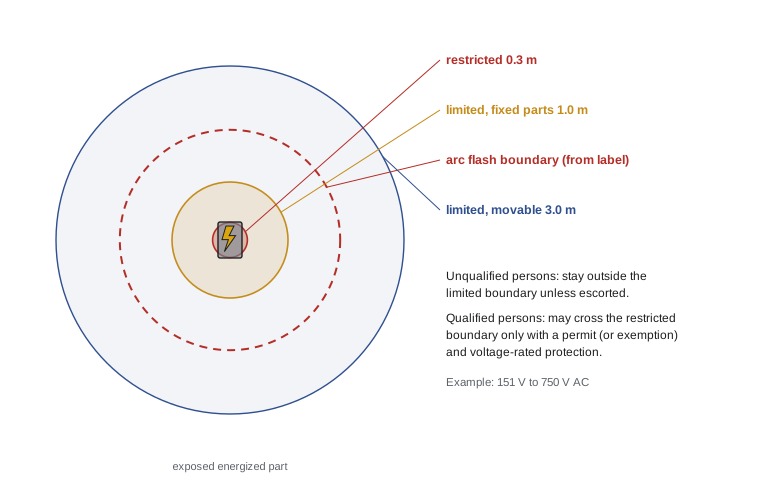
The AC boundary table
CSA Z462-24 and NFPA 70E-2024 Table 130.4(E)(a) give the shock boundaries for AC systems. The values below are the common low and medium voltage rows. The 2024 editions aligned the restricted approach boundary with the minimum approach distances used for utility work and added a note that the values assume an elevation of up to 900 m; at higher elevations, such as parts of Alberta and British Columbia, the restricted boundary must be increased. Metric values are rounded slightly differently in different documents, so always use the table in the edition your employer has adopted.
| Nominal voltage, phase to phase | Limited: exposed movable conductor | Limited: exposed fixed part | Restricted (includes inadvertent movement adder) |
|---|---|---|---|
| Less than 50 V | Not specified | Not specified | Not specified |
| 50 V to 150 V | 3.0 m | 1.0 m | Avoid contact |
| 151 V to 750 V | 3.0 m | 1.0 m | 0.3 m |
| 751 V to 5 kV | 3.0 m | 1.0 m | 0.6 m |
| 5.1 kV to 15 kV | 3.0 m | 1.5 m | 0.7 m |
| 15.1 kV to 36 kV | 3.0 m | 1.8 m | 0.8 m |
The limited approach boundary has two values. The larger one applies to an exposed movable conductor, such as an overhead conductor that can sway or a cable being pulled, because it can move towards the person. The smaller one applies to fixed circuit parts, such as bus inside a switchboard. In most indoor equipment work, the fixed-part value is the one that matters.
Worked problem
Boundaries for a 600 V panel
An electrician removes the cover of a 347/600 V distribution panel to take voltage readings. What are the limited and restricted approach boundaries?
Show solution
- Use the phase-to-phase voltage, 600 V, which falls in the 151 V to 750 V row.
- The bus and terminals are fixed parts, so the limited approach boundary is 1.0 m.
- The restricted approach boundary is 0.3 m.
- Any unqualified person, such as a building operator holding the door, must stay at least 1.0 m away unless escorted, and the electrician's hands and probes will cross 0.3 m, so shock protection is required.
Answer: Limited approach boundary 1.0 m; restricted approach boundary 0.3 m. Rubber insulating gloves with leather protectors are needed for the measurement.
The DC boundary table
DC systems are now common in battery rooms, uninterruptible power supplies, solar arrays, electric vehicle chargers, rail transit, data centres and telecommunications. The DC table uses different voltage bands because the shock hazard thresholds differ.
| Nominal DC voltage | Limited: exposed movable conductor | Limited: exposed fixed part | Restricted |
|---|---|---|---|
| Less than 50 V | Not specified | Not specified | Not specified |
| 50 V to 300 V | 3.0 m | 1.0 m | Avoid contact |
| 301 V to 1 kV | 3.0 m | 1.0 m | 0.3 m |
| 1.1 kV to 5 kV | 3.0 m | 1.5 m | 0.5 m |
| 5.1 kV to 15 kV | 3.0 m | 1.5 m | 0.7 m |
Worked problem
DC boundaries for a battery string and an EV charger
Find the shock boundaries for (a) a 125 V DC station battery in a substation and (b) the 800 V DC output bus inside a fast charger for electric vehicles.
Show solution
- (a) 125 V DC falls in the 50 V to 300 V row. The limited approach boundary for fixed parts is 1.0 m and the restricted boundary is to avoid contact.
- (b) 800 V DC falls in the 301 V to 1 kV row. The limited approach boundary for fixed parts is 1.0 m and the restricted boundary is 0.3 m.
- Both systems are hazardous even though one is a battery and one is electronics: DC cannot simply be switched off at the battery terminals, and charger capacitors can stay charged after the input is opened.
Answer: (a) 1.0 m limited, avoid contact restricted. (b) 1.0 m limited, 0.3 m restricted.
Crossing the boundaries
Crossing the limited approach boundary is not prohibited for qualified persons, but it means a shock hazard is present and the shock risk assessment applies. Crossing the restricted approach boundary requires all of the following:
- The person is qualified for the task.
- An energized work permit is in place, unless the task is exempt (Lesson 6).
- The person uses PPE suitable for working near exposed energized parts and rated for the voltage, such as rubber insulating gloves with leather protectors, or the energized parts are insulated or guarded from the person.
- No uninsulated part of the body crosses the boundary. Insulating gloves protect hands only; leaning a shoulder or head into the space requires insulating sleeves or barriers.
- The person minimizes the time spent inside the boundary and plans the work to avoid inadvertent movement, such as stepping back into a live part or reaching across one.
Conductive articles such as watches, rings, metal frame glasses, key chains, metal pens, necklaces and body piercings must not be worn inside the restricted approach boundary. Conductive tools and equipment, such as metal ladders, steel tape measures and uninsulated tools, must not be used there either.
Worked problem
Who may be where during a 13.8 kV task
A crew is testing relays in a 13.8 kV switchgear lineup with one cubicle's rear cover removed and the bus still energized. A safety coordinator who is not a qualified electrical worker wants to observe. Where may each person stand?
Show solution
- 13.8 kV is in the 5.1 kV to 15 kV row: limited approach boundary 1.5 m for fixed parts, restricted approach boundary 0.7 m.
- The safety coordinator must stay at least 1.5 m from the exposed bus unless escorted and continuously advised by a qualified person, and may never cross 0.7 m.
- The qualified relay technicians may work within 1.5 m but must not cross 0.7 m without voltage-rated protection suitable for 13.8 kV, which in practice means the exposed bus should be de-energized or covered.
- The arc flash boundary must also be checked from the label; at medium voltage it is often several metres and may set the real keep-out distance.
Answer: Use the 5.1 to 15 kV row and then compare with the arc flash boundary. The larger of the shock and arc flash boundaries decides where unqualified observers may stand.
Overhead lines and limits of approach
The CSA Z462 approach boundaries apply to workplace electrical equipment. Work near overhead power lines is governed by separate provincial limits of approach, which apply to people, equipment and materials. For example, O. Reg. 213/91 s. 188 in Ontario requires a minimum distance of 3 m for lines of 750 V to 150 kV, 4.5 m for 150 kV to 250 kV and 6 m for over 250 kV, unless the line is de-energized or specific precautions are in place. British Columbia's OHSR Part 19 sets limits of approach in Table 19-1A, and Alberta's OHS Code Part 17 sets safe limits of approach for overhead lines. Utility workers follow their own utility safety rules, such as the IHSA Electrical Utility Safety Rules in Ontario.
These overhead line distances are not interchangeable with the workplace boundaries. A forklift operator in a yard near a 27.6 kV line is governed by the overhead line rules, while an electrician opening a 600 V switchboard in the same building is governed by the workplace boundaries.
Common mistakes
MistakeUsing phase-to-ground voltage to look up the boundary table.
InsteadThe tables use nominal phase-to-phase voltage; 120/208 V is in the 151 to 750 V row.
MistakeAssuming DC below 300 V needs no shock precautions.
InsteadDC from 50 to 300 V still has a limited approach boundary and requires avoiding contact.
MistakeTreating the arc flash boundary as one of the shock boundaries.
InsteadIt is calculated separately and may be larger or smaller.
MistakeWearing a watch or ring when working inside the restricted approach boundary.
InsteadRemove all conductive articles before crossing it.
MistakeApplying overhead line limits of approach to work inside a switchboard.
InsteadUse the workplace boundary tables for equipment and the overhead line rules for lines.
Summary and key terms
- Body current depends on voltage and path resistance; skin resistance collapses at higher voltages.
- Tens of milliamperes through the chest can cause fibrillation.
- The limited approach boundary marks the shock hazard; unqualified persons need an escort to cross it.
- The restricted approach boundary requires qualification, permits and shock protection to cross.
- The arc flash boundary is at 1.2 cal/cm² and is independent of the shock boundaries.
- AC and DC have separate tables; use nominal phase-to-phase voltage for AC.
- Overhead line limits of approach are separate rules for work near lines.
- Limited approach boundary
- The distance from an exposed energized part within which a shock hazard exists.
- Restricted approach boundary
- The distance within which there is an increased likelihood of shock due to arc-over and inadvertent movement.
- Arc flash boundary
- The distance at which incident energy equals 1.2 cal/cm² (5 J/cm²).
- Exposed
- Capable of being inadvertently touched or approached because not suitably guarded, isolated or insulated.
- Touch voltage
- The voltage between a part a person touches and the point where current leaves the body.
- Inadvertent movement adder
- Extra distance in the restricted boundary for unintentional movement.
- Ventricular fibrillation
- A chaotic heart rhythm that stops effective pumping.
- Let-go threshold
- The current above which a person cannot release a gripped conductor.
- Limits of approach
- Minimum distances from overhead lines set by provincial rules or OSHA.
Practice problems
Work each problem on paper first, then reveal the answer to check.
Which AC row applies to a 120/208 V panel?
Show answer
151 V to 750 V, using the 208 V phase-to-phase voltage.
What is the restricted approach boundary for 600 V AC?
Show answer
0.3 m.
What body current flows at 600 V through 1,500 Ω?
Show answer
400 mA.
What incident energy defines the arc flash boundary?
Show answer
1.2 cal/cm², or 5 J/cm².
What is the restricted boundary for 48 V DC telecom equipment?
Show answer
Not specified; it is below 50 V.
Why does the limited boundary have a movable conductor value?
Show answer
Movable conductors such as overhead lines can swing towards a person.
Name three conductive articles to remove before crossing the restricted boundary.
Show answer
Watches, rings, metal frame glasses, key chains or necklaces.
What did the 2024 editions add about elevation?
Show answer
Restricted boundary values assume elevations up to about 900 m (3,000 ft) and must be increased above that.
Does DC cause fibrillation as readily as AC?
Show answer
No, it needs a higher current, but it still can, and it causes burns and violent muscle reactions.
Who may cross the limited approach boundary?
Show answer
Qualified persons, and unqualified persons only when escorted and continuously advised by a qualified person.
Lesson quiz · 5 questions
Score 60% or more to complete this lesson.
Create a free account to save your progress, take quizzes and earn a certificate.