
GCP-112 · Lesson 8 of 12 · 17 min
Responsible AI in practice: fairness, transparency and accountability
▶ Video coming soon A video version of this lesson is on the way.
In early November 2026, a pilot that Birchline's marketing team had started on its own produced a problem nobody intended. The team used an image model to create lifestyle pictures for an email campaign about winter hiking gear. Of the 40 images selected, every hiker in the expert-level gear shots was a young man, while women appeared mostly in the casual-wear shots. Nobody had asked for that. The model reproduced patterns common in its training data, and the people choosing images did not notice until a customer replied to the email asking whether Birchline thought women did not hike in winter. The campaign was paused, and the steering committee asked Jules to turn "responsible AI" from a phrase on a slide into a practice. This lesson covers what that practice looks like.
What responsible AI means
Responsible AI is the practice of designing, building and using AI systems in ways that are fair, safe, transparent, accountable and respectful of privacy and human rights, and that benefit the people they affect. Many organizations publish principles. Google has published AI principles since 2018 and has revised them since, centred on pursuing benefits while managing risks, avoiding harm, and responsible development and deployment. International frameworks such as the OECD AI principles express similar ideas. The principles are the easy part. The work is turning them into decisions about specific systems.
Farah suggests treating responsible AI the way Birchline treats safety in its stores. Everyone agrees safety matters, but what keeps people safe is checklists, training, inspections, incident reports and someone accountable for each store. Responsible AI needs the same: concrete practices, applied to each system in proportion to its risk.
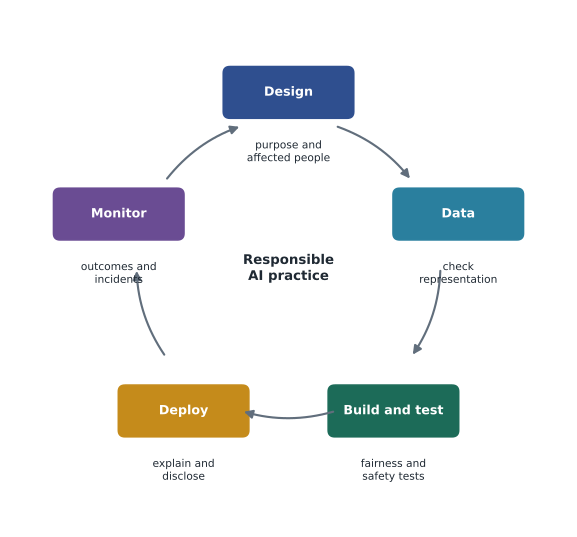
Fairness and bias
Bias in AI means systematic differences in how a system treats or represents people or groups, usually reflecting patterns in its training data, its design or how it is used. Fairness is the goal of avoiding unjust or harmful differences. Bias can enter at many points.
| Where bias enters | How | Birchline example |
|---|---|---|
| Training data | Patterns and gaps in the data a model learned from | Winter hiking images in training data mostly showed young men |
| Grounding and examples | The organization's own documents and few-shot examples | Example descriptions using different adjectives for women's and men's products |
| Problem framing | What the system is asked to optimize | A recommender optimized only for clicks pushing the same items to everyone |
| Evaluation | Testing only on typical cases or one language | Testing the review digest only on English reviews |
| Use | How people apply or trust the outputs | Staff choosing images without checking for representation |
Generative AI bias often shows up as representation problems, who appears and how, and quality differences, such as summaries that are more accurate for English text than French, or a speech tool that transcribes some accents less accurately. Both matter for a retailer serving a diverse customer base in two official languages, and for any organization's staff.
Fairness has no single formula, and different definitions can conflict. For consequential decisions about individuals, such as credit or hiring, fairness is a technical and legal field of its own, and Birchline does not use generative AI for those decisions at all. For Birchline's content and assistant use cases, the practical approach is to define the groups and qualities that matter for each use case, test for differences, and fix what is found.
Testing for bias
For the paused image campaign, Jules and the marketing lead set up a simple representation check before any AI-generated image set is used: count who appears in each type of shot, compare against Birchline's intended audience, and adjust prompts or selections when the mix is skewed. They also add explicit guidance to image prompts about the range of people to show.
# Who appears in a set of 40 selected campaign images, by shot type.
shots = {
    "expert gear": {"women": 0, "men": 18, "mixed group": 2},
    "casual wear": {"women": 12, "men": 4, "mixed group": 4},
}
for shot, counts in shots.items():
    total = sum(counts.values())
    women_share = (counts["women"] + counts["mixed group"] / 2) / total
    note = "  <- review" if women_share < 0.3 or women_share > 0.7 else ""
print(f"{shot:<12} {total} images, women about {women_share:.2f} of people shown{note}")expert gear 20 images, women about 0.05 of people shown <- review casual wear 20 images, women about 0.70 of people shown
What this code does
For each shot type in a set of campaign images, the script estimates the share of people shown who are women, counting mixed groups as half. Any share below 0.3 or above 0.7 is flagged for review. Expert-gear images show women only about 0.05 of the time and are flagged, which points to a representation gap worth fixing.
The check is crude, counting with simple categories, and the team knows it. Its value is that it turns a vague worry into a number someone must look at before the campaign goes out. The same approach works for text: Jules's team runs the product description prompt on matched pairs, such as the same jacket in a women's and a men's version, and compares the adjectives used. They find the drafts call women's jackets "flattering" three times as often, trace it to the example set, and fix the examples.
For the review digest, the quality check compares the accuracy of summaries in English and French on a labelled sample. A large gap would mean Quebec stores get worse digests, which would be both unfair and bad for business.
Transparency
Transparency means people can understand when AI is being used, what it does, and what its limits are. It works at several levels.
- Disclosure to users. Customers using the shopping assistant see a clear statement that they are chatting with an AI assistant, what it can and cannot do, and how to reach a person. Birchline labels AI-generated images in campaigns where policy requires it and is considering doing so in all campaigns.
- Documentation for decision makers. Each AI system has a short record describing its purpose, the model and data it uses, known limitations, test results and the owner. These records are sometimes called model cards or system cards, and they help reviewers, auditors and future teams.
- Explanations of outputs. Where practical, the system shows why it produced an answer, such as the policy assistant citing the paragraph it relied on.
Transparency also has legal dimensions. Quebec's Law 25 requires organizations to inform people when a decision about them is based exclusively on automated processing and to explain it on request, and federal guidance in Canada encourages disclosure of AI use. Canada's federal government has no comprehensive AI law in force as of late 2026; the proposed Artificial Intelligence and Data Act lapsed in January 2025, and the June 2026 national AI strategy favours targeted measures. Birchline follows the federal Voluntary Code of Conduct on the responsible development and management of advanced generative AI systems as a reference point.
Explainability
Explainability is the ability to describe how a system reached an output in terms people can understand. Large generative models are hard to explain fully, because their outputs come from billions of learned parameters rather than readable rules. Leaders should therefore distinguish two things. Full mechanical explanation of a large model is not available today. Useful explanation for a particular use often is: showing the sources a grounded answer used, the facts extracted before drafting, the rule that sent a case to a person, or the factors a classical model weighed. Birchline designs its systems so that each output comes with the evidence a reviewer needs, which serves explainability and the review practices in lesson 4 at the same time.
Where a use case needs a full, auditable explanation, such as a decision with legal effects on a person, that is a strong signal to use a more explainable approach or to keep the decision with a person.
Accountability
Accountability means that named people are responsible for an AI system's behaviour and its effects, and that there are ways to raise concerns, investigate and fix problems. An AI system cannot be accountable; people and organizations are. Birchline's practice has four parts.
- An owner for every system. A business owner answers for what the system does and a technical owner for how it works. Dana's rule from lesson 2 applies here too.
- Impact assessment before launch. For each customer-facing or employee-affecting use case, the team completes a short assessment: who is affected, what could go wrong for them, how likely and how serious it is, and what controls apply. Lesson 9 places this inside the governance process.
- Channels for concerns. Customers can reach a person from the assistant, staff can flag outputs, and anyone can report a concern to the AI review group.
- Incident handling. When something goes wrong, such as the image campaign, the team records what happened, who was affected, the cause and the fix, and shares the lesson. Incidents are treated as information, not as occasions for blame.
| Responsible AI question | For the paused image campaign |
|---|---|
| Who is affected? | Customers receiving the email; women and older customers who hike |
| What went wrong? | Images reinforced a stereotype about who does serious outdoor activity |
| Root cause | Model bias from training data; no representation check; prompts did not ask for range |
| Fixes | Representation check before use; prompt guidance; reviewer checklist; label AI images |
| Owner | Marketing lead (business), Jules (program), image tool administrator (technical) |
| Lesson shared | Short note to all teams using image generation |
Safety and appropriate use
Responsible AI also covers safety: preventing outputs that are harmful, dangerous or inappropriate for the context. Safety settings and screening, covered in lesson 7, block categories such as hate, harassment, sexual content and dangerous instructions. Context still matters. The shopping assistant should not give medical advice about frostbite beyond suggesting that customers seek help, and when a customer mentions an injury from a product, the assistant hands over to a person and the safety team is notified. These boundaries are written into the assistant's instructions, tested in red teaming and checked in monitoring.
Appropriate use includes intellectual property too. Generated text and images can resemble existing works, and the law on training and outputs is still developing in both countries, with major court cases and settlements in 2025 and 2026. Birchline's practice is to keep human creative control over campaign material, avoid prompts that ask for the style of named living artists or for competitors' branding, check images for recognizable logos or likenesses, and use tools whose terms give the company the rights it needs.
Proportion: more care where the stakes are higher
Applying every responsible AI practice at full strength to every use would stop useful work. Birchline scales its practices to the risk of each system.
| Risk level | Examples | Practices required |
|---|---|---|
| Low | Drafting internal notes; brainstorming slogans | All-staff rules; user checks output |
| Medium | Product description drafts; review digests; staff policy assistant | Documented record; bias and quality tests; human review; monitoring |
| High | Customer-facing shopping assistant; anything affecting staff schedules or pay | Impact assessment; red teaming; disclosure; human escalation; executive sign-off; regular audits |
| Not permitted | Hiring decisions, credit decisions, employee discipline | Generative AI not used to make or recommend these decisions |
Jules plans to relaunch the hiking campaign in late November with a new image set that has passed the representation check, a reviewer checklist, and a small label noting that some images were created with AI. The marketing lead has already written to the customer who raised the problem to explain what is changing.
Common mistakes
MistakeTreating responsible AI as a statement of principles only.
InsteadTurn principles into practices: tests, records, reviews, owners and incident handling.
MistakeAssuming a model is neutral because nobody asked it to be biased.
InsteadExpect training-data bias, test for representation and quality differences, and fix what you find.
MistakePromising full explanations of how a large model works.
InsteadProvide useful explanations for each use, such as sources and extracted facts.
MistakeSaying the AI is responsible for a mistake.
InsteadName the people who own each system and its outcomes.
MistakeApplying the same controls to every use case.
InsteadScale practices to risk, and rule out uses that are too consequential.
Summary and key terms
- Responsible AI means AI that is fair, safe, transparent, accountable and respectful of privacy, put into practice across a system's life cycle.
- Bias can enter through training data, grounding examples, framing, evaluation and use, and often shows up as representation or quality differences between groups or languages; test for these and fix them.
- Transparency means disclosing AI use, documenting systems and explaining outputs, with legal duties that differ between jurisdictions.
- Explainability for large models is limited, but useful explanation for a use case, such as cited sources, is often possible.
- Accountability needs named owners, impact assessments, channels for concerns and incident handling.
- Safety and intellectual property are part of appropriate use, and all practices should scale with risk.
- Responsible AI
- Designing and using AI fairly, safely, transparently and accountably, for the benefit of those affected.
- Bias
- Systematic differences in how a system treats or represents people or groups.
- Fairness
- The goal of avoiding unjust or harmful differences between people or groups.
- Transparency
- Making it clear when AI is used, what it does and what its limits are.
- Explainability
- The ability to describe how a system reached an output in understandable terms.
- Accountability
- Named people being responsible for a system and its effects, with ways to fix problems.
- Model card
- A short document describing a model or system's purpose, data, limits and test results.
- Impact assessment
- A review of who a system affects, how it could harm them and what controls apply.
- Representation check
- Counting who appears in generated content and comparing with the intended audience.
Practice problems
Work each problem on paper first, then reveal the answer to check.
Why did the winter hiking images show mostly young men in expert shots?
Show answer
The image model reproduced patterns from its training data, and there was no representation check or guidance in the prompts.
What is a realistic form of explainability for the staff policy assistant?
Show answer
Showing the policy paragraph each answer came from.
Who is accountable when an AI system makes a mistake?
Show answer
The named people and organization that own and operate the system, not the system itself.
Listening to the people affected
The image campaign problem was found by a customer, not by Birchline. Jules takes that as a lesson in itself. The responsible AI practice now includes asking people who will be affected by a system for their view before launch, in proportion to the risk. For the shopping assistant, that means testing with a small group of real customers, including French-speaking customers and customers who use screen readers, and asking what confused or bothered them. For staff tools, it means involving the champions and, where relevant, staff representatives. These conversations regularly surface problems that internal testers miss, because the people building a system share the same blind spots.
Lesson quiz · 5 questions
Score 60% or more to complete this lesson.
Create a free account to save your progress, take quizzes and earn a certificate.