
GCP-112 · Lesson 11 of 12 · 18 min
Scaling from pilot to production
▶ Video coming soon A video version of this lesson is on the way.
The product description pilot ended its eight weeks on November 6, 2026 with results that met the decision rule from lesson 2: median editing time of 17 minutes, editor quality ratings level with the baseline, factual errors down to about one in every 100 drafts after the data fixes, and 41 of the 50 most recent descriptions started from an AI draft. On November 10 the steering committee voted to expand it to every new product from January 2027. Jules is delighted, and Farah is cautious in the way experienced architects are. "Pilots succeed because a small, motivated team watches everything," she says. "Production has to succeed when nobody is watching closely, at ten times the volume, on a model that the provider will upgrade at some point next year." This lesson covers the gap between a successful pilot and a reliable production system, and the plan Birchline writes to cross it.
Why pilots stall
Many organizations have far more generative AI pilots than production systems. The reasons are familiar from other technology but sharper with AI.
| Reason pilots stall | What it looks like | Remedy |
|---|---|---|
| No measured value | The pilot "seemed good" but nobody set a baseline | Baselines and KPIs agreed before the pilot (lesson 2) |
| Quality not proven at scale | Tested on 50 easy examples; production sees thousands of messy ones | Larger, representative evaluation sets including edge cases |
| Data not ready | Pilot used a hand-cleaned sample; production data is untidy | Data fixes at the source and automated checks (lesson 5) |
| Integration missing | Pilot ran in a side tool; production needs the real systems | Plan integration early; budget for it |
| No owner | The pilot team returns to other work | Named business and technical owners with time allocated |
| Costs unclear at scale | Usage multiplies; nobody modelled it | Cost forecasts and budgets with alerts |
| Governance surprise | Approval needed for production was never planned | Use the approval path from the start (lesson 9) |
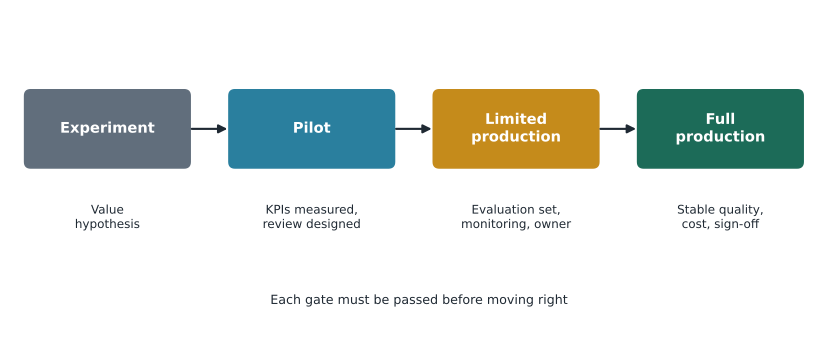
A staged rollout
Birchline does not switch from eight copywriters to every product overnight. The production plan expands in stages, each with a short check before the next.
- Stage 1, January 2027: all new products in two categories (footwear and tents), the most complex specifications, with the full review screen and daily quality sampling.
- Stage 2, February: all new products, with sampling reduced to a weekly audit if quality holds.
- Stage 3, spring: refreshing old descriptions, about 9,000 products, run in batches with stricter checks because old spec sheets are less reliable.
Each stage has a rollback plan: if quality drops below the agreed level, the system can be switched off for a category in minutes and copywriters return to writing from scratch, which they can still do. Keeping the old path available until the new one is proven is one of the simplest risk controls in any rollout.
Evaluation at production scale
In the pilot, editors effectively evaluated every draft. In production, Birchline needs an evaluation set: a fixed collection of test cases with known good answers or criteria, run whenever anything changes. The description team builds a set of 300 products, chosen to include every category, both languages, unusual sizing systems, missing fields and spec sheets known to contain errors. Each case has the expected facts and a rubric score from an editor.
# Compare two prompt versions on the same evaluation set (illustrative results).
eval_results = {
    "prompt v3": {"facts_correct": 291, "missing_flagged": 18, "missing_total": 20, "avg_rubric": 4.3},
    "prompt v4": {"facts_correct": 294, "missing_flagged": 15, "missing_total": 20, "avg_rubric": 4.5},
}
cases = 300
for name, r in eval_results.items():
    fact_rate = r["facts_correct"] / cases
    miss_recall = r["missing_flagged"] / r["missing_total"]
print(f"{name}: facts {fact_rate:.3f}, missing-field recall {miss_recall:.2f}, rubric {r['avg_rubric']}")prompt v3: facts 0.970, missing-field recall 0.90, rubric 4.3 prompt v4: facts 0.980, missing-field recall 0.75, rubric 4.5
What this code does
Two prompt versions are compared on 300 evaluation cases: the fraction of facts correct, the fraction of missing fields correctly flagged, and the average rubric score. Prompt v4 gets slightly more facts right and a higher rubric score, but it flags only 15 of 20 missing fields against 18 for v3. The comparison shows a newer prompt can improve overall while getting worse at one important check.
The new prompt version scores better on facts and rubric but flags fewer missing fields, which is the behaviour that protects against invented specifications. Farah's rule is that no change ships if it makes a safety-critical measure worse, even if the average improves, so prompt v4 goes back for another revision. Without the evaluation set, the team would have seen only the higher rubric score and shipped it.
Monitoring in production
Once in production, a generative AI system needs monitoring like any service, plus some AI-specific signals.
| Signal | What it shows | Birchline's threshold or action |
|---|---|---|
| Availability and latency | Whether the system is up and fast enough | Alert if drafts take over 30 seconds or fail |
| Quality sample | Accuracy and rubric scores on a weekly random sample | Drop to full review if facts accuracy falls below 0.98 |
| Rejection and edit rates | How often editors reject or heavily edit drafts | Investigate if heavy edits rise above 1 in 5 |
| Safety and screening events | Blocked or flagged content | Review every block weekly |
| Drift | Changes in inputs or outputs over time | Compare monthly input mix and output length with the evaluation baseline |
| Cost per item | Usage and support cost per description | Budget alerts at half, 90 and 100 out of every 100 of the monthly budget |
| User feedback | Flags and comments from editors | Read weekly; tag reasons |
Drift deserves explanation. A system can degrade without any change to its code. The inputs may change: a new supplier sends spec sheets in a different format, or a new product category arrives. The world may change: a new regulation affects how products may be described. Or the model may change: providers improve models and eventually retire older versions. Monitoring compares current inputs and outputs with what was tested, so the team notices drift before customers do.
Managing model and prompt versions
Production systems should know exactly which model version, prompt version and settings produced each output. Birchline keeps prompts in version control alongside the application code, records the model version in each output's log entry, and pins a specific model version rather than always using "the latest". When the provider announces a new version, the team runs the evaluation set on it, compares the results, and switches only when the new version is at least as good on every critical measure. Google Cloud, like other providers, publishes model version and retirement information, and Birchline's AI inventory from lesson 9 shows which systems use which model, so nothing is missed.
This discipline has a name in industry, often MLOps or, for large language models, LLMOps: the practices of deploying, monitoring, versioning and improving machine learning systems reliably. Leaders do not need the tools, but they should expect the practices.
Costs at scale
Usage costs that were trivial in a pilot can grow quickly in production, particularly for customer-facing systems where volume depends on customers. Jules's cost forecast for the shopping assistant, planned for spring 2027, models three volumes, because nobody knows how many shoppers will use it.
# Illustrative monthly usage forecast for the shopping assistant. Not real prices.
price_per_million_tokens = 2.50
tokens_per_conversation = 9000
for conversations in (20_000, 60_000, 150_000):
    usage = conversations * tokens_per_conversation / 1_000_000 * price_per_million_tokens
print(f"{conversations:>7,} conversations a month -> about {usage:>6,.0f} dollars of model usage")20,000 conversations a month -> about 450 dollars of model usage 60,000 conversations a month -> about 1,350 dollars of model usage 150,000 conversations a month -> about 3,375 dollars of model usage
What this code does
Using an illustrative price per million tokens and an estimate of tokens per conversation, the program forecasts monthly model usage cost at three volumes. Cost grows in direct proportion to the number of conversations. This kind of forecast helps set a budget before launch.
Cost controls at scale include setting budgets with alerts on the project, limiting the length of conversations and responses, caching answers to common questions, routing simple requests to a smaller model, and keeping grounding passages short and relevant. Each lever affects quality too, so changes go through the evaluation set like any other change.
Operating model: who runs it
A production system needs people. Birchline's operating model for each production AI system names the business owner, who decides what the system should do and answers for its outcomes; the technical owner, who keeps it running and manages versions; the reviewers, whose time is budgeted; and the support path for users. The AI review group receives a monthly summary of quality, incidents and cost for every high and medium-risk system.
As more systems reach production, Birchline sets up a small AI centre of excellence, building on the cloud centre of excellence from GCP-102: Farah, Jules, an analyst, and part-time representatives from security and data. It maintains shared assets: the prompt library, evaluation sets, the review screen, the monitoring dashboards and the procurement questions. Shared assets are how a second and third production system get built in half the time of the first.
Readiness checklist before each stage
Before each rollout stage, the technical owner completes a short readiness checklist, and the business owner signs it. The checklist makes the gates in the figure concrete.
| Check | Question |
|---|---|
| Evaluation | Has the evaluation set been run on the exact version going live, with every critical measure at or above its threshold? |
| Monitoring | Are dashboards and alerts live for availability, quality samples, edit rates, safety events and cost? |
| Rollback | Has switching the system off for a category been tested, and do users know the fallback? |
| People | Are reviewers trained, is their time scheduled, and do users know how to report problems? |
| Data | Are the sources for the new scope ready on every dimension from lesson 5? |
| Governance | Is the AI inventory entry updated, and has the review group approved the expanded scope? |
| Support | Does the help desk know about the system, and is there an escalation path out of hours? |
The checklist is short on purpose. Each line has caught a real gap at least once in Birchline's experience or in Farah's previous work. The rollback line, for example, exists because at her previous employer a tool could only be switched off by one engineer, who was on holiday the week it needed switching off.
Learning from production
Production also produces knowledge that improves the next system. Birchline keeps a short running log for each production system with notable failures, user feedback themes, cost surprises and the fixes made. Once a quarter, the centre of excellence reads across the logs for patterns. In the description tool's first planned quarter, Farah expects patterns around older spec sheets and new categories, and the log is designed to capture them so that the policy assistant and the shopping assistant can avoid repeating them.
A final production habit is to retire systems deliberately. If a use case stops delivering value, or a better option appears, the owner proposes retirement to the review group, users are told in advance, data and logs are kept or deleted according to policy, and the AI inventory is updated. Systems that are never retired accumulate cost and risk long after anyone remembers why they exist.
Worked problem
Is quality holding?
A weekly sample of 150 production drafts finds 146 with all facts correct. The threshold for staying on sampled review is a facts accuracy of at least 0.98. Does the system stay on sampled review?
Show solution
- Accuracy = 146 ÷ 150 ≈ 0.973.
- The threshold is 0.98.
- 0.973 is below 0.98.
Answer: No. The system returns to full review for that category until the cause is found and fixed.
Common mistakes
MistakeTreating a successful pilot as proof that production will work.
InsteadPlan staged rollout, scaled evaluation, monitoring, owners and rollback before expanding.
MistakeShipping a change because the average score improved.
InsteadCheck every critical measure on the evaluation set; never make safety-critical measures worse.
MistakeAlways using the latest model version automatically.
InsteadPin versions, test new ones on the evaluation set, then switch deliberately.
MistakeForgetting that systems drift.
InsteadMonitor inputs, outputs and quality over time against the tested baseline.
MistakeLeaving production systems without people.
InsteadName owners, budget reviewer time and report regularly to the review group.
Summary and key terms
- Pilots stall without measured value, scaled quality, ready data, integration, owners, cost forecasts and planned governance.
- Scale in stages with checks and a rollback path.
- Build a representative evaluation set and run it on every change, refusing changes that worsen safety-critical measures.
- Monitor availability, quality samples, edit rates, safety events, drift, cost and user feedback.
- Pin model and prompt versions, test new model versions before switching, and record versions with outputs, following MLOps or LLMOps practices.
- Forecast costs at several volumes and use budgets, length limits, caching and smaller models where quality allows.
- Give each production system owners, reviewers and support, and share assets through a centre of excellence.
- Production
- The live use of a system by its intended users as part of normal work.
- Staged rollout
- Expanding a system in steps, with checks before each step.
- Rollback
- Returning quickly to the previous way of working if a change fails.
- Evaluation set
- A fixed collection of test cases used to measure a system after every change.
- Drift
- Gradual change in inputs, outputs or quality over time.
- Version pinning
- Using a specific model version until a new one has been tested.
- LLMOps
- Practices for deploying, monitoring, versioning and improving systems built on large language models.
- Centre of excellence
- A small team that maintains shared practices and assets for a technology.
Practice problems
Work each problem on paper first, then reveal the answer to check.
Why does prompt v4 go back for revision despite a higher rubric score?
Show answer
It flags fewer missing fields, a safety-critical measure, and no change ships if it worsens one.
Give two causes of drift.
Show answer
New input formats or product categories, changes in the world such as regulations, or model upgrades.
Why pin a model version?
Show answer
So outputs stay predictable until a new version has been tested on the evaluation set.
Lesson quiz · 5 questions
Score 60% or more to complete this lesson.
Create a free account to save your progress, take quizzes and earn a certificate.