
GCP-112 · Lesson 2 of 12 · 19 min
Building the business case and measuring value
▶ Video coming soon A video version of this lesson is on the way.
Dana Leclair, Birchline's CFO, has approved many technology projects and cancelled a few. When Jules brings her the product description pilot, her first question is the one she asks of every project: "What will it cost, what will it return, and how will we know?" She is not hostile to generative AI. She uses Gemini in Gmail every day. But she has read enough vendor slides to distrust numbers that nobody measured. This lesson shows how Jules builds a business case Dana can check, and how the team measures value once the pilot runs.
Why generative AI business cases go wrong
Generative AI business cases fail in a few predictable ways. Some count the time a tool could save without asking whether people will use it, or whether the saved time turns into anything useful. Some leave out costs that appear later, such as reviewing outputs, maintaining the data the model relies on, or training staff. Some promise transformation in the first quarter, then disappoint when the pilot shows a smaller, steadier gain. And some never set a baseline, so nobody can say afterwards whether anything changed.
Farah's advice is to treat the business case as a hypothesis with numbers attached. It states what the team believes, how big the effect might be, what it will cost to find out, and what result would justify going further. A good pilot can then confirm the hypothesis, shrink it or reject it, and each of those is a useful answer.
The benefit side
Jules starts with the copy team's real numbers. Birchline launches about 2,400 new products a year. Each description currently takes a copywriter about 40 minutes, including reading the supplier spec sheet, writing, and fixing the editor's comments. With a grounded first draft, the team estimates 15 minutes per description for review and editing. The fully loaded cost of a copywriter's time, including benefits and overhead, is about 48 dollars an hour.
With those figures, 2,400 × (40 − 15) ÷ 60 gives 1,000 hours a year. At 48 dollars an hour, that is about 48,000 dollars of staff time. Farah immediately asks the question that separates a good case from a vendor slide: what will the team do with the time? The head of merchandising answers that the backlog of products waiting for descriptions, currently about three weeks, delays launches, and the freed time would go to clearing it and writing seasonal buying guides, which the team never has time for. Faster launches have a revenue effect, but it is harder to measure, so Jules lists it as a secondary benefit rather than adding a guess to the total.
Benefits are easier to defend when they are sorted by how firmly they can be measured.
| Benefit type | Example | How firm |
|---|---|---|
| Hard savings | Contractor spend no longer needed for seasonal copy surges | Firm: appears in the budget |
| Time released | 1,000 copywriter hours a year redirected to buying guides | Measurable, but value depends on how the time is used |
| Speed | New products online about two weeks sooner | Measurable; revenue effect estimated |
| Quality and consistency | Every description follows the style guide and sizing format | Measurable with editor ratings and audits |
| Experience | Fewer customer questions about missing product details | Measurable over time; many causes |
The cost side
Generative AI costs are more than the model's price. Jules lists every cost the pilot and a full rollout would have, including people's time.
- Model usage: most generative AI services charge by the amount of text processed and generated, measured in tokens, or by the number of images or seconds of audio. Each product description needs the spec sheet, style rules and examples as input, plus a few hundred words of output.
- Platform and integration: building the prompt, connecting the catalogue, testing, and the small application editors use. For Birchline this is mostly internal staff time.
- Review: editors still read every draft. That time is part of the after-state cost, not a hidden extra; it is already inside the 15 minutes.
- Data work: cleaning catalogue fields, collecting approved example descriptions, and keeping the style guide current.
- Change and training: teaching the team the new workflow, and the productivity dip in the first weeks while people adjust.
- Ongoing operations: monitoring quality, updating prompts when models change, security reviews, and support.
The model usage cost is often the smallest line for internal productivity tools, and the largest surprises usually come from people's time and from usage growing faster than planned. Jules uses illustrative prices for the estimate and labels them as such, because prices change and depend on the model chosen. The team will replace them with real figures from the pilot's billing export.
# Illustrative figures only. Replace with real pilot data.
items_per_year = 2400
minutes_before, minutes_after = 40, 15
hourly_cost = 48.0                  # loaded cost of a copywriter hour, in dollars

tokens_per_item = 6000              # input and output tokens per description (estimate)
price_per_million_tokens = 2.50     # illustrative blended price, in dollars
build_cost = 22000                  # one-time: integration, testing, training
run_cost_per_year = 9000            # monitoring, prompt upkeep, support

hours_saved = items_per_year * (minutes_before - minutes_after) / 60
benefit = hours_saved * hourly_cost
model_cost = items_per_year * tokens_per_item / 1_000_000 * price_per_million_tokens
yearly_cost = model_cost + run_cost_per_year
net_year1 = benefit - yearly_cost - build_cost
payback_months = build_cost / ((benefit - yearly_cost) / 12)
print(f"Hours saved per year : {hours_saved:,.0f}")
print(f"Benefit per year     : {benefit:,.0f}")
print(f"Model usage per year : {model_cost:,.0f}")
print(f"Net value, year 1    : {net_year1:,.0f}")
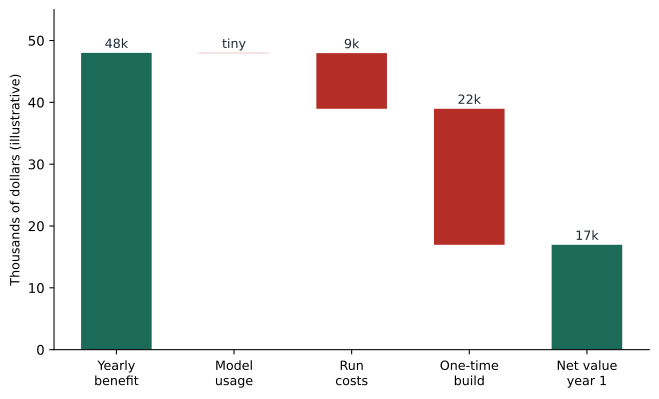
print(f"Payback (months) : {payback_months:.1f}")Hours saved per year : 1,000 Benefit per year : 48,000 Model usage per year : 36 Net value, year 1 : 16,964 Payback (months) : 6.8
What this code does
Using illustrative figures, the program works out the hours saved by writing descriptions faster and values them at a copywriter's hourly cost. It subtracts the model usage, the yearly running cost and the one-time build cost to get the first-year net value. It then shows the build cost would be paid back in about 6.8 months.
The model usage line, at these illustrative prices, comes to only a few dozen dollars a year. The build and run costs dominate. That is typical for a focused internal tool, and it tells Dana where the real risk lies: not in the cloud bill, but in whether the team adopts the tool and whether the 15-minute estimate holds.
Return on investment and payback
Two simple measures summarize a business case. Return on investment (ROI) compares net gain with cost. Payback period is how long it takes for cumulative net benefits to repay the one-time investment.
Costs that grow with success
One more cost line deserves attention because it grows when a project succeeds. If the product description tool works, other teams will want it, the volume of drafts will rise, and the descriptions will be extended to French for Quebec shoppers. Each step adds usage, review time and support. Jules adds a line to the case called growth costs, with a simple rule: every expansion must bring its own small business case, so that success does not quietly turn a cheap pilot into an expensive service nobody budgeted for.
Worked problem
Payback period
A tool costs 22,000 dollars to build. Once running, it produces 48,000 dollars a year of benefit and costs 9,000 dollars a year to run. How many months until it pays back the build cost?
Show solution
- Net monthly benefit = (48,000 − 9,000) ÷ 12 = 3,250 dollars.
- Payback = 22,000 ÷ 3,250 ≈ 6.8 months.
Answer: About 7 months, if the estimated time savings are achieved.
Dana adds two cautions that Jules writes into the case. First, ROI depends on the benefit estimate, so the case shows a range: what happens if editing takes 25 minutes rather than 15? Second, released time is only real value if it is used well, so the case names the buying guides as the planned use and commits to counting them.
build, run = 22000, 9000
for minutes_after in (15, 20, 25, 30):
    benefit = 2400 * (40 - minutes_after) / 60 * 48
    net_month = (benefit - run) / 12
    payback = build / net_month if net_month > 0 else float("inf")
print(f"{minutes_after} min: benefit {benefit:>7,.0f} a year, payback {payback:5.1f} months")15 min: benefit 48,000 a year, payback 6.8 months 20 min: benefit 38,400 a year, payback 9.0 months 25 min: benefit 28,800 a year, payback 13.3 months 30 min: benefit 19,200 a year, payback 25.9 months
What this code does
The business case is rerun for four possible results from the pilot, from 15 to 30 minutes per description. For each one the program works out the yearly benefit and how many months it takes to pay back the build cost. The payback stretches from under 7 months to about 26 months, showing how sensitive the case is to the time saved.
Even in the cautious case of 30 minutes per description, the tool pays back in under two years. That sensitivity table persuades Dana more than the headline number, because it shows the case does not depend on one optimistic assumption.
Measuring value: baselines and KPIs
A business case is only as good as the measurement that follows. Before the pilot starts, the team records a baseline: how things work now, measured the same way they will be measured later. For the copy team that means timing a sample of descriptions over two normal weeks, counting the backlog, and collecting editor quality ratings on a simple 1 to 5 scale.
Then Jules defines key performance indicators (KPIs) for the pilot. Good KPIs cover more than speed, because a tool that makes work faster but worse is not a success.
| KPI family | Product description pilot | Why it matters |
|---|---|---|
| Business outcome | Days from product arrival to published description | The reason the project exists |
| Efficiency | Editing minutes per description | Tests the main benefit assumption |
| Quality | Editor rating; factual errors found per 100 drafts | Catches a tool that is fast but wrong |
| Adoption | Share of new descriptions started from an AI draft | Value only appears if people use it |
| Satisfaction | Copywriter survey after four and eight weeks | Reveals friction the numbers miss |
| Cost | Model usage and support time per description | Keeps the run cost honest |
Farah adds one technique for fairness. For the first month, the team splits new products at random: half are written the old way and half from AI drafts. Comparing the two groups over the same weeks removes the effect of seasonal workload or a particularly easy batch of products. This kind of controlled comparison, often called an A/B test, is the most convincing way to measure impact when the number of items is large enough.
Measuring what is harder to measure
Some benefits resist neat numbers. A staff policy assistant might reduce the calls to head office, but also give store staff confidence that is hard to quantify. Jules uses a few honest techniques. Proxy measures stand in for the real effect, such as counting calls to the head-office help line. Before-and-after surveys ask users how long tasks take and how confident they feel. Sampled audits check a random set of outputs for accuracy each week. And the team keeps a short log of stories, specific examples where the tool helped or failed, because the steering committee remembers a concrete example longer than a chart.
Measurement also needs a decision point. The pilot charter says that after eight weeks the steering committee will choose one of three paths: expand to all products if editing time is under 25 minutes with no drop in quality; adjust and extend for four weeks if results are mixed; or stop if quality falls or adoption stays low. Agreeing the decision rule in advance stops a pilot from drifting on for months because nobody wants to call it.
Presenting the case
Jules's one-page summary for the steering committee has five parts: the problem in the business's words; the proposed solution and its review step; the costs, one-time and yearly, with assumptions labelled; the expected benefits as a range, with the baseline already measured; and the decision rule at the end of the pilot. It ends with the risks and how each is controlled, a section that later lessons fill in more fully. Dana approves the pilot with one change: the run cost must include a named person who owns the tool after launch. "Projects without an owner," she says, "become problems without an owner."
Common mistakes
MistakeCounting time saved without saying how it will be used.
InsteadName the planned use of released time and measure it.
MistakeLeaving review, data and training costs out of the case.
InsteadList every cost, including people's time, and label estimates as estimates.
MistakeStarting a pilot without a baseline.
InsteadMeasure the current process the same way the pilot will be measured.
MistakeTracking only speed.
InsteadBalance efficiency with quality, adoption, satisfaction and cost KPIs.
MistakeLetting pilots run without a decision date.
InsteadAgree the decision rule and date in the pilot charter.
Summary and key terms
- A generative AI business case is a hypothesis with numbers: benefits, costs, a baseline and a decision rule.
- Benefits range from hard savings to time released, speed, quality and experience, and time released only counts if it is put to use.
- Costs include model usage, integration, review, data work, training and ongoing operations; for internal tools, people's time usually outweighs usage charges.
- ROI and payback summarize the case, and a sensitivity range shows whether it depends on optimistic assumptions.
- Measure against a baseline with balanced KPIs, use controlled comparisons where possible, and add proxy measures, surveys, audits and stories for harder-to-measure value.
- Business case
- A structured argument that a project is worth its cost, with stated assumptions.
- Baseline
- A measurement of the current process taken before a change.
- KPI
- Key performance indicator: a measure tracked to judge success.
- Token
- A unit of text a model processes; many services price usage by tokens.
- ROI
- Return on investment: net gain divided by cost.
- Payback period
- The time for cumulative net benefits to repay the one-time investment.
- Sensitivity analysis
- Recalculating results with different assumptions to see how much they matter.
- A/B test
- A controlled comparison where similar items are split between the old and new way.
- Proxy measure
- A measurable stand-in for an effect that is hard to measure directly.
Practice problems
Work each problem on paper first, then reveal the answer to check.
Why does Dana want a range of benefits rather than one number?
Show answer
To see whether the case still works if the main assumption, such as editing time, is less favourable.
Name one KPI that would catch a tool that is fast but produces worse descriptions.
Show answer
Editor quality ratings, or factual errors found per 100 drafts.
What does a pilot decision rule do?
Show answer
It states in advance which results lead to expanding, adjusting or stopping the pilot, so a decision is made on time.
Lesson quiz · 5 questions
Score 60% or more to complete this lesson.
Create a free account to save your progress, take quizzes and earn a certificate.