
GCP-102 · Lesson 1 of 12 · 20 min
Why organizations move to the cloud
▶ Video coming soon A video version of this lesson is on the way.
In October 2026 Birchline Outfitters held the steering committee meeting that made its cloud move official. Owen Mitchell, who has spent eight years looking after Birchline's servers, backups and help desk, sat at the end of the table while Farah Qureshi, the company's cloud architect, walked the executives through the plan. The hardware lease on the data centre room behind the Toronto head-office warehouse ends in late 2027. Replacing the servers would lock Birchline into another five years of the same equipment. Moving to Google Cloud would not. Dana Leclair, the chief financial officer, asked the question every finance leader asks: "Why is this better than just buying new servers?" This lesson is Farah's answer, and the reasoning behind it is the reasoning the Cloud Digital Leader exam expects you to understand.
GCP-101 introduced the building blocks of Google Cloud: regions and zones, the resource hierarchy, IAM, billing and the main products. GCP-102 takes the business view. It follows Birchline from the decision to move through data, AI, modernization, security and operations, and finishes with a transformation roadmap. The Cloud Digital Leader exam is written for people who work alongside technical teams rather than as engineers themselves, so it tests whether you can explain why a choice makes sense for an organization, not whether you can configure it.
What digital transformation means
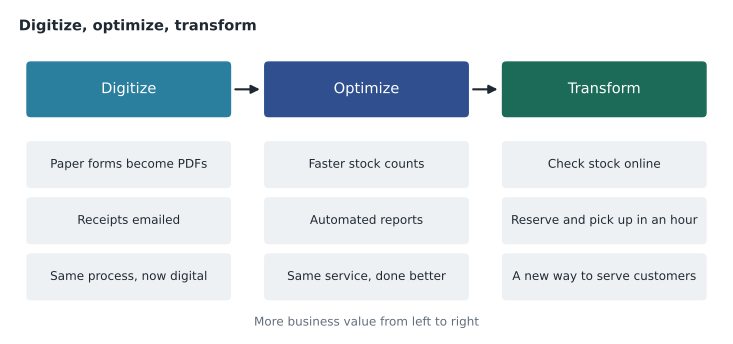
Digital transformation is the use of modern technology to change how an organization creates value: how it serves customers, runs its operations and makes decisions. It is not the same as buying new technology. A company that copies its paper forms into PDF files has digitized something, but it has not transformed. A company that lets customers check stock in their nearest store, reserve an item and pick it up an hour later has changed the service itself, and that change depends on data flowing quickly between the online shop, the stores and the warehouses.
Cloud computing is one of the main enablers of that change. The cloud is a model in which computing resources such as servers, storage, databases, networking and software are delivered on demand over a network, usually the internet, and paid for according to use. The provider owns and operates the physical equipment; the customer rents what it needs, when it needs it. Google Cloud is one such provider, alongside others such as Amazon Web Services and Microsoft Azure.
Two other terms appear constantly in transformation conversations. Cloud-native describes applications designed from the start to run in the cloud, typically built from small independent services, packaged in containers, deployed automatically and able to scale up and down on their own. Open source software is software whose source code is published under a licence that lets anyone use, study, change and share it. Many of the technologies at the heart of modern cloud computing are open source, including Kubernetes, which Google originally developed and released, and TensorFlow. Open standards are published specifications that any vendor can implement, such as the protocols that let a browser talk to any web server. Openness matters to Dana because it reduces the risk of being trapped with one supplier.
From buying servers to renting capacity
Birchline's current model is the traditional one. Every five years it buys servers, storage arrays and network equipment sized for its busiest week, which for an outdoor retailer is the run-up to the winter holidays and the first warm weekend of spring. For the other fifty weeks of the year most of that capacity sits idle. Buying it is a capital expenditure (CapEx): a large up-front purchase recorded as an asset and depreciated over several years. The cloud turns most of that into operating expenditure (OpEx): an ongoing cost that rises and falls with use and appears in the monthly budget like electricity or rent.
The shift matters for more than accounting. With CapEx, Birchline has to forecast years ahead, and a wrong forecast is expensive either way: too little capacity means a slow or crashed online shop during the holiday rush, and too much means money spent on equipment that is never used. With OpEx, Birchline can start small, measure real demand and adjust. Dana likes predictability, so Farah is careful to point out that OpEx is not automatically cheaper. It is more flexible, and the flexibility only saves money if someone watches the bills, a discipline covered in lesson 11.
The fair way to compare the two is total cost of ownership (TCO): every cost of running a system over its life, not just the purchase price. On-premises TCO includes the hardware, software licences, the room and its lease, power and cooling, backup equipment, the staff time spent patching and replacing parts, and the cost of outages. Cloud TCO includes the monthly bills, the staff time to manage cloud resources, any migration project and the training needed. Many organizations that compare only the hardware price against the cloud bill reach the wrong answer in both directions.
# A simplified five-year TCO comparison for Birchline's shop and data systems.
# All figures are invented, in thousands of dollars per year.
on_prem = {"hardware (spread over 5 years)": 180, "software subscriptions": 95,
           "room lease, power and cooling": 70, "backup and recovery site": 40,
           "staff time: patching, repairs": 120}
cloud = {"compute, storage and databases": 260, "network and support plan": 35,
         "staff time: cloud operations": 90, "migration project (spread over 5 years)": 30}
years = 5
on_prem_total = sum(on_prem.values()) * years
cloud_total = sum(cloud.values()) * years
print("On-premises, 5 years:", on_prem_total, "thousand")
print("Cloud, 5 years:     ", cloud_total, "thousand")
print("Difference:         ", on_prem_total - cloud_total, "thousand, lower for",
"cloud" if cloud_total < on_prem_total else "on-premises")On-premises, 5 years: 2525 thousand Cloud, 5 years: 2075 thousand Difference: 450 thousand, lower for cloud
What this code does
Each yearly cost for running the systems in-house is listed and added up, and the same is done for running them in the cloud. Both totals are multiplied by five years and compared. With these invented figures the cloud comes out about 450 thousand dollars cheaper over five years.
The numbers in a real TCO study come from Birchline's own invoices and usage, and Farah warns that the comparison is only as honest as its assumptions. Leaving out staff time, the cost of the backup site or the price of an outage makes on-premises look cheaper than it is. Assuming every server will be resized perfectly in the cloud makes the cloud look cheaper than it will be in the first year.
The business benefits of cloud
Google's own exam guide lists the benefits organizations usually seek, and Birchline's steering committee recognized most of them in its own situation.
| Benefit | What it means | Birchline example |
|---|---|---|
| Scalability | Adding or removing capacity as demand changes | The online shop can grow for the holiday rush and shrink in January |
| Elasticity | Scaling that happens automatically and quickly | Extra web servers start on their own when traffic spikes |
| Agility and speed | Getting new ideas into customers' hands sooner | A new store-pickup feature can be tested in weeks, not quarters |
| Flexibility | Choosing from many services and changing direction | Trying a new analytics tool without buying hardware |
| Reliability and high availability | Systems that keep running when parts fail | Running across several zones so one failure does not stop sales |
| Global reach | Serving users from locations close to them | Faster pages for shoppers in every province or state |
| Security | Specialist teams and built-in protections | Encryption and threat detection Birchline could not build alone |
| Data-driven insight | Analysing large amounts of data quickly | Seeing which products sell where, in near real time |
Scalability and elasticity are often confused. Scalability is the ability to add capacity; elasticity is doing it automatically, in both directions, as demand changes. A system can be scalable without being elastic if someone has to request and approve every new server. Reliability is the ability to keep working correctly over time, and high availability is a design goal in which a service stays up even when components fail. Cloud providers make these easier by offering many identical data centres, but they do not make them automatic. Birchline still has to design its systems to use more than one zone, a topic that returns in lessons 6 and 11.
Agility is the benefit executives tend to value most once they have seen it. In Birchline's current setup, a team that wants a new test server files a request, waits for hardware or a free virtual machine, and then waits for someone to install it. In the cloud, an approved team can have a test environment in minutes and delete it when the experiment ends. Jules Baptiste, the e-commerce product manager, has a backlog of ideas that have waited months for infrastructure. For Jules, the cloud's real promise is that ideas can be tested quickly and dropped cheaply if they fail.
Drivers, hurdles and the cost of standing still
Organizations rarely move to the cloud because technology is fashionable. They move because something forces a decision. At Birchline the drivers are the end of the hardware lease, an online shop that slowed to a crawl during last year's holiday sale, a data warehouse that takes all night to load and cannot answer questions about the previous day until mid-morning, and a growing worry about ransomware after a competitor was hit. Other common drivers include mergers, new regulations, expansion into new markets and pressure from customers who expect digital services.
The hurdles are just as real. Staff need new skills, and some fear their jobs will disappear. Existing applications may depend on old operating systems or licences that are hard to move. Contracts and data residency rules limit where some data can be stored. Costs can be hard to forecast at first. And moving a business-critical system while it is still serving customers carries risk. Farah's plan addresses each of these: a training budget, starting with low-risk systems, keeping customer data in Canadian regions, and a pilot before the online shop moves.
There is also a risk of not adopting new technology, and the exam guide treats it as a business risk in its own right. Competitors that move faster can offer services Birchline cannot match. Ageing hardware becomes more likely to fail and harder to secure. Skilled staff may leave for employers with more modern tools. And the next hardware purchase locks in today's limits for another five years. Doing nothing is a decision, and it has costs that rarely appear on a budget line until something breaks.
What makes Google Cloud different
The exam expects you to know the points Google itself emphasizes when it explains why customers choose Google Cloud. Farah summarized them for the committee in plain terms. AI leadership: Google has worked on AI research for many years and offers its own models, including the Gemini family, along with tools to build and run AI agents. AI Hypercomputer: the term Google uses for its integrated system of AI hardware, including GPUs and Google's own Tensor Processing Units (TPUs), software and flexible ways of paying for them. An AI-ready data platform: data services such as BigQuery that are built to feed analytics and AI. Openness and interoperability: support for open source and open standards, and products that work across other clouds. Security: a platform designed to be secure by default, backed by Google's threat intelligence. And a global network: Google's private fibre network connecting its data centres around the world.
These are the provider's claims, and a sensible digital leader treats them as a starting point for questions rather than as conclusions. Birchline compared Google Cloud with other providers on price, the services it needed, the skills of its staff, the availability of Canadian regions and the support it could buy. Google Cloud was chosen mainly for BigQuery, which the analytics team had already tested, and for the managed Kubernetes and serverless options that suited the online shop. The exam does not ask you to argue that Google Cloud is the best choice for everyone; it asks you to explain what Google Cloud offers and when those offerings fit.
Common mistakes
MistakeTreating cloud as a way to cut costs automatically.
InsteadCompare total cost of ownership honestly, and plan for cost management; the main gains are often agility and reliability.
MistakeCalling any new technology purchase a digital transformation.
InsteadAsk whether the way the organization serves customers or makes decisions has actually changed.
MistakeAssuming scalability and elasticity mean the same thing.
InsteadScalability is the ability to add capacity; elasticity means it happens automatically in both directions.
MistakeIgnoring the cost of doing nothing.
InsteadList the risks of staying put, such as failing hardware and lost competitiveness, alongside the risks of moving.
Worked problem
Explaining the move to the finance team
Dana asks Owen to explain in two sentences why Birchline should move its online shop to the cloud rather than buy bigger servers. What should the answer include?
Show solution
- Name the business problem: the shop slowed during last year's holiday sale because capacity is fixed.
- Name the cloud benefit that solves it: capacity that scales up automatically for the rush and down again afterwards.
- Name the financial effect: Birchline pays for the extra capacity only while it is used, instead of buying hardware sized for one busy week.
Answer: A good answer links the change to a business outcome: "Our shop slows down when it is busiest because our servers are a fixed size. In the cloud it can grow for the holiday rush and shrink afterwards, so we pay for peak capacity only during the peak."
Summary and key terms
- Digital transformation uses technology to change how an organization creates value, not just to digitize what it already does.
- Cloud computing delivers computing resources on demand and shifts much spending from capital expenditure to operating expenditure.
- Total cost of ownership is the fair way to compare cloud and on-premises costs.
- The main business benefits are scalability, elasticity, agility, reliability, global reach, security and faster insight from data.
- Drivers, hurdles and the risk of not adopting all shape the decision.
- Google Cloud emphasizes AI leadership, the AI Hypercomputer, an AI-ready data platform, openness, security and its global network.
- Digital transformation
- Using modern technology to change how an organization serves customers, runs operations and makes decisions.
- Cloud computing
- On-demand delivery of computing resources over a network, paid for according to use.
- Cloud-native
- Designed from the start to run in the cloud, usually as small services that scale automatically.
- Open source
- Software whose source code anyone may use, study, change and share under its licence.
- CapEx
- Capital expenditure: a large up-front purchase depreciated over years.
- OpEx
- Operating expenditure: an ongoing cost that varies with use.
- Total cost of ownership
- Every cost of running a system over its life, including staff time and outages.
- Elasticity
- Capacity that grows and shrinks automatically with demand.
Practice problems
Work each problem on paper first, then reveal the answer to check.
Why is comparing a server's purchase price with a monthly cloud bill misleading?
Show answer
It ignores other on-premises costs such as power, cooling, the room, backups, staff time and outages, and other cloud costs such as migration and training.
Give one example of a risk of not adopting cloud technology.
Show answer
Competitors that move faster can offer better services, or ageing hardware becomes harder to secure and more likely to fail.
What is the difference between digitizing and transforming?
Show answer
Digitizing turns existing processes into digital form; transforming changes the service or the way value is created.
Lesson quiz · 5 questions
Score 60% or more to complete this lesson.
Create a free account to save your progress, take quizzes and earn a certificate.