
GCP-101 · Lesson 12 of 12 · 19 min
Choosing services: a guided design walkthrough
▶ Video coming soon A video version of this lesson is on the way.
Eleven weeks after Owen's first morning, Farah hands him a one-page brief and an empty whiteboard. "You have every piece now," she says. "Design the new returns platform end to end, and explain each choice the way you would to Dana, Jules and Teresa. I will play all three." This final lesson follows that design session. It brings together location, hierarchy, identity, billing, compute, storage, databases, networking and operations, and shows a method Owen can use for any design question, including the scenario questions on Google Cloud exams.
The brief
Birchline accepts about 9,000 returns a month online and in stores, rising to about 30,000 in January after the holidays. Today, returns are handled by an old internal app on a single server plus a lot of email. The new platform must let shoppers start a return on the website, print a label, and track it; let store staff and warehouse staff check in returned items; store photos of damaged items; tell the inventory system when items are back in stock; and give the finance and data teams reporting. The requirements Farah writes on the board:
- Customer data stays in Canada, and photos of returned items must be kept for two years and then deleted.
- The customer-facing part must be available during store hours and should cope with the January surge without manual work.
- Staff sign in with their Birchline accounts; shoppers sign in with their shop accounts.
- Monthly running cost should be predictable, and close to zero for parts that are idle overnight.
- The team is small: three developers and Owen.
A method for design questions
Farah's method has five steps, and Owen writes them in the corner of the whiteboard. First, list the requirements and constraints, separating must-haves from preferences. Second, sketch the data: what is stored, its shape, how often it is read and written, and how long it must be kept. Third, choose the most managed service that meets each need, moving toward more control only for a stated reason. Fourth, add the cross-cutting layers: location, hierarchy, identity, network, operations and cost. Fifth, check the design against every requirement and note the trade-offs.
The same method works for exam questions. Scenario questions usually contain a few decisive phrases, such as must not manage servers, needs a specific operating system, global consistency, the lowest cost for rarely accessed data, or already uses Kubernetes. Underlining those phrases, and eliminating options that violate any of them, is often enough to find the answer.
Step 2: the data
| Data | Shape | Access pattern | Retention | Choice |
|---|---|---|---|---|
| Return requests, items, statuses | Relational: returns link to orders, items and stores | Many small reads and writes; transactions | Seven years for finance | Cloud SQL for PostgreSQL, high availability |
| Photos of returned items | Files, a few MB each | Written once, viewed a few times in the first weeks | Two years, then delete | Cloud Storage, regional bucket, lifecycle rules |
| Return labels (PDF) | Files | Downloaded once or twice | 90 days | Cloud Storage, same bucket, separate prefix and rule |
| Events for inventory | Small messages | Published when items are checked in | Until processed | Pub/Sub topic |
| Reporting history | Analytical tables | Large monthly and ad hoc queries | Seven years | BigQuery, fed from the database and events |
Owen considers Firestore for return requests, because the mobile app might show return status. He decides against it: returns link to orders, items, refunds and stores, finance needs transactional correctness, and Birchline's team already knows SQL. Spanner is not needed either, because the data is regional and well within Cloud SQL's capacity. He writes the reasoning down, because Farah's next question is always why not the other one.
Step 3: compute
The platform has three pieces of code: a web front end and API for shoppers and staff, a function that makes thumbnails of uploaded photos, and a nightly job that loads data into BigQuery. All three are new, stateless and containerizable, and the team is small, so the most managed options win.
| Component | Service | Reason |
|---|---|---|
| Returns web app and API | Cloud Run service | Stateless, scales out for January and down at night, no servers to patch |
| Photo thumbnails | Cloud Run function triggered by Cloud Storage events through Eventarc | Runs only when a photo arrives |
| Inventory updates | Pub/Sub topic with a push subscription to a small Cloud Run service | Decouples returns from the inventory system; retries if inventory is down |
| Nightly reporting load | Cloud Run job started by Cloud Scheduler | Runs to completion once a night |
| Old returns app | Retired after cutover | Replaced entirely |
Owen checks Compute Engine and GKE against the brief and records why neither is needed: nothing requires operating system control, and the team does not need Kubernetes. If a future requirement appears, such as a vendor component that only runs on a particular Linux, a small managed instance group could be added without changing the rest.
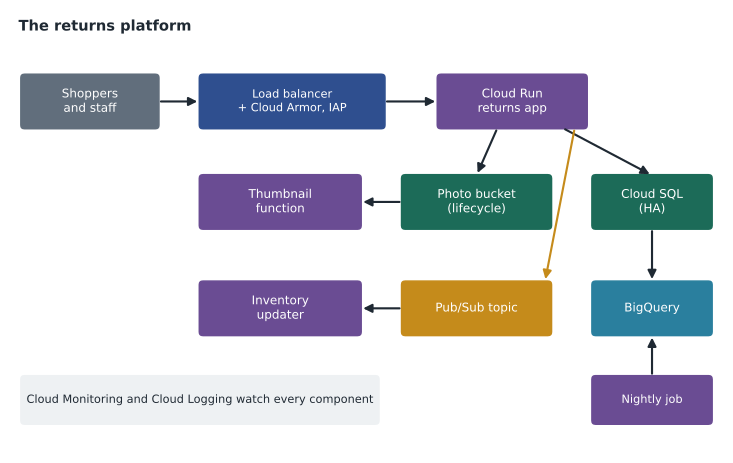
Step 4: the cross-cutting layers
Location. Everything runs in northamerica-northeast2 (Toronto). Cloud SQL uses its high availability configuration across two zones, with automated backups and a cross-region read replica in Montréal for recovery. The photo bucket is regional, in the primary region, because photos can be re-uploaded in the rare event of a regional disaster and a dual-region bucket would cost more. The organization policy on locations already prevents anything being created elsewhere.
Hierarchy. Two new projects, bl-returns-prod in the Production folder and bl-returns-dev in Non-production, so production access and budgets stay separate. Both carry the four required labels. Terraform creates both projects and their resources from the same code.
Identity. Staff sign in through Identity-Aware Proxy in front of the staff pages, using their Cloud Identity accounts and a group, returns-staff@birchline.example; shoppers sign in through the shop's existing customer accounts, which the app checks. Each component runs as its own service account: returns-app has Cloud SQL Client and Storage Object Admin on the photo bucket only; thumbnailer has object access on the same bucket; inventory-updater can call the inventory API; reporting-job can write to one BigQuery dataset. Developers get Cloud Run Developer on the dev project and read-only roles on production. No keys are created.
Network. The shopper and staff entry point is the existing global external Application Load Balancer, with a new path rule and Cloud Armor. Cloud Run reaches Cloud SQL over a private IP address in the Shared VPC, so the database has no public address. The inventory system, still on Compute Engine, is reached privately on the same network.
Operations. Uptime checks on the shopper and staff pages; alerting policies on error rate, p95 latency and Pub/Sub messages waiting too long; an SLO of 99.5 good requests in every 100 during store hours; logs to the _Default bucket for 30 days with the organization's audit sink unchanged; Error Reporting and Cloud Trace enabled. Runbooks for the three alerts are written before launch.
Cost. Owen estimates the monthly bill with the pricing calculator, using illustrative figures in his model below. Cloud Run and the function scale to zero overnight; the Cloud SQL instance is the steady cost and a candidate for a committed use discount after three months; photo storage grows until the two-year lifecycle rule starts deleting. A budget on the two projects alerts the team and Dana's finance group.
# Illustrative monthly estimate, not current list prices.
returns_per_month = {"typical": 9000, "january": 30000}
photo_mb = 3.0
photos_per_return = 1.5
storage_price_per_gb = 0.02
cloud_sql_monthly = 260.0        # small HA instance, always on
run_cost_per_1000_returns = 1.10 # requests, CPU and memory while busy

for label, n in returns_per_month.items():
    new_photo_gb = n * photos_per_return * photo_mb / 1024
    run_cost = n / 1000 * run_cost_per_1000_returns
    print(f"{label:8} new photos {new_photo_gb:6.1f} GB, Cloud Run about {run_cost:6.2f}, Cloud SQL {cloud_sql_monthly:.2f}")

two_year_gb = (9000 * 11 + 30000) * 2 * photos_per_return * photo_mb / 1024
print(f"photo storage after two years: about {two_year_gb:,.0f} GB, costing about {two_year_gb * storage_price_per_gb:,.2f} a month")typical new photos 39.6 GB, Cloud Run about 9.90, Cloud SQL 260.00 january new photos 131.8 GB, Cloud Run about 33.00, Cloud SQL 260.00 photo storage after two years: about 1,134 GB, costing about 22.68 a month
What this code does
Using illustrative prices, the program estimates the monthly cost of the returns app in a typical month and a busy January. It works out how many gigabytes of new photos arrive, the Cloud Run cost from the number of returns, and the fixed database cost. It then adds up two years of photos to estimate the storage size and its monthly charge.
The model shows what matters for this design: the database is the main fixed cost, compute follows the number of returns, and photo storage stays modest because of the lifecycle rule. Dana gets her predictable number, with January's surge visible in advance.
Step 5: checking the design
| Requirement | How the design meets it |
|---|---|
| Data residency | Single approved region plus a recovery replica in the second approved region; organization policy enforces locations |
| Photos kept two years, then deleted | Lifecycle rule deletes objects at 730 days |
| Available in store hours, copes with January | Cloud Run autoscaling, Cloud SQL HA across zones, load balancer with health checks, SLO and alerts |
| Staff and shopper sign-in | IAP with Cloud Identity groups for staff; existing customer accounts for shoppers |
| Predictable, low idle cost | Serverless compute scales to zero; budget alerts; commitment for the database after usage is known |
| Small team | No servers or clusters to manage; Terraform and Cloud Run revisions for safe, repeatable releases |
Farah, playing Teresa, asks what happens if the photo bucket is made public by mistake. Owen points to public access prevention enforced by organization policy. Playing Jules, she asks how a bad release is undone. Owen answers with Cloud Run revisions and traffic splitting. Playing Dana, she asks what the bill will be in January. Owen shows the model and the budget. Then, as herself, she asks the question she always asks: what would you change if the brief changed? Owen has an answer for three cases: a global expansion would point toward Spanner and a dual-region bucket; a vendor component would add a small managed instance group; heavy mobile use might add Firestore for status updates.
Common mistakes
MistakeStarting a design by choosing a favourite service.
InsteadStart from requirements and data, then choose the most managed service that meets them.
MistakeDesigning compute and forgetting identity, network and operations.
InsteadAdd the cross-cutting layers explicitly: location, hierarchy, IAM, network, monitoring and cost.
MistakeChoosing the most resilient option for every component regardless of cost.
InsteadMatch resilience to the cost of failure for each piece of data and each component.
MistakeAnswering exam scenarios from memory of a product name.
InsteadUnderline the decisive phrases in the question and eliminate options that break any of them.
From design to delivery
A good design is only the start. Farah asks Owen how the returns platform will be built and released, and he sketches the delivery path beside the architecture. The Terraform code for both projects lives in the platform team's repository and is applied through a pipeline after review. The application code lives in the returns team's repository; each merge triggers Cloud Build, which runs the tests, builds a container image, stores it in Artifact Registry and deploys it to the development project. Promotion to production is a deliberate step: the same image is deployed to bl-returns-prod as a new Cloud Run revision that first receives a small share of traffic, about one request in ten, while the team watches the error and latency alerts.
The migration from the old returns app is planned in the same spirit. Open returns are copied to Cloud SQL with a one-off script, staff are trained in two stores first, and the old app is kept read-only for a month so that anyone can look up an old return. Only after January's surge passes cleanly is the old server switched off for good, which removes one more machine from the room behind the warehouse.
Worked problem
An exam-style scenario
A company wants to run a new stateless web API with unpredictable traffic, pay nothing when it is idle, and avoid managing servers or clusters. The API needs a relational database in one region with automatic failover. Which combination fits best?
Show solution
- Decisive phrases: stateless, unpredictable traffic, pay nothing when idle, no servers or clusters.
- Compute: Compute Engine and GKE both involve servers or clusters, so Cloud Run is the fit; it scales to zero.
- Database: relational, one region, automatic failover, which is Cloud SQL with high availability. Spanner would also work but is designed for global scale and costs more.
Answer: Cloud Run with Cloud SQL in its high availability configuration.
Owen photographs the whiteboard. It is the first architecture he has designed for the cloud, and every box has a reason written next to it. Farah tells him it is ready for review by the platform team, and that he is ready for GCP-102, where the same thinking is applied to the business questions on the Cloud Digital Leader exam.
Summary and key terms
- A reliable design method has five steps: list requirements and constraints; sketch the data and its access patterns; choose the most managed service that meets each need; add the cross-cutting layers of location, hierarchy, identity, network, operations and cost; and check the design against every requirement, recording trade-offs.
- For Birchline's returns platform this produced Cloud Run, a Cloud Run function, Pub/Sub, Cloud SQL with high availability, Cloud Storage with lifecycle rules and BigQuery, in one approved region with a recovery replica, separate projects, dedicated service accounts, IAP for staff, a private database connection, SLO-based alerts and a budget.
- The same method, focused on decisive phrases, answers exam scenario questions.
- Requirement
- Something the design must achieve, such as residency, availability or cost.
- Constraint
- A limit the design must respect, such as team size or an approved region.
- Managed service
- A service in which the provider runs the infrastructure and operations.
- Event-driven design
- Components that react to messages or events rather than calling each other directly.
- Pub/Sub
- Google Cloud's messaging service for sending events between systems.
- Identity-Aware Proxy
- A service that checks identity and IAM before allowing access to an application.
- Trade-off
- A choice that improves one quality at the expense of another.
- Decisive phrase
- Words in a scenario question that rule options in or out.
Practice problems
Work each problem on paper first, then reveal the answer to check.
What are the five steps of the design method?
Show answer
List requirements, sketch the data, choose the most managed fitting service, add cross-cutting layers, and check against requirements.
Why did Owen choose a regional rather than dual-region photo bucket?
Show answer
Photos can be re-uploaded after a rare regional disaster, so the extra cost of dual-region was not justified.
Which phrase in a scenario points toward Compute Engine?
Show answer
A need for a specific operating system, kernel setting or licensed software that requires control of the VM.
Lesson quiz · 5 questions
Score 60% or more to complete this lesson.
Create a free account to save your progress, take quizzes and earn a certificate.