
FAT-120 · Lesson 8 of 12 · 19 min
Sprinkler supervisory and waterflow devices
At Cartwright Distribution Centre, the sprinkler system is the main fire protection, and the fire alarm system's most important job there is to know at every moment whether the sprinklers are ready and whether water is flowing. The building has three wet risers, a dry-pipe system for the unheated loading dock, a fire pump, and an outdoor post indicator valve on the underground supply. Every one of those has devices that report to the panel: waterflow switches, pressure switches, valve tamper switches, a low-air switch, pump signals and a low-temperature switch in the pump room. Gerry spends a morning walking Sasha through them with the sprinkler contractor's foreman, Luis. 'The sprinkler fitters install the devices,' Luis says, 'and Bramwell wires them and makes sure the panel knows what they mean. If either of us gets it wrong, the building can sit with a closed valve for a month and nobody knows.'
Waterflow detection
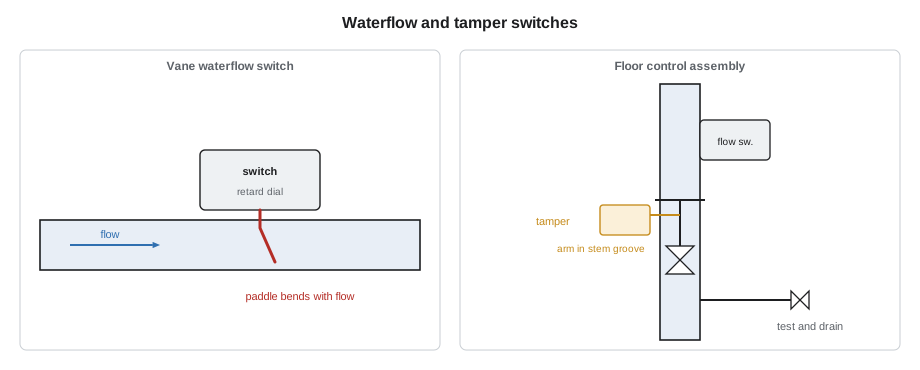
When a sprinkler opens in a wet-pipe system, water starts to flow in the pipes that feed it. A vane-type waterflow switch detects that flow directly: a thin flexible paddle inserted into the pipe through a hole is pushed by moving water, and its movement operates a switch. Because water can surge briefly in the pipes when the city supply pressure changes, every waterflow switch has a retard, an adjustable delay, typically up to about 90 seconds, so that the switch only operates if the flow continues. The installation standards require a waterflow alarm to be indicated within a set time of flow starting, so the retard is set as short as nuisance surges allow.
Pressure-type waterflow switches are used where a vane switch can't be, such as on dry-pipe and pre-action systems, where there is no water in the pipe until the system trips, and on alarm check valves. When a dry-pipe valve trips, water flows into the system and pressure rises in the alarm line; a pressure switch on that line operates. A waterflow signal is an alarm signal, the same as a smoke detector or a manual station: it starts notification, control functions and the call to the fire department. In a fully sprinklered building with no automatic detection, waterflow may be the only automatic way the alarm starts.
Testing waterflow
Waterflow switches are tested by flowing water, not by pushing the paddle. Each system has an inspector's test connection, a valve with an orifice the same size as one sprinkler, usually at the most remote part of the system, that lets a technician discharge water as if one sprinkler had opened. Opening it should operate the waterflow switch within the required time. On floor control assemblies, a test and drain valve beside the switch serves the same purpose. The test confirms that the switch operates, that the retard is set correctly, and that the panel shows the alarm for the right floor or zone and sends it to the monitoring station. Because the test sounds the building's alarm and discharges water, it is coordinated with the owner, the monitoring station and the sprinkler contractor.
# Waterflow switch retard check from a test log (times in seconds)
required = 90     # alarm must be indicated within this time of flow starting
tests = [  # location, retard setting, time from test valve opening to panel alarm
    ("Riser 1, floor control", 45, 52),
    ("Riser 2, floor control", 60, 68),
    ("Riser 3, floor control", 85, 97),
    ("Dock dry system (pressure)", 0, 71),
]
for loc, retard, t in tests:
    status = "ok" if t <= required else "too slow: reduce the retard or check the switch"
print(f"{loc:28s} retard {retard:3d} s, alarm at {t:3d} s -> {status}")Riser 1, floor control retard 45 s, alarm at 52 s -> ok Riser 2, floor control retard 60 s, alarm at 68 s -> ok Riser 3, floor control retard 85 s, alarm at 97 s -> too slow: reduce the retard or check the switch Dock dry system (pressure) retard 0 s, alarm at 71 s -> ok
Riser 3's switch was set close to its maximum retard after the fitters had problems with surges during a city main repair, and with the extra few seconds of panel processing it now takes too long. Luis reduces the retard to 60 seconds and Sasha retests it. The dry-pipe system's longer time is typical, because the dry valve must trip and water must fill the alarm line before the pressure switch sees it; its test is judged against the requirements for dry systems, which allow for the time to trip.
Valve supervision
A sprinkler system with a closed valve is a system that doesn't work, and closed valves are one of the main reasons sprinkler systems fail in real fires. Every valve that controls the water supply to sprinklers is therefore supervised. A tamper switch, also called a supervisory or valve supervisory switch, is clamped to the valve and operates when the valve moves from fully open. On an outside screw and yoke valve, the switch has an arm that sits in a groove filed in the valve stem; as the valve is closed, the stem moves and the arm rides out of the groove. On butterfly valves and post indicator valves, the switch is often built into the valve's operator or indicator. The standards require the switch to operate within a set amount of valve movement, so that a valve closed even a little is reported, and to restore only when the valve is fully open again.
A tamper switch sends a supervisory signal, not an alarm. Someone closing a valve for maintenance should not evacuate the building, but the owner and the monitoring station must know the protection is impaired. When a valve is closed for work, the impairment procedure applies: the owner is notified, the monitoring station is told the signal is expected, the fire department may be told, a fire watch may be required, and the valve's reopening is confirmed by the restoral signal at the panel.
Other supervisory devices
Several other conditions threaten a sprinkler system's readiness and are supervised. A dry-pipe system holds air or nitrogen in its pipes; a low-air pressure switch warns when pressure falls toward the point where the dry valve would trip, which might mean a leak or a failed compressor. A high-air switch may also be used. In unheated pump houses, valve rooms and dry-valve enclosures, a low-temperature switch warns before water in the pipes or valves can freeze, typically set a few degrees above freezing. Water storage tanks have level switches and, where they could freeze, water temperature switches. Fire pumps report signals such as pump running, loss of power, phase reversal, and controller trouble, which the pump standard and the fire alarm standard together determine.
| Device | Watches | Signal |
|---|---|---|
| Vane waterflow switch | Water flowing in a wet system | Alarm (after retard) |
| Pressure waterflow switch | Pressure in the alarm line of a dry or alarm valve | Alarm |
| Valve tamper switch | Control valve moved from fully open | Supervisory |
| Low-air switch | Dry-pipe system air pressure falling | Supervisory |
| Low-temperature switch | Room or enclosure near freezing | Supervisory |
| Fire pump signals | Pump running, power loss, phase reversal, controller trouble | Supervisory (pump running often supervisory or alarm as designed) |
| Tank level or temperature | Water storage below level or near freezing | Supervisory |
Each device is connected through an input module or on its own supervised circuit so that the panel shows exactly which one operated. Combining all of a building's tamper switches on one circuit, or one module, is a common shortcut on older systems. It saves money, but when the signal comes in, nobody knows which valve to check, and a second valve closing while the first is still closed sends no new signal at all. Current practice, and many authorities, expect each valve to be individually identified, and many standards require that waterflow and supervisory signals not share a circuit.
The fire department connection and post indicator valve
The fire department connection lets firefighters pump water into the sprinkler system from a hydrant. It has a check valve, so the system's water doesn't flow out, and it is not usually supervised electronically, but it is part of what the fire alarm technician sees on a survey, as Sasha did at Tamarind House. The post indicator valve, a valve on the underground supply with a post above ground showing 'open' or 'shut' through a window, is supervised by a tamper switch in its head, and the cable from the building to the post is buried and must be protected. Outside, the post indicator valve is also the most likely valve to be closed by someone who shouldn't, which is why its handle is locked or chained as well as supervised.
Coordinating with the sprinkler trade
In most of Canada, sprinkler fitters install and test the sprinkler system to NFPA 13 and NFPA 25, as the National Building Code and National Fire Code reference them, and the fire alarm technician wires and verifies the devices that report to the panel to CAN/ULC-S524 and S537. The boundary is the device's terminals. The two trades test together, because a waterflow test proves both systems at once, and their records must agree.
Problems at the boundary are common. A fitter replaces a valve and reconnects the tamper switch to the wrong set of contacts, so the switch reports normal with the valve closed. A switch is installed on a valve but the stem groove is never filed, so the arm never sits correctly. A new floor is added with a new floor control valve, and the sprinkler side is finished but the fire alarm side isn't. Joint testing at the end of each job, with both trades present and both records signed, prevents these.
Worked problem
A tamper signal that wouldn't clear
During Cartwright's annual inspection, the panel shows 'SUPERVISORY, RISER 2 VALVE TAMPER'. The valve is fully open according to Luis, and turning it a little doesn't change the signal. What should Sasha check?
Show solution
- Confirm with Luis that the stem is fully out: an OS&Y valve's stem position shows whether it is open.
- Look at the tamper switch: the arm should sit in the stem's groove; if it has slipped out, the switch reads 'off-normal' even with the valve open.
- Check the switch's contacts and wiring at the input module: a fault there could hold the module in the supervisory state.
- Do not silence and walk away; the signal must clear only when the valve and switch are proven normal.
Answer: The arm has been knocked out of the groove by a forklift's mast brushing the riser. Luis repositions and tightens the switch, Sasha confirms the signal clears, then closes the valve two turns to prove the switch operates, reopens it and confirms the restoral. They add a guard post beside the riser to the deficiency list.
Antifreeze, pre-action and other system types
Different sprinkler system types bring different devices. Antifreeze systems, used in small unheated areas, are wet systems filled with an approved antifreeze solution; they use vane or pressure waterflow switches like wet systems. Pre-action systems, used in data rooms and archives, keep the pipes dry until the fire alarm system detects a fire and opens a valve, so that a broken sprinkler alone doesn't flood the room; the fire alarm system supervises the system's air pressure and releases the valve through a listed releasing circuit, as in Lesson 6. Deluge systems, with open sprinklers, are released the same way and used for high-hazard areas such as transformer yards. For each type, the sprinkler designer and the fire alarm designer agree which devices report which signals, and the result goes into the sequence of operation and the testing plan.
Underground and outdoor wiring to sprinkler devices needs attention too. The cable to a post indicator valve, or to a tamper switch in a valve pit, runs in conduit rated for wet locations, and splices are made in sealed boxes above grade where possible, because water in a buried splice is a classic cause of ground faults and intermittent supervisory signals. When Sasha sees a tamper signal that comes and goes after rain, the outdoor cable is the first place she looks.
Common mistakes
MistakeTesting a waterflow switch by pushing the paddle.
InsteadFlow water through the inspector's test connection or test drain.
MistakeSetting the retard to its maximum to stop surges.
InsteadUse the shortest setting that avoids surges and still meets the required time.
MistakeWiring tamper switches to send an alarm.
InsteadTamper switches send supervisory signals.
MistakePutting all valve tamper switches on one circuit.
InsteadIdentify each valve individually so the right one is checked.
MistakeClosing a valve for work without an impairment procedure.
InsteadNotify, arrange a fire watch if needed and confirm restoral.
Summary and key terms
- Waterflow switches send alarm signals when water flows; vane types for wet systems, pressure types for dry and alarm valves.
- Retards prevent alarms from surges, but the alarm must still be indicated within the required time.
- Tamper switches supervise valves and send supervisory signals when a valve moves from fully open.
- Low-air, low-temperature, tank and fire pump signals are also supervisory.
- Each device should be individually identified at the panel.
- Sprinkler and fire alarm trades test together at the device boundary.
- Waterflow switch
- A device that detects water flowing in sprinkler piping and sends an alarm.
- Retard
- An adjustable delay that keeps a waterflow switch from responding to brief surges.
- Tamper switch
- A switch that sends a supervisory signal when a sprinkler valve moves from fully open.
- Inspector's test connection
- A test valve with an orifice equal to one sprinkler, used to test waterflow alarms.
- Low-air switch
- A switch that warns when a dry-pipe system's air pressure falls.
- Post indicator valve
- An underground supply valve with a post showing open or shut.
Practice problems
Work each problem on paper first, then reveal the answer to check.
A waterflow test takes 97 seconds from opening the test valve to the panel alarm, and 90 seconds is allowed. What is the likely fix?
Show answer
Reduce the retard setting and retest.
What signal should a low-temperature switch in a pump room send?
Show answer
A supervisory signal.
Why is a waterflow signal an alarm, not a supervisory?
Show answer
Water flowing means a sprinkler has opened, most likely because of a fire.
What does the inspector's test connection simulate?
Show answer
One sprinkler opening at the remote end of the system.
Lesson quiz · 5 questions
Score 60% or more to complete this lesson.
Create a free account to save your progress, take quizzes and earn a certificate.