
FAT-120 · Lesson 10 of 12 · 19 min
Visual notification: strobes and candela
A student at Willowbank who is deaf has joined the school this year, and her parents have asked how she will know when the fire alarm sounds. The answer, in most of the building, is the strobes: bright white flashes that tell anyone who can't hear the alarm, or can't hear it over noise, that the building is in alarm. Ravi asks Sasha to check whether the strobes in the 1968 wing meet current requirements, since that wing will be connected to the new panel during the summer work. 'A strobe isn't a decoration,' he says. 'It has to be bright enough for the size of the room, mounted where people can see it, and flashing in step with every other strobe in view. And it can't flash so fast that it triggers a seizure.' This lesson covers visual notification appliances: how they are rated, where they go and how they are made to work together.
Why visual signals
Visual signals serve people who are deaf or hard of hearing, and people in places so noisy that audible signals can't be relied on: gyms during games, workshops, mechanical rooms and loading docks. They are also used where an audible signal is deliberately quiet or private, such as in hospitals where staff respond to chimes and strobes. Accessibility laws and building codes have driven their spread since the 1990s, and most new fire alarm systems put visual appliances in all public and common-use spaces, washrooms, assembly areas and many work areas. In sleeping rooms used by people who are deaf, strobes bright enough to wake people, and tactile devices such as bed shakers, are added.
The National Building Code requires visual signal devices in specified spaces, such as assembly areas, and in other places where the ambient noise is high or people with hearing loss are expected, and CAN/ULC-S526 is the product standard for them. CAN/ULC-S524 sets installation, and the provincial accessibility rules may add requirements, such as for suites designed for people with hearing loss. The fire alarm designer checks the edition in force.
Candela and the light from a strobe
A strobe's brightness is rated in candela, the unit of luminous intensity. The rating is the effective intensity of the flash, measured along the strobe's axis; off-axis, the intensity falls, and the listing defines how it falls with angle. Typical ratings are 15, 30, 75, 110, 135 and 185 candela, and many appliances let the installer select the rating with a switch, which also changes the current the appliance draws: a 185 cd setting draws several times the current of 15 cd. The light falls off with the square of the distance, so a person twice as far from a strobe sees a quarter of the illumination.
Strobes flash between once and twice per second, with a very short flash. The upper limit is set because flashing lights at higher rates can trigger seizures in people with photosensitive epilepsy, and multiple unsynchronized strobes in the same view can combine into a higher effective flash rate. That is why every strobe visible from one place must be synchronized, flashing at the same instant, so the combined rate stays within the safe range. Synchronization is done by the panel's notification circuits, by a sync module, or by a sync protocol built into the appliances, and strobes from different manufacturers usually can't be synchronized together.
Sizing strobes for a room
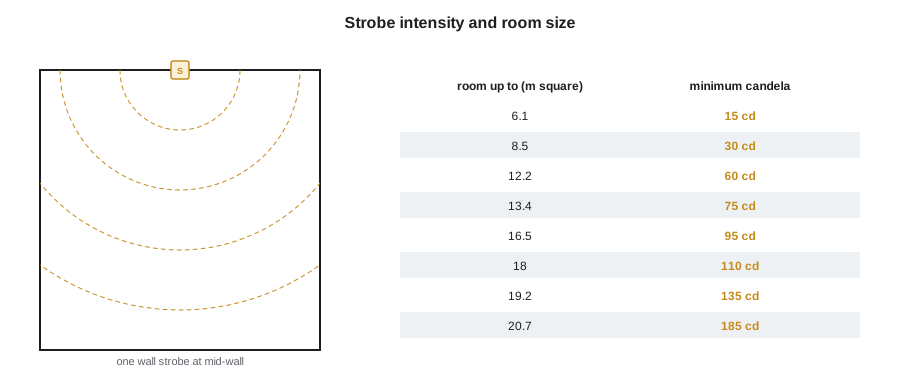
The installation standards give tables of minimum candela for one strobe, or for two or four strobes, mounted on the walls or ceiling of square rooms of given sizes. A single wall strobe at the centre of one wall of a room up to about 6 m square needs only 15 cd; one up to about 21 m square needs 185 cd. Rectangular rooms are treated as squares based on their longer dimension, unless the strobe is on a long wall and the standard's rules allow otherwise. Larger rooms, and rooms where furniture or partitions block the view, use several lower-candela strobes spread around the room rather than one very bright one, so that anyone anywhere can see a flash without it being blinding up close.
# Wall strobe selection for square rooms (one strobe, centre of a wall; values as commonly tabulated)
table = [  # (maximum room side in m, minimum candela)
    (6.1, 15), (8.5, 30), (12.2, 60), (13.4, 75), (16.5, 95), (18.0, 110), (19.2, 135), (20.7, 185),
]
rooms = [  # name, length, width (m)
    ("Office 112", 4.0, 3.5),
    ("Classroom 204", 9.0, 8.0),
    ("Library", 15.0, 12.0),
    ("Gym", 30.0, 20.0),
]
for name, L, W in rooms:
    side = max(L, W)
    cd = next((c for s, c in table if side <= s), None)
    if cd is None:
        print(f"{name:14s} {side:4.1f} m: larger than the table for one strobe -> use several strobes")
    else:
print(f"{name:14s} {side:4.1f} m: one wall strobe of at least {cd} cd")Office 112 4.0 m: one wall strobe of at least 15 cd Classroom 204 9.0 m: one wall strobe of at least 60 cd Library 15.0 m: one wall strobe of at least 95 cd Gym 30.0 m: larger than the table for one strobe -> use several strobes
The table values follow the widely used wall-mounted table for one strobe in a square room, converted to metres; designers use the table in the edition of the standard that applies. The classroom needs a 60 cd strobe because it is just over the 30 cd size; a second 30 cd strobe on the opposite wall, if the multi-strobe table allows it, is another option. The gym is too large for one strobe and gets several, as Ravi's design in Lesson 9 showed.
Mounting height and location
Wall-mounted strobes are mounted so that the entire lens is between 2000 and 2400 mm above the floor, under CAN/ULC-S524, high enough to be seen over people and furniture and low enough to light the room below. Where the ceiling is too low for that, the strobe goes as close to the ceiling as allowed, and ceiling-mounted strobes, listed for ceiling mounting and selected from the ceiling tables, are used in rooms with high ceilings. Strobes are placed so that their light is seen from everywhere in the space, including around corners and partitions.
In corridors, strobes are spaced along the length so that no point is too far from one; the standards give a maximum distance from the corridor's ends and between strobes, and corridors wider than a set width are treated as rooms. In washrooms, a strobe is needed where the public or staff use the room. In large open offices with workstation partitions, strobes are placed so that someone seated in a cubicle can see a flash, which may mean more strobes than the open-room table suggests.
Sleeping rooms
In sleeping rooms, a strobe must be bright enough to wake a sleeping person, which takes far more light than alerting someone who is awake. The requirements for visual signals in sleeping rooms of suites designed for people with hearing loss, and for smoke alarms with visual components, follow the code and its referenced standards; one Canadian code text requires at least 175 cd for the visual component in a sleeping room. Tactile appliances such as bed shakers and pillow vibrators are used with them for people who are deaf.
Other visual signals
Not every visual signal is a white strobe. Amber or other coloured strobes may be used for mass notification messages, so people can tell a non-fire emergency from a fire. Textual displays and digital signs can show instructions during an emergency. Annunciators and graphic panels show firefighters the location of alarms, but those are for responders, not occupants. Status lights on detectors are not notification appliances. A technician installing coloured strobes or signs checks that they are part of the approved design and that the white fire strobes remain distinct.
| Space | Typical visual provision | Notes |
|---|---|---|
| Small office or meeting room | One wall strobe, 15 or 30 cd | Size from the room table |
| Classroom | One 60 cd or two 30 cd strobes | Check sightlines over students |
| Corridor | Strobes spaced along its length | Wide corridors are treated as rooms |
| Gym or auditorium | Several strobes around the room | Avoid a single blinding strobe |
| Washroom | One strobe visible from all stalls' approaches | Public and common-use washrooms |
| Sleeping room (accessible) | High-intensity strobe plus tactile device | Intensity depends on mounting height |
Power and testing
Strobes draw much more current than horns, and a large current surge when they all charge at once. That makes notification circuit voltage drop and power supply sizing critical, which FAT-130 covers in detail. At installation, every strobe's candela setting is set to the design value, recorded and checked, and synchronization is checked by watching all strobes in view flash together. During verification and inspection, each strobe is confirmed to flash, at the correct rate, with no visible lag between strobes in the same view.
# Strobe current on one notification circuit at its candela settings (illustrative currents)
current_ma = {15: 45, 30: 65, 75: 120, 110: 155, 185: 245}   # mA at the circuit's rated voltage, from a data sheet
strobes = [15, 15, 30, 30, 75, 75, 110, 110, 185]
total = sum(current_ma[c] for c in strobes)
print(f"{len(strobes)} strobes, total {total} mA = {total / 1000:.2f} A")
for c in sorted(set(strobes)):
    n = strobes.count(c)
    print(f"  {n} x {c:3d} cd at {current_ma[c]} mA = {n * current_ma[c]} mA")
print("the circuit and power supply must carry this with margin, at the lowest battery voltage")9 strobes, total 1015 mA = 1.01 A 2 x 15 cd at 45 mA = 90 mA 2 x 30 cd at 65 mA = 130 mA 2 x 75 cd at 120 mA = 240 mA 2 x 110 cd at 155 mA = 310 mA 1 x 185 cd at 245 mA = 245 mA the circuit and power supply must carry this with margin, at the lowest battery voltage
Worked problem
The 1968 wing at Willowbank
The old wing has twelve classrooms with one 15 cd strobe each, mounted 1800 mm high beside the door. The classrooms are 9 m by 8 m. The wing is being connected to the new panel. What should Sasha report?
Show solution
- Each classroom's longer side is 9 m, so one wall strobe needs at least 60 cd from the table, not 15 cd.
- The lens height of 1800 mm is below the 2000 to 2400 mm range in CAN/ULC-S524.
- The old strobes may not synchronize with the new appliances, which matters where two are visible at once, such as in corridors and the gym doorways.
- Connecting the wing is an alteration, so the strobes in the work area must meet current requirements; replacing them with synchronized 60 cd appliances at the right height is needed.
Answer: Ravi's revised design replaces the wing's strobes, and the parents of the deaf student are told that every classroom she uses, the corridors and the washrooms will have strobes she can see from anywhere in the room. Her classroom also gets a vibrating pager tied to the system as an extra measure, as the school's accessibility plan provides.
Visual signals in existing buildings
Many existing buildings have strobes installed before the current rules, with low candela ratings, unsynchronized flashes or mounting heights that are now outside the range. The rules for existing systems generally let those strobes stay until the system is altered, but an alteration that affects an area, as at Willowbank, usually brings that area's appliances up to the current requirements. Owners are often surprised by the cost, because brighter strobes also need more power and sometimes new notification circuits and power supplies. A survey that lists every strobe's rating, height and synchronization before the work is priced avoids surprises later, and it is a job Sasha is now often sent to do.
Survey results feed the power design. Replacing twelve 15 cd strobes with 60 cd strobes more than doubles their current, so the survey also records which notification circuit each strobe is on and how loaded each circuit already is. Ravi uses those numbers in FAT-130's voltage drop and battery calculations to decide whether the wing needs a new power supply as well as new appliances.
Common mistakes
MistakeUsing one bright strobe in a large or partitioned room.
InsteadSpread several lower-candela strobes so everyone sees a flash.
MistakeMixing strobes that can't be synchronized in one view.
InsteadSynchronize every strobe visible from one place.
MistakeLeaving strobes at a factory default candela.
InsteadSet and record the design value.
MistakeMounting strobes beside doors at low height.
InsteadMount them in the standard's height range.
MistakeForgetting the extra current of high-candela strobes.
InsteadInclude it in circuit and power calculations.
Summary and key terms
- Visual signals serve people who are deaf or hard of hearing and spaces too noisy for audible signals.
- Strobes are rated in candela; light falls with the square of distance.
- Strobes visible from one place must be synchronized, flashing once to twice per second.
- Room tables give the minimum candela for one or more strobes; large rooms get several strobes.
- CAN/ULC-S524 sets wall strobes with the whole lens between 2000 and 2400 mm above the floor.
- High-candela settings draw much more current, which affects power design.
- Strobe
- A visual notification appliance that produces bright, brief flashes.
- Candela
- The unit of luminous intensity used to rate strobes.
- Synchronization
- Making all strobes in view flash at the same instant.
- Visual notification appliance
- A device that warns people by light rather than sound.
- Tactile appliance
- A device, such as a bed shaker, that warns by vibration.
- Photosensitive epilepsy
- A condition in which flashing light can trigger seizures.
Practice problems
Work each problem on paper first, then reveal the answer to check.
A meeting room is 8 m by 6 m. What minimum candela does one wall strobe need from the lesson's table?
Show answer
30 cd (longer side 8 m, up to 8.5 m).
Why must strobes in the same view be synchronized?
Show answer
Unsynchronized flashes can combine into a rate that could trigger seizures, and look confusing.
A strobe's lens is 1900 mm above the floor. Does it meet CAN/ULC-S524?
Show answer
No: the whole lens must be between 2000 and 2400 mm.
Seen from twice as far away, how much light from a strobe reaches a person?
Show answer
About a quarter.
Lesson quiz · 5 questions
Score 60% or more to complete this lesson.
Create a free account to save your progress, take quizzes and earn a certificate.