
FAT-120 · Lesson 7 of 12 · 19 min
Manual pull stations
Willowbank School has had four false alarms this year, all from the same manual station in the main hallway outside the gym, and all during lunch. The principal asks Bramwell what can be done short of removing it, which the code doesn't allow. Sasha and Gerry visit at lunchtime and watch: the station sits right where students line up for the cafeteria, at shoulder height for a teenager leaning on the wall. 'A manual station has to be easy to use in a fire,' Gerry says. 'That also makes it easy to use when there isn't one. Our job is to keep it where the code needs it, at the height the code sets, and make a false pull a little harder and a lot more noticeable.' Manual stations are the oldest initiating devices and the simplest, and the rules for where and how they go are some of the most precise in the installation standard.
Why manual stations matter
A person who discovers a fire is often the first and fastest detector in the building. Manual stations let that person start the alarm without waiting for smoke to reach a detector, and in many buildings, such as smaller ones without automatic detection throughout, they are the main way an alarm starts. They are placed at exits so that people pull them on the way out, which also means a person leaving the building is never asked to go deeper into it to find one. The codes require them in most buildings that have a fire alarm system, with some exceptions, such as fully sprinklered buildings of certain occupancies where the authority accepts waterflow and automatic detection instead, or where staff-only stations are allowed.
Types of manual stations
Single-action stations operate with one motion, such as pulling a handle down or pushing a panel in. Dual-action stations need two separate motions, such as lifting a flap or pushing a bar and then pulling the handle, which cuts accidental operation. Some stations use a break-glass element or a glass rod that breaks when the handle is pulled, although many jurisdictions now discourage glass because of injuries. After operation, the station stays in the alarm position until it is reset with a key or a tool, so the fire department can see which station was pulled. In two-stage systems, a station may have a key switch that sends the second-stage, general alarm signal, used by staff.
Addressable stations contain an address module, so the panel reports exactly which one was pulled; conventional stations are contact devices on an initiating circuit. Weatherproof stations are used outdoors and in wet areas. Explosion-proof stations are used in hazardous locations. Keyed stations, which only staff with a key can operate, are allowed where the occupants' condition makes malicious operation likely, such as some psychiatric units and detention areas, provided staff are present and carry keys.
Where they go
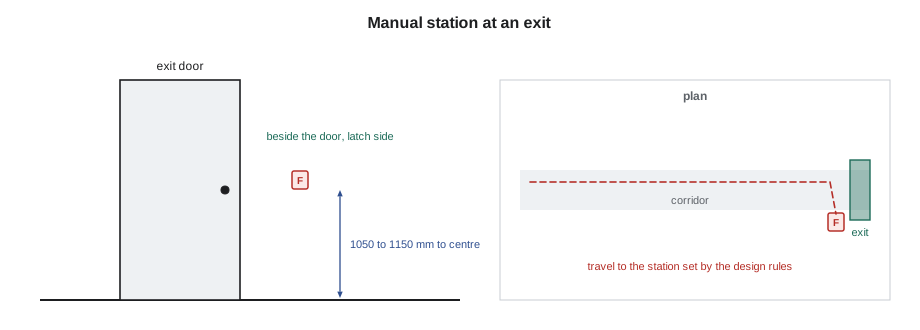
CAN/ULC-S524 and the National Building Code set where manual stations are located: near every required exit from each floor area, in the path of travel, so people leaving pass them, and at other locations the code or the authority requires. The station is mounted on the wall beside the exit door, on the latch side where practical, and clearly visible, not hidden behind an open door, a display or furniture. Where an exit is through a wide opening, stations are needed at both sides. Large floor areas may need additional stations so that no one has an unreasonable distance to travel to reach one, and the designer applies the standard's rules for the occupancy.
Height matters because a station must be reachable by everyone, including people in wheelchairs, and the standard sets a mounting range. The current edition of CAN/ULC-S524 sets the centre of the station between 1050 and 1150 mm above the finished floor, lower than the range of earlier editions, which was 1200 to 1400 mm, to suit accessibility requirements. Existing stations installed under earlier editions don't have to be moved unless they are replaced or the authority requires it, but every new or relocated station follows the current range.
# Manual station layout check for one floor (CAN/ULC-S524 heights; Bramwell rule: beside the door, within 1.5 m)
height_range = (1050, 1150)        # allowed mounting height (mm)
max_from_exit = 1.5      # maximum distance from the exit door (m), if the standard sets one
stations = [  # name, height (mm), distance from the exit door (m), longest travel to it (m)
    ("Exit 1 (main doors)", 1100, 0.4, 25),
    ("Exit 2 (gym corridor)", 1350, 0.3, 30),
    ("Exit 3 (east stair)", 1100, 0.5, 40),
    ("Exit 4 (library)", 1120, 2.4, 22),
]
max_travel = None           # longest allowed travel to a station (m), or None if the design rules differ
for name, h, d, travel in stations:
    notes = []
    if not (height_range[0] <= h <= height_range[1]):
        notes.append("height outside range")
    if max_from_exit is not None and d > max_from_exit:
        notes.append("too far from the exit")
    if max_travel is not None and travel > max_travel:
        notes.append("travel too long: add a station")
print(f"{name:24s} {'ok' if not notes else '; '.join(notes)}")Exit 1 (main doors) ok Exit 2 (gym corridor) height outside range Exit 3 (east stair) ok Exit 4 (library) too far from the exit
At Willowbank, the gym corridor station turns out to be one installed years ago at the old height. When it is relocated, it must meet the current range. The library station is too far from its exit door: it was mounted where a bookcase now blocks the wall beside the door, so it was put around the corner, where people leaving would not pass it.
Reducing false pulls
Malicious and accidental pulls are a real cost: fire department responses, lost class time, and the danger that people stop taking alarms seriously. Several measures help without making the station harder to use in a real fire. Clear protective covers, listed for use with the station, fit over it and must be lifted before the station can be operated; many sound a loud local horn when lifted, which startles the person and draws attention, and most false pulls stop there. Dual-action stations add a second motion. Stations that mark the hand with dye when pulled, or cameras covering the area, are used in some schools as deterrents. Placing a station so it isn't where people lean, line up or play also helps, as long as it stays in the required location.
What may not be done is just as important. A station may not be removed, covered with an unlisted box, locked except where keyed stations are permitted, or relocated away from the exit to make it less tempting. Any cover must be listed for use with that station, must not prevent operation, and must be clearly marked. The authority having jurisdiction and the owner must agree to covers in occupancies such as schools, and the fire safety plan should explain them.
| Measure | Effect | Notes |
|---|---|---|
| Clear cover with local horn | Stops most malicious pulls when the horn sounds | Must be listed with the station |
| Dual-action station | Cuts accidental operation | Common in schools and public buildings |
| Location within the allowed zone | Moves the station away from lineups | Must stay near the exit |
| Keyed station | Only staff can operate | Only where permitted, with staff present |
| Education and signs | Students and staff know the cost of false alarms | Supports, not replaces, the hardware |
Installation details
Stations are installed on a listed back box or surface box as the manufacturer specifies, with the wiring protected, and labelled at the panel with their exact location. They are mounted on a wall that won't be moved or blocked by furniture and doors; a station behind an open door is a common deficiency. Outdoors, a weatherproof back box and gasket are used. In a hazardous location, an explosion-proof station listed for the area classification is required. Where a station has a local horn cover, the cover's battery must be replaced on schedule, and the inspection checks it.
Every station is tested at installation and periodically by operating it, normally with the reset key or tool to open it and operate the switch, rather than pulling the handle in a way that breaks a glass rod or marks someone with dye. The test confirms that the panel receives the alarm from that address or zone, and that the station resets properly. FAT-230 covers test frequencies.
Worked problem
Fixing the Willowbank lunchtime pulls
The gym corridor station has been pulled four times at lunch. It sits 1350 mm high, beside the corridor's exit door, where students line up. What should Bramwell recommend?
Show solution
- The station must stay at that exit, but its height is outside the current range, so relocating it to the correct height is required anyway.
- Within the area beside the door, it can be moved a little toward the hinge side, out of the lineup but still visible and beside the exit.
- A listed clear cover with a local horn will stop most pulls when the horn startles the student and draws staff attention.
- The school can change where students line up, and include false alarms in assemblies on safety.
Answer: The principal agrees to all four measures. Over the following term, the horn on the cover sounds twice at lunch, and the fire alarm doesn't sound once.
Manual stations in special occupancies
Some occupancies need special arrangements. In hospitals and care homes, stations are still placed at exits, but staff, not patients, are expected to use them, and the fire safety plan trains staff to pull the nearest station and then follow the protect-in-place procedure. In detention facilities, stations are often keyed and located in staff areas, with staff present at all times. In buildings where the fire alarm also serves as an emergency communication system, a station may be paired with a separate mass notification station, coloured differently, so people don't use the wrong one. In large assembly spaces such as arenas, stations are placed at the exits from the seating and the concourse. In each case, the designer works from the code's requirement and the authority's acceptance, and the variations are recorded in the fire safety plan so the building's staff know what to expect.
Outdoors and in industrial plants, stations need protection from weather and damage. Weatherproof stations have gaskets and drain holes and are mounted on weatherproof boxes; explosion-proof stations in hazardous locations are part of a listed assembly with sealed conduit fittings, and their installation follows the electrical code's rules for those locations. In parking garages, stations near exits are often fitted with protective guards against vehicle damage, as long as the guards don't block access. Stations on outdoor loading docks at Cartwright are weatherproof and wired through input modules inside the building, so moisture in the station can't affect the loop.
A station that is pulled is evidence. Fire investigators and the fire department want to know which station started the alarm, so after an alarm the station is left in its operated position until the responders have seen it, and only then reset and recorded. Addressable systems record the time and address; on conventional systems, the operated station is found by walking the zone. Gerry tells Sasha never to reset a pulled station on arrival at a call: the record is part of the response.
Finally, stations are part of the building's look, and architects sometimes ask for them to be painted, recessed into millwork or covered with decorative panels. A station must stay its listed colour and be clearly identifiable, so painting it is not allowed, and any recessing or surround must be part of its listing or approved by the authority. Raising this early, at the design stage, saves an argument with the interior designer on site.
Common mistakes
MistakeMoving a station away from the exit to make it less tempting.
InsteadIt must stay near the exit, in the path of travel.
MistakeCovering a station with an unlisted box or locking it.
InsteadUse only listed covers; key-only stations are allowed only where permitted.
MistakeMounting a new station at an old height.
InsteadNew and relocated stations follow the current height range.
MistakeInstalling a station behind a door that swings open over it.
InsteadMount it where it stays visible and unobstructed.
MistakeTesting by pulling the handle and breaking the glass rod.
InsteadOpen the station with its key or tool and operate the switch.
Summary and key terms
- Manual stations let a person start the alarm, and are placed at exits so people pass them on the way out.
- Single-action and dual-action stations, keyed stations, weatherproof and explosion-proof types exist for different places.
- CAN/ULC-S524 now sets the station's centre between 1050 and 1150 mm above the floor.
- Listed covers with local horns, dual-action stations and careful siting reduce false pulls.
- Stations may not be removed, locked or moved away from exits to stop false alarms.
- Test stations with their reset key or tool and confirm the signal at the panel.
- Manual station
- A device a person operates to start a fire alarm.
- Dual-action station
- A station needing two separate motions to operate.
- Keyed station
- A station that can be operated only with a key, used where permitted.
- Protective cover
- A listed clear cover over a station, often with a local horn.
- Travel distance
- The distance a person walks along the path of travel to reach a station.
- Reset key
- The key or tool used to open, test and reset a station.
Practice problems
Work each problem on paper first, then reveal the answer to check.
A new station is mounted with its centre at 1200 mm. Does it meet the current CAN/ULC-S524 range?
Show answer
No: the range is 1050 to 1150 mm.
A wide exit opening has stations on one side only. What is the usual fix?
Show answer
Add a station on the other side, as the standard requires for wide openings.
Name two measures that reduce false pulls without removing the station.
Show answer
A listed cover with a local horn and a dual-action station (also careful siting, education).
Why are stations placed at exits rather than in the middle of floors?
Show answer
People pass them on the way out and aren't sent deeper into the building.
Lesson quiz · 5 questions
Score 60% or more to complete this lesson.
Create a free account to save your progress, take quizzes and earn a certificate.