
FAT-120 · Lesson 1 of 12 · 19 min
Initiating devices and how they report
Sasha's second term at Bramwell Fire Protection starts in the stockroom. Gerry Tremaine has her pull one of everything off the shelves and lay it on the bench: a photoelectric smoke detector and its base, an addressable heat detector, a conventional heat detector with a fusible element, a duct detector housing with its sampling tube, a dual-action pull station, a waterflow switch with its paddle, a valve tamper switch, a horn-strobe, a ceiling speaker-strobe and a small addressable input module. 'Every one of these is either telling the panel something or telling people something,' he says. 'This term you learn what each one senses, how it reports, where it goes and why. Get the placement wrong and the best panel in the world is listening to a device that will never see the fire.' FAT-110 introduced the families of devices. This course takes each one in depth, starting with the question every initiating device answers: how does the panel find out?
What an initiating device does
An initiating device is any device that sends a signal into the fire alarm system when it detects a condition or when a person operates it. Automatic initiating devices sense a physical effect of fire: smoke particles, heat, radiation from flames, carbon monoxide or the movement of water in a sprinkler pipe. Manual initiating devices respond to a person: a pull station, or in some systems a key switch. Supervisory initiating devices watch the fire protection systems themselves: a valve tamper switch, a low-air switch on a dry-pipe system, a fire pump running signal. The panel treats these signals differently. An alarm signal starts the building's fire response. A supervisory signal tells staff and the monitoring station that a protection feature is off-normal and needs attention. A trouble signal means the system itself has a fault, such as an open circuit, a missing device or a failed power supply.
Every initiating device has three parts that matter to a technician: the sensing element, which decides when the condition is present; the output, which is how it tells the panel; and the listing, which says what it was tested to do and how it must be installed. A smoke detector that is listed for duct air speeds of 0.5 to 20 m/s (100 to 4,000 ft/min) and installed in a duct running faster than that is not a working smoke detector, however clean its chamber is. A heat detector listed at a 9.1 m (30 ft) spacing does not protect a room spaced at 15 m (50 ft). The installation instructions and the listing are part of the device.
Product standards and listings
In Canada, each type of initiating device is tested to its own ULC product standard: CAN/ULC-S529 for smoke detectors used with fire alarm systems, CAN/ULC-S530 for heat detectors, CAN/ULC-S528 for manual stations and CAN/ULC-S531 for smoke alarms, which are the self-contained devices installed in dwelling units. A device must be listed by a recognized certification body for use in Canada, and its listing mark tells the inspector that it was tested to the Canadian standard. CAN/ULC-S524 then says how the listed devices are installed: where they go, how far apart, at what height, and how they are wired. The National Building Code says where they are required.
The distinction between a smoke detector and a smoke alarm matters on the job. A smoke detector is a sensor that reports to a fire alarm control unit; it doesn't sound by itself, apart from an optional sounder base. A smoke alarm is a complete device with its own sensor, sounder and usually a battery, installed in a home or a suite, and it is normally not part of the building's fire alarm system. At Riverlight Tower, each suite has smoke alarms that wake the people in that suite, while the building's smoke detectors in the corridors report to the panel. Mixing the two up, such as wiring a smoke alarm into a fire alarm circuit, is a common mistake on renovation jobs.
Contact devices on conventional circuits
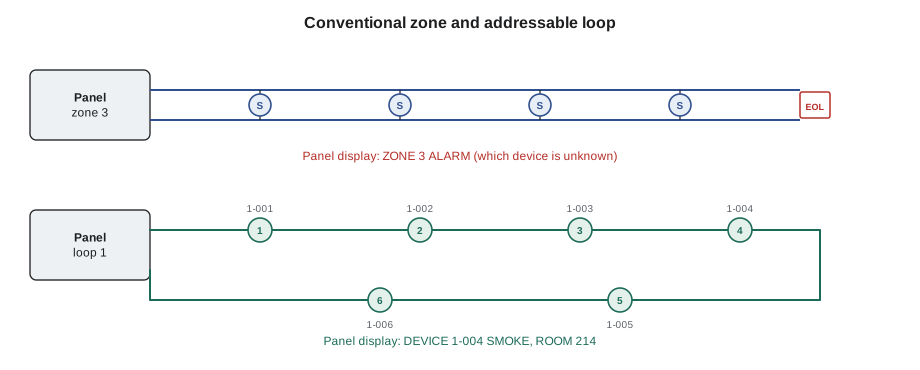
A conventional initiating device reports by changing the electrical state of the circuit it is on. Most are simply a set of contacts that close when the device operates. The panel sends a small supervisory current through the initiating circuit and an end-of-line resistor at the far end, and measures the current. In the normal state, the current is set by the end-of-line resistor. When a device closes its contacts, it puts a much lower resistance across the circuit, the current rises, and the panel sees an alarm. If a wire breaks, the current falls to almost nothing, and the panel sees a trouble. A short across the circuit can be reported as an alarm or a trouble, depending on the panel and the circuit class.
Two-wire smoke detectors are a special case, because they need power to work and get it from the same two wires that carry the signal. In the normal state, each detector draws a small standby current. When it alarms, it switches in a current-limiting element and draws an alarm current, which the panel reads as an alarm. This is why a panel's data sheet lists which two-wire detectors are compatible with it, and how many may be on one circuit: too many detectors' standby current looks like an alarm, and an incompatible detector may never pull enough current to alarm.
# Conventional initiating circuit: what the panel sees in each state (illustrative values)
V = 24.0                 # circuit voltage
R_eol = 3900.0            # end-of-line resistor (ohms)
R_wire = 12.0            # loop wire resistance (ohms)
I_det = 0.00006          # standby current of each two-wire smoke detector (A)
n_det = 20              # detectors on the circuit
R_alarm = 470.0          # resistance a device in alarm puts across the circuit (ohms)

i_normal = V / (R_eol + R_wire) + n_det * I_det
i_alarm = V / (R_alarm + R_wire)
i_open = n_det * I_det / 2      # half the detectors still connected, beyond a break nobody is
print(f"normal : {i_normal * 1000:6.2f} mA")
print(f"alarm  : {i_alarm * 1000:6.2f} mA")
print(f"open   : {i_open * 1000:6.2f} mA")
# A panel with bands such as: below 2 mA = trouble, 2 to 15 mA = normal, above 15 mA = alarm
for state, i in (("normal", i_normal), ("alarm", i_alarm), ("open", i_open)):
    ma = i * 1000
    seen = "trouble" if ma < 2 else ("alarm" if ma > 15 else "normal")
print(f"{state:7s} -> panel reads {seen}")normal : 7.33 mA alarm : 49.79 mA open : 0.60 mA normal -> panel reads normal alarm -> panel reads alarm open -> panel reads trouble
The output shows why the end-of-line resistor matters. Without it, the panel couldn't tell a healthy circuit from a broken one, because both would carry almost no current. The bands in the script are illustrative; each panel has its own values and its own list of compatible detectors and resistor values, and the installer uses the ones in the panel's installation manual.
Addressable devices
An addressable device has its own electronics and an address, set by switches, a programming tool or automatically by the panel. The panel polls each address in turn on the signalling line circuit, and each device replies with its status: normal, alarm, trouble, or for an analog detector, the actual reading from its sensor. Because each device reports individually, the panel can say exactly which device is in alarm and where it is, can detect a single missing or failed device, and can apply different programming to different devices. An analog addressable smoke detector sends its chamber reading, and the panel decides when that reading is high enough for an alarm, compensates for slow drift as the detector gets dirty, and warns when compensation has run out.
Devices that aren't addressable themselves, such as a waterflow switch, a tamper switch or a conventional heat detector, are connected to the signalling line circuit through an input module, sometimes called a monitor module. The module watches the contacts of the device, through its own short supervised circuit with an end-of-line resistor, and reports their state at its address. Output modules, called control or relay modules, work the other way, letting the panel operate a door holder, fan shutdown relay or other output. At Tamarind House, each sprinkler floor control valve has a tamper switch and a waterflow switch, each on its own input module, so the panel can report 'Floor 4 waterflow' or 'Floor 4 valve tamper' separately.
| Signal source | Typical device | Panel response |
|---|---|---|
| Automatic alarm | Smoke, heat, flame or multi-criteria detector | Alarm: notification, control functions, monitoring |
| Manual alarm | Pull station | Alarm, same as automatic |
| Waterflow | Vane or pressure switch on sprinkler piping | Alarm, after a retard delay |
| Supervisory | Valve tamper, low air, low temperature, fire pump | Supervisory signal, no evacuation |
| Trouble | Open or short circuit, missing device, power fault | Trouble signal to staff and monitoring |
Alarm verification and other ways of confirming
Nuisance alarms are the biggest threat to people's trust in fire alarm systems, and several features help a system confirm a signal before sounding. Alarm verification applies to smoke detectors: when one reports, the panel resets it and waits a short period, and sounds the general alarm only if the detector reports again within a confirmation window, or if another device reports. The total delay is limited, typically to about a minute, so a real fire is not delayed much. Positive alarm sequence, used where staff are always present, gives trained staff a short time to acknowledge and investigate before the general alarm sounds. Cross-zoning, used mainly for releasing suppression systems, waits for two separate detectors before acting. Each of these is permitted only in certain places and must be approved and recorded in the sequence of operation.
Two-stage systems, common in Canadian hospitals and some large buildings, use a different approach: an alert signal sounds first, telling staff to investigate, and the general alarm follows after a set time or when staff, a second device or a manual station escalates it. Eastview General Hospital uses this arrangement with its protect-in-place strategy. The first stage is still an alarm signal, not a supervisory one; it simply starts a staged response.
Device status lights and test features
Most detectors have an LED that shows their state. Conventional detectors often flash in normal standby and light steadily in alarm; addressable ones may flash when polled and light steadily or change colour in alarm. Many detectors have a magnet test switch, a test button reached through the housing, or a way to be tested with listed test aerosol or a smoke generator. Some addressable detectors can be put in alarm from the panel for testing. These features help with installation checks and inspections, which FAT-230 covers in detail. Gerry's rule for new technicians is that the LED tells you what the device thinks; only the panel tells you what the system thinks, so always confirm at the panel.
Worked problem
Reading an addressable alarm
During a fire drill at Tamarind House, the panel shows: 'ALARM 2-031 SMOKE DET 4TH FL ELEV LOBBY'. A minute later it shows 'TROUBLE 2-032 INPUT MOD 4TH FL WATERFLOW, DEVICE MISSING'. What happened, and what should Sasha check?
Show solution
- The first line is an alarm from smoke detector 31 on loop 2, in the fourth-floor elevator lobby: the drill device.
- The second line is a trouble, not an alarm: the panel lost communication with input module 32 on the same loop.
- A 'device missing' trouble means the module isn't answering its poll: a loose connection, a damaged module or a wiring fault.
- Because the module serves the fourth-floor waterflow switch, a real waterflow on that floor would not be reported while the trouble lasts.
Answer: Sasha checks the module first, in the ceiling near the floor control valve, and finds a contractor has pulled its cover loose while installing a light. She reseats it, the trouble clears, and she records the impairment time in the log.
Common mistakes
MistakeTreating a smoke alarm and a smoke detector as the same device.
InsteadSmoke alarms are self-contained; smoke detectors report to a panel.
MistakeLeaving out or moving the end-of-line resistor on a conventional circuit.
InsteadIt must be at the far end, so the panel supervises the whole circuit.
MistakeMixing two-wire detectors not listed as compatible with the panel.
InsteadUse only the detectors and quantities the panel's documents list.
MistakeWiring a tamper switch so it sends an alarm.
InsteadValve tamper switches send supervisory signals.
MistakeTrusting a device LED instead of the panel.
InsteadConfirm every test result at the panel.
Summary and key terms
- Initiating devices send alarm, supervisory or trouble information to the control unit.
- Product standards (CAN/ULC-S529, S530, S528, S531) test the devices; CAN/ULC-S524 sets installation; the NBC says where they are required.
- Conventional devices change the current on a supervised circuit with an end-of-line resistor.
- Addressable devices report individually by address; analog detectors send their readings.
- Input modules connect contact devices to addressable loops; output modules operate other systems.
- Alarm verification, positive alarm sequence, cross-zoning and staged alarms confirm signals where permitted.
- Initiating device
- A device that sends a signal to the fire alarm system when it detects a condition or is operated.
- End-of-line resistor
- A resistor at the end of a conventional circuit that lets the panel supervise the wiring.
- Addressable device
- A device with its own address that reports its status individually to the panel.
- Input module
- An addressable module that monitors the contacts of a non-addressable device.
- Alarm verification
- A feature that confirms a smoke detector signal before sounding the general alarm.
- Smoke alarm
- A self-contained smoke-sensing device with its own sounder, used in dwelling units.
Practice problems
Work each problem on paper first, then reveal the answer to check.
A conventional circuit has a 3,900-ohm end-of-line resistor and 12 ohms of wire. About what current flows at 24 V, ignoring the detectors?
Show answer
24 / 3,912 = about 6.1 mA.
Which signal should a dry-pipe low-air switch send?
Show answer
A supervisory signal.
Why does an addressable panel report a 'device missing' trouble?
Show answer
A device stopped answering its poll.
Name two ways a system can confirm a smoke detector signal before sounding a general alarm.
Show answer
Alarm verification and positive alarm sequence (also cross-zoning or a staged alarm, where permitted).
Lesson quiz · 5 questions
Score 60% or more to complete this lesson.
Create a free account to save your progress, take quizzes and earn a certificate.