
FAT-110 · Lesson 8 of 12 · 20 min
Sprinklers, standpipes and suppression systems
The sprinkler room at the Cartwright Distribution Centre is a concrete room off the loading dock, with a 150 mm (6 in) water main coming up through the floor into a tall red riser covered in valves, gauges and switches. Gerry brings Sasha here before they test any detector in the building, because in this warehouse the sprinklers do most of the fire protection, and the fire alarm system's most important job is to watch them. The two systems are designed, installed and maintained by different trades, under different standards, but they meet at a handful of switches on that riser, and if the fire alarm technician doesn't understand what each one means, the alarm system can't do its part. This lesson explains how sprinkler systems work, the main types, the devices the fire alarm system monitors, standpipes and fire pumps, and special suppression systems that the alarm system may release.
How a sprinkler works
A sprinkler system is a network of pipes filled with water, or with air that is replaced by water when needed, and sprinkler heads spaced across the ceiling. Each sprinkler is closed by a heat-sensitive element: usually a small glass bulb filled with liquid, or a fusible metal link. When the hot gas from a fire heats the element to its rated temperature, the bulb shatters or the link melts, the cap falls away, and water sprays onto a deflector that spreads it over the area below. Only the sprinklers heated by the fire open; in most fires, one or two sprinklers control or put out the fire. The scenes in films where every sprinkler in a building goes off at once are not how ordinary sprinkler systems work.
Sprinkler elements are rated by temperature and by how quickly they respond. Ordinary-temperature sprinklers, the most common, operate at about 57 to 77 °C (135 to 170 °F); the bulb's colour shows the rating, red for about 68 °C (155 °F). Higher ratings are used near heat sources and under hot roofs. Quick-response sprinklers have thin bulbs or light links with a low response time index, the same RTI described in Lesson 3, and open sooner in a growing fire; they are required in light-hazard areas such as offices, apartments and hospitals, where getting water on the fire early saves lives. Standard-response sprinklers have a higher RTI and are used in many industrial and storage areas.
The equation describes how the element temperature T_e follows the gas temperature T_g around it, at a speed set by the gas velocity u and the RTI. Combined with the t-squared fire and Alpert's ceiling-jet formulas, it shows how much sooner a quick-response sprinkler opens. The script below runs that model for a medium fire with a sprinkler 2.1 m (7 ft) from the fire's centre.
# When does a sprinkler open? t-squared fire, Alpert ceiling jet, RTI element model (illustrative)
import math
def jet(q, H, r):
    dT = 16.9 * q ** (2 / 3) / H ** (5 / 3) if r <= 0.18 * H else 5.38 * (q / r) ** (2 / 3) / H
    u = 0.96 * (q / H) ** (1 / 3) if r <= 0.15 * H else 0.195 * q ** (1 / 3) * H ** 0.5 / r ** (5 / 6)
    return dT, u
def opens(alpha, H, r, rti, t_act, t0=20.0, dt=0.5):
    te, t = t0, 0.0
    while t < 1200:
        t += dt
        q = alpha * t * t
        dT, u = jet(q, H, r)
        te += math.sqrt(u) / rti * (t0 + dT - te) * dt
        if te >= t_act:
            return t, q
alpha = 0.01172                                   # medium t-squared fire, kW/s2
for label, rti in (("standard response", 100), ("quick response", 50)):   # RTI in (m s)^0.5
    for h in (3, 6):                         # ceiling height (m)
        t, q = opens(alpha, h * 1, 2.1 * 1, rti, 68.0)
print(f"{label:17s} ceiling {h:>2} m: opens at {t:4.0f} s, fire about {q:5.0f} kW")standard response ceiling 3 m: opens at 232 s, fire about 634 kW standard response ceiling 6 m: opens at 326 s, fire about 1246 kW quick response ceiling 3 m: opens at 200 s, fire about 469 kW quick response ceiling 6 m: opens at 296 s, fire about 1027 kW
The quick-response sprinkler opens about half a minute sooner, when the fire is noticeably smaller, and the higher ceiling delays both. Those seconds are why the warehouse's high roof uses special large-drop or early-suppression sprinklers designed for storage fires, and why offices use quick-response heads.
Types of sprinkler systems
A wet-pipe system, the most common type, keeps its pipes full of water under pressure. When a sprinkler opens, water flows at once. Wet systems are simple and reliable, but they can't be used where the pipes might freeze, such as unheated loading docks and parking garages in a Saskatoon winter.
A dry-pipe system keeps its pipes filled with compressed air or nitrogen, which holds a dry-pipe valve closed. When a sprinkler opens, the air escapes, the pressure drops, the valve trips, and water fills the pipes and flows from the open sprinkler. There is a delay while the water travels, so codes limit the size of dry systems. The fire alarm system monitors the air pressure: a low-air switch sends a supervisory signal if pressure drops, which might mean a leak or a failing compressor, and it must be fixed before the valve trips by itself.
A pre-action system also keeps its pipes dry, but its valve opens only when a separate detection system, usually the fire alarm system's detectors, signals a fire. Single-interlock systems fill the pipes on detection and discharge when a sprinkler opens; double-interlock systems need both detection and a sprinkler opening. Pre-action systems protect spaces where accidental water discharge would be very costly, such as data rooms, archives and museums, and in freezers. A deluge system has open sprinklers or nozzles and a valve opened by detection; when it opens, water flows from every head at once. Deluge systems protect high-hazard areas such as aircraft hangars, transformer yards and some industrial processes. Pre-action and deluge valves are often controlled by a releasing panel, a fire alarm control unit listed for releasing service.
What the fire alarm system watches
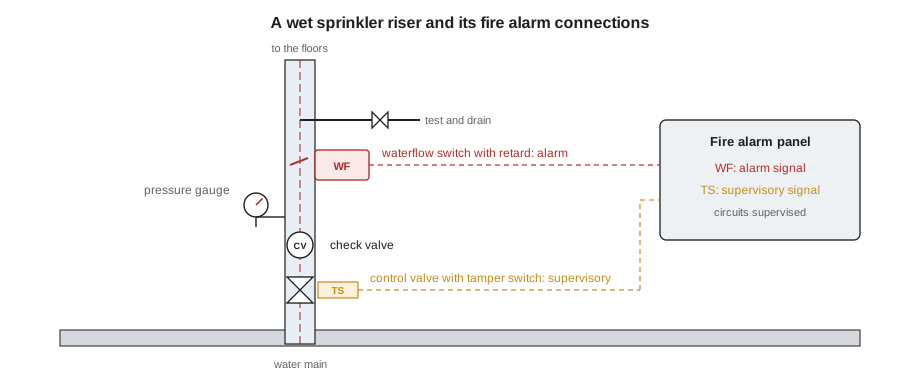
On a wet riser, the waterflow switch is the key device. A thin flexible paddle, or vane, sits inside the pipe; when water moves through the pipe, it pushes the paddle, which operates a switch. Because water pressure in a city main surges, the paddle might twitch without a real flow, so the switch has an adjustable retard, a delay of up to about 90 seconds, so that only a sustained flow sends an alarm. Some systems use a pressure switch on an alarm check valve instead. A waterflow alarm is an alarm signal: it sounds the building's evacuation signals and is transmitted to the monitoring station, because water flowing means a sprinkler has opened and there is very likely a fire.
Every control valve that could shut off water to sprinklers has a tamper switch, also called a valve supervisory switch. Outside screw and yoke valves have a switch that senses the stem moving; butterfly valves have the switch built in; post indicator valves in the yard have a switch on the post. If anyone starts to close a valve, the switch sends a supervisory signal within a short movement, typically before the valve is a fifth closed or within two turns of the handwheel. A closed sprinkler valve is one of the most common reasons sprinklers fail in real fires, so the supervisory signal must be answered: someone checks the valve, finds out why it moved, and restores it or records the impairment.
| Device | What it senses | Signal type |
|---|---|---|
| Waterflow switch (vane) or pressure switch | Sustained water flow in the sprinkler pipe | Alarm |
| Valve tamper switch | A control valve moved from fully open | Supervisory |
| Low-air switch (dry or pre-action) | Air pressure in dry pipes below normal | Supervisory |
| Fire pump running | The fire pump has started | Supervisory or alarm, per the design |
| Fire pump trouble (power loss, phase reversal) | A fault in the pump controller's power | Supervisory or trouble |
| Low temperature switch | A room with water-filled pipes getting too cold | Supervisory |
Waterflow alarms are often the only automatic initiating devices in a sprinklered warehouse like Cartwright, because ceiling smoke detectors would be useless under a high, cold roof. The building is still protected: if a fire starts, the sprinklers operate, the waterflow switch sends an alarm, the building evacuates, and the fire department is called. The fire alarm system turns the sprinkler system into a detection system too.
Fire department connections, standpipes and fire pumps
A fire department connection is a set of hose inlets on the outside of the building, usually near the main entrance, through which a fire engine can pump water into the sprinkler or standpipe system to boost its pressure and supply. Standpipes are vertical pipes with hose valves at each floor, normally in the stairs, that let firefighters connect hoses inside the building instead of dragging them up from the street. Riverlight Tower and Tamarind House both have standpipes. Some standpipes are kept full of water and some are dry until the fire department fills them.
Where the city water pressure is not enough for the sprinklers or standpipes in a tall building or a large warehouse, a fire pump boosts it. Fire pumps are driven by electric motors or diesel engines, and their controllers report several conditions to the fire alarm system: pump running, loss of power or a phase, phase reversal, and, for diesel pumps, engine trouble and low fuel. Riverlight Tower has an electric fire pump in its basement; when Gerry tests the alarm system there, he confirms with the sprinkler contractor that each of the pump controller's signals reaches the panel and is labelled correctly.
Special suppression systems
Some spaces are protected by suppression systems that don't use water sprinklers. Clean agent systems flood a room with a gas that puts out the fire without leaving residue, protecting server rooms, telecommunications rooms and archives. Carbon dioxide systems are used in unoccupied industrial spaces because CO2 at extinguishing concentrations is deadly to people. Wet chemical systems in commercial kitchen hoods spray a liquid that cools and smothers cooking oil fires. Dry chemical and foam systems protect other special hazards.
The fire alarm system's role varies. For a clean agent system, a releasing panel usually controls the release: it waits for two detectors in the room, a cross-zoned arrangement that reduces false discharges, sounds a pre-discharge warning so people can leave, counts down, closes dampers and shuts down air handlers, and then releases the agent. An abort switch lets someone pause the countdown, and a manual release lets someone fire it at once. For a kitchen hood system, the hood system's own detectors and mechanical controls release the agent; the fire alarm system receives a signal that the hood system has discharged and sounds the building alarm, and shuts off the fuel to the cooking appliances if the design calls for it. Testing these systems requires coordination with the suppression contractor and great care: a technician must never accidentally discharge an agent.
Who does what
The sprinkler system is designed, installed and maintained by sprinkler fitters and fire protection contractors, under NFPA 13 for installation, as referenced by the building code, and NFPA 25 for inspection, testing and maintenance, as referenced by the fire code. The fire alarm technician installs, programs and tests the monitoring devices' connection to the panel, but does not adjust valves, drain the system or operate the sprinkler contractor's equipment unless trained and authorized. When a waterflow switch is tested, the sprinkler contractor usually opens the inspector's test connection, a valve that releases the same flow as one sprinkler, and the fire alarm technician times how long the alarm takes to arrive at the panel.
# Waterflow test log: time from opening the inspector's test valve to the alarm at the panel
tests = [("Riser 1 (office)", 42), ("Riser 2 (warehouse north)", 71), ("Riser 3 (warehouse south)", 104), ("Dock dry system", 55)]
LIMIT = 90   # seconds; the alarm must arrive within this time of flow starting (check the standard in use)
for riser, seconds in tests:
    status = "pass" if seconds <= LIMIT else "FAIL - adjust the retard or check the switch"
print(f"{riser:28s} {seconds:4d} s {status}")Riser 1 (office) 42 s pass Riser 2 (warehouse north) 71 s pass Riser 3 (warehouse south) 104 s FAIL - adjust the retard or check the switch Dock dry system 55 s pass
Riser 3's switch took too long, so Gerry asks the sprinkler fitter to check the retard setting and the paddle. Often the retard has been turned to maximum to stop nuisance alarms from pressure surges, which hides the real problem of a surging supply. The fix is coordinated between the two trades, retested, and recorded by both.
Worked problem
A supervisory signal on a Friday afternoon
At 4:40 on a Friday, Cartwright's panel shows 'Supervisory: Valve tamper, Riser 2 control valve'. The warehouse manager wants to silence it and deal with it Monday. What should happen?
Show solution
- A tamper signal means the valve that supplies part of the warehouse's sprinklers may be partly or fully closed, leaving that area unprotected.
- Someone must go to the riser now and look at the valve. If a contractor closed it for work, the work and the impairment must be recorded and the fire department and insurer notified as the fire code and the owner's procedures require.
- If nobody knows why it moved, the valve is reopened fully, the switch restores, and the event is recorded and investigated.
- Silencing the buzzer is allowed, but the condition stays on the panel and in the monitoring station's records until it clears.
Answer: The signal is answered the same day. A closed valve is a fire protection impairment, not a nuisance, and leaving it for the weekend would leave part of the warehouse without sprinkler protection.
Common mistakes
MistakeThinking every sprinkler in a building opens at once.
InsteadOnly sprinklers heated by the fire open, except in deluge systems.
MistakeTreating a waterflow alarm as a supervisory signal.
InsteadWaterflow means a sprinkler has likely opened; it is an alarm.
MistakeTurning the retard to maximum to stop surges.
InsteadKeep it within the allowed delay and fix the supply surges with the sprinkler contractor.
MistakeOperating sprinkler valves without authority.
InsteadValves belong to the sprinkler contractor and the owner; coordinate every test.
MistakeTesting a clean agent panel without isolating the release.
InsteadFollow the suppression contractor's procedure so the agent cannot discharge.
Summary and key terms
- Sprinklers open individually when their heat-sensitive element reaches its rated temperature.
- Quick-response sprinklers have a low RTI and open sooner; they protect light-hazard areas.
- Wet, dry-pipe, pre-action and deluge systems suit different spaces and hazards.
- Waterflow switches send alarm signals; valve tamper, low-air and pump switches send supervisory signals.
- Fire department connections, standpipes and fire pumps support firefighting and supply.
- Releasing panels control clean agent, pre-action and deluge systems; kitchen hood systems report discharge to the fire alarm.
- Sprinkler and fire alarm trades coordinate every test of the devices that join their systems.
- Wet-pipe system
- A sprinkler system with pipes full of water under pressure.
- Dry-pipe system
- A sprinkler system with pipes full of air that holds the water back until a sprinkler opens.
- Pre-action system
- A dry system whose valve opens on a signal from a detection system.
- Waterflow switch
- A device that detects sustained water flow in a sprinkler pipe and sends an alarm.
- Retard
- An adjustable delay on a waterflow switch that ignores brief pressure surges.
- Tamper switch
- A switch that sends a supervisory signal when a sprinkler control valve is moved.
- Standpipe
- A vertical pipe with hose valves on each floor for firefighters.
- Releasing panel
- A control unit listed to operate a suppression system.
Practice problems
Work each problem on paper first, then reveal the answer to check.
Which kind of signal does a waterflow switch send?
Show answer
An alarm signal.
Why do waterflow switches have a retard?
Show answer
To ignore brief pressure surges so only a sustained flow causes an alarm.
Which sprinkler system type suits an unheated loading dock?
Show answer
A dry-pipe system.
What does a cross-zoned clean agent system wait for before releasing?
Show answer
Two detectors in the protected space, then a countdown.
Lesson quiz · 5 questions
Score 60% or more to complete this lesson.
Create a free account to save your progress, take quizzes and earn a certificate.