
FAT-110 · Lesson 4 of 12 · 19 min
Why buildings need fire alarms: life safety and property protection
Every few months, someone asks Donna Achebe, Bramwell's service manager, why their building needs such an expensive system when nothing has ever caught fire there. Donna usually answers with a question of her own: how long would it take everyone in the building to get out if a fire started right now, and how long would they have? This lesson is about the answer. It explains what fire alarm systems are for, the difference between protecting people and protecting property, the time race between a fire and the people escaping it, why some buildings protect occupants in place instead of evacuating them, and why a system that people trust is as important as one that works.
Lessons written in fires
Most of the rules in fire codes were learned the hard way. In 1958, a fire at Our Lady of the Angels School in Chicago killed 92 children and 3 teaching sisters; the school had no automatic alarm, the fire smouldered unseen in a basement stairwell, and when smoke filled the upper corridor the classrooms were cut off. Schools across North America added fire alarms, drills and enclosed stairs in the years that followed. In 2003, a fire in The Station nightclub in Rhode Island killed 100 people within minutes when pyrotechnics ignited foam on the walls; it showed how quickly a fast fire overtakes a crowd. In 2014, a fire in a seniors' residence in L'Isle-Verte, Quebec, killed 32 people, many of whom needed help to move, and led to new requirements for sprinklers and staff in residences for older people. Each disaster pointed to the same gap: people did not learn about the fire early enough, or could not get out in the time they had.
Today, deaths in large buildings with working alarms and sprinklers are rare. Most fire deaths now happen in homes, often where a smoke alarm was missing or disabled. A technician who has heard these stories understands why the code takes things seriously that look minor on a work order, such as a disconnected battery, a bypassed zone or a smoke detector covered during painting and never uncovered.
What the system is for
Codes describe several objectives for fire protection, and fire alarm systems serve each of them. The first is life safety: giving occupants enough warning to escape or move to a safe place, and helping firefighters arrive and work. The second is property protection: limiting damage to the building and its contents by detecting fire early, calling the fire department and starting suppression. The third is mission continuity: keeping essential operations running, as in a hospital, a data centre or a telephone exchange. Some buildings add environmental protection, preventing a fire from releasing hazardous material.
The National Building Code of Canada is written as an objective-based code, with objectives for safety, health, accessibility and the fire and structural protection of buildings. Each requirement is linked to the objectives it supports, so a requirement for a fire alarm system is there because it reduces the risk that people will be exposed to a fire before they can escape, or that a fire will spread before it can be fought. Knowing the objective helps when a designer proposes an alternative solution: it has to achieve at least the same level of performance.
A system designed only for property protection can look very different from one designed for life safety. A warehouse protected by sprinklers might need only waterflow alarms and valve supervision to call the fire department; there is little need to wake sleeping people. A hotel needs smoke detection in corridors, smoke alarms in every room, and notification loud enough to wake guests behind closed doors. When owners ask why their system is the way it is, the answer is usually which objectives the code applies to their building.
The time race: available and required safe egress time
Fire engineers describe the race between a fire and the people escaping it with two times. The available safe egress time, or ASET, is how long it takes from ignition until conditions in a space become untenable: smoke too thick to see, heat too high or toxic gases too concentrated. The required safe egress time, or RSET, is how long people need to get out. For a building to be safe, RSET must be shorter than ASET, with a margin to spare.
RSET has four parts. Detection time runs from ignition to the moment a detector, a sprinkler or a person notices the fire. Alarm time runs from detection to the moment occupants are warned; in a single-stage system it is a few seconds, but in a two-stage system or one with alarm verification it can be minutes. Pre-movement time is the time people spend deciding to act: finishing a phone call, gathering belongings, looking for children or waiting to see if the alarm is real. It is often the longest part. Travel time is the time to walk to and through the exits, including queues at stairs and doors.
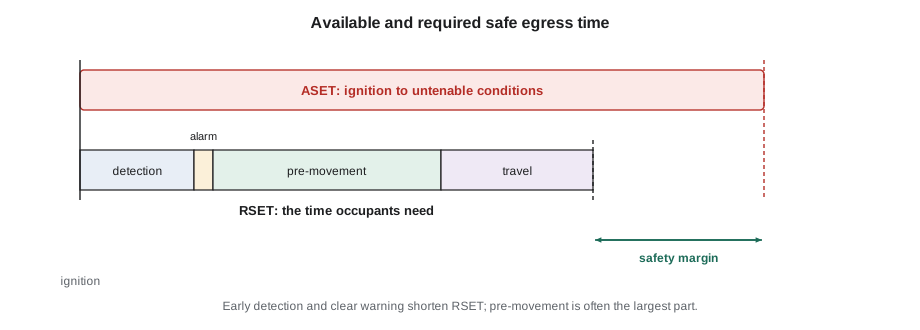
A fire alarm system shortens three of the four parts. Early detection cuts the detection time. Clear, loud, unmistakable notification cuts the alarm time and, just as important, the pre-movement time, because people respond faster to a signal they recognise and trust, and fastest of all to a clear voice message telling them what to do. Fire alarms don't change travel time directly, but by triggering door releases and keeping exit stairs clear of smoke they protect the routes people travel on.
# Rough RSET for one floor of an office building (illustrative values)
import math
area = 1200                        # floor area (m2)
load_factor = 9.3                   # floor area per person (m2 per person), a typical office value
people = math.floor(area / load_factor)
exit_width = 1.8                    # total clear width of the two stair doors (m)
flow = 60                          # people per m of width per minute, a common design value
travel_dist = 40                   # longest walking distance to a stair (m)
walk_speed = 1.2                    # m per second
t_det, t_alarm, t_pre = 60, 10, 120  # seconds
t_walk = travel_dist / walk_speed
t_queue = people / (flow * exit_width) * 60
t_travel = max(t_walk, t_queue)
rset = t_det + t_alarm + t_pre + t_travel
print(f"Occupants: {people}")
print(f"Walking time {t_walk:.0f} s, queue time at the stairs {t_queue:.0f} s -> travel {t_travel:.0f} s")
print(f"RSET = {t_det} + {t_alarm} + {t_pre} + {t_travel:.0f} = {rset:.0f} s")
for aset in (300, 420):
print(f"ASET {aset} s -> margin {aset - rset:.0f} s")Occupants: 129 Walking time 33 s, queue time at the stairs 72 s -> travel 72 s RSET = 60 + 10 + 120 + 72 = 262 s ASET 300 s -> margin 38 s ASET 420 s -> margin 158 s
The result for one floor of Tamarind House shows that pre-movement is the largest part, and that the margin depends heavily on how fast the fire grows. If the alarm system took a further two minutes to warn people, as it might if it relied on a person finding the fire and pulling a station, the margin against the faster fire would disappear. Real designs use more careful methods, but this rough calculation shows what an alarm system is buying: minutes.
Evacuate, relocate or protect in place
Not every building can, or should, empty all at once when the alarm sounds. In most low buildings, total evacuation is the plan: everyone leaves at the first alarm. In tall buildings, sending everyone into the stairs at once would cause crowding and slow the people who are in the most danger, so many high-rises use staged or phased evacuation: the fire floor and the floors next to it evacuate first, while others are alerted and wait for instructions, often given by voice. Two-stage systems, common in some Canadian buildings, sound an alert signal throughout the building and an alarm signal only where evacuation is needed, as Lesson 5 explains.
Hospitals, care homes and similar buildings use a defend-in-place or protect-in-place strategy. Patients on life support, in surgery or unable to walk cannot be moved quickly, and moving them can be more dangerous than the fire. The building is divided into compartments by fire and smoke separations, staff move patients horizontally to the next compartment, and the fire alarm system releases doors, closes smoke dampers, and alerts staff with coded signals or voice messages instead of loud evacuation signals throughout. At Eastview General Hospital, Sasha learns that an alarm in one ward starts a precise sequence of actions that keep the rest of the building working normally while the staff respond.
Property protection and the fire department
Once people are safe, the fire alarm's next job is to get the fire department to the fire quickly and to start suppression. Most systems send signals to a monitoring station that calls the fire department; the time saved compared with waiting for someone to phone can be several minutes. At the fire alarm control unit or an annunciator at the main entrance, arriving firefighters read where the alarm started and which devices have operated since, so they can go straight to the fire. In sprinklered buildings, a waterflow alarm tells them a sprinkler has opened and roughly where. The sooner they arrive and find the fire, the smaller it is.
Insurers care about the same things. A building with a monitored alarm and sprinklers is a much lower risk than one without, and many insurers require them or offer lower premiums for them. Insurers also want proof that the system is maintained, which is one reason the inspection reports that Gerry and Sasha write matter: an unmaintained system may be no better than none, and a claim after a fire may depend on whether the records show the system was kept in service.
Nuisance alarms and trust
A fire alarm system that cries wolf trains people to ignore it. If the alarm at Willowbank School went off every week because of burnt toast, staff would start waiting to see if it was real, and the pre-movement time in a real fire would grow. Unwanted alarms also send fire trucks on needless calls, cost owners money in many municipalities that charge for repeated false alarms, and tempt building staff to disconnect or bypass devices. Reducing nuisance alarms is part of life safety, not a convenience.
Most unwanted alarms come from a few causes: cooking, steam, dust and construction work near smoke detectors; aerosol sprays; malicious pulls of manual stations; and faulty or dirty devices. Technicians and designers reduce them by choosing the right detector for each space, keeping detectors clean and tested, covering detectors properly during construction work and uncovering them afterwards, using protective covers on manual stations where false pulls are common, and investigating every unwanted alarm to find and fix the cause rather than just resetting the panel.
Worked problem
Why a two-minute delay matters
The owner of a small office building asks Donna whether the building could rely on occupants pulling manual stations instead of having smoke detectors in the corridors, to save money. The design fire is medium growth. Using the t-squared model from Lesson 3, what is the difference in fire size between detection by a smoke detector at about 60 seconds and detection by a person noticing at about 180 seconds?
Show solution
- For a medium fire, alpha is about 0.01172 kW/s².
- At 60 s the fire is about 0.01172 x 60² = 42 kW, roughly a burning wastebasket.
- At 180 s it is about 0.01172 x 180² = 380 kW, the size of a fully burning chair.
- The later alarm means occupants start moving with a fire about nine times larger, smoke spreading in the corridor, and two minutes less margin.
Answer: Whether manual stations alone are allowed is decided by the code for that building, but the physics shows why codes require automatic detection in many occupancies.
Common mistakes
MistakeThinking a system that has never had a fire has never done its job.
InsteadIts job is to be ready; the risk it covers is the fire that hasn't happened yet.
MistakeTreating pre-movement time as negligible.
InsteadPeople often take minutes to start moving; clear, trusted signals shorten it.
MistakeExpecting every building to evacuate fully at once.
InsteadTall buildings and hospitals use staged evacuation or protect in place by design.
MistakeResetting the panel after a nuisance alarm and leaving.
InsteadFind and fix the cause, record it, and recommend design changes if needed.
MistakeLeaving detectors covered after construction work.
InsteadCovers must come off at the end of each day's work, and the removal recorded.
Summary and key terms
- Fire codes were shaped by disasters in which people learned of fires too late or could not escape in time.
- Fire alarms serve life safety, property protection, mission continuity and sometimes environmental protection.
- RSET, made up of detection, alarm, pre-movement and travel time, must be less than ASET with a margin.
- Early detection and clear notification shorten RSET; pre-movement is often the largest part.
- Buildings may evacuate fully, in stages, or protect occupants in place, as in hospitals.
- Monitoring and annunciation get firefighters to the fire faster; insurers depend on maintained systems.
- Nuisance alarms erode trust and increase pre-movement time; every unwanted alarm should be investigated.
- Life safety
- Protecting occupants and firefighters from injury and death.
- Property protection
- Limiting fire damage to the building and its contents.
- ASET
- Available safe egress time: from ignition until conditions become untenable.
- RSET
- Required safe egress time: the time occupants need to reach safety.
- Pre-movement time
- The time between hearing a warning and starting to move.
- Protect in place
- A strategy in which occupants stay in or move within the building under protection, as in hospitals.
- Nuisance alarm
- An alarm caused by something other than a fire, such as cooking, steam or dust.
Practice problems
Work each problem on paper first, then reveal the answer to check.
Name the four parts of RSET.
Show answer
Detection, alarm, pre-movement and travel time.
ASET is 360 s and RSET is 290 s. What is the margin?
Show answer
70 s.
Why do hospitals not sound general evacuation signals throughout the building?
Show answer
Many patients cannot be moved quickly; staff relocate them within the building.
Give two ways to reduce nuisance alarms.
Show answer
Choose suitable detectors for each space and keep them clean; cover detectors properly during construction and uncover them afterwards.
Lesson quiz · 5 questions
Score 60% or more to complete this lesson.
Create a free account to save your progress, take quizzes and earn a certificate.