
FAT-110 · Lesson 2 of 12 · 20 min
Fire science basics: combustion, smoke and heat
On Sasha's second week, Gerry hands her a smoke detector head with its cover off and asks a question that sounds simple: what is this thing actually looking for? Sasha says smoke. Gerry asks what smoke is, how much of it a fire makes in the first minute, how fast it moves, and why a detector that sees one kind of fire well can be slow to see another. She doesn't know yet. By the end of this lesson she will, because every decision in fire alarm work, from which detector goes in which room to how far apart the devices are spaced, comes back to how fires behave. This lesson covers combustion, the products a fire gives off, how heat moves, and the idea of heat release rate, which is the single most useful number in fire science.
What combustion needs
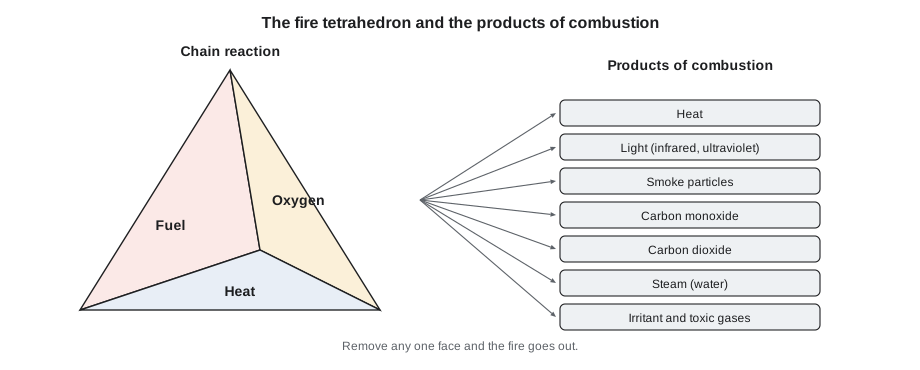
Combustion is a fast chemical reaction between a fuel and oxygen that releases heat and light. It needs four things at once, and the fire tetrahedron puts them on four faces: fuel, which may be a solid such as wood or plastic, a liquid such as cooking oil, or a gas such as natural gas; oxygen, usually from the air, which is about 21 percent oxygen; heat, enough to bring the fuel to the temperature where it gives off flammable vapours and those vapours ignite; and an uninhibited chemical chain reaction, in which the heat from burning keeps producing more vapour and more reaction. Remove any one and the fire goes out. Water mostly removes heat; a lid on a pan removes oxygen; shutting a gas valve removes fuel; some extinguishing agents break the chain reaction.
Solids and liquids don't burn directly. Heat makes them give off vapour, by evaporation in a liquid or by pyrolysis in a solid, where the material breaks down chemically into gases, and it is the vapour mixed with air that burns. That is why a log needs a lot of heat to get going but a thin shaving lights at once: the shaving heats through quickly and releases vapour faster. Most of the fuel in modern buildings is plastic: foam in furniture and mattresses, carpets, insulation on cables, computer cases, packaging. Plastics release a great deal of energy and dense, toxic smoke when they burn, and a room full of them can go from a small flame to a dangerous fire in a few minutes.
Two ways things burn
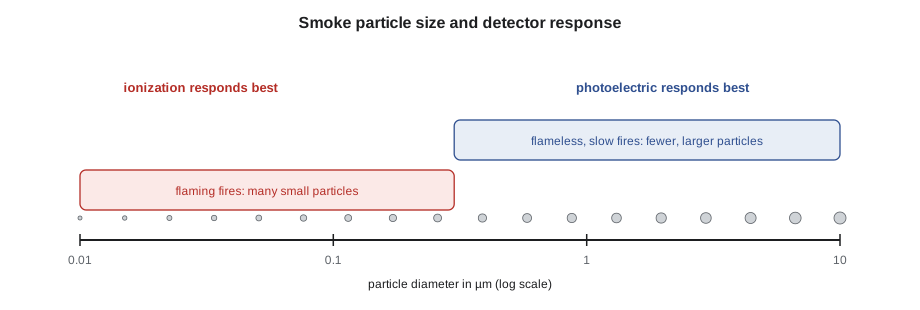
Flaming combustion is the visible fire most people imagine: vapour burns in the air above the fuel with a flame. It is fast, hot and bright, and it produces a lot of small soot particles and a strong upward flow of hot gas. Smouldering combustion is slower and has no flame: the fuel's surface glows and reacts directly with oxygen, as in a cigarette dropped into a sofa cushion, a pile of oily rags, or overheated insulation in a cable bundle. Smouldering produces less heat and a slow, cool, grey smoke with larger particles, and a lot of carbon monoxide relative to the amount of fuel burned. A smouldering fire can go on for hours and then burst into flame when it reaches more oxygen or more fuel.
Many deadly residential fires begin by smouldering at night. The occupants are asleep, the smoke spreads quietly, and carbon monoxide builds up before there is any flame to see or much heat to feel. That is why codes put smoke alarms, not heat alarms, in and near sleeping rooms. Flaming fires, especially those in flammable liquids, produce heat quickly and are detected well by heat detectors and flame detectors. Choosing a detector means knowing which kind of fire is likely in the space.
The products of combustion
A fire gives off four things a detector can sense. Heat raises the temperature of the air and surfaces near the fire. Smoke is a mixture of tiny solid and liquid particles suspended in hot gases; the particles range from a few nanometres, too small to see, to a few micrometres, large enough to scatter light. Gases include carbon dioxide, carbon monoxide, water vapour and, from burning plastics, irritants and poisons such as hydrogen cyanide and hydrogen chloride. Light, from the flame itself, includes infrared and ultraviolet radiation at wavelengths specific to burning.
| Product | What it is | Detected by |
|---|---|---|
| Heat | Rising temperature of air and surfaces | Heat detectors: fixed temperature and rate of rise |
| Smoke particles | Soot and droplets from about 0.01 to 10 micrometres | Photoelectric and ionization smoke detectors, air sampling |
| Carbon monoxide | A toxic gas from incomplete burning | CO detectors and multi-criteria detectors |
| Flame radiation | Infrared and ultraviolet light from burning | Flame detectors |
For people, smoke and toxic gases, not flames, are the main killers. Smoke blocks vision, so occupants cannot find exits; irritant gases make eyes stream and throats close; carbon monoxide replaces oxygen in the blood, causing confusion and then unconsciousness. People caught in a room filling with smoke can become unable to escape well before the fire itself reaches them. A fire alarm system's most important job is to warn people while the smoke is still thin enough for them to walk out.
How smoke detectors see smoke
Two technologies have dominated smoke detection for decades. A photoelectric detector has a dark chamber with a light source, usually an infrared light-emitting diode, and a light sensor placed so that it cannot see the source directly. When smoke enters, particles scatter some light onto the sensor, and when the signal passes a threshold the detector goes into alarm. Larger, lighter-coloured particles scatter light well, so photoelectric detectors respond quickly to smouldering fires and slow, cool smoke.
An ionization detector contains a tiny radioactive source that ionizes the air between two plates, so a small current flows. Smoke particles attach to the ions and reduce the current; when it drops past a threshold, the detector alarms. Ionization detectors respond quickly to the many small particles from fast flaming fires, but more slowly to smouldering smoke, and they are more prone to nuisance alarms from cooking. The radioactive source also makes their disposal more complicated. Commercial systems now use photoelectric and multi-criteria detectors almost exclusively, and fire alarm codes and standards are moving in the same direction.
Multi-criteria detectors combine two or more sensors, such as photoelectric smoke, heat and carbon monoxide, and use software to decide whether the pattern of readings looks like a fire. A burst of steam from a shower raises the smoke reading but not carbon monoxide or the temperature rise of a real fire; a smouldering fire raises smoke and carbon monoxide together. Combining sensors lets the detector respond quickly to real fires while ignoring many of the sources of nuisance alarms that make building occupants lose trust in the system. Aspirating, or air-sampling, systems go further: a fan draws air through a network of pipes with small holes into a very sensitive laser detector, and are used in data centres, clean rooms and high warehouses.
How heat moves
Heat moves in three ways, and all three matter to how a fire grows and how it is detected. Conduction is heat flow through a solid, from hot to cold, as in a steel beam heating along its length or a pan handle getting warm. Convection is heat carried by a moving fluid: the fire heats the air around it, the hot air becomes less dense and rises, carrying heat and smoke upward in a column called the plume. Radiation is heat carried as infrared light, which travels in straight lines and heats whatever it falls on; it is what you feel on your face near a campfire, and it is how a fire in one item ignites another nearby without touching it.
For detection, convection is the key. The plume rises from the fire to the ceiling, then spreads outward along the ceiling as a thin, fast layer of hot gas called the ceiling jet. Ceiling-mounted smoke and heat detectors sit in that jet. The jet is hottest and fastest close to the point above the fire and cools and slows as it spreads, which is why detectors have a spacing: a detector too far from the fire sits in jet that is too cool and slow to set it off quickly. Lesson 3 puts numbers on this.
Heat release rate
The size of a fire is measured by its heat release rate: how much energy it gives off each second, in kilowatts, abbreviated kW. A wastebasket fire might be 50 to 100 kW; a burning upholstered chair can reach 1,000 kW or more within a few minutes; a fully involved room can exceed several thousand kW. In some US sources, heat release rate is given in Btu per second, where 1 Btu/s is about 1.055 kW, so 1,000 Btu/s is about 1,055 kW, a number that appears in fire growth models. Heat release rate is the best single predictor of how quickly smoke and heat build up, how fast detectors respond, and whether a room will reach flashover, the point at which everything in it ignites.
Heat release rate can be estimated from how much fuel burns each second and how much energy that fuel contains. The heat of combustion is the energy released when one kilogram of fuel burns completely; wood is about 15 to 18 MJ/kg, most plastics 25 to 45 MJ/kg, and petrol about 44 MJ/kg. Real fires don't burn completely, so a combustion efficiency, usually between 0.6 and 0.9, reduces the result.
Here the heat release rate is the mass burning rate in kilograms per second times the heat of combustion in kilojoules per kilogram times the efficiency. The script below estimates heat release rates for a few fuels Sasha will see in the buildings Bramwell serves.
# Heat release rate from burning rate, heat of combustion and efficiency
fuels = [  # name, burning rate (g/s), heat of combustion (MJ/kg), combustion efficiency
    ("Wastebasket of paper", 4, 16, 0.7),
    ("Upholstered chair (foam)", 30, 27, 0.75),
    ("Cooking oil in a pan", 6, 37, 0.8),
    ("Wooden pallet stack", 60, 16, 0.75),
    ("Cartons of plastic goods", 90, 30, 0.7),
]
for name, rate_g, hc, chi in fuels:
    q_kw = (rate_g / 1000) * (hc * 1000) * chi   # kg/s x kJ/kg = kW
print(f"{name:26s} {q_kw:7.0f} kW ({q_kw / 1.055:6.0f} Btu/s)")Wastebasket of paper 45 kW ( 42 Btu/s) Upholstered chair (foam) 608 kW ( 576 Btu/s) Cooking oil in a pan 178 kW ( 168 Btu/s) Wooden pallet stack 720 kW ( 682 Btu/s) Cartons of plastic goods 1890 kW ( 1791 Btu/s)
The cartons of plastic goods, the kind of fuel stacked in racks at the Cartwright Distribution Centre, release almost twenty times as much heat as the wastebasket. That is why the warehouse depends on sprinklers to control fire, with the alarm system watching the sprinklers, while a small office relies on detectors to give occupants early warning.
Temperature and what it does
Temperatures in a fire are measured in degrees Celsius in most of the world and in fire science, and in degrees Fahrenheit in everyday use in the United States. A heat detector rated at 57 °C (135 °F) is a common ordinary-temperature rating; rooms that run warm, such as attics and boiler rooms, need higher ratings so the detector doesn't alarm on normal conditions. Human skin begins to burn at about 45 °C (113 °F) after a few seconds of contact or exposure; air above about 60 °C (140 °F) becomes painful to breathe; and flashover in a room usually happens when the hot layer under the ceiling reaches about 500 to 600 °C (930 to 1,110 °F). Those numbers explain why the window for escape is short once a room's ceiling layer starts to heat up.
Worked problem
Why the smoke alarm was slow
At Willowbank School's family studies room, Sasha is asked to explain a story from the school's staff room: a teacher once set off nothing when a tea towel smouldered on a hot element for several minutes, yet the heat detector went into alarm in seconds when an oven was opened. Use fire science to explain both events.
Show solution
- The smouldering towel gave off a small amount of cool, grey smoke with large particles and very little heat; its plume barely rose and did not heat the ceiling.
- The room has a heat detector, not a smoke detector, because cooking would cause nuisance smoke alarms. A heat detector cannot sense cool smoke at all.
- The open oven released a burst of hot air that rose straight to the ceiling. The rate-of-rise element sensed the temperature climbing quickly and alarmed, as it is designed to.
Answer: The detector chosen for the room trades early warning of smouldering fires for freedom from cooking alarms. That choice belongs to the designer, who may consider a multi-criteria detector set for kitchens.
Common mistakes
MistakeSaying that flames are the main danger to people.
InsteadSmoke and toxic gases cause most deaths; early smoke detection protects people.
MistakeAssuming every detector sees every fire equally well.
InsteadPhotoelectric detectors favour smouldering fires, ionization favour fast flaming fires, heat detectors need heat.
MistakeMixing up kW and Btu/s.
Instead1 Btu/s is about 1.055 kW; check which unit a source uses.
MistakeThinking a heat detector will catch a smouldering fire.
InsteadSmouldering fires make little heat; heat detectors are for spaces where smoke detectors are unsuitable.
MistakeForgetting that the plume carries smoke to the ceiling.
InsteadDetectors sit in the ceiling jet; their distance from the plume sets how quickly they respond.
Summary and key terms
- Combustion needs fuel, oxygen, heat and a chain reaction; removing one puts the fire out.
- Solids and liquids burn through the vapour they release when heated.
- Flaming fires are fast and hot with small particles; smouldering fires are slow and cool with larger particles and more carbon monoxide.
- Smoke and toxic gases cause most fire deaths.
- Photoelectric, ionization, heat, flame, CO and multi-criteria detectors each sense different products of combustion.
- Heat moves by conduction, convection and radiation; the plume and ceiling jet carry smoke and heat to detectors.
- Heat release rate in kW measures fire size and drives how fast smoke and heat build up.
- Fire tetrahedron
- The four things combustion needs: fuel, oxygen, heat and a chain reaction.
- Pyrolysis
- Chemical breakdown of a solid by heat into flammable gases.
- Smouldering
- Slow, flameless combustion at a fuel surface.
- Plume
- The rising column of hot gas and smoke above a fire.
- Ceiling jet
- The thin, fast layer of hot gas that spreads along the ceiling from the plume.
- Heat release rate
- The energy a fire gives off per second, in kilowatts.
- Heat of combustion
- The energy released when one kilogram of fuel burns completely.
- Multi-criteria detector
- A detector that combines several sensors to decide whether a fire is present.
Practice problems
Work each problem on paper first, then reveal the answer to check.
A fuel burns at 20 g/s with a heat of combustion of 25 MJ/kg and an efficiency of 0.8. What is the heat release rate?
Show answer
0.020 x 25,000 x 0.8 = 400 kW.
Which kind of detector responds better to a smouldering mattress, photoelectric or ionization?
Show answer
Photoelectric.
Which form of heat transfer carries smoke to a ceiling detector?
Show answer
Convection, in the plume and ceiling jet.
About how many kW is 1,000 Btu/s?
Show answer
About 1,055 kW.
Lesson quiz · 5 questions
Score 60% or more to complete this lesson.
Create a free account to save your progress, take quizzes and earn a certificate.