
FAT-110 · Lesson 5 of 12 · 20 min
System types and architectures
Sasha has now seen four buildings with Gerry, and none of their fire alarm systems look the same. Willowbank School has an older panel with a row of red zone lights, each labelled with a wing of the school. Tamarind House has an addressable panel with a screen that names every device by floor and room. Riverlight Tower's panel sits in a fire safety room beside the lobby, with a microphone for voice messages. Eastview General Hospital has panels on every floor, linked together, and a graphic workstation in the security office. This lesson sorts out what distinguishes these systems: how devices are connected and identified, how the system signals occupants, how it is powered and supervised, and how it reports to the outside world.
The parts of every system
Every commercial fire alarm system is built from the same main parts. The fire alarm control unit, often called the panel, is the brain. Initiating devices, such as smoke detectors, heat detectors, manual stations and sprinkler waterflow switches, are its inputs. Notification appliances, such as horns, bells, chimes, speakers and strobes, are outputs that warn people. Control outputs, usually relays or relay modules, switch other systems: door holders, elevator recall, fan shutdown. Annunciators repeat the panel's information at the entrance where firefighters arrive. Power supplies provide primary power from the building's electrical system and secondary power from batteries or a generator. And a transmitter or communicator sends signals to a monitoring station.
Household systems are different. A house or an apartment unit is usually protected by smoke alarms, each a self-contained device with its own sensor and sounder, often interconnected so that all sound together, powered by the house wiring with a battery backup. Smoke alarms are not part of the building's fire alarm system unless they are specifically connected to it. Riverlight Tower has both: each apartment has its own smoke alarms that sound only in that suite, and the building has a fire alarm system with detectors and manual stations in corridors, stairs and service rooms. Lesson 12 returns to why that split matters.
Conventional systems
In a conventional system, devices are wired in groups called zones, each zone on its own initiating device circuit. A circuit runs from the panel through a set of detectors and manual stations and ends at an end-of-line device, usually a resistor, that the panel uses to supervise the wiring: a small current flows through the loop, and if the wire breaks the current stops and the panel shows a trouble. When any device on the zone operates, it draws more current, and the panel knows that something on that zone has gone into alarm, but not which device.
Willowbank School's panel has twelve zones: one per wing per floor, plus the gym, the kitchen and the sprinkler waterflow switches. When a detector in the north wing operates, the panel lights zone 4, and someone has to walk the wing looking for the one detector with its red light on. Conventional systems are simple and inexpensive for small buildings, but they give less information, and they need a separate pair of wires from the panel for every zone, which makes large buildings costly to wire.
Addressable systems
In an addressable system, each device has its own address, set by switches, a programming tool or the panel itself, and all devices share a signalling line circuit, or SLC, sometimes called a loop. The panel polls each device in turn, many times a minute, asking for its status. A smoke detector reports its reading as a number; the panel decides whether that reading means alarm, pre-alarm, dirty or normal. Monitor modules connect conventional devices such as waterflow switches and give them an address; control modules switch outputs. One pair of wires can carry hundreds of devices.
The benefits are large. The panel shows exactly which device operated and where, by a text label such as 'Smoke detector, 3rd floor, Room 312, file storage'. It reports dirty detectors before they cause nuisance alarms, as at Tamarind House. It allows each device to be programmed individually: one detector can release only the doors nearest it, another can recall a particular elevator. And it allows sensitivity to be adjusted, within listed limits, from the panel. Almost all new systems in buildings of any size are addressable.
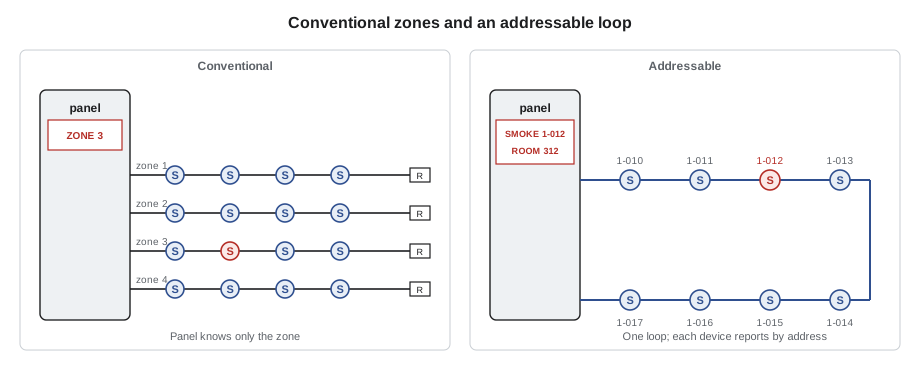
Some addressable systems wire the loop in a ring, out from the panel and back again, so a single break doesn't cut off any device: the panel talks to devices from both ends. Others run the loop out and stop. Which way is allowed or required depends on the building, the installation standard and the design, and it is tied to the idea of circuit classes, which FAT-210 explains in detail. The short version is that some circuit arrangements keep working through a single open or ground fault, and others report the fault but lose the devices beyond it.
# Plan signalling line circuits (loops) for a building with a spare-capacity allowance
import math
floors = {  # floor: (detectors, manual stations, monitor and control modules)
    "Ground floor": (28, 6, 14), "2": (22, 4, 6), "3": (22, 4, 6), "4": (22, 4, 6),
    "5": (22, 4, 6), "6": (24, 4, 8), "Roof and mechanical": (10, 1, 12),
}
loop_capacity = 250       # addressable points one loop can carry, from the panel's listing (illustrative)
spare = 0.20              # leave 20 % spare for future changes
usable = int(loop_capacity * (1 - spare))
total = 0
for f, (d, m, mod) in floors.items():
    n = d + m + mod
    total += n
    print(f"{f:22s} {n:4d} points")
loops = math.ceil(total / usable)
print(f"Total {total} points; {usable} usable per loop -> {loops} loop(s)")Ground floor 48 points 2 32 points 3 32 points 4 32 points 5 32 points 6 36 points Roof and mechanical 23 points Total 235 points; 200 usable per loop -> 2 loop(s)
Tamarind House fits on two loops with room to grow. The same building on a conventional system would need a separate zone for every area the code requires to be identified, plus separate circuits for waterflow switches, and would give the fire department far less information.
How the system warns occupants
In Canada, the National Building Code allows two ways of signalling. In a single-stage system, any alarm sounds the alarm signal throughout the building, telling everyone to leave. In a two-stage system, an alarm first sounds an alert signal throughout the building, a slower pattern that tells staff to investigate and occupants to prepare; if a trained person confirms the fire by turning a key at a manual station or the panel, or if a set time passes without anyone acknowledging the alert, the system sounds the alarm signal. Two-stage systems are used where trained staff are always present, such as hospitals and some large buildings. The alarm signal must follow the temporal pattern, three pulses and a pause, so that it is recognised anywhere.
Voice systems add spoken messages to tones. An emergency voice communication or voice evacuation system plays pre-recorded messages for each type of event, and lets the fire department or trained staff speak to selected areas through a microphone at the panel. People respond faster and more appropriately to clear instructions than to a tone alone, especially in tall buildings, large assembly spaces and buildings where not everyone should leave at once. Riverlight Tower's system can tell the fire floor to evacuate and the rest of the building to stay in their units and listen for further instructions. Voice systems are the subject of FAT-310.
Visual signals, usually strobes, are added in public and common areas, and in rooms used by people who are deaf or hard of hearing, so that the alarm reaches everyone. Strobes must be bright enough for the room and synchronized when more than one is visible, so that their flashing does not combine into a rate that could trigger seizures in people with photosensitive epilepsy.
Power and supervision
A fire alarm system must work when the building's power fails, because fires often cause power failures or start during them. Every system has two power sources. The primary supply is a dedicated circuit from the building's electrical panel, locked or marked so it can't be switched off by mistake. The secondary supply is a set of batteries, sometimes with an emergency generator, sized to run the system in normal standby for a long period, typically 24 hours, and then in alarm for a shorter period, typically 5 minutes for general alarm and longer for voice systems, depending on the code and standard. FAT-130 covers the battery calculations.
Supervision means the panel continuously checks its own circuits and power. It detects open circuits, ground faults, and on some circuits short circuits; loss of primary power; low or disconnected batteries; and devices that stop answering on an addressable loop. Any of these produces a trouble signal at the panel, a buzzer and a yellow light, and usually a signal to the monitoring station. A ground fault is worth special mention: it means some part of the wiring has made contact with earth, and while one ground fault may not stop the system working, a second one can, so it must be found and fixed.
Monitoring: how alarms leave the building
Most fire alarm systems are connected to a monitoring station, which in Canada is often called a fire signal receiving centre. CAN/ULC-S561 sets how these centres and the communication paths to them are built and operated: the centre is staffed around the clock, receives alarm, supervisory and trouble signals, and calls the fire department for alarms within set times. The building's communicator usually sends signals over a telephone line, a cellular network or the internet, often over two paths so that one failure doesn't cut the building off. Fire codes and local by-laws decide which buildings must be monitored.
Large campuses link several panels on a network, so that each building's panel works on its own but shares information with the others and with a central workstation. Eastview General Hospital's network ties together panels in each wing; the security office's graphic display shows every alarm on a floor plan, and a fault in one wing's panel doesn't take down the others. FAT-320 covers networking and integration.
Wireless systems
Some systems use wireless devices that communicate with the panel by radio rather than wires. They are listed for fire alarm use with supervision of each device's battery and radio link, and they are useful in historic buildings, in temporary structures, and where running cable would be very disruptive. Most commercial systems are still wired, but wireless devices increasingly appear as additions to wired systems. A technician working on one checks signal strength and battery condition as part of every test.
Worked problem
Choosing between conventional and addressable for a small building
A two-storey daycare with eight rooms asks Bramwell for a quote. The owner wants the cheapest option. What should Ravi weigh before recommending conventional or addressable?
Show solution
- The code decides the minimum: how many separately annunciated zones the building needs and which devices are required.
- With eight rooms and a small device count, a conventional panel with four or five zones may meet the code at lower cost.
- An addressable panel identifies exactly which device operated, flags dirty detectors before nuisance alarms, and allows future rooms to be added on the same loop.
- For a daycare, where a fast, confident response matters and nuisance alarms are disruptive, the extra information and maintenance features may be worth the cost.
Answer: Ravi prices both, explains what each gives, and lets the owner decide within the code minimum, noting that addressable costs less to change later.
Reading a panel for the first time
When Sasha walks up to a panel she hasn't seen before, Gerry has her answer four questions before touching anything. Is it conventional or addressable, which the display usually makes obvious? Is it single-stage, two-stage or voice? Is it showing any active alarm, supervisory or trouble condition right now? And where does it report: is there a communicator, and which monitoring company holds the account? The answers tell her what the building expects of the system, what a change she makes will affect, and who has to be called before she starts. The panel's front often carries a laminated card with the monitoring company's number and account details, and the documentation box nearby should hold the drawings and the sequence of operation. A technician who can answer those four questions in the first two minutes is unlikely to be surprised by what happens when the first device is operated.
Common mistakes
MistakeCalling an apartment smoke alarm a fire alarm detector.
InsteadSmoke alarms are self-contained household devices; detectors report to the building's panel.
MistakeAssuming a conventional panel shows which device operated.
InsteadIt shows only the zone; someone must find the device.
MistakeIgnoring a single ground fault because the system still works.
InsteadA second ground fault can disable circuits; find and fix the first.
MistakeForgetting the system must run on batteries.
InsteadThe secondary supply is sized for long standby followed by alarm.
MistakeLeaving strobes unsynchronized where several are visible.
InsteadSynchronize them so the combined flash rate stays safe.
Summary and key terms
- Every system has a control unit, initiating devices, notification appliances, control outputs, annunciators, power supplies and a communicator.
- Conventional systems group devices into zones; addressable systems give each device its own address on a shared loop.
- Addressable systems identify devices, report dirty detectors and allow device-by-device programming.
- Canadian systems are single-stage or two-stage; the alarm signal uses the temporal pattern.
- Voice systems give spoken instructions and suit tall and large buildings.
- Systems have primary and secondary power and supervise their wiring, power and devices.
- Signals go to a monitoring station that calls the fire department.
- Initiating device
- A device that sends an input to the panel, such as a detector, manual station or waterflow switch.
- Notification appliance
- A device that warns people, such as a horn, speaker or strobe.
- Conventional system
- A system in which devices are grouped in zones and reported by zone.
- Addressable system
- A system in which each device has its own address and reports individually.
- Signalling line circuit (SLC)
- The shared circuit that carries data between an addressable panel and its devices.
- End-of-line device
- A resistor or other device at the end of a circuit that lets the panel supervise the wiring.
- Temporal pattern
- The standard three-pulse evacuation signal.
- Secondary power
- Batteries or a generator that run the system when primary power fails.
Practice problems
Work each problem on paper first, then reveal the answer to check.
A panel shows 'Zone 6 alarm' and nothing more. Is it conventional or addressable?
Show answer
Conventional.
What does an end-of-line resistor let the panel detect?
Show answer
An open circuit in the wiring, by the loss of supervisory current.
An addressable loop is rated for 250 points and you keep 20 % spare. How many points can you use?
Show answer
200.
Name two kinds of secondary power for a fire alarm system.
Show answer
Batteries and an emergency generator.
Lesson quiz · 5 questions
Score 60% or more to complete this lesson.
Create a free account to save your progress, take quizzes and earn a certificate.