
DCT-330 · Lesson 9 of 12 · 20 min
Change management: risk, approval and change windows
Data centres are most at risk not when equipment fails on its own, but when people are working on it. Opening the wrong breaker, closing a valve on the wrong loop, updating firmware on both UPS systems at once, or forgetting to take a CRAH out of maintenance mode: each of these has caused real outages somewhere. Change management is the discipline of planning, approving, carrying out and recording every change to a live facility so that the risk is understood and controlled before anyone touches anything. This lesson covers how changes are classified, assessed and approved, and how change windows and freezes protect customers. Lesson 10 covers the procedure documents that the work itself follows.
Why change management matters
Uptime Institute's outage research consistently finds that human error contributes to a large share of significant outages, roughly two-thirds to four-fifths by its estimates, and that the most common forms are staff not following procedures and procedures that were themselves faulty. In its 2025 report, among organizations that had a major outage involving human error, failure to follow procedures was cited in a clear majority of cases. These are not careless people; they are skilled people working on complex systems without enough structure. Change management is that structure.
The ITIL framework calls this practice change enablement, a name kept in ITIL Version 5, released in 2026, and taught in the ITIL courses (ITIL-141). Data centres apply the same principles to physical infrastructure, with more emphasis on safety and on the physical sequence of steps.
What counts as a change
At Stonebridge a change is any planned addition, removal or modification that could affect the facility's power, cooling, fire protection, security, monitoring or network infrastructure, or a customer's service. That includes obvious work, such as replacing a UPS module or adding a busway tap-off, and less obvious work: updating BMS software, changing an alarm limit (lesson 3), moving a sensor, altering a CRAH's setpoint, adding a rack to a row, or changing a door's access schedule. Routine operation within normal limits, such as a technician reading a meter, and customer work inside their own equipment, are not facility changes, though customer work that affects the facility, such as adding servers that raise a rack's power, is captured through requests and capacity checks.
Types of change
Changes are sorted by how much review they need:
- Standard changes: low-risk, frequent, well-understood changes with a pre-approved procedure, such as installing a tap-off box using the standard MOP, replacing a CRAH filter, adding a server to a customer rack, or making an alarm limit change already approved by rationalization. They are recorded but need no individual approval.
- Normal changes: everything else that is planned. They are assessed for risk and approved at the level the risk requires, from the shift lead to the change advisory board.
- Emergency changes: changes needed urgently to restore service or prevent imminent harm, such as isolating a leaking pipe section or replacing a failed controller to get a CDU back. They are approved quickly by a small group, often the on-call engineer and the critical facilities manager, and reviewed afterwards.
A healthy change process has many standard changes, a steady number of normal ones and few emergencies. A rise in emergency changes usually means that problems are not being found early enough, or that people are using the emergency route to avoid review.
Assessing risk
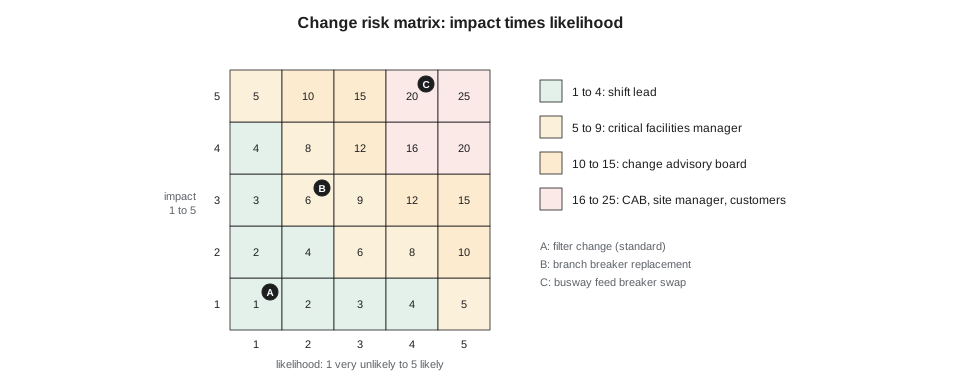
Each normal change is assessed by asking what could go wrong and how bad it would be. Stonebridge uses a simple matrix: the impact if the change goes wrong (from 1, no effect on customers, to 5, loss of customer load across a hall) multiplied by the likelihood (from 1, very unlikely, to 5, likely), giving a score from 1 to 25. The score sets the approval level and the controls required.
Impact is judged from the state the facility will be in during the work. Work on one side of a 2N system leaves the load on the other side alone: the impact of a second failure during the work is high, even if the work itself is simple. Work that reduces redundancy (taking a UPS module, CRAH or generator out) raises impact; work done with full redundancy intact lowers it. Likelihood is judged from the complexity of the work, how familiar the team is with it, whether a tested procedure exists and whether the work can be undone quickly.
# Change risk scoring and approval level
def approval(impact, likelihood):
    score = impact * likelihood
    if score <= 4:  level = "shift lead"
    elif score <= 9: level = "critical facilities manager"
    elif score <= 15: level = "change advisory board"
    else: level = "CAB + site manager + affected customers' agreement"
    return score, level

changes = [  # (change, impact, likelihood)
    ("Replace CRAH-A03 filters (standard MOP)", 1, 1),
    ("Add Hall D flow-deviation alarm in BMS", 2, 2),
    ("Replace branch breaker 2-17 on PDU-B2-05", 3, 2),
    ("UPS-B2 module firmware update", 4, 3),
    ("Swap Hall D busway BW-D1-04 feed breaker", 5, 4),
]
for name, i, l in changes:
    s, lvl = approval(i, l)
print(f"{name:45s} impact {i} x likelihood {l} = {s:2d} -> {lvl}")Replace CRAH-A03 filters (standard MOP) impact 1 x likelihood 1 = 1 -> shift lead Add Hall D flow-deviation alarm in BMS impact 2 x likelihood 2 = 4 -> shift lead Replace branch breaker 2-17 on PDU-B2-05 impact 3 x likelihood 2 = 6 -> critical facilities manager UPS-B2 module firmware update impact 4 x likelihood 3 = 12 -> change advisory board Swap Hall D busway BW-D1-04 feed breaker impact 5 x likelihood 4 = 20 -> CAB + site manager + affected customers' agreement
The numbers are a guide, not a substitute for thought. The value of the matrix is that it makes the people planning the change say out loud what could go wrong and how bad it would be, and it gives everyone the same scale.
The change request
A normal change starts as a change request ticket. Stonebridge's form asks for: what is being changed and why; the systems and customers affected; the redundancy state during the work; the risk score and its reasoning; the date, time and expected duration; who will do the work and who will supervise; the method of procedure (lesson 10) or a link to it; the back-out plan if it goes wrong; how success will be checked; and what records will be updated afterwards. A change request that cannot answer these questions is not ready to approve.
The change advisory board
Higher-risk changes are reviewed by the change advisory board (CAB), a weekly meeting of the critical facilities manager, the electrical and mechanical engineers, the operations shift leads, a security representative and, when their space is affected, the account managers who speak for customers. The CAB does not do the technical design of a change. It checks that the change has been thought through, that its timing does not clash with other work or with customer events, that the redundancy state during the work is acceptable, and that customers have been told. It can approve, reject, or send a change back with questions.
Technicians attend the CAB when their changes are reviewed, and often notice practical problems the engineers miss: the generator test scheduled for the same night, the delivery that will block the corridor, the CRAH that is already out of service in the same hall.
Change windows and freezes
A change window is a period agreed in advance, often in customer contracts, when changes that carry risk to customer services may be made. Stonebridge's standard window for normal changes in shared halls is Tuesday to Thursday, 22:00 to 05:00, with the customers' agreement for anything that reduces redundancy on their power or cooling. Low-risk standard changes can happen any time. Some customers have their own windows: Corvid AI asks that Hall D changes avoid the first week of each month, when its largest training jobs start.
A change freeze is a period when no normal changes are made except emergencies: around major holidays, during a customer's critical business period such as Bayview's year-end processing, or after a serious incident until the cause is understood. Freezes reduce risk at the times when an outage would cost most, and they are posted on the change calendar.
# Change calendar check: conflicts between proposed changes and existing plans
from datetime import datetime as D
calendar = [  # (start, end, item, systems)
    (D(2027, 3, 16, 22), D(2027, 3, 17, 2), "GEN-A block monthly load test", {"GEN-A", "SWBD-A2", "Hall A"}),
    (D(2027, 3, 17, 22), D(2027, 3, 18, 4), "UPS-B2 module firmware update", {"UPS-B2"}),
    (D(2027, 3, 29, 0), D(2027, 4, 2, 0), "Bayview year-end freeze", {"Hall A"}),
]
proposed = [
    (D(2027, 3, 16, 23), D(2027, 3, 17, 1), "Replace breaker 2-17 on PDU-B2-05", {"PDU-B2-05", "UPS-B2", "Hall A"}),
    (D(2027, 3, 17, 23), D(2027, 3, 18, 1), "CRAH-A07 actuator replacement", {"CRAH-A07", "Hall A"}),
    (D(2027, 3, 30, 22), D(2027, 3, 31, 1), "Add tap-off box BW-D1-04", {"BW-D1-04", "Hall D"}),
]
def overlap(a1, a2, b1, b2): return a1 < b2 and b1 < a2
for s, e, name, systems in proposed:
    clashes = [item for cs, ce, item, csys in calendar if overlap(s, e, cs, ce)]
    shared = [item for cs, ce, item, csys in calendar if overlap(s, e, cs, ce) and (systems & csys or "Hall A" in csys and "Hall A" in systems)]
print(f"{name:36s}: {'conflict with ' + ', '.join(shared) if shared else ('same time as ' + ', '.join(clashes) + ' (no shared systems)' if clashes else 'clear')}")Replace breaker 2-17 on PDU-B2-05 : conflict with GEN-A block monthly load test CRAH-A07 actuator replacement : same time as UPS-B2 module firmware update (no shared systems) Add tap-off box BW-D1-04 : same time as Bayview year-end freeze (no shared systems)
The first proposed change would replace a B-side branch breaker while the A-side generator block is being load tested, so for those two hours a rack could be relying on the A side while its generators are under test. The CAB moved it to the next night. The actuator change overlaps the UPS-B2 firmware work in time but shares no systems except the hall, and was allowed. The tap-off box falls during Bayview's freeze but is in Hall D, outside the frozen hall, so it may go ahead.
Telling customers
Customers must know about changes that could affect them. Stonebridge sends a maintenance notice through the portal, usually at least ten business days before a normal change that reduces redundancy on a customer's power or cooling, and at least 48 hours before any other customer-affecting change. The notice says what will be done, when, what the customer might notice (for example, one feed to their racks off for 30 minutes), what they should check beforehand (that every device is dual-corded and both feeds are live), and who to contact. Emergency changes are notified as soon as possible, often by phone first.
Customers sometimes object or ask for a different time. Their concerns are taken to the CAB, and a change that a customer has good reason to oppose is usually moved. The point of the notice is not to tell customers what will happen to them but to let them prepare and, where necessary, to protect themselves.
After the change
Every change ends with a closure step: was it completed as planned, partly, or backed out? Were there any unexpected events? Were the records updated (DCIM, drawings, labels, alarm database)? A change that caused an incident, or was backed out, gets a short review to learn why. Monthly reports track the number of changes by type, the share completed successfully first time, and the number that caused incidents. Stonebridge's target is that fewer than one change in 200 causes a customer-affecting incident.
Worked problem
The GEN-D2 follow-up as a normal change
After the DCT-220 storm, the incident report recommended that any generator whose starting system has been repaired must pass a second test start within 48 hours. The critical facilities manager wants it added to the maintenance procedures. Is it a change, and how is it handled?
Show solution
- It is a change: it alters a procedure and adds work on generators, which affects the generator blocks' availability during tests.
- Type: normal, because it is new; once approved, each repeat test becomes a standard change using the generator test MOP.
- Risk: during a test start the generator is unavailable for a few minutes; the block stays at N+1 minus one unit, which is N, as it was during the first test. Impact 3 (one block at N briefly), likelihood 1 (well-practised test) gives 3: shift lead approval for each test, but the procedure change itself goes to the CAB because it changes a standard.
- The CAB approves, the maintenance procedure is revised, the generator vendor is told, and Hall D's customer is informed that tests may occur at short notice after repairs.
- Records: the procedure's revision number changes, the old revision is withdrawn, and the change is closed with links to the incident report.
Answer: Even a change that adds safety goes through the process, so that everyone who depends on the procedure knows it changed.
Common mistakes
MistakeTreating a setpoint or alarm limit tweak as too small to be a change.
InsteadAny modification that could affect the facility is a change; small ones can be standard changes.
MistakeUsing the emergency route because the CAB is slow.
InsteadEmergency changes are for real emergencies; plan normal changes in time.
MistakeScoring risk without considering the redundancy state during the work.
InsteadWork that leaves the load on one path raises impact.
MistakeSending maintenance notices the day before.
InsteadFollow notice periods so customers can prepare.
MistakeClosing a change without updating records.
InsteadClosure includes DCIM, drawings, labels and the alarm database.
Summary and key terms
- Human error during work is a major cause of outages; change management controls the risk before anyone touches anything.
- Any planned modification that could affect the facility or customers is a change.
- Changes are standard (pre-approved), normal (assessed and approved) or emergency (fast approval, later review).
- Risk is scored as impact times likelihood, considering the redundancy state during the work; the score sets the approval level.
- The CAB reviews higher-risk changes for planning, timing, redundancy and customer impact.
- Change windows, freezes and customer notices protect customers; every change is closed with records updated.
- Change
- A planned addition, removal or modification that could affect the facility or a customer's service.
- Standard change
- A low-risk, pre-approved change carried out with a standard procedure.
- Emergency change
- An urgent change to restore service or prevent harm, approved quickly and reviewed afterwards.
- CAB
- Change advisory board: the group that reviews and approves higher-risk changes.
- Change window
- An agreed period when risky changes may be made.
- Change freeze
- A period when only emergency changes are allowed.
- Back-out plan
- The steps to return to the starting state if a change goes wrong.
Practice problems
Work each problem on paper first, then reveal the answer to check.
A change has impact 4 and likelihood 3. What is its score and approval level at Stonebridge?
Show answer
12: change advisory board.
Is adjusting a CRAH supply setpoint by 0.5 K a change?
Show answer
Yes; it can be a standard change if a pre-approved procedure covers it.
Why does working on one side of a 2N system raise the impact score?
Show answer
The load is on one path; a second failure during the work would drop it.
What must a maintenance notice tell a customer?
Show answer
What, when, what they might notice, what to check beforehand, and who to contact.
Lesson quiz · 5 questions
Score 60% or more to complete this lesson.
Create a free account to save your progress, take quizzes and earn a certificate.