
DCT-210 · Lesson 9 of 12 · 19 min
Patching, cross-connects and the meet-me room
The meet-me room at YUL-2 is a long, narrow, windowless room with two doors, a card reader and a camera on each, and rows of cabinets full of panels. Ike Adeyemi's security team keeps a separate access list for it, and Jamal's badge did not open it until he finished the room's induction with Nadia. It is the busiest cabling space on the campus: every carrier that serves Stonebridge's customers ends its fibres here, and every connection between a customer and a carrier, or between two customers, is made here by a Stonebridge technician with a patch cord. This lesson covers patching in general and cross-connects in particular, because they are the work a data centre technician does most often.
Interconnect and cross-connect
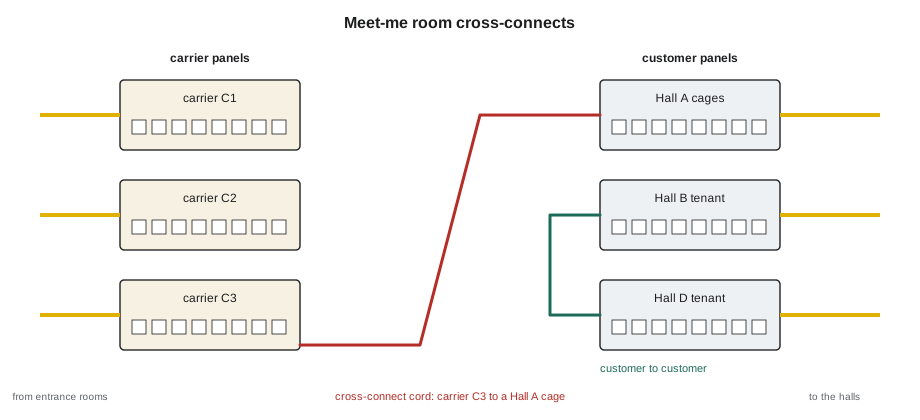
There are two ways to join equipment to the structured plant. In an interconnect, the equipment port is cabled directly to the permanent cabling: a switch's port connects with a cord to a panel, and the panel's permanent trunk runs to the far end. In a cross-connect, there are two panels, one cabled permanently to each side, and a short patch cord between them joins the two. The equipment's own cabling never moves; changes are made by moving the cord between the panels.
Cross-connects add a mated pair or two to the link and cost panel space, but they keep each party's cabling separate and make changes quick, safe and auditable. That is why they are used wherever two different owners meet: carrier and customer, customer and customer, Stonebridge's network and a tenant's. Inside one customer's network, interconnects are more common.
How a cross-connect is ordered
A customer who wants a circuit from a carrier orders the circuit from the carrier and a cross-connect from Stonebridge. The carrier issues a document, usually called a letter of authorization and connecting facility assignment, LOA-CFA, which names the carrier's panel and port in the meet-me room where its end of the circuit appears. The customer gives Stonebridge the LOA-CFA with its cross-connect order, and Stonebridge's portal turns the order into a ticket, as Jamal saw with ticket XC-41877 in DCT-110. The ticket names:
- The A side: the carrier, its panel and port in the meet-me room, and the circuit identifier from the LOA-CFA.
- The Z side: the customer, its cage, cabinet and panel, and the port on Stonebridge's customer panel in the meet-me room that leads there.
- The media: single-mode or multimode, connector type and polish, and duplex or parallel.
- The cord type and length, which the technician confirms on site.
Stonebridge does not test the carrier's circuit, which belongs to the carrier, but it does test its own cabling from the meet-me room to the customer's cabinet when the cross-connect is installed, and it records the light levels. When a circuit does not work, those records show quickly whose side the problem is on.
Making a cross-connect
Nadia's procedure for a meet-me room cross-connect is the same every time, and Jamal follows it until he could do it in his sleep:
- Check the ticket against the LOA-CFA: carrier name, panel, port and circuit identifier must all match.
- At the carrier panel, read the panel and port labels and confirm the port is the one named. Never use a port because it looks free; carriers reserve ports.
- At the customer panel, confirm the port leads to the right cabinet by the port map, and check the far end is not in use.
- Choose the cord: the right fibre type, connector and polish, and the shortest length that reaches through the managers with a service loop.
- Inspect and clean both ports and both cord ends, then connect, routing the cord through the managers as Lesson 10 describes.
- Label the cord at both ends with the cross-connect number.
- Check light: with the carrier's signal present, measure the received power at the customer's panel port or ask the customer to read it from their equipment, and record it.
- Close the ticket with photographs of both ends and the light reading.
Choosing a cord length
A cord that is too short pulls on the connectors; one that is too long leaves loops that clog the managers. Stonebridge stocks cords in fixed lengths, and the technician works out the length from the route: up from the port to the horizontal manager, along the manager and any troughs between cabinets, and down to the far port, plus a service loop.
# Choose a stock cord length for a cross-connect between two panels
stock = [1, 2, 3, 5, 7, 10]
def route(up_units_a, across, up_units_b, loop):
    unit = 0.0445
    return up_units_a * unit + across + up_units_b * unit + loop
jobs = [("XC-43118 carrier C3 port 17 to cust panel MMR-C-07 port 4", 6, 1.2, 9),
        ("XC-43120 cust-to-cust MMR-C-07 port 12 to MMR-C-09 port 2", 4, 2.4, 14),
        ("XC-43122 carrier C1 port 3 to MMR-C-02 port 22", 20, 0.6, 2)]
for name, ua, across, ub in jobs:
    need = route(ua, across, ub, 0.3)
    cord = min(l for l in stock if l >= need)
print(f"{name}: route {need:.2f} m -> use a {cord} m cord")XC-43118 carrier C3 port 17 to cust panel MMR-C-07 port 4: route 2.17 m -> use a 3 m cord XC-43120 cust-to-cust MMR-C-07 port 12 to MMR-C-09 port 2: route 3.50 m -> use a 5 m cord XC-43122 carrier C1 port 3 to MMR-C-02 port 22: route 1.88 m -> use a 2 m cord
Panels are measured in rack units, so the vertical part of a route is easy to work out from the elevation. The horizontal part depends on the troughs and managers, which is why experienced technicians measure the first cord of a new route with a tape and write the result on the cabinet drawing.
Patching inside a cage
Inside a customer's cage, patching connects the customer's equipment to its own panels, to Stonebridge's panel at the top of each cabinet, and between the customer's own cabinets. Customers decide how their cages are cabled, but Stonebridge's house rules apply: cords stay inside the customer's own cabinets and managers, no cord crosses into another customer's space, and anything that connects to Stonebridge's plant goes through Stonebridge's panel. When a customer asks for remote hands to patch inside its cage, the ticket must give the port map, because the technician cannot work out a customer's intentions from the equipment.
Disconnecting and recovering cords
A cross-connect that is no longer needed is a hazard: it uses panel ports, clutters the managers and may be connected by mistake to something new. When a customer cancels a circuit, Stonebridge disconnects the cross-connect only after the customer's written request and the carrier's confirmation that the circuit is out of service. The technician identifies the cord by its label at both ends, unplugs it, removes it completely from the managers rather than leaving it coiled in place, caps the ports and updates the records. Stonebridge calls this recovery, and its quarterly audits look for cords whose cross-connect number has no open order.
Customer-to-customer cross-connects
Colocation customers often connect directly to each other: a bank to its payment processor, a cloud provider to a content network, Corvid AI to the storage provider it buys from. These are cross-connects too, made in the meet-me room between two customer panels, with an order from each party or a letter from one authorizing the other. They carry another customer's traffic, so the same rules apply as for carrier circuits, and Stonebridge never makes one on the word of one party alone.
# Build the work order lines for a cross-connect ticket from the order details
order = {"ticket": "XC-43118", "a_party": "carrier C3", "a_panel": "MMR-CAR-C3-01", "a_port": 17,
         "circuit": "C3-ETH-100G-55821", "z_party": "Bayview Credit Union", "z_panel": "MMR-C-07", "z_port": 4,
         "z_end": "YUL2-A-31-03-PP2 port 4", "media": "OS2 duplex LC UPC"}
print(f"Work order {order['ticket']}")
print(f"  A: {order['a_party']}, panel {order['a_panel']} port {order['a_port']}, circuit {order['circuit']}")
print(f"  Z: {order['z_party']}, panel {order['z_panel']} port {order['z_port']} -> {order['z_end']}")
print(f"  Media: {order['media']}")
print(" Steps: verify LOA-CFA, inspect and clean 4 end faces, connect, label both ends, record light level")Work order XC-43118 A: carrier C3, panel MMR-CAR-C3-01 port 17, circuit C3-ETH-100G-55821 Z: Bayview Credit Union, panel MMR-C-07 port 4 -> YUL2-A-31-03-PP2 port 4 Media: OS2 duplex LC UPC Steps: verify LOA-CFA, inspect and clean 4 end faces, connect, label both ends, record light level
Worked problem
A port that looked free
A ticket asks Jamal to cross-connect carrier C1's port 9 to a Hall B customer's panel. At the carrier panel he finds port 9 already has a cord in it, while port 10 is empty.
Show solution
- He does not move the cord in port 9 and does not use port 10, though it looks free.
- He reads the label on the cord in port 9: it is cross-connect XC-38804, to a Hall A customer, still open in the records.
- He reports the conflict. Nadia calls carrier C1's operations desk, which confirms that the LOA-CFA was issued with a typing error: the new circuit is on port 19.
- The customer obtains a corrected LOA-CFA. Jamal makes the cross-connect on port 19 the next day.
Answer: If he had used port 10, or unplugged port 9, he would have connected the customer to the wrong circuit or taken another customer's circuit down. Carrier ports are used only as the LOA-CFA names them.
Security and access in the meet-me room
The meet-me room holds the connections of every carrier and every customer on the campus, so access to it is tightly controlled. Only technicians who have finished the room's induction are on its access list, every entry is logged by badge and camera, and each visit must match an open ticket. Carriers' own technicians are escorted, and they work only on their own panels. Cabinets in the room are locked, the keys are signed out from the security desk, and no cord, tool or spare part is left in the room at the end of a job. Ike Adeyemi's team reviews the access logs against the tickets every week, and a visit with no ticket is investigated.
There is a practical reason for all this besides security. The meet-me room is where a careless moment does the most harm: a cord pulled from the wrong carrier port can take down a bank's link to its branches, a payment processor's link to a card network, or a cloud provider's link to the internet. Nadia makes new technicians practise the cross-connect procedure on the training panel in the workshop until it is automatic before they make their first live one.
Light levels and fault finding
When a customer reports that a circuit through a cross-connect has stopped working, the first question is whose side the fault is on. The light level recorded when the cross-connect was installed is the starting point. A technician measures the light arriving at the customer's panel port from the carrier, with the customer's agreement, and compares it with the record. If the light is still there at the recorded level, the problem is beyond Stonebridge's cabling, in the customer's equipment or cords. If it is gone at the carrier panel too, the carrier's side has failed. If it is present at the carrier panel but missing at the customer's panel, the fault is in Stonebridge's cabling or the cross-connect cord, and the technician inspects, cleans and tests that segment.
Records of light levels also help when a carrier says its circuit is working and the customer says it is not. Stonebridge does not take sides in such disputes, but a measured light level at the customer's panel, compared with the reading taken when the cross-connect was installed, usually ends the argument quickly and points both parties to the right place.
Common mistakes
MistakeUsing a carrier port because it looks free.
InsteadUse only the port named on the LOA-CFA, and report conflicts.
MistakeMaking a customer-to-customer cross-connect on one party's request.
InsteadGet authorization from both parties.
MistakeLeaving a disconnected cord coiled in the managers.
InsteadRecover it completely, cap the ports and update the records.
MistakeChoosing a long cord to be safe.
InsteadWork out the route and use the shortest stock length that reaches with a service loop.
MistakeClosing the ticket without a light reading.
InsteadRecord the received power so later faults can be located.
Summary and key terms
- An interconnect cables equipment directly to the plant; a cross-connect joins two panels with a cord.
- Cross-connects are used where different owners meet, especially in the meet-me room.
- Carrier cross-connects are ordered with an LOA-CFA naming the carrier's panel and port.
- Check labels against the ticket, inspect and clean, connect, label, record light and photograph.
- Choose cord length from the route plus a service loop.
- Disconnect only with authorization, recover cords completely and keep records current.
- Interconnect
- Equipment cabled directly to the permanent cabling.
- Cross-connect
- A patch cord joining two panels, each cabled to a different side.
- LOA-CFA
- Letter of authorization and connecting facility assignment naming a carrier port.
- A side and Z side
- The two ends of a circuit or cross-connect.
- Recovery
- Removing a disconnected cord completely and updating the records.
- Meet-me room
- The secured room where carriers and customers are cross-connected.
Practice problems
Work each problem on paper first, then reveal the answer to check.
Why are cross-connects used where two owners meet?
Show answer
Each owner's cabling stays fixed and separate, and changes are made safely with a cord.
What document names a carrier's port in the meet-me room?
Show answer
The LOA-CFA.
A route measures 2.3 m (7.5 ft) including the service loop. Which stock cord?
Show answer
The next stock length up: 3 m (10 ft).
What must happen before a cross-connect is disconnected?
Show answer
A written request from the customer and confirmation that the circuit is out of service.
Lesson quiz · 5 questions
Score 60% or more to complete this lesson.
Create a free account to save your progress, take quizzes and earn a certificate.